Part Three · Hoof and Horn
Chapter 12
The Wild Cattle
The great bull of the caves, the buffalo demon, the white buffalo woman, and the bison that nearly vanished.
Assisted and Curated by Claude, Referenced and Collated by me

Aurochs, gaur, wild buffalo, bison
In 1627, in the Jaktorów forest in Poland, the last known aurochs died. She was a female, and she died, as far as anyone knows, of natural causes. For centuries, the aurochs had been protected as a royal game animal, with gamekeepers paid to guard the dwindling herd; in 1564, a royal inspection found thirty-eight. Then, over a few decades, disease, hunting, and the competition of domestic cattle finished them. The aurochs thus became one of the first species whose extinction was recorded as it happened.

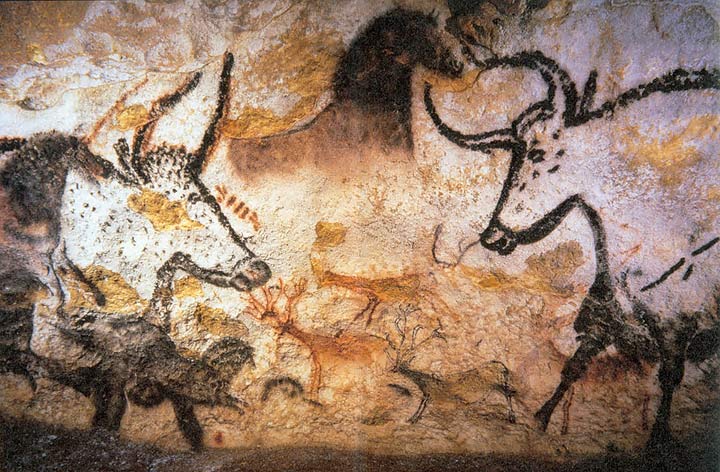
The aurochs was the wild ancestor of most of the world's domestic cattle. It was enormous: the bulls stood up to around 1.8 metres at the shoulder, black with a pale stripe along the spine, with great forward-curving horns; the cows were smaller and reddish-brown. Julius Caesar, describing the wild forests of Germany, wrote that the aurochs were a little smaller than elephants, which was an exaggeration, but an understandable one. The great bulls of Lascaux, painted seventeen thousand years ago, are aurochs, and they are the largest animals painted in the cave.
The aurochs has haunted people ever since its death. In the 1920s and 1930s, two German brothers, Heinz and Lutz Heck, directors of the zoos in Munich and Berlin, tried to "breed back" the aurochs by crossing cattle breeds that seemed to keep some of its features: Spanish fighting bulls, Highland cattle, Hungarian grey cattle and others. The result, Heck cattle, looked something like an aurochs but was smaller and different in many ways. The project had an uglier side. Lutz Heck was a member of the Nazi party and close to Hermann Göring, who dreamed of restoring a primeval German forest stocked with aurochs for hunting. Heck cattle survived the war, and some still graze in rewilding projects in Europe. Since 2008, a Dutch-led effort called the Tauros Programme has tried again, this time using genetic knowledge of the aurochs from ancient DNA, aiming for a large wild grazer that can shape open woodland as the aurochs once did. The aurochs, gone for four hundred years, is still being imagined back into existence.
Julius Caesar's description, in his Gallic War, is worth quoting in summary. He wrote that the aurochs of the Hercynian forest were a little smaller than elephants, of great strength and speed, and that they spared neither man nor beast once seen. Young men proved their courage by trapping and killing them in pits, and the horns, rimmed with silver, were used as drinking cups at great feasts. Such horns, along with aurochs bones, have been found in Bronze Age and Iron Age graves in Europe. In India, the Indian aurochs, from which the zebu descends, survived on the plains of the north into prehistoric times; its bones have been found at sites in the Ganga valley and the Narmada valley, and its descendants pull ploughs and carts in Indian villages to this day.
Cattle have been at the centre of human life for so long that our languages remember it. The Sanskrit word gavishti, literally "desire for cows", was used in the Rigveda for a battle or raid, because so many early wars were fought over cattle. The word goshthi, a gathering or discussion, comes from goshtha, a cowshed. In English, the word "pecuniary", meaning financial, comes from the Latin pecus, cattle, and "fee" from an old Germanic word for livestock. Long before coins and banks, a person's wealth was counted in heads of cattle, and the language of money still carries the smell of the cowshed.
From wild bull to sacred cow
Cattle were domesticated at least twice: taurine cattle, the humpless cattle of Europe and the Near East, from aurochs in the Near East around ten thousand years ago; and zebu cattle, the humped cattle of India, from the Indian aurochs in the region of the Indus Valley perhaps eight thousand years ago. We met the bulls of Çatalhöyük, whose horns lined the walls of houses, in the earlier book. The bull was, from the beginning of farming, an animal of immense symbolic power: the embodiment of strength, male fertility, and the wildness that domestication tamed but never quite erased.
In the Mesopotamian Epic of Gilgamesh, the goddess Ishtar sends the Bull of Heaven to destroy Uruk, and Gilgamesh and Enkidu kill it. In Minoan Crete, young men and women vaulted over the horns of charging bulls in a sport or ritual depicted in frescoes at Knossos, and the myth of the Minotaur, half man and half bull, living in the labyrinth beneath the palace, may echo these rites. In Egypt, the Apis bull of Memphis was worshipped as a living manifestation of the god Ptah, and when it died, it was mummified and buried in a great stone sarcophagus in the Serapeum at Saqqara. In India, the bull Nandi is the mount and devoted companion of Shiva, and his statue sits facing the inner shrine of every Shiva temple, gazing at the god. Zebu bulls appear on some of the finest Indus Valley seals.
The bull's sacred story runs deep in the earth. At Çatalhöyük in Turkey, one of the world's first towns, people nine thousand years ago set the skulls of wild bulls, horns and all, into the walls and benches of their houses, and plastered and painted them. They lived every day beside these great horned heads. In the cities of the Indus Valley, more than four thousand years ago, the humped zebu bull was carved on small stone seals with such care, the heavy dewlap, the strong shoulders, the curved horns, that they are counted among the finest animal carvings of the ancient world. On the "Pashupati" seal, a buffalo stands among the animals around the seated figure.

At Lepakshi in Andhra Pradesh, one of the largest stone Nandis in India, carved from a single boulder in the sixteenth century, still lies gazing patiently towards the temple. Nandi, Shiva's bull, always faces the god, and devotees whisper their wishes into his ear so that he can pass them on. He is a picture of perfect, patient devotion: strength that waits. Krishna himself is Govinda and Gopala, the cowherd god, who grew up among cows in Vrindavan. And the cow appears throughout the Vedas as a symbol of plenty and of light; the dawn's rays are sometimes called her cows.
Anthropologists have argued about why the cow became so sacred in India, and their argument is worth understanding. In 1966 the American anthropologist Marvin Harris wrote a famous paper that went against the common Western view. Many foreigners looked at India's cows wandering the streets and saw only waste: animals that could have been eaten, kept alive for religious reasons. Harris said this missed the point. Think of a poor farmer's cow over her whole life. Alive, she gives milk. She gives birth to bullocks, which pull the plough and the cart, so that a family does not need a tractor. Her dung is dried into cakes and burned as cooking fuel, or spread on the fields as fertiliser, or used to plaster floors. Eaten, she feeds a family for a few days. Kept alive, she supports it for years. In hard times, a hungry family might be tempted to kill her, and lose everything for the future. The religious rule against killing her, Harris argued, protects the family from that desperate choice. In his view, the sacred cow is not a mistake but a deep piece of practical wisdom, dressed as religion.

Not everyone agrees with Harris, and many say he left out the real power of belief and feeling. But his argument opened up an important question that anthropologists still ask: when a custom looks strange from outside, what problem might it be solving for the people who keep it?
In Africa, the British anthropologist E. E. Evans-Pritchard lived among the Nuer, cattle herders of what is now South Sudan, and in The Nuer (1940) described a people whose whole social world ran through their cattle. Marriages were sealed by gifts of cattle. Disputes were settled in cattle. Young men took names from their favourite oxen and composed poems and songs in praise of them. Evans-Pritchard wrote that to understand the Nuer, you had to understand their cows, because almost every relationship between people was expressed through them. It is a reminder that for most of history, for very many people, cattle were not just animals. They were wealth, family, poetry and religion all at once.
Marvin Harris's 1966 essay, "The Cultural Ecology of India's Sacred Cattle", challenged a common Western view that Hindus were irrational to keep "useless" cows that they would not eat. Harris argued the opposite. India's cows, he said, were part of a finely balanced farming system. Bullocks pulled ploughs and carts in a country where most farmers could not afford tractors. Cow dung was the main fuel for cooking in millions of homes, and fertiliser for fields. Cows grazed on stubble and roadside grass that people could not use, and turned it into milk. In droughts, when farmers were tempted to eat their cattle, the religious ban on killing cows protected the animals that would be needed to plough again when the rains returned. Harris concluded that the sacred cow made good ecological sense. His argument was influential and much debated: critics pointed out that it underplayed the real religious and political history of cow protection. But it changed how anthropologists study food taboos, asking what practical role a belief might play.

The history of cow protection in India is complex. In the Vedas, cattle were wealth, and the cow was praised as aghnya, "not to be killed", though Vedic rituals sometimes included animal sacrifice. Over centuries, under the influence of Buddhist and Jain ideas of non-violence and of Vaishnava devotion to Krishna the cowherd, the cow became more and more sacred. Krishna's childhood in Gokul and Vrindavan, herding cows, playing his flute to them, and lifting the Govardhan hill to shelter them from Indra's storm, is one of the most loved stories in Hindu devotion. The festival of Govardhan Puja, the day after Diwali, honours this. In the nineteenth and twentieth centuries, cow protection became a powerful political movement, and it remains a deeply contested issue in India today.
The Nuer of South Sudan, whom E. E. Evans-Pritchard studied in the 1930s, offer a striking parallel. Evans-Pritchard wrote that the Nuer's "social idiom is a bovine idiom". A young man takes an "ox-name" from the colour and markings of his favourite ox, composes songs and poems about it, and dances with his arms raised to imitate its horns. Marriages are made by paying cattle to the bride's family, quarrels are settled in cattle, and the dead are honoured with cattle sacrifice. A Nuer, Evans-Pritchard said, could describe dozens of colour patterns in cattle, with special words for each. His book The Nuer (1940) became a classic of anthropology, and its description of a people whose whole world turned around their herds has helped scholars think about the deep ties between people and cattle everywhere, including in India's pastoral communities like the Gaddis, the Rabaris and the Todas.

India today has more cattle than almost any other country, and more than fifty recognised native breeds, adapted over thousands of years to different climates: the Gir and Kankrej of Gujarat, the Sahiwal and Red Sindhi of the northwest, the Ongole of Andhra Pradesh, the Hallikar and Amrit Mahal of Karnataka, the Kangayam of Tamil Nadu and the tiny Vechur of Kerala, one of the smallest cattle breeds in the world, under a metre tall. Indian zebu cattle were exported in the nineteenth and twentieth centuries to Brazil, the United States and Australia, where their heat tolerance and resistance to ticks made them valuable; Brazil's huge Nelore herds descend from Ongole cattle, and Gir cows taken to Brazil now produce more milk than in their homeland. Ironically, while Indian breeds flourished abroad, many in India were crossed with European breeds like Holstein and Jersey to increase milk yield, and some native breeds declined. In the twenty-first century, there has been a revival of interest in them, both for their hardiness and for cultural reasons.

The gaur
India is home to the largest wild bovine on earth: the gaur, sometimes misleadingly called the Indian bison. A big gaur bull may weigh over a tonne and stand nearly two metres at the shoulder, with a massive dorsal ridge, glossy black-brown coat, and white "stockings" on its lower legs. Gaur live in herds in hilly forests across India and Southeast Asia, and despite their size, they are shy. Even tigers usually avoid adult bulls. In the forests of northeast India, a domesticated form of the gaur, the mithun, is kept by communities such as the Adi, Apatani, and Naga peoples, not for milk or ploughing but as a measure of wealth, a gift in marriage, and an animal for sacrifice at feasts. The mithun is, in a sense, a wild animal that has partly chosen to live with people.

The wild water buffalo, ancestor of the domestic buffalo, survives in small numbers in Assam, especially in Kaziranga National Park, and in scattered remnants in central India. Chhattisgarh has made it the state animal, though its wild population there is tiny. The wild yak lives on the high Tibetan plateau, and its domestic descendants provide milk, wool, meat, dung for fuel, and transport for the peoples of the Himalaya.

The gaur's size and strength are hard to grasp until you stand near one. A large bull can weigh a tonne or more, with a high muscular ridge running from the shoulders along the back, and curved horns up to eighty centimetres long. Despite this bulk, gaur are surprisingly agile on steep hillsides. They feed mostly at dawn and dusk, and in areas with many people they become active at night. In the Nilgiris and in Kodagu, gaur have in recent years moved out of the forests into tea and coffee estates and even towns like Kotagiri, where they wander along roads and into gardens, as the Mongabay film in this chapter shows. Scientists think this is partly because forests have been degraded by invasive plants like lantana, and partly because estates offer grass and water. Living so close to people brings danger on both sides.

The mithun of northeast India is one of the most interesting domestic animals in the world. It is a semi-domesticated form of the gaur, kept by the Adi, Nyishi, Apatani and Naga peoples, among others. Mithun are not milked or used for ploughing; they roam freely in the forest, returning to the village to lick salt from the hands of their owners. They are a measure of wealth and status, given in marriage, used to settle disputes, and sacrificed at great feasts of merit, where a man raises his standing by slaughtering many mithun and feeding the village. The Naga "feast of merit" was once one of the central institutions of village life. The mithun is the state animal of Arunachal Pradesh and Nagaland, and in 1988 the government set up a National Research Centre on Mithun in Nagaland.

The wild water buffalo, ancestor of the domestic buffalo that gives India more than half its milk, is one of the most endangered large mammals in the country. Fewer than four thousand pure wild buffalo may survive in the world, most of them in Assam, especially Kaziranga and Manas. In central India, a small, ageing herd survived in the Udanti forests of Chhattisgarh, the state animal, dwindling to just a handful of animals, with very few females; in 2020, wild buffalo from Assam were moved to Chhattisgarh to try to rescue the population, a move that has been controversial. Wild buffalo are much larger than domestic ones, with enormous horns spreading up to two metres from tip to tip, the longest of any living bovine, and they are fierce. Interbreeding with domestic buffaloes, which wander into their grazing grounds, is a constant threat to their genetic purity. In the Assam floods every monsoon, wild buffalo, rhinos and deer crowd onto high ground, sometimes crossing highways where they are struck by vehicles.

The wild cattle's India
Gaur live in the hilly forests of the Western Ghats, central India and the Northeast. The largest herds are in the Nilgiri Biosphere Reserve, in Bandipur, Nagarahole, Mudumalai and Wayanad, in Karnataka's Bhadra and Kudremukh, in Kerala's Periyar, Parambikulam and Silent Valley, and in the Anamalais. In central India, they live in Kanha, Satpura, Pench and Melghat. Bandhavgarh's gaur had died out by the late 1990s; in 2011 and 2012, about fifty gaur were moved from Kanha to Bandhavgarh in one of India's first large mammal reintroductions, and they have since multiplied. A similar effort brought gaur to Madhya Pradesh's Sanjay Tiger Reserve in 2023. Gaur need water, shade and fresh grass in the dry season, and herds gather along rivers like the Kabini, the Moyar and the Bhavani.


Wild water buffalo survive mainly in Assam, in the floodplain grasslands of Kaziranga, Manas, Dibru-Saikhowa and the Laokhowa and Burachapori sanctuaries along the Brahmaputra, where they wallow in the shallow, reedy pools called beels. In central India, a few remain in the Indravati Tiger Reserve along the Indravati river in Chhattisgarh's Bastar, and in the Udanti-Sitanadi Tiger Reserve. The wild yak lives in India only in a few remote valleys of Ladakh's Changchenmo, while domestic yaks graze the high pastures of Ladakh, Lahaul, Sikkim and Arunachal's Tawang. The mithun browses in the forested hills of Arunachal, Nagaland, Manipur and Mizoram. The cattle of the subcontinent thus span every level, from the riverside grass of Assam to the windswept plateaus above four thousand metres.

The buffalo demon and the lord of death
If the bull in Indian tradition is the companion of Shiva, the buffalo is darker. Yama, the god of death, rides a black buffalo. And the most famous of all demons in Indian religion is Mahishasura, the buffalo demon, who through his austerities won a boon that no man or god could kill him, and then conquered heaven. The gods, unable to defeat him, combined their energies to create the goddess Durga, who fought him for nine days and nights and killed him on the tenth, as he emerged from the body of the buffalo in his true form. This victory is celebrated across India in the festivals of Navaratri and Durga Puja. The image of the goddess spearing the buffalo demon is one of the most powerful in Indian art, found from the rock-cut temples of Mamallapuram to the clay images of Kolkata.

Interestingly, several communities, especially in central and southern India, have alternative traditions in which Mahishasura is a benevolent king or ancestor, and the buffalo is sacred. Among the Todas of the Nilgiri hills, a small pastoral community, buffaloes are at the centre of religious life: their dairies are temples, the dairymen are priests, and the milking and processing of buffalo milk follow elaborate rituals of purity.
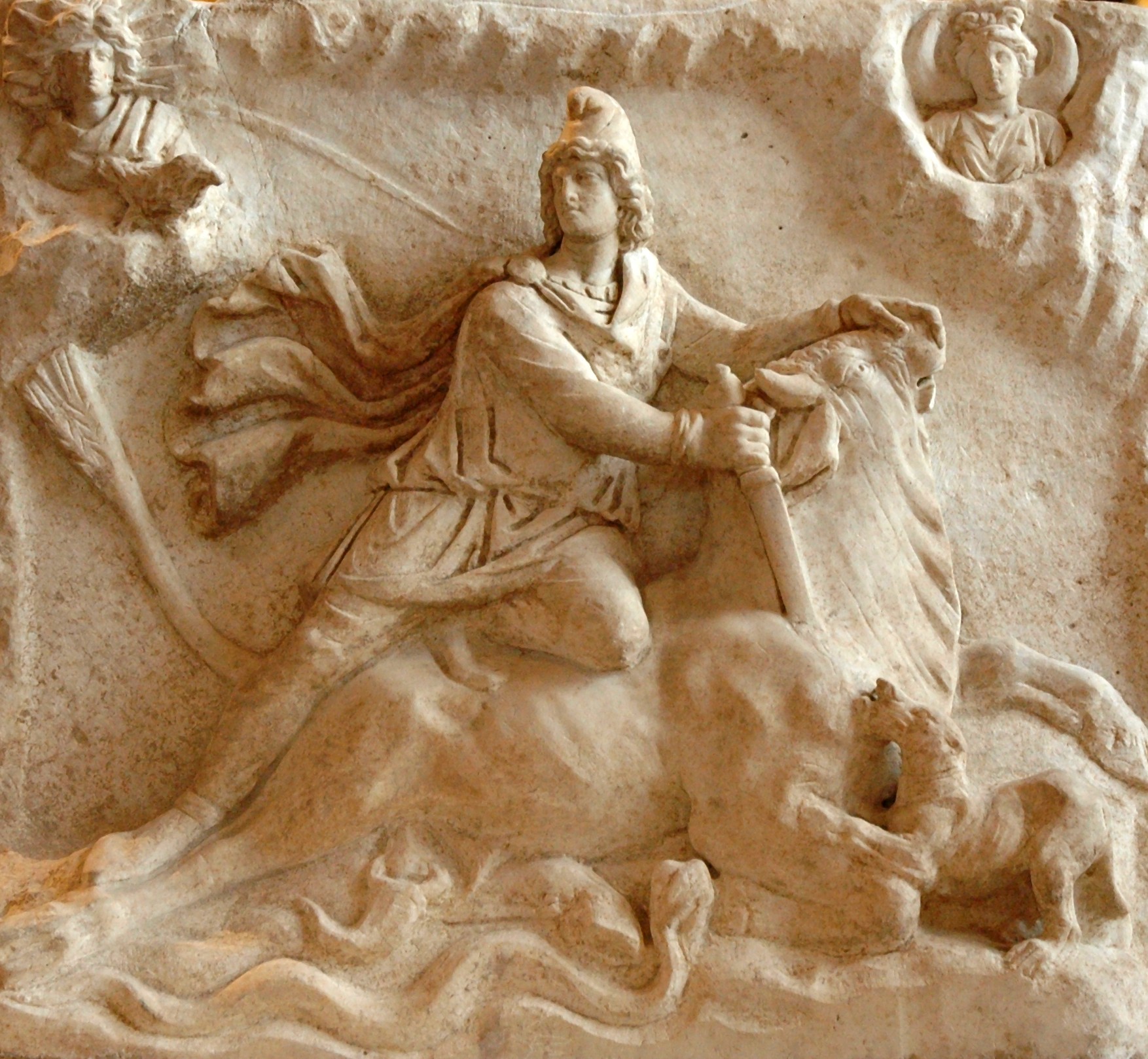
Carl Jung saw a similar drama in the religion of the Roman god Mithras. Mithras was worshipped mostly by soldiers, in small underground temples built to look like caves, and these temples have been found from Rome to Britain; one was dug up in the middle of London. At the end of each one was the same scene, carved or painted: the young god Mithras kneeling on a bull, holding back its head and plunging a knife into its neck. And from the dying bull, new life springs up. Ears of wheat grow from its tail, and in some versions vines grow from its blood. A dog and a snake reach up to drink the blood.

Jung read this scene as the sacrifice of our animal nature so that something new can grow. The bull stands for raw, untamed force inside us: lust, rage, the urge simply to have and to dominate. These forces are not evil in themselves, they are life itself, but while they rule us, nothing higher can grow. When they are faced, mastered and "sacrificed", their energy is not lost. It turns into something new, like the bull's blood turning into grain and wine. This is close to the meaning of Durga's victory over the buffalo demon Mahishasura. The buffalo stands for brute stubborn ignorance, and when it is overcome, the world is set free. In both stories, life comes out of the defeat of the beast.

The painter Pablo Picasso, in the 1930s, drew and painted the Minotaur, the bull-headed man of Greek myth, again and again. He often used it as a picture of himself. His Minotaurs are sometimes lustful and violent, sometimes lonely, sometimes wounded and dying, sometimes blind and led gently by a little girl. Through the half-man, half-bull, Picasso seemed to be looking honestly at his own appetites and cruelty, and at the loneliness that came with them. It is the bull inside the man, shown not as a hero but as something both frightening and pitiable.
The image of Durga killing Mahishasura, called Mahishasuramardini, "she who crushed the buffalo demon", is one of the most powerful in Indian art. One of its greatest versions is the seventh-century relief in the Mahishasuramardini cave at Mamallapuram, where the goddess, riding her lion with eight arms full of weapons, charges at the buffalo-headed demon, who retreats with his club. The scene is full of motion; the demon's army stumbles backwards. In Bengal's Durga Puja, now recognised by UNESCO as part of the world's intangible cultural heritage, artists in Kumartuli in Kolkata spend months shaping giant clay images of the goddess killing the demon, which are worshipped for five days and then immersed in the river. In this tradition, the goddess is also a daughter coming home to her parents for a short visit, and the immersion is a tearful farewell.

There is another side to the story. In parts of Jharkhand, West Bengal and Karnataka, some Adivasi and Dalit communities remember Mahishasura not as a demon but as a just king, or a buffalo-herding ancestor, killed by deceit. The Asur community of Jharkhand, one of India's smallest tribes, regards Mahishasura as their forebear and observes a period of mourning during Durga Puja. In Mysuru, whose name is often linked to Mahishasura, a large statue of him stands on Chamundi Hill, where the goddess Chamundeshwari is said to have killed him. These alternative traditions remind us that myths are told from many sides, and that the demon of one story can be the ancestor of another.

Jung's interest in the Mithraic bull-slaying is linked to his break with Freud. In Symbols of Transformation (1912), the book that ended their friendship, Jung analysed the fantasies of an American woman and traced them to myths from around the world. He paid special attention to Mithras, the god whose cult spread through the Roman army from the first century CE. In the cult's central image, the tauroctony, Mithras kneels on a bull and plunges a dagger into its neck, while a dog and a snake lick the blood and a scorpion attacks the bull's genitals, and from the bull's tail sprout ears of wheat. Jung read this as the sacrifice of the instinctive, animal libido, which, once given up, becomes the source of new life and culture. The Durga story can be read in a similar way: the buffalo's brute power is overcome, and from its defeat comes order and abundance.
The white buffalo
On the Great Plains of North America lived the American bison, perhaps thirty to sixty million of them at the start of the nineteenth century, in herds that took days to pass. For the Lakota, the Cheyenne, the Blackfoot, the Comanche, and other Plains nations, the bison, called tatanka in Lakota, was the source of nearly everything: food, clothing, shelter, tools, fuel, and spiritual power. In a sacred Lakota story, White Buffalo Calf Woman appeared to the people during a time of hunger, brought them the sacred pipe and the seven sacred rites, and, as she departed, turned into a white buffalo calf. The rare birth of a white bison calf is still regarded by many Plains peoples as a sign of profound spiritual significance.

In the second half of the nineteenth century, the bison were slaughtered on a scale that has few parallels in history. Commercial hunters killed them by the millions for their hides, often leaving the meat to rot, and the destruction was encouraged by some American officials as a way of breaking the Plains peoples by destroying their food supply. By the late 1880s, the zoologist William Hornaday estimated that fewer than a thousand remained. Photographs of the period show mountains of bison skulls, taller than the men standing beside them, waiting to be ground into fertilizer. A small number of ranchers, conservationists, and Native nations saved the remnant, and today there are several hundred thousand bison, though only a small fraction are wild, free-ranging animals.
In Europe, the wisent, or European bison, was hunted to extinction in the wild by 1927. All living wisent descend from about a dozen animals that survived in zoos. They were bred back and released, above all in the Białowieża Forest on the border of Poland and Belarus, and now number in the thousands.
By the late 1880s, of a population once numbering in the tens of millions, fewer than a thousand remained.
The slaughter of the American bison is one of the worst wildlife disasters in history. In the 1870s, a new tanning process made bison hides useful for industrial leather, especially for the belts that drove factory machines. Railways cut across the plains, carrying hunters in and hides out. Professional hunters killed thousands each; one, Buffalo Bill Cody, claimed over four thousand in eighteen months to feed railway workers. Some army officers openly said that killing the bison would force the Plains nations onto reservations by destroying their food. By 1889, the naturalist William Hornaday counted fewer than a thousand. A few people, including some Native ranchers, the rancher Charles Goodnight and his wife Mary Ann, and the American Bison Society founded in 1905 with President Theodore Roosevelt as honorary president, saved the last herds. In 2016, the bison became the national mammal of the United States, a symbol of recovery as well as of loss.
White Buffalo Calf Woman, Ptesan Wi, is central to Lakota religion. According to the story, two hunters saw a beautiful woman in white approaching across the prairie. One had impure thoughts and was turned to bones; the other was sent to prepare his people. She came to the camp and gave them the sacred pipe, showing them how to pray with it, and taught the seven sacred rites, including the sweat lodge, the vision quest and the Sun Dance. As she left, she rolled on the ground and became a white buffalo calf, then other colours, and disappeared. In 1994, a white female bison calf named Miracle was born on a farm in Wisconsin, and thousands of Native Americans came to see her as a sign of hope and renewal. The story shows how, for the Plains nations, the bison was not just food but a relative and a messenger of the sacred.

The bull in the arena
The ancient ritual encounter between young men and bulls survives in several forms. In Tamil Nadu, the festival sport of jallikattu, held during the harvest festival of Pongal, involves young men trying to hold on to the hump of a charging bull. It is regarded by its supporters as an expression of Tamil identity and a way of preserving native cattle breeds, and it was at the centre of a massive protest movement in 2017 after the Supreme Court banned it on grounds of animal cruelty; the ban was effectively overturned by state legislation. In Spain, the bullfight, with its roots in ancient rites, remains both celebrated and fiercely opposed.

Other Indian festivals honour cattle more gently. On Mattu Pongal in Tamil Nadu, the day after the harvest festival of Pongal, cattle are given the day off. They are bathed, their horns are painted in bright colours and capped with brass, and garlands and bells are hung around their necks, in thanks for the year's work in the fields. Families feed them sweet pongal and touch their feet. It is a festival of gratitude to the animals whose labour makes the harvest possible.


In coastal Karnataka, pairs of buffaloes race through flooded, muddy paddy fields in Kambala. A man runs behind each pair, holding the reins and a whip, sending up great fans of water. It is a village sport, but it is also bound up with harvest, pride and worship of local spirits. Rishab Shetty's film Kantara (2022), which was a huge hit across India, features the thunder of Kambala and is steeped in the spirit-worship of that coast, the bhuta kola rituals in which a performer becomes the voice of a guardian spirit.


Lijo Jose Pellissery's Malayalam film Jallikattu (2019) goes somewhere darker. A buffalo escapes from a butcher in a hill village in Kerala, and the whole village turns out to catch it. As the night goes on, the chase gets wilder, old grudges come out, men fight and trample each other, and the crowd becomes more and more like a herd of animals. At the end, it is no longer clear who is the beast. The film was India's entry for the Oscars. It is less about the animal than about the beast inside the crowd: how ordinary people, together and excited, can lose themselves and become something wild and frightening.

Jallikattu's name comes from salli, coins, and kattu, tied: in the past, a bundle of coins was tied to the bull's horns as a prize for the man who could grab it. It is held during Pongal, the Tamil harvest festival, especially around Madurai at Alanganallur, Palamedu and Avaniyapuram. The bulls are of native breeds like Kangayam and Pulikulam, raised with great care and often treated as family members; owners say that without jallikattu, these breeds would vanish. Animal-welfare groups documented bulls being made drunk, having chilli rubbed in their eyes and tails twisted, and injuries and deaths among both bulls and men. In 2014 the Supreme Court banned it. In January 2017, huge peaceful protests gathered on Chennai's Marina beach for days, with students, farmers and film stars demanding its return as a matter of Tamil identity. The Tamil Nadu government passed a law allowing it, and in 2023 the Supreme Court upheld that law. The argument over jallikattu is really an argument about who decides what counts as cruelty and what counts as culture.

Kambala, its Karnataka cousin, is a race rather than a fight. Pairs of buffaloes, yoked together and driven by a man running behind them, race through a straight track of water and mud in paddy fields, usually between November and March. In 2020 a young runner named Srinivasa Gowda became famous across India when his timing behind his buffaloes, worked out over a hundred metres, was compared to Usain Bolt's. Kambala is tied to the worship of local spirits, bhutas, and to the farming calendar of the Tulu-speaking coast. Kantara draws on exactly this world, of buffalo races, spirit possession and the long struggle over forest land between villagers, landlords and the state.
What the wild cattle teach
The wild cattle show more starkly than any other animals how completely human beings can transform a species, and how quickly they can destroy one. The aurochs became the cow and vanished. The bison fell from tens of millions to hundreds. The gaur and the wild buffalo survive in fragments. And yet the power of the bull remains in our myths and festivals: Nandi gazing at Shiva, the goddess spearing the buffalo demon, the white buffalo calf bringing the sacred pipe. The strength that humans tamed is still, in their imagination, the strength of gods.

Indian literature has told the bond between farmers and cattle with deep feeling, and no one did it better than Premchand. His story "Do Bailon Ki Katha", "The Tale of Two Bullocks", is one of the best-loved animal stories in Hindi. Heera and Moti are two bullocks who belong to a farmer named Jhuri, and they love him and each other. When they are sent away to work for a harsh man, they suffer, escape, are locked in a cattle pound, help the other animals there to break free, are sold, and at last find their own way home to Jhuri, who weeps with joy to see them. Under the simple story, Premchand is writing about patience, friendship and the right of even the humblest to resist cruelty. Many readers have seen in it a picture of India's own struggle for freedom.
His last finished novel, Godaan (1936), "The Gift of a Cow", filmed in 1963, is one of the great novels of Indian village life. It follows Hori, a poor, honest farmer whose lifelong dream is simply to own a cow, a sign of respect and security in his village. He gets one, loses it through his brother's jealousy, and spends the rest of his life sinking deeper into debt, crushed by landlords, moneylenders and priests. When he dies, worn out, his wife gives the priest the few coins she has as the ritual "gift of a cow" for his soul, the gift of a cow he never really had. It is one of the saddest endings in Indian literature, and it shows how the cow could stand for everything a poor family hoped for and could never quite reach.
Premchand's "Do Bailon Ki Katha", published in 1931, tells of two bullocks, Heera and Moti, owned by a farmer named Jhuri. When Jhuri sends them to his brother-in-law's house, they are badly treated and run away home. Later they are seized and sent to a cattle pound, where they free other animals by breaking down a wall, and are finally sold to a butcher, but recognise the road home and escape back to Jhuri's door. The story is about loyalty and friendship between the two animals, but readers in 1931 also saw in it a story about India: two patient beasts of burden, harnessed and beaten, who finally break their chains and return home. In Godaan (1936), Premchand's farmer Hori longs for a cow as a sign of dignity, gets one on credit, and loses it when his own brother poisons it out of jealousy. Debts, landlords and moneylenders grind Hori down, and he dies without ever giving the cow, godaan, that Hindus believe a dying man should give. The cow here is the dream of a decent life that the poor farmer can never reach.
Verghese Kurien's "White Revolution" belongs in any story of Indian cattle. Kurien, an engineer trained in the United States, arrived in Anand, Gujarat, in 1949 to run a government creamery and stayed to help build the Kaira District Cooperative Milk Producers' Union, with the farmer-leader Tribhuvandas Patel. The cooperative, which became famous as Amul, collected milk from small farmers, often women with one or two buffaloes or cows, paid them fairly and quickly, and processed it in modern plants. In 1970, the government launched Operation Flood to spread the model across India. Within a few decades, India became the world's largest milk producer. The story was told in Shyam Benegal's film Manthan (1976), funded by half a million Gujarat dairy farmers who each gave two rupees. It is one of the few films in the world produced by the very people it is about. The cow and the buffalo, sacred and practical at once, helped lift millions of Indian families out of poverty.