Part Three · Hoof and Horn
Chapter 11
The Deer and the Antelope
Crowns that fall and grow again, the golden deer of the Ramayana, the stag with a cross between its antlers, and the people who died for the blackbuck.
Assisted and Curated by Claude, Referenced and Collated by me

Families Cervidae and Bovidae
In 1730, in the village of Khejarli near Jodhpur, soldiers of the Maharaja of Marwar arrived to cut down the khejri trees that grew around the village. The wood was needed for lime kilns for a new palace. The people of Khejarli belonged to the Bishnoi community, followers of a fifteenth-century saint, Guru Jambheshwar, who had laid down twenty-nine principles for his followers, among them a prohibition on cutting green trees and killing animals. A woman named Amrita Devi stepped forward and hugged a tree, refusing to let the axes touch it. The soldiers killed her. Her three daughters took her place, and they too were killed. Then others from the village came forward, one after another, to embrace the trees. According to Bishnoi tradition, three hundred and sixty-three people died before the Maharaja, learning what was happening, ordered the cutting stopped and issued a decree protecting trees and animals in Bishnoi villages.

The Bishnoi still protect the wildlife around their villages in the Thar desert, and the animal most closely associated with them is the blackbuck, an antelope of the Indian plains, whose males have spiralling horns and black-and-white coats. Bishnoi women have been known to nurse orphaned fawns. In Bishnoi villages, blackbuck and chinkara graze near houses, unafraid. It is one of the most remarkable living examples, anywhere, of a religious ethic that treats wild animals as persons under protection.
The Bishnoi faith was founded by Guru Jambheshwar, often called Jambhoji, who was born in 1451 in the village of Pipasar in the Thar desert. According to tradition, he witnessed a terrible drought in 1485, in which people cut down trees and killed animals to survive, and saw that this only made the desert worse. He laid down twenty-nine rules, bis (twenty) and noi (nine), which gave the community its name. Among them are rules of cleanliness, honesty and non-violence, and two of the most famous: do not cut green trees, and be compassionate to all living beings. The Bishnois also bury rather than cremate their dead, to save wood. In an arid land where every tree and every animal is precious, this was not only religion but survival wisdom. The khejri tree, which can live through drought, feeds goats with its leaves, fixes nitrogen in the soil and gives pods eaten by people, is the backbone of the desert's farms. Protecting it protected everything else.
The Khejarli sacrifice of 1730 is remembered every year at a fair in the village, held on the tenth day of the bright fortnight of the month of Bhadrapada, the date of the massacre. A memorial lists the names of those who died, including Amrita Devi and her daughters Asu, Ratni and Bhagu. Her last words are remembered in a Marwari saying: sar sånthe rookh rahe to bhi sasto jaan, "if a tree is saved even at the cost of one's head, it is worth it." The story is now taught in Indian schools and has been told in films and comics. It has also been retold around the world as one of the earliest recorded acts of organised environmental resistance.
The blackbuck is one of the most beautiful antelopes in the world, and one of the few found only in the Indian subcontinent. Adult males turn from tan to a deep black-brown above, with white underparts and white rings around the eyes, and their spiralling horns can grow longer than sixty centimetres, with three to five twists. Females and young males are tan and usually hornless. Blackbuck were once found in herds of thousands across the plains of India; nineteenth-century travellers described seeing herds stretching to the horizon. Hunting, often with trained cheetahs by the Mughals and later with guns by the British and the princes, and the ploughing of grasslands, reduced them to scattered pockets. Thanks to protection and the Bishnoi, numbers have recovered in Rajasthan, Gujarat, Haryana and parts of the Deccan. The blackbuck is the state animal of Punjab, Haryana and Andhra Pradesh, and in Hindu belief it is the vehicle of Chandra, the moon god. The Manusmriti even defines the land fit for Vedic sacrifice as the land where the black antelope roams freely.
Antlers and horns
Deer and antelope are often confused, but they belong to different families. Deer have antlers, which are made of bone, are usually grown only by males (reindeer are the exception, in which females also grow them), and are shed and regrown every year. Antelope, like cattle, goats, and sheep, have horns, which consist of a bony core covered by a sheath of keratin, the material of hair and fingernails, and are never shed.

The annual growth of antlers is one of the wonders of biology. A growing antler is covered in a soft, furry skin called velvet, rich in blood vessels and nerves, and it can grow faster than almost any other tissue in the animal kingdom, in some large deer by more than two centimetres a day. When the antler is fully grown, the velvet dries and is rubbed off against trees, and the hard, dead bone that remains becomes a weapon and a display for the mating season, the rut. After the rut, the antlers fall, and the cycle begins again. Medical researchers study antlers for clues to bone regeneration and even to the control of rapid, cancer-like growth.
The rut is the most dramatic event in a deer's year. Male red deer in Scotland and the hangul in Kashmir bellow, or roar, to attract females and challenge rivals, and fight with locked antlers. The sambar, India's largest deer, calls with a loud, ringing bell-like call. The chital, or spotted deer, the most common deer of Indian forests, lives in herds and can breed at almost any time of year, so stags in hard antler and stags in velvet may be seen together.

Every year the stag loses its crown, and every year it grows a new one, faster than almost any tissue in nature.
Deer and antelope fill India's oldest art. In the rock paintings of Bhimbetka and other shelters of central India, they are the most common animals of all: herds of them, drawn in red and white, often shown being hunted with bows and arrows. For the people who painted them, deer were the animals of everyday life, food and skins, watched every day and followed for miles.

Far to the north, at Star Carr in England, archaeologists found something remarkable: more than thirty red-deer skull caps with the antlers still on, about eleven thousand years old. They had been carefully trimmed and holes had been made in them, so that they could be worn on a human head. No one knows exactly how they were used. Perhaps hunters wore them to creep close to deer. More likely, many think, they were worn in ritual or dance, so that a person could become the deer for a while.
That idea, of a person putting on the deer to travel beyond the ordinary world, survived for thousands of years. In Siberia, shamans, the healers and spirit-travellers of many northern peoples, once wore headdresses with iron antlers when they drummed and went into trance, believing that in spirit they were journeying to other worlds to bring back lost souls or cures. The deer, swift and alert, was the right animal to carry them. For the Sámi of Scandinavia and the Evenki and Nenets of Siberia, life still turns around the reindeer: they follow the herds across the tundra, live off their milk, meat and skins, and their calendars, songs and stories are shaped by the reindeer's year.
Star Carr, in North Yorkshire, is one of the most important Stone Age sites in Europe. About eleven thousand years ago, as the ice sheets retreated, hunter-gatherers lived on the shore of a lake there, Lake Flixton, now drained and covered with peat. First excavated by Grahame Clark from 1949, and again by teams from the Universities of York and Manchester from 2004, the site has given up a timber platform, the oldest known house in Britain, and thirty-three red-deer frontlets: the top of a stag's skull with the antlers attached, hollowed and pierced with holes so that they could be tied on a person's head. Were they worn in rituals, as disguises for hunting, or both? No one knows. But they recall the antlered headdresses worn by Siberian shamans into the twentieth century, and the antlered figure on the Gundestrup cauldron. For at least ten thousand years, people have put on the stag's crown to step into another role.

The Sámi of northern Scandinavia, and the Nenets and Evenki of Siberia, still organise their lives around reindeer, the one deer that has been domesticated. Nenets herders migrate up to a thousand kilometres a year across the Yamal peninsula, following their herds between winter forest and summer tundra. Reindeer give them meat, milk, skins for clothing and tents, and transport. Siberian shamans' drums were often made of reindeer hide, and the reindeer was believed to carry the shaman's spirit on its journeys to other worlds. Some scholars have even suggested that the image of Santa Claus's flying reindeer may echo Siberian shamanic beliefs, carried west by traders and storytellers, though this remains speculative.
Antler growth has caught the attention of medical researchers. A growing antler is the fastest-growing bone in the animal kingdom, building up to two centimetres a day in large deer, and it is the only mammal organ that can be fully regrown each year. The growth is driven by stem cells in a structure called the pedicle on the deer's skull. In 2023, scientists in China transplanted deer antler stem cells onto the heads of mice and grew small antler-like bones. Studies of antlers also interest cancer researchers, because antler cells divide at a rate similar to tumour cells but stay perfectly controlled. Understanding how the deer switches growth on and off could one day help with bone injuries and diseases.

India's deer and antelope are remarkably diverse. Besides the chital, sambar, barasingha and blackbuck, there are the barking deer or muntjac, whose alarm call sounds like a dog's bark; the tiny Indian chevrotain or mouse deer, the size of a hare, a living relic of the earliest deer-like animals; the hog deer of the Terai grasslands; the hangul of Kashmir and the shou of Sikkim; and the musk deer of the Himalaya. Among the antelopes and their relatives are the nilgai, Asia's largest antelope, often called the "blue bull"; the chinkara or Indian gazelle; the four-horned antelope or chousingha, the only wild animal in the world with four horns; and the Tibetan antelope or chiru of Ladakh, whose fine wool, shahtoosh, was smuggled to make luxury shawls until a crackdown in the 1990s and 2000s. Each lives in a different corner of India's landscape, from desert to swamp to high plateau, and together they feed the tiger, the leopard, the wolf and the dhole.
The partnership of the forest
We began this book with an alliance: the langur in the tree and the chital on the ground. The partnership has been documented in detail. Langurs drop leaves and fruit that chital eat, and langurs, with their high view, spot predators early and give alarm calls; chital, with their keen sense of smell, detect predators the monkeys might miss. Each species listens to the other's alarms. In African savannas, similar alliances exist between antelope and baboons, and between zebra and wildebeest, whose senses complement one another.

Antelope are built for speed and vigilance. The blackbuck can run at up to eighty kilometres an hour. The springbok of southern Africa performs a strange, stiff-legged leap called pronking, bouncing high into the air with an arched back, apparently to show predators that it is fit and not worth chasing. The great migration of the Serengeti, in which around a million and a half wildebeest, together with zebras and gazelles, move in a vast circle following the rains, is the largest movement of land mammals on earth.
Some antelope have suffered catastrophic losses. The saiga, a strange antelope of the Central Asian steppes with a large, bulbous nose, was reduced by poaching for its horns, used in traditional Chinese medicine, to a small fraction of its former numbers. In 2015, more than two hundred thousand saiga, a majority of the global population, died within a few weeks from a bacterial infection triggered by unusual heat and humidity. They have since recovered strongly in Kazakhstan, one of conservation's surprising comeback stories.
The scientist who documented the langur-chital partnership most carefully in India was the ecologist A. J. T. Johnsingh, along with others working in Kanha, Bandipur and Mudumalai. They found that chital gather beneath trees where langurs are feeding, especially in the dry season, when leaves and fruit dropped by the monkeys are a valuable extra food. Chital and langurs respond to each other's alarm calls, and both respond to the calls of other species too: the bark of the sambar, the shriek of the peafowl, the chatter of the jungle babbler. A tiger moving through Kanha sets off a chain of calls that experienced guides can read like a map. Some researchers have even suggested that predators learn to read these calls and change their routes to avoid them. The forest is a network of informers.
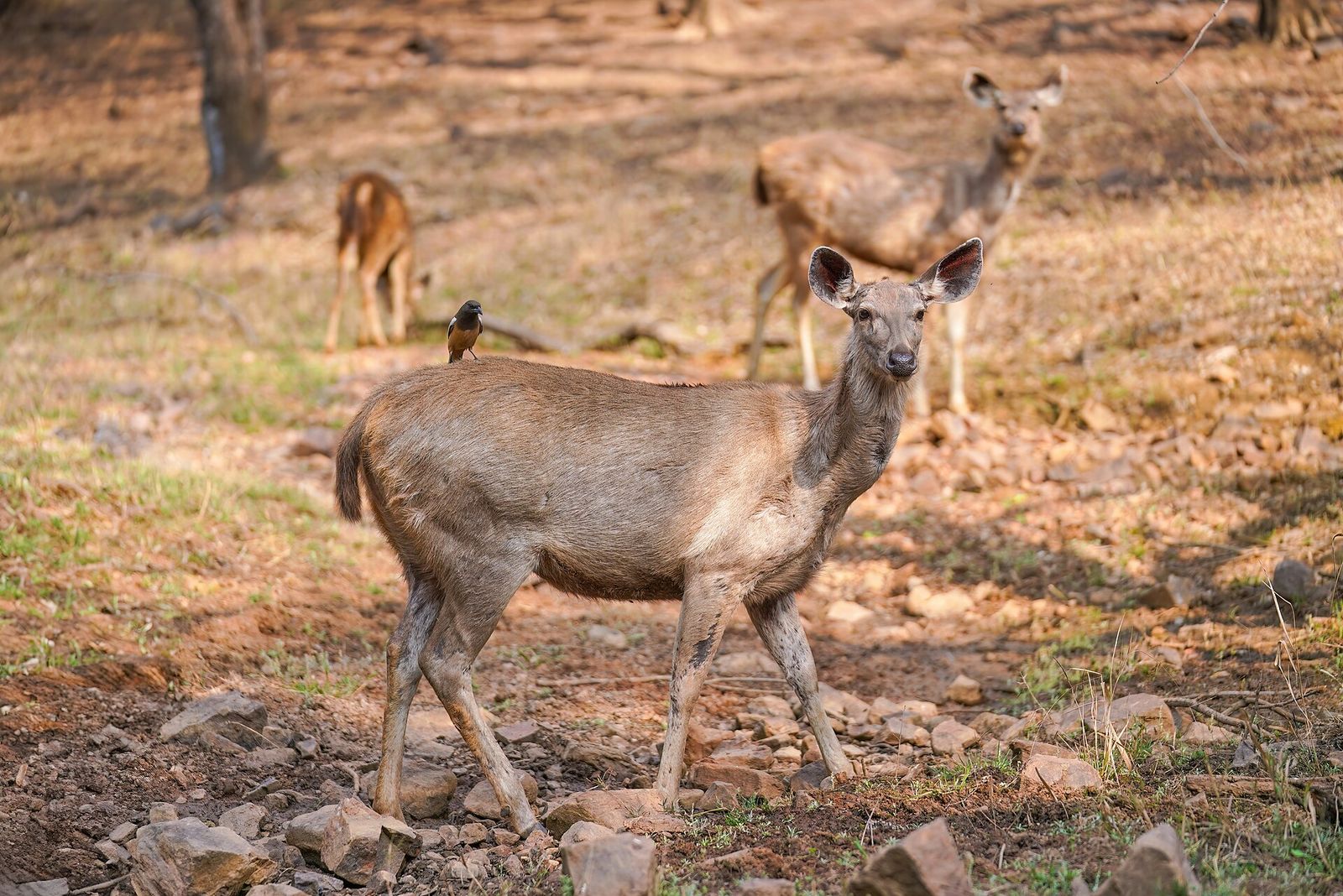
The Serengeti migration is not only a spectacle but an engine of the ecosystem. The wildebeest move in a great clockwise loop through Tanzania and Kenya, following the rains to fresh grass, and in doing so they shape everything: their grazing keeps the grass short and nutritious, their dung fertilises the soil, and the thousands that drown each year crossing the Mara River feed fish, crocodiles and vultures. When their numbers crashed in the early twentieth century from rinderpest, a cattle disease introduced from Asia, the Serengeti became a land of tall grass and fires. When the disease was eliminated in the 1960s, the herds returned to over a million, and the grasslands and even the trees changed. India once had a similar spectacle, the vast herds of blackbuck and chinkara on the Deccan and western plains, now remembered only in old travel accounts.
Deer also shape forests in ways we rarely notice. By browsing young trees and grazing grass, they decide which plants grow where; where deer are too many, as in parts of Europe and North America without predators, forests fail to regenerate. Where tigers, leopards and wolves keep deer moving, the forest grows back in patches. The deer, prey to every hunter of the forest, is also one of its gardeners.
The golden deer and the cursed king
Deer play pivotal roles in both great Indian epics. In the Ramayana, the demon Maricha takes the form of a golden deer to lure Rama away from Sita, so that Ravana can abduct her. Sita, enchanted by its beauty, asks Rama to catch it; Rama, pursuing it deep into the forest, finally shoots it, and it cries out in Rama's voice, deceiving Lakshmana into leaving Sita alone. The golden deer is the beautiful illusion that leads to catastrophe, and mṛga-tṛṣṇā, "deer-thirst," is the Sanskrit word for a mirage.

In the Mahabharata, King Pandu, hunting in the forest, shoots a deer that is mating. The deer is in fact the sage Kindama, who had taken deer form to make love to his wife, and as he dies, he curses Pandu to die if he ever lies with a woman. This curse sets in motion the entire story, since Pandu's sons, the Pandavas, must be born through divine intervention. The sage Rishyashringa, "deer-horned," born of a doe, was a boy raised in the forest who had never seen a woman; he was lured to a drought-stricken kingdom, and his arrival brought the rain.
The Buddha preached his first sermon in the Deer Park at Sarnath, and the image of two deer flanking the wheel of dharma is one of Buddhism's oldest symbols. Several Jataka tales, stories of the Buddha's previous lives, tell of him as a golden deer who offered his own life to save a pregnant doe, moving a king to protect all deer in his kingdom. In Japan, the deer of Nara, who famously bow to visitors in exchange for crackers, are regarded as messengers of the gods of the Kasuga shrine, and have been protected for more than a thousand years.
The deer appears again and again in stories as the animal that leads people somewhere they did not mean to go. A hunter sees a beautiful deer, chases it deeper and deeper into the forest, loses his way, and finds himself in an enchanted place, or meets the person who will change his life. Jungian readers often see such a deer as the call of the unconscious, the hidden, deeper part of the mind. It is shy and lovely and cannot be caught by force. If you grab at it, it vanishes. You can only follow it, gently, and see where it leads. Many people know a feeling like this: a quiet pull towards a different kind of life, an interest or a longing that does not make sense yet but will not go away.
The golden deer of the Ramayana shows the other side. Sita sees a deer with a golden coat and silver spots, and longs for it. Rama goes after it, and it leads him far away, until it is shot and reveals itself as the demon Maricha in disguise, crying out in Rama's voice so that Lakshmana too is lured away and Sita is left alone for Ravana to take. Here the beautiful deer is not a call to something deeper. It is a trap: the longing for something lovely that turns out to be an illusion, and that pulls us away from what truly matters. India's word for a mirage, mrigatrishna, means exactly this: the deer's thirst, the deer running towards water that is not there. The hard part, in life, is telling the two kinds of deer apart.
The poet Kabir found a third meaning, and it may be the deepest. The musk deer has a pocket on its belly that gives off a strong, sweet scent. Kabir says the deer smells this scent, and does not know it comes from its own body, so it runs wildly through the forest looking for where it comes from: kasturi kundal basai, mriga dhoondhe ban mahi, "the musk is in its own navel, but the deer searches the forest for it." In the same way, he says, God is inside every person, but people search for God in temples, pilgrimages and holy places. It is one of the oldest Indian pictures of something very human: looking everywhere except within. It applies to more than religion. People search for happiness, peace or worth in money, praise and other people's approval, when what they are looking for may be closer than they think.
The deer also opens one of the greatest plays in Sanskrit. Kalidasa's Abhijnanashakuntalam begins with King Dushyanta in his chariot, chasing a deer through the forest, bow drawn. Just as he is about to shoot, hermits stop him: this deer belongs to the hermitage and must not be killed. He lowers his bow, and in that hermitage he meets Shakuntala. So the play begins with a king learning to hold back his power, and that is where love begins. Later, when Shakuntala leaves the hermitage to go to the king's court, her pet fawn, which she had raised and fed by hand, tugs at the hem of her dress and will not let her go. The whole forest seems to grieve. It is one of the most tender scenes in Indian literature: the bond between a young woman and the animals she grew up with.

Sanskrit poets praised a beautiful woman as mriganayani, "doe-eyed": large, dark, gentle eyes that seem always ready to take fright. And the restless deer runs through classical love poetry as a picture of a shy, wandering heart, one that is drawn to love but startles easily and must be approached gently.
The golden deer episode is one of the turning points of the Ramayana, and different tellings handle it differently. In Valmiki's version, Lakshmana warns Rama that the deer must be a demon in disguise, since no real deer looks like that, but Sita longs for it so much that Rama goes. When the dying Maricha cries out "Ha Sita! Ha Lakshmana!" in Rama's voice, Sita forces Lakshmana to go to Rama's help, accusing him of wanting her for himself. Later retellings add the famous "Lakshmana rekha", a protective line Lakshmana draws around the hut that Sita must not cross, an idea not found in Valmiki. In the Tamil and Bengali retellings, and in Ramlila performances, the golden deer scene is a favourite moment, often played with a dancer in a glittering costume. The Sanskrit word mrigatrishna, "deer-thirst" or mirage, links the episode to an old Indian idea: the world itself is like the golden deer, shining with an appeal that leads us away from what really matters. The Advaita philosophers used the mirage as a standard image for maya.
The Jataka story of the Banyan Deer, the Nigrodhamiga Jataka, is one of the most famous of the Buddha's past-life tales. A king loves to hunt deer, so he encloses two herds in a park, led by two golden deer kings, the Banyan Deer and the Branch Deer. The deer agree to send one of their number each day to the royal kitchen, so that the rest are not chased and wounded. One day the lot falls on a pregnant doe of the Branch herd. Her leader refuses to spare her, so she goes to the Banyan Deer, who offers to go in her place. The king, astonished to see the golden deer king lay his own head on the block, asks why. Hearing the answer, he spares the deer, then, at the deer king's request, all deer, then all four-footed animals, birds and fish. The story is carved on the railings of the Bharhut and Sanchi stupas. It is perhaps the oldest Indian story to argue that kindness to animals is a duty of rulers.
Kabir's line about the musk deer comes from a short couplet, a doha, of the kind that made him one of the most quoted poets of India. Kabir, a fifteenth-century weaver of Varanasi, attacked the empty rituals of both Hindus and Muslims and taught that God lives within the heart. The musk deer, kasturi mriga, has a gland that produces a strong scent, and the deer, the poet says, runs wildly through the forest, searching for the scent's source, never realising it comes from its own body. So, he says, God is in every heart, but the world does not see it. The real musk deer, a small, fanged, antlerless deer of the Himalaya, has been hunted to near-extinction for that gland, whose musk was used in perfumes and medicines and was once worth more than its weight in gold. The poet's image of inner wealth became, for the animal itself, a fatal curse.
In Kalidasa's play, the deer appears at the very start and at the very heart. King Dushyanta is chasing a deer in his chariot, his bow drawn, when hermits stop him: this is an ashram deer, protected, and must not be killed. He lowers his bow, and his act of restraint leads him to Shakuntala. Later, when Shakuntala leaves the hermitage to join her husband, a young deer she has raised clings to the hem of her dress and will not let her go, and the whole forest seems to grieve. The scene is one of the most loved in Sanskrit literature. Goethe, who read the play in translation in 1791, wrote a short poem in praise of it, saying that it combined the blossoms of spring and the fruits of autumn. Through Shakuntala's fawn, the deer entered world literature as an image of tenderness and the bond between humans and the creatures they raise.
The stag in the West
In Greek myth, the hunter Actaeon stumbled on the goddess Artemis bathing and was transformed into a stag and torn apart by his own hounds. The Celts had a horned god, known from a single inscription as Cernunnos, depicted on the silver Gundestrup cauldron sitting cross-legged with antlers on his head, surrounded by animals, a Master of Animals like those we met in the earlier book. In Christian legend, Saint Eustace, and later Saint Hubert, the patron saint of hunters, were converted when, while hunting, they saw a stag with a crucifix glowing between its antlers. In Hungarian legend, the brothers Hunor and Magor followed a miraculous white stag into the land where they founded their peoples. In Arthurian romance, the white stag appears as a messenger from the otherworld, leading knights into adventure. The Scythians of the steppe made golden stags with antlers flowing along their backs, one of the masterpieces of ancient animal art.

Why does the deer, above all, lead humans into other worlds? Perhaps because of its grace, its alertness, its sudden appearance and disappearance at the edge of the forest, and its antlers, which fall and grow again like the branches of a tree. The deer is the animal of thresholds.
The deer is the animal of thresholds. It appears at the forest's edge and leads us across.

The Bible's Psalm 42 begins: "As the hart panteth after the water brooks, so panteth my soul after thee, O God." A hart is a male deer. Imagine one in a dry land, exhausted, desperate for water. The psalmist says that is how his soul longs for God. It is a picture of longing so strong it is almost physical, and it is close, in a way, to Kabir's musk deer, though the psalm finds the answer outside, in God, where Kabir finds it within.
Most people in the West met the deer through Bambi. But before Disney there was a book, Felix Salten's Bambi, A Life in the Woods (1923), written in Vienna. It is a serious, often dark novel about the dangers of the forest, where deer live in fear of a creature they call only "He": man, the hunter. Disney's Bambi (1942) softened much of the story, but kept its most famous moment. Bambi's mother is shot by a hunter, off screen, while the two of them are out in the snowy meadow looking for grass. Generations of children were shattered by it, and the film shaped how millions felt about hunting: for many, the hunter was never again a hero.

In Hayao Miyazaki's Japanese animated film Princess Mononoke (1997), the god of the forest is a great deer-like spirit with a strange, almost human face. Where it walks, flowers bloom and die in a moment, because it gives life and takes it. In the story, people building an ironworks cut down the forest and finally shoot off the spirit's head, and the whole land begins to die. It is one of the strongest images in modern film of what happens when we kill the sacred heart of the wild, and it ends not with simple blame but with the hard work of people and forest learning to live side by side.

Felix Salten, the author of Bambi, was a Jewish writer in Vienna, and his 1923 novel is darker than the film. Bambi learns that "He", the hunter, is the one creature all the forest fears, and that the forest is full of death. The book has been read as an allegory of the precarious life of Jews in Europe, and in 1936 the Nazis banned it. Salten fled to Switzerland in 1939. Walt Disney bought the film rights, and the 1942 film made the forest gentler and the animals cuter, but kept the central shock: the death of Bambi's mother, shot off-screen by hunters. Generations of children have remembered that moment as their first experience of grief in a film. American hunters complained that the film was anti-hunting propaganda; conservationists said it helped create public sympathy for wildlife. The phrase "Bambi effect" is now used for the way people protect cute animals more readily than ugly ones.

India's rescued deer
India has more species of deer than almost any other country, and several have been brought back from the edge. The barasingha, or swamp deer, named for its "twelve-tined" antlers, was reduced in central India to a few dozen animals of the hard-ground subspecies in Kanha National Park by the 1970s; careful management of its grasslands brought it back to several hundred, and it is now the state animal of Madhya Pradesh. The hangul, the Kashmir red deer, survives in small numbers in and around the Dachigam National Park. The sangai, or brow-antlered deer of Manipur, lives only on the floating mats of vegetation of Keibul Lamjao National Park on Loktak Lake, the only floating national park in the world, and is woven into the Meitei culture of Manipur as a symbol of the bond between humans and nature.


The barasingha's rescue in Kanha is one of the great successes of Indian conservation, and it shows how detailed the work must be. The hard-ground barasingha, a subspecies found only in central India, prefers short, moist grasslands and needs particular grasses to feed and breed. By 1970, poaching and the loss of meadows had left only about sixty-six animals in Kanha. Forest officers moved villages out of the core meadows, burned and managed the grass to keep it fresh, built an enclosure to protect breeding animals from predators, and guarded the herds. By the 2010s, Kanha had several hundred barasingha, and small groups were moved to Satpura, Van Vihar near Bhopal and Bandhavgarh to start new populations. The swamp deer of the north, in Dudhwa and Kaziranga, belong to a different subspecies, and the Kaziranga herds face floods every monsoon.


The sangai of Manipur has an even more precarious home. Keibul Lamjao National Park, on the southern edge of Loktak Lake, is made of phumdis, floating mats of soil and vegetation, some thick enough to bear a deer's weight. The sangai walks on them with a careful, dancing gait, which gives it the name "dancing deer". By 1951 it was thought to be extinct; then a small herd was rediscovered, and in 1975 the census counted only fourteen. Numbers have since risen to a few hundred. But the Ithai barrage, built in the 1980s for a hydroelectric project, keeps Loktak's water levels high all year, and the phumdis are thinning and breaking up, so the deer's floating world is slowly sinking. In Meitei legend, the sangai is the bond between humans and nature: in one story, a hunter's beloved is transformed into a deer, and Manipur's annual Sangai Festival celebrates the animal as the state's emblem.


India's deer country
India has more kinds of deer and antelope than almost any country in Asia, and their homes span the whole subcontinent. Chital and sambar are the deer of the central and southern forests, in Kanha, Bandhavgarh, Tadoba, Bandipur and Nagarahole, where they gather along rivers like the Banjar and Kabini. Kanha's barasingha live in the great open grasslands called maidans, in the valley of the Banjar and its streams. The northern swamp deer live in the Terai grasslands of Dudhwa, along the Suheli and Sharda rivers on the Nepal border, and in the floodplains of Kaziranga beside the Brahmaputra, where each monsoon's flood drives them to higher ground.

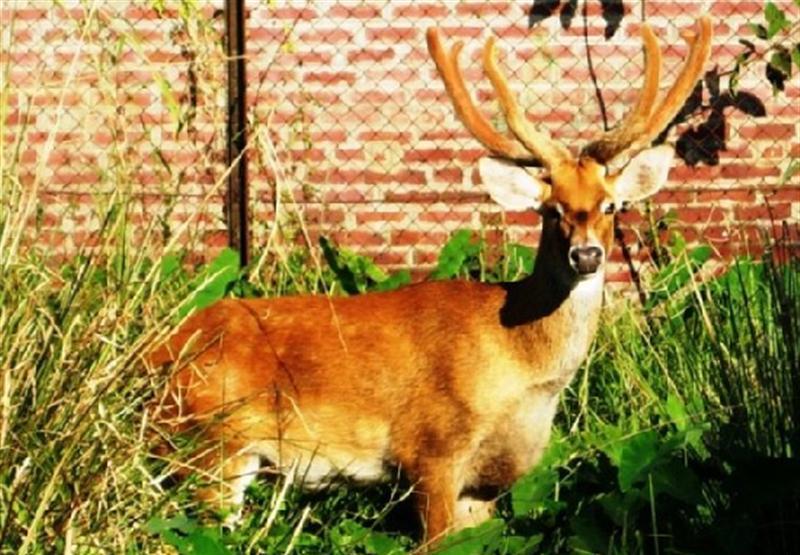

The hangul, Kashmir's red deer, survives in Dachigam National Park above Srinagar, along the Dagwan river, and in a few nearby forests; its numbers fell to a few hundred and remain dangerously low. The Sikkim stag, or shou, a close relative, is almost gone. The sangai lives only on the floating phumdis of Keibul Lamjao, at the edge of Loktak Lake in Manipur, fed by the Manipur river. The musk deer lives in Himalayan forests of birch and rhododendron, in Uttarakhand's Kedarnath sanctuary along the upper Mandakini river, and in the Himalaya of Himachal, Sikkim and Arunachal. The Tibetan antelope, or chiru, crosses into India only on the cold plateau of Ladakh's Changchenmo valley and the area around Daulat Beg Oldi, at over five thousand metres.


The antelopes are animals of open country. Blackbuck graze in Velavadar in Gujarat, Tal Chhapar in Rajasthan, Point Calimere in Tamil Nadu, where they share coastal grassland and salt marsh with flamingos, Ranebennur in Karnataka, and around Bishnoi villages in the Thar and Haryana. The chinkara, a small gazelle, lives in the Thar desert, in the Desert National Park near Jaisalmer, and in the dry plateaus of the Deccan. The four-horned antelope hides in the dry deciduous forests of central and southern India. The nilgai lives across the north and west, from the Gangetic plain to Gujarat. Each of these places is a different India, salt flat, floodplain, desert, alpine meadow, and each deer and antelope has shaped itself to one of them.

What the deer teaches
The deer is prey, always alert, always ready to flee, and yet it is the animal that humans have most often followed into the sacred. It teaches the beauty of vigilance and renewal. And the Bishnoi of Khejarli, who embraced the trees and died for them, teach what human beings are capable of when they decide that the lives of other creatures are worth protecting at the cost of their own.

The Khejarli story did not stay in the past. In 1730, Amrita Devi and 362 other Bishnoi villagers gave their lives hugging khejri trees to stop a ruler's soldiers from cutting them down. Her example inspired later Indian environmental movements, above all Chipko in the 1970s. In the Garhwal Himalaya, when contractors came to cut forests that villages depended on, village women led by people like Gaura Devi went out and put their arms around the trees, daring the loggers to cut them first. "Chipko" means "to cling" or "to hug". The tree-huggers of the Himalaya were following the path that a Bishnoi woman in the desert had shown more than two centuries before.
India's national award for wildlife protection, the Amrita Devi Bishnoi Wildlife Protection Award, is named after her. The Bishnoi are studied around the world as one of the oldest living conservation communities: a whole people whose religion, since the fifteenth century, has included rules against cutting green trees and killing animals, and who will step in to protect the blackbuck and chinkara around their villages even at the risk of their lives.

They showed this resolve again in modern times. In 1998, while shooting a film near Jodhpur, the actor Salman Khan and others were accused of hunting blackbuck. For many people the case might have faded away. The Bishnoi did not let it. They pursued it through the courts for twenty years, until in 2018 a court convicted him and sentenced him to five years in prison (he appealed, and was released on bail). Whatever one thinks of the case, it showed something rare: a village community holding one of the most famous men in the country to account, for the sake of a deer.
The nilgai shows how belief and conflict can tangle. Its Hindi name means "blue cow", and in parts of north India many farmers would not kill it because of its supposed link to the sacred cow, even as herds of nilgai raided their crops at night. In Bihar, Haryana and Uttar Pradesh, nilgai damage has become a major complaint, and state governments have sometimes allowed culling, provoking protests. Some officials even tried renaming it rojh or ghodaroz, "horse-like", to separate it from the cow in people's minds. The episode shows that the way we name an animal can decide how we treat it.