Part Three · Hoof and Horn
Chapter 13
The Horse
The animal that carried empires, the white horse of the sacrifice, and the last wild horses that turned out not to be wild.
Assisted and Curated by Claude, Referenced and Collated by me

Equus ferus · Equus hemionus
On the steppes of Mongolia, a few thousand stocky, dun-coloured horses with dark, upright manes graze in the grass, living in small family bands. They are Przewalski's horses, named after the Russian explorer Nikolai Przhevalsky, who described them in the 1870s. For more than a century, they were celebrated as the last truly wild horses on earth, the only surviving population never domesticated. They went extinct in the wild in the late 1960s, and were saved only because a few dozen survived in zoos; carefully bred, their descendants were returned to Mongolia from the 1990s onward. Their recovery is one of conservation's triumphs.

Then, in 2018, a team of geneticists led by Ludovic Orlando published a study of ancient horse DNA that overturned the story. Przewalski's horses, they found, descended from the horses of the Botai culture of northern Kazakhstan, which some five and a half thousand years ago had been herded and probably milked by people. They were not truly wild at all. They were the feral descendants of some of the earliest horses to live with humans. And the modern domestic horse, it emerged from later studies, descends not from the Botai horses but from a different lineage, domesticated in the steppes of the lower Volga and Don rivers around 2200 BCE, which then spread with astonishing speed across Eurasia. There are, it seems, no truly wild horses left anywhere on earth.
The Przewalski's horse has a dramatic modern history. The explorer Nikolai Przhevalsky, travelling in the Gobi in 1879, was given the skull and hide of a wild horse shot by hunters, and sent them to St Petersburg, where scientists described it as a new species. In the early 1900s, the German animal dealer Carl Hagenbeck organised expeditions that captured dozens of foals, many of whom died on the journey; the survivors were sold to zoos. In the wild, hunting, harsh winters and competition with herders' livestock wore the population down, and the last confirmed sighting in Mongolia was in 1969. All the Przewalski's horses alive today descend from just twelve or so of the captured animals, and one domestic mare. Careful breeding in zoos built the population back up, and from 1992 horses were flown back to Mongolia, to Hustai National Park and the Gobi. Today there are about two thousand, several hundred of them living free. In Mongolian they are called takhi, "spirit" or "worthy of worship". The horses that were declared "not truly wild" in 2018 have nonetheless become wild again.
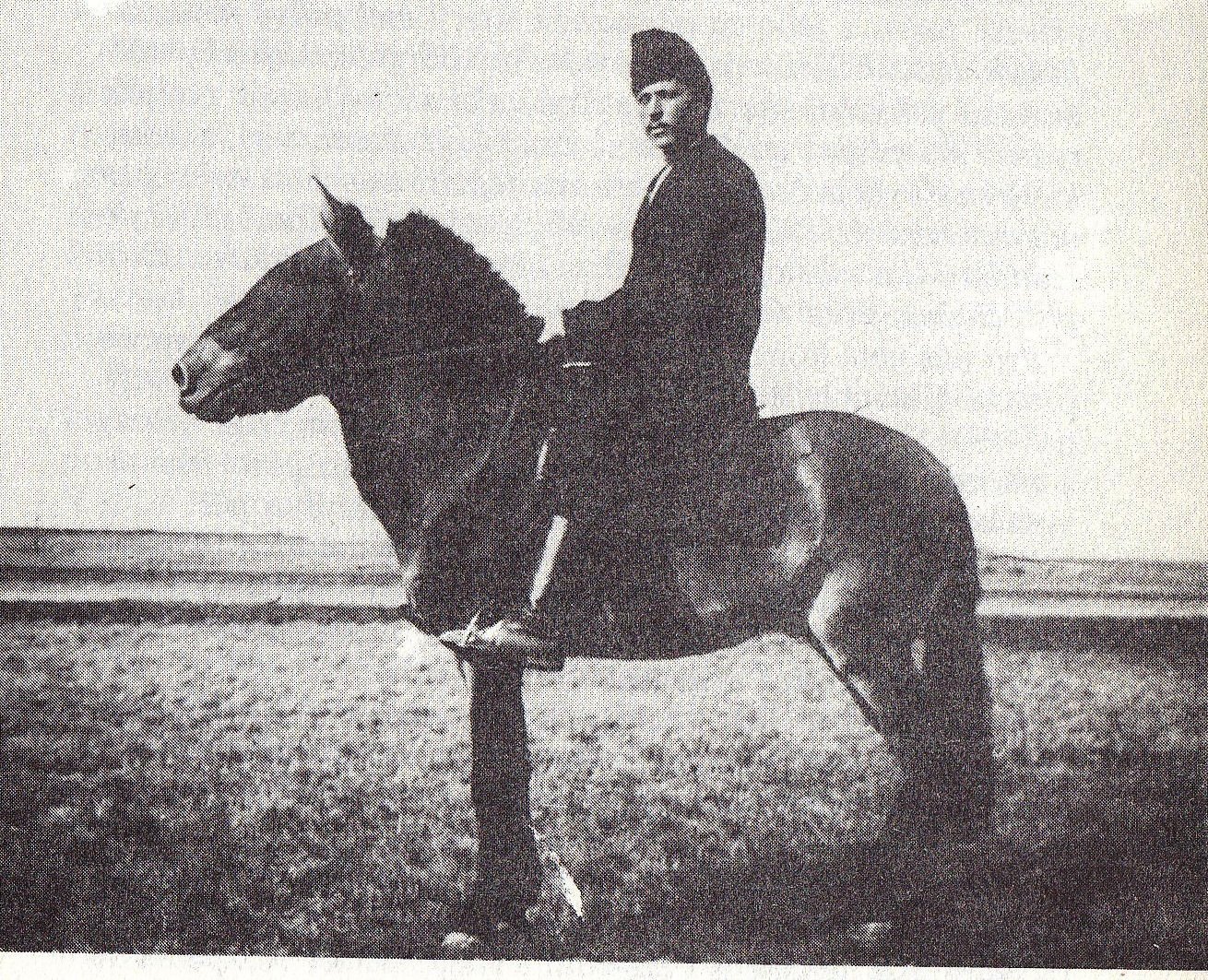
The 2018 study led by Ludovic Orlando of Copenhagen and Toulouse, and the larger 2021 study that followed, are among the great detective stories of genetics. Orlando's team collected DNA from hundreds of ancient horse bones across Eurasia. They first showed that the horses of the Botai culture in Kazakhstan, which had long been thought to be the first domestic horses, were the ancestors of Przewalski's horses, not of modern domestic horses. Then, in 2021, they traced the modern domestic horse to the western steppe around the lower Volga and Don, where a new type of horse appeared around 2200 BCE, with genes linked to a calmer temperament and a stronger back. Within a few centuries, this horse spread across Eurasia, replacing other horse populations, along with the spoke-wheeled chariot. In other words, almost every horse alive today, from Arabian racers to Marwari warhorses to Shetland ponies, descends from one population domesticated about four thousand years ago.
How horses live
Horses, wild or feral, live in bands, typically of one stallion, several mares, and their young. Contrary to the popular image of the stallion as leader, it is often an older mare who decides when and where the band moves; the stallion's role is more to guard the band and fight off rival males. Young horses leave their birth band as they mature, fillies joining other bands and colts forming bachelor groups until they can win mares of their own.
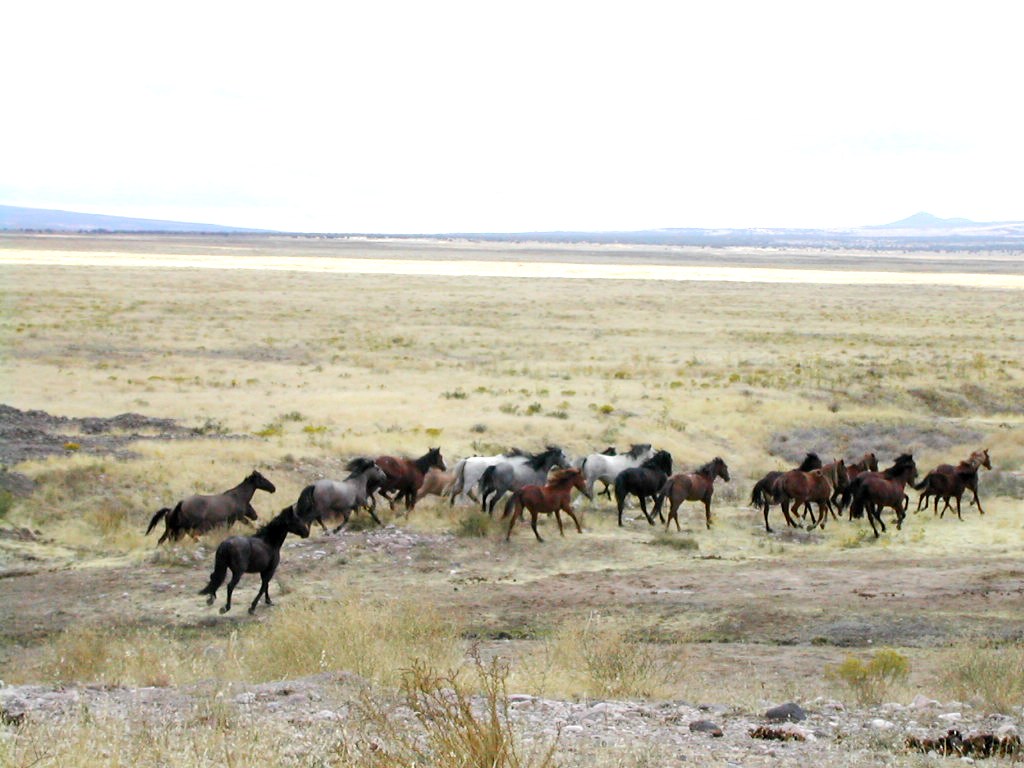
The horse is a prey animal, and almost everything about it is designed for detecting danger and escaping. Its eyes, set on the sides of its head, give it a field of vision of around three hundred and fifty degrees. It can sleep standing up, thanks to a system of ligaments and tendons, called the stay apparatus, that locks its legs without muscular effort, so that it can flee instantly if a predator approaches, though it needs to lie down for short periods of deep sleep. Horses communicate through a rich vocabulary of body language: the position of the ears, the tension of the lips, the swish of the tail, and a range of whinnies, nickers, and snorts. A 2016 study found that horses can recognize angry and happy human facial expressions and respond to them.
India has its own wild equid, the Indian wild ass, or khur, which survives in the salt desert of the Little Rann of Kutch in Gujarat. Once reduced to a few hundred animals, its population has recovered to several thousand. In the high Himalaya of Ladakh and Tibet lives the kiang, the largest of the wild asses.
There are, it seems, no truly wild horses left anywhere on earth.

Horses taught psychology one of its great lessons, and the story is a good one. In Berlin in the early 1900s, a retired schoolteacher named Wilhelm von Osten owned a horse called Hans. Von Osten claimed he had taught Hans to count, add, tell the time and even spell, and Hans would answer questions by tapping his hoof the right number of times. Crowds came to watch. Experts examined him and could find no trick. "Clever Hans" became famous across Europe.
Then, in 1907, a young psychologist named Oskar Pfungst tested him more carefully. He found that Hans got the answers right only when the person asking knew the answer, and only when Hans could see that person. What was happening was this. As Hans tapped, the questioner, without meaning to, would lean forward slightly and tense up. When Hans reached the right number, the questioner would relax very slightly, perhaps lift his head or let out a breath. Hans had learned to read these tiny, unconscious signals and stop tapping. He could not do sums. But he was doing something remarkable all the same: reading human body language far more finely than most humans can. Von Osten was not lying. He truly believed in his horse, and did not know he was giving the answers away.
The "Clever Hans effect" is still taught as a warning in every science. When we expect a certain result, we can bring it about without knowing it, through tiny cues in how we ask, look and react. This is why good experiments are done "blind", so that the people running them do not know which answer they are hoping for. A horse in Berlin is the reason.

Freud also had a Hans. His case of "Little Hans" (1909) was about a five-year-old boy in Vienna who became terrified of horses, especially of a horse falling down in the street and biting him. Freud traced the fear back to the boy's feelings about his father, a powerful figure he loved and feared at the same time, whom the big, strong horse seemed to stand for. Whatever one thinks of Freud's reading, it shows again how animals give shape to feelings children cannot yet put into words.
And there is the story told about the philosopher Friedrich Nietzsche. In January 1889, in the Italian city of Turin, he is said to have seen a cab driver beating a tired horse in the street. He ran to the horse, threw his arms around its neck and wept, and then collapsed. He never recovered his mind, and spent the last eleven years of his life in silence, cared for by his mother and sister. No one knows if the story happened just like this. But it has lasted because it is such a strange picture: the philosopher of strength and the "will to power", undone by pity for a beaten horse. The Hungarian director Béla Tarr made a slow, dark film, The Turin Horse (2011), imagining what happened to that horse and its poor owners afterwards, over six days as the world seems to wind down around them.

The Clever Hans affair began in Berlin around 1900. Wilhelm von Osten, a retired schoolteacher, believed animals could think like humans and spent years teaching his Russian trotting horse, Hans, arithmetic, reading and music. Hans answered questions by tapping his hoof: three taps for three, and so on. He seemed to add, subtract, tell the time, and even spell words. Crowds came to see him, and in 1904 a commission of experts, including a circus manager, zoologists and a psychologist, examined him and found no trickery. Then a young psychologist, Oskar Pfungst, ran careful experiments. He found that when the questioner did not know the answer, or stood out of the horse's sight, Hans failed. Hans was watching the questioner's face and body: as he approached the right number of taps, people relaxed, or slightly raised their heads, without knowing it, and Hans stopped. Von Osten never accepted the result. But Pfungst's work became a classic lesson: researchers can accidentally signal the answers they expect. Modern science's "double-blind" tests, in which neither tester nor subject knows the correct answer, owe something to Hans. And Hans himself was clever in a real way: he had learned to read tiny human gestures with astonishing accuracy, which is exactly what horses do with each other.
Freud's "Little Hans" was a five-year-old Viennese boy, Herbert Graf, son of the music critic Max Graf, a friend of Freud's. In 1908, after seeing a horse collapse in the street, the boy became terrified that a horse would bite him or fall down, and refused to go outside. His father wrote detailed letters to Freud, who saw the boy only once. Freud interpreted the fear as a disguised fear of the father, part of what he called the Oedipus complex, the horse's black muzzle standing for the father's moustache. Critics have pointed out that the boy had actually seen a frightening accident, and that a simpler explanation would do. Herbert Graf grew up to become a well-known opera director in New York. Whatever we think of Freud's reading, the case shows how big the horse loomed in city life before cars: a powerful, unpredictable animal on every street.
The story of Nietzsche's horse comes from a single account, published years after his death and possibly embellished. According to it, on 3 January 1889, in the Piazza Carlo Alberto in Turin, Nietzsche saw a cab driver beating his horse, rushed to it, threw his arms around its neck and burst into tears, then collapsed. He never recovered his mind, spending the remaining eleven years of his life in the care of his mother and sister. The scene has fascinated writers because Nietzsche had famously attacked pity as a weakness. Milan Kundera, in The Unbearable Lightness of Being, wrote that Nietzsche was trying to apologise to the horse for Descartes, who had claimed animals were mere machines. Béla Tarr's film The Turin Horse (2011), in black and white, with very few words, follows the cab driver and his daughter on their remote farm over six days, as the horse refuses to eat or move and their world slowly winds down to darkness. It is one of the bleakest and most beautiful films about the bond between humans and animals.

Horses read human faces, as the main text says. In 2016, researchers at the University of Sussex showed horses photographs of human faces that were angry or happy; when they saw angry faces, their heart rates rose and they looked at the photos mostly with their left eye, which sends information to the side of the brain that processes threats. Later work found that horses remember a person's expression and treat that person differently hours later. This sensitivity is one reason horses are used in therapy for people with trauma, autism and other conditions: the horse reacts honestly to the feelings a person shows, and people learn to calm themselves to calm the horse.
The Indian wild ass, or khur, gives the horse family a distinctly Indian story. Once found across the dry northwest, it was reduced by the 1960s to a single population in the Little Rann of Kutch, a vast salt flat in Gujarat that floods in the monsoon and bakes in summer. A disease outbreak in the 1960s killed many, and numbers fell to about 360 by 1969. The Wild Ass Sanctuary was created in 1973. Since then, numbers have risen to over six thousand by the 2020 census, and khur have spread beyond the sanctuary into surrounding farmland, where they sometimes raid crops. The khur can run at over fifty kilometres an hour, and the Rann's salt workers, the Agariyas, who live and work on the flats for eight months a year making salt by hand, see them often. The khur shows that the wildness the domestic horse lost survives, in its cousins, in some of India's harshest landscapes.
The horse's India
India's wild equids live in its harshest places. The Indian wild ass, the khur, lives in the Little Rann of Kutch, a 5,000-square-kilometre salt flat between Kutch and mainland Gujarat, flooded each monsoon by the Banas, Rupen and Saraswati rivers and by sea water, then dried into a cracked white plain in summer. Small raised islands of grass, called bets, give the khur food and shelter when the flat is flooded. The kiang lives on the Changthang plateau of eastern Ladakh, around Tso Moriri, Tso Kar and Hanle, at over four thousand metres, in herds that can number dozens.


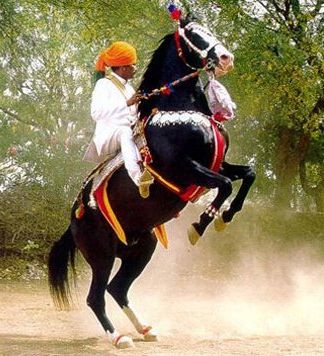
India's horse breeds are tied to regions. The Marwari horse, with its curved ears, comes from Marwar in western Rajasthan, the Kathiawari from Saurashtra in Gujarat, and both were bred by Rajput and Kathi warriors for endurance in the desert. The Manipuri pony, small and quick, was the horse of sagol kangjei, the Manipuri game from which modern polo is descended; British officers learned polo in Manipur and Assam in the nineteenth century, and the Mapal Kangjeibung in Imphal is often called the oldest polo ground in the world. The Spiti horse and the Zanskari pony, hardy and sure-footed, carry loads on Himalayan passes; the Bhutia pony works in Sikkim. The Pushkar fair, beside Pushkar lake, and the Tilwara fair near Balotra, held in the dry bed of the Luni river in Rajasthan, are among the great horse and camel markets of India.


The horse and the empire
No animal has changed human history more than the horse. It gave human beings speed, range, and military power that no foot soldier could match. The spread of the domestic horse and the light, spoke-wheeled chariot around four thousand years ago transformed warfare across Eurasia, from Egypt and Mesopotamia to China and India. Horse-riding pastoralists of the steppe, the Scythians, the Huns, the Turks, and the Mongols, built some of the largest empires in history. The Mongol empire of the thirteenth century, the largest contiguous land empire ever, was built on horseback.

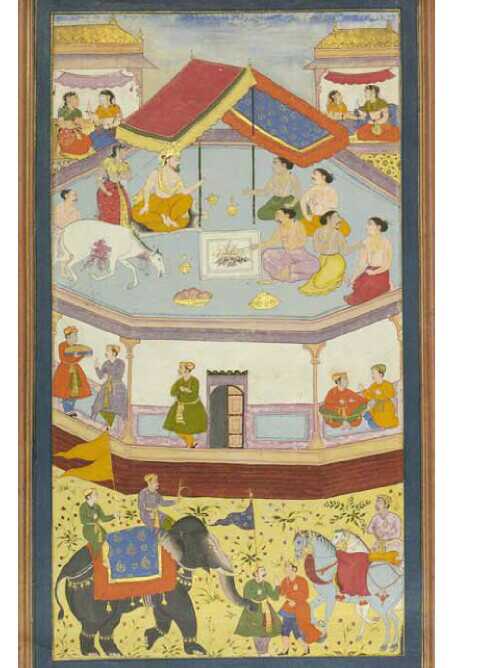
The horse is sacred in the traditions of almost every people who rode it. In the Rigveda, horses draw the chariot of the sun god Surya, seven of them, and the divine twins, the Ashvins, whose name means "horsemen," are healers and rescuers. The Ashvamedha, the horse sacrifice, was the greatest of the Vedic royal rituals: a consecrated stallion was released to wander for a year, followed by an army, and any territory it entered without resistance was claimed by the king; at the end of the year, it was sacrificed in an elaborate rite. The horse Uchchaihshravas, white and seven-headed, emerged from the churning of the ocean, and became the mount of Indra. Vishnu's final incarnation, Kalki, will come at the end of this age on a white horse, sword blazing, to destroy evil and begin a new cycle. Hayagriva, the horse-headed form of Vishnu, is the god of knowledge who recovered the Vedas from the demons who had stolen them.
The Buddha, on the night he renounced his palace, rode out on his beloved horse Kanthaka, who, according to legend, died of grief when his master sent him back. The Rajput hero Maharana Pratap's horse Chetak, wounded at the battle of Haldighati in 1576, is said to have carried him to safety before collapsing; a memorial to the horse stands at the site. The Marwari and Kathiawari horses of western India, with their distinctive inward-curving ear tips that sometimes touch at the top, were bred by Rajput and other warrior communities and prized for their courage and endurance.
The horse's rise is written in the ground. At Sintashta, in the steppes of southern Russia, archaeologists have found graves about four thousand years old in which people were buried with chariots, two-wheeled carts with spoked wheels, along with the horses that pulled them. These are among the oldest chariots known. The light, fast chariot drawn by horses changed warfare across Asia and Europe, and the people who mastered it spread widely.
At Sinauli in Uttar Pradesh, archaeologists in 2018 uncovered burials of about the same age with wooden-wheeled carts or chariots, alongside swords, shields and helmets. It was an exciting find for Indian archaeology, and it raised questions about who these people were and how they lived. Whether horses pulled these carts is still being debated, since no horse bones were found with them; they may have been drawn by cattle. Questions like this matter, because the arrival of the horse in India is tied up with big arguments about history and language. The honest answer, for now, is that we do not yet know.

Later, the horse became a symbol of the sun and of royal power. The Sun Temple at Konark in Odisha, built in the thirteenth century, is designed as the sun god Surya's enormous chariot, with twenty-four carved stone wheels and seven horses straining to pull it across the sky. The seven horses are often linked with the seven days of the week, or the seven colours of light, and the wheels with the hours or the months: the whole temple is a picture of time, carried along by the sun. At Srirangam and Hampi, halls are filled with carved pillars of rearing horses, with riders spearing tigers and warriors at their feet, images of strength and royal glory.
In the villages, the horse has its own religion. In Tamil Nadu, huge terracotta horses, some taller than a house, stand outside the shrines of Ayyanar, the guardian god of the village. People believe he rides out at night on these horses to patrol the boundaries and keep away disease, thieves and evil spirits, so villagers offer him new clay horses when a prayer is answered. In Gujarat and Rajasthan, Bhil and other communities also offer clay horses to their gods. The Rathwa Bhils of Gujarat paint Pithora murals on the walls of their houses, bright paintings crowded with horses, riders, animals and people, made for the god Pithora's wedding procession and to bring blessings to the home.

At the Pushkar fair in Rajasthan, held each year around the full moon of Kartik, Marwari horses with their curved, inward-touching ears are shown, traded and raced alongside thousands of camels. Far to the north, in Mongolia, the great Naadam festival still centres on horse races across the open steppe, ridden by children, because they are light. For the people of the steppe, the horse was simply life.
Some Indian horses have become legends. Chetak, the horse of Maharana Pratap of Mewar, is remembered for the battle of Haldighati in 1576. Wounded, he is said to have carried his master to safety across a stream, and then died. Shyam Narayan Pandey's Hindi poem Haldighati tells the story, and its lines about Chetak's speed and loyalty are learned by heart by schoolchildren across north India. And Indian audiences of every age remember Dhanno, the tonga mare of the chatterbox Basanti in Sholay (1975), who gallops for her life in one of Hindi cinema's best-loved chases.

India's horse history has a special puzzle: the horse is not native to the subcontinent in its domestic form, and Indian rulers spent huge sums importing horses for most of history. Horses do not breed well in the hot, humid plains, so for centuries kings bought them from Central Asia, Persia and Arabia. In the time of the Vijayanagara empire, Portuguese and Arab merchants shipped thousands of horses a year to the ports of the west coast, and the kings of Vijayanagara and the Deccan Sultanates competed for them. The Portuguese captured Goa in 1510 partly to control this horse trade. The traveller Domingo Paes described Vijayanagara's horse markets and the rearing stone horses carved in its temples. The great carved horses of the Vittala temple at Hampi and the Sesharaya mandapa at Srirangam, rearing on their hind legs with riders spearing tigers, are monuments to an age when the warhorse was the most precious and most foreign creature in the kingdom.
The question of the horse in the Indus Valley and the Rigveda is one of the most heated arguments in Indian history. The Rigveda, composed in the northwest of the subcontinent from about 1500 BCE, is full of horses and chariots: the horse is praised, sacrificed, prayed to. Yet the Indus cities, a thousand years earlier, have yielded almost no clear horse bones, and their seals show bulls, elephants and tigers, but not horses. Most historians and geneticists conclude that the domestic horse arrived in South Asia with steppe peoples speaking early Indo-European languages around the second millennium BCE, the same time the steppe horse was spreading across Eurasia. Others argue for a much older native presence. The Sinauli finds of 2018, with their wooden carts and copper-covered wheels, added fuel to the debate: their excavators called them chariots, while many other scholars say they were solid-wheeled carts possibly pulled by cattle. The argument is about more than horses. It touches on questions of origins and identity that remain politically charged in India.

The Ashvamedha, the great horse sacrifice, deserves more explanation. It was the grandest of Vedic royal rites, described in detail in texts like the Shatapatha Brahmana. A white stallion was consecrated and released to wander for a year, guarded by four hundred young warriors. Any king through whose land it passed had to submit or fight. At the end of the year, the horse was brought back and sacrificed in a ceremony lasting several days, involving the king's queens in rituals that later commentators found shocking. Kings who performed it claimed to be universal rulers. In the Ramayana, Rama's Ashvamedha horse is captured by two boys, Lava and Kusha, who turn out to be his own sons; the confrontation leads to the recognition of Sita. Historical kings performed it too: the Gupta emperor Samudragupta in the fourth century issued gold coins showing the sacrificial horse to celebrate his Ashvamedha. Some scholars see in the ritual a very old Indo-European rite; Irish and Roman texts also describe royal horse sacrifices.
Chetak's story comes from the battle of Haldighati in June 1576, between Maharana Pratap of Mewar and the Mughal army of Akbar, led by Raja Man Singh of Amber. The battle was fought in a narrow pass in the Aravalli hills. According to tradition, Chetak, wearing an elephant's trunk mask to frighten the Mughal war elephants, reared up so that Pratap could strike at Man Singh on his elephant; the elephant's tusk-blade wounded Chetak's leg. Badly hurt, Chetak carried Pratap out of the battle and leapt across a stream before collapsing and dying. A small memorial, the Chetak Smarak, stands near the pass. Historians cannot confirm all the details, but the story became central to Rajput pride and to Indian nationalism. Shyam Narayan Pandey's long poem Haldighati (1939) made it famous, and its lines on Chetak, describing the horse moving as fast as the wind, so fast that the enemy could not see him, are among the most recited in Hindi.

The terracotta horses of Tamil Nadu are among the largest clay sculptures in the world. In villages across the state, Ayyanar, the guardian god, stands at the edge of the village with his attendants, and devotees give him horses, sometimes five or six metres high, made by potters of the Velar community, so that he can ride out at night to patrol the boundaries and protect the village from evil spirits. Every few years, new horses are made and old ones are left to crumble back into the earth. In Gujarat, the Rathwa Bhils' Pithora paintings are made as vows, when a family asks the god Pithora for help in illness or trouble. A trained painter, the lakhindra, covers the main wall of the house with rows of brightly coloured horses, the horses of the gods coming to the wedding of Pithora, in a ceremony accompanied by music and a priest's chanting. Horses here are not warhorses at all, but spirit-horses, carriers of gods between worlds, very close to Odin's Sleipnir.
Winged horses and the white horse on the hill
In Greece, Pegasus, the winged horse, sprang from the neck of Medusa when Perseus beheaded her, and struck the ground with his hoof to create the spring of the Muses. Poseidon, god of the sea, was also the god of horses, and waves are still called "white horses." In Norse myth, Odin rides the eight-legged horse Sleipnir, which carries him between the worlds, even to the land of the dead. The Celtic goddess Epona, protector of horses, was worshipped across the Roman empire by cavalrymen.

On a chalk hillside in Oxfordshire, in England, the Uffington White Horse, a stylized horse over a hundred metres long cut into the turf and filled with chalk, has been maintained by local people for about three thousand years. It survives only because, generation after generation, people have climbed the hill to scour it clean; left alone, it would be grassed over within decades. It is a monument not only to the horse but to continuity, to the willingness of a community to keep caring for a sacred image across three millennia.

The Uffington White Horse has been dated, using a technique that measures when soil was last exposed to sunlight, to between about 1380 and 550 BCE, making it a Bronze Age or early Iron Age creation. Its long, flowing lines, more like a modern abstract drawing than a realistic horse, have inspired artists for centuries. For most of its history, local people held a "scouring" festival every few years to clean it, with games, cheese-rolling and feasting; the novelist Thomas Hughes described one in The Scouring of the White Horse (1859). During the Second World War, it was covered with turf so that German pilots could not use it as a landmark. Today the National Trust organises volunteers to re-chalk it. Some think it may not be a horse at all, but a dragon; nearby is Dragon Hill, where, legend says, Saint George killed the dragon. Either way, its survival is a lesson in community: three thousand years of people deciding, again and again, that this image was worth keeping.

Pegasus's story connects to the larger Greek world of horses and the sea. Poseidon, god of the sea and of horses, was Pegasus's father, and the winged horse sprang from the neck of the Gorgon Medusa when the hero Perseus cut off her head. Later, the young hero Bellerophon tamed Pegasus with a golden bridle given by Athena, and rode him to kill the Chimera, a fire-breathing monster. But when Bellerophon tried to ride Pegasus up to Mount Olympus, the home of the gods, Zeus sent a gadfly to sting the horse, and Bellerophon fell to earth, lame and blinded, wandering alone for the rest of his life. Pegasus flew on and became a constellation. The story is a warning against pride, the Greek hubris: the horse may carry us high, but not as high as the gods.

Horses with wings and horses of the sun appear across Asia too. The Buddha's horse Kanthaka, after carrying him out of the palace on the night of his renunciation, is said to have died of grief and been reborn as a god. In Tibetan Buddhism, the lungta, the "wind horse", is a symbol of good fortune: prayer flags printed with a horse carrying a flaming jewel on its back flutter on mountain passes across the Himalaya, including in Ladakh, Sikkim and Arunachal, so that the wind carries the prayers across the world. In Chinese legend, the "heavenly horses" of Ferghana in Central Asia, said to sweat blood, were so prized that the Han emperor Wu sent armies across the deserts around 100 BCE to obtain them. The famous bronze "Flying Horse of Gansu", found in a tomb in 1969, shows a horse galloping so fast that one hoof rests on a flying swallow. Wherever people rode horses, they imagined horses that could fly.
What the horse teaches
The horse, a creature designed by evolution to flee, became the animal on which humans rode into battle. That partnership between a prey animal and a predator is one of the strangest in nature. It depended on trust built slowly, and on human understanding of the horse's fears and signals. The earliest cave painters painted horses more than any other animal; at Chauvet and Lascaux, they gallop across the walls. Thirty thousand years later, the horse remains the animal most often painted, sculpted, and celebrated in human art, and yet its wild ancestors are gone. The horse gave humans the world, and lost its own wildness in the giving.

Writers have often given the horse the moral high ground. In the last part of Jonathan Swift's Gulliver's Travels (1726), Gulliver reaches a land ruled by the Houyhnhnms, wise, calm, truthful horses who live by reason and have no word for a lie. In the same land live the Yahoos, filthy, greedy, quarrelling creatures who are, Gulliver realises with horror, human beings. When he finally goes home to England, he can barely stand the smell of his own family, and spends his time talking to the horses in his stable. Swift was using the horse to hold up a mirror to humanity, and it is not a flattering one.
Anna Sewell's Black Beauty (1877) is told by the horse himself, from his happy youth to years of hard work as a cab horse in London, and finally to a kind home. Sewell wrote it, she said, to make people kinder to horses, and it worked. It showed readers the suffering caused by things like the "bearing rein", a strap that held horses' heads painfully high for fashion, and helped bring changes in how working horses were treated. It may be the most influential animal book ever written. Leo Tolstoy's story "Strider" is also told by an old horse, a piebald gelding who has been sold and resold all his life. He cannot understand why humans keep calling him "my horse". What does "my" mean? Through the horse's puzzled eyes, Tolstoy questions the whole idea of owning living beings.
Peter Shaffer's play Equus (1973) is about a psychiatrist trying to understand a teenage boy who blinded six horses in a stable. As he slowly uncovers the boy's story, he finds that the boy had made the horses into gods, worshipped them with a private, passionate, terrifying religion, and then lashed out in shame. The psychiatrist can "cure" him, but he begins to envy the boy: he himself has never felt anything so intensely. The play asks whether making people normal also takes away something wild and precious in them.
Steven Spielberg's War Horse (2011), based on Michael Morpurgo's novel, follows a farm horse called Joey who is sold to the army in the First World War and passes through the hands of British, German and French people, each of whom cares for him for a while. Millions of horses died in that war. Through Joey, the story shows the war from outside any one side, and shows how the same animal could draw kindness out of enemies.

Swift's Houyhnhnms are one of the sharpest satires ever written. In the fourth part of Gulliver's Travels, Gulliver lands in a country ruled by horses who live by pure reason, have no word for lying, and cannot understand war, greed or lawyers. They keep, as beasts of burden, a race of filthy, greedy, quarrelsome creatures called Yahoos, who turn out to be humans. When Gulliver explains European society to his Houyhnhnm master, the horse concludes that humans are Yahoos with a little reason, which they use mainly to make themselves worse. Gulliver returns home so disgusted with humankind that he cannot bear his own family and spends his days talking to his horses in the stable. Swift, writing in 1726, used the horse to hold up a mirror to human pride.
Anna Sewell wrote Black Beauty in the last years of her life, while she was seriously ill, and it was published in 1877, five months before she died. She had been lame since childhood and depended on horse-drawn carriages, which made her sensitive to how horses were treated. The novel is told by the horse himself, from his happy youth through years of hard work and cruelty as a London cab horse, to a peaceful old age. Its targets were real practices: the "bearing rein", which held horses' heads painfully high for fashion, overworking, and beating. The book sold millions of copies and helped lead to campaigns against the bearing rein, and is often called the most influential animal-welfare novel ever written. Like Tolstoy's "Strider", narrated by an old piebald gelding who reflects on how humans use words like "my" to claim ownership of other beings, it asks the reader to see the world through a horse's eyes.
Peter Shaffer's Equus is based on a real crime Shaffer heard about: a seventeen-year-old stable boy in England who blinded six horses. In the play, a psychiatrist, Martin Dysart, tries to understand the boy, Alan Strang, and discovers that Alan has made the horses into gods, worshipping a deity he calls Equus, and that his crime came from a terrible clash between this private religion, his parents' strict beliefs and his own awakening sexuality. As Dysart "cures" the boy, he wonders whether he is also destroying the only passion Alan has, and envies the boy's capacity for worship, which his own dull life lacks. The play, first staged in 1973, asks what we lose when we make people "normal", and shows the horse as one of humanity's oldest objects of awe. Spielberg's War Horse (2011), from Michael Morpurgo's novel and the celebrated stage play with life-size puppet horses, tells a gentler story, of a farm boy and his horse Joey separated by the First World War, in which some eight million horses died on all sides.
The camel, the horse's desert partner, deserves a word too, because in western India it often took the horse's place. The Raikas or Rebaris of Rajasthan have bred camels for centuries, and the Pushkar fair began as a camel and cattle market linked to a pilgrimage to the town's Brahma temple. The Bikaner Camel Corps, raised by the Maharaja of Bikaner, fought in the First World War, and India's Border Security Force still patrols the Thar desert on camels and leads the Republic Day parade with its camel contingent. But Rajasthan's camel numbers have fallen sharply, from about a million in the 1980s to under three hundred thousand by 2019, as roads and tractors replaced them. In 2014 the camel was declared Rajasthan's state animal. Like the horse, the camel shows how quickly an animal that shaped human history can be left behind when machines take over its work.
