Part One · The Hunters
Chapter 2
The Lion
The only cat that lives in families, the emblem of kings, and a last Asian stronghold in the dry forests of Gujarat.
Assisted and Curated by Claude, Referenced and Collated by me

Panthera leo
The national emblem of India is a lion. More precisely, it is four lions, standing back to back on a round abacus, carved from polished sandstone in the third century BCE for the emperor Ashoka and set on top of a pillar at Sarnath, near Varanasi, the place where the Buddha preached his first sermon. On the abacus beneath the lions run an elephant, a bull, a horse, and a lion, separated by wheels of dharma. The Buddha's teaching was called, in early Buddhist texts, the simhanada, the lion's roar: a proclamation of truth so powerful that it silences all other voices, as the roar of a lion silences the forest. Ashoka's lions face the four directions, roaring the dharma to the world.
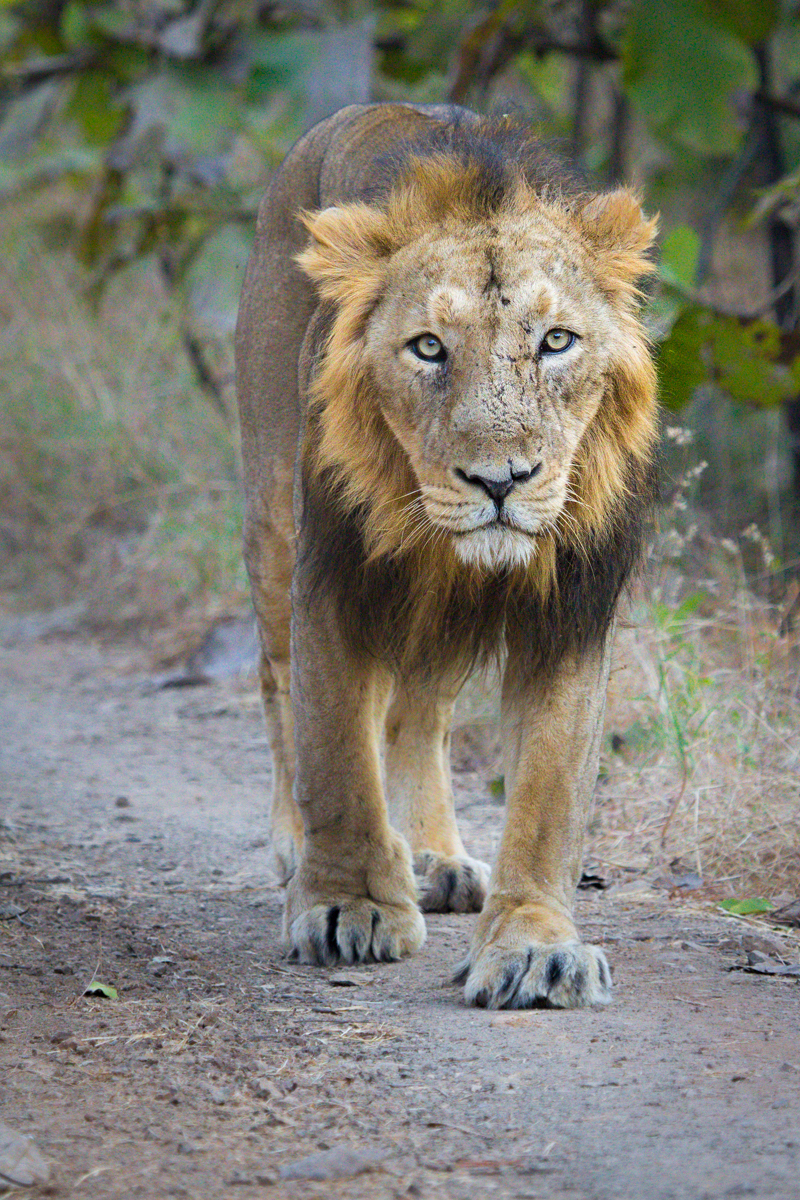
It is a nice irony that the lion, an emblem of royalty on three continents, is the most democratic of the cats. It is the only one that lives in true social groups. To understand why kings loved the lion, it helps to understand how lions actually live.
The pride
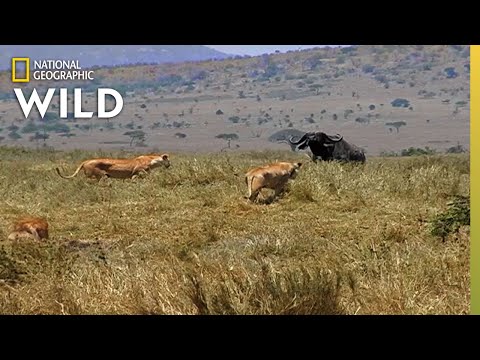
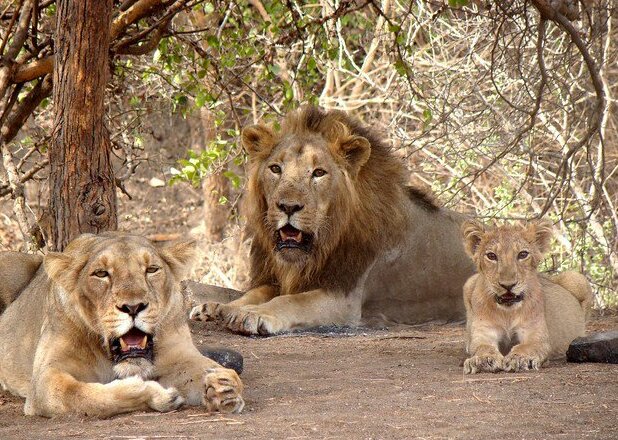
A lion pride is, at its core, a sisterhood. It consists of a group of related females, mothers, daughters, sisters, aunts, and cousins, typically between two and a dozen or more, who stay together for life on a territory they inherit from their mothers. With them live their cubs, and a coalition of one or more adult males, often brothers, who have won control of the pride from previous males. The females do most of the hunting, often cooperatively, some circling around prey and driving it toward others waiting in ambush. The American biologist Craig Packer, who studied the lions of the Serengeti for decades, found that the females' main reason for living in groups was not hunting efficiency but defence: of their territory against neighbouring prides, and of their cubs against invading males.

That defence is necessary because of the darkest fact of lion society. When a new coalition of males takes over a pride, they usually kill the young cubs sired by the previous males. This brings the mothers back into breeding condition quickly, so that the new males can father cubs of their own during their brief reign, which typically lasts only two or three years before younger males overthrow them in turn. Infanticide is not an aberration in lion life. It is a structural feature, and much of female lion behaviour, from synchronized breeding to communal nursing in shared crèches, can be understood as a defence against it.
The male's great mane, which appears in no other cat, seems to function as an honest signal. Packer and his colleague Peyton West, using life-sized model lions with different manes, found that females preferred males with darker manes, and that other males were more cautious of them. Darker manes were associated with higher testosterone, better nutrition, and greater fighting ability. The mane, in other words, is a crown, and it tells the truth about the one who wears it.
A lion pride is, at its core, a sisterhood. The males are temporary kings.
The lion's family life, a group of lionesses ruled over, it seems, by a great maned male, has long been read as a picture of power. Philosophers and poets have used the lion to think about what it means to be strong, and what strength is for. Two of these readings are worth taking slowly, because they say something deep in very few words.
The first comes from the German philosopher Friedrich Nietzsche. In his book Thus Spoke Zarathustra (1883), written almost like a book of scripture, he describes "three changes of the spirit", three stages that a person may pass through on the way to becoming truly free. First the spirit becomes a camel. The camel kneels down and asks to be loaded. It carries every duty, every rule, every "thou shalt" that its parents, teachers, religion and society place on it. It is strong, patient and obedient, and it carries all this weight out into the desert.
Then, in the loneliest desert, the camel turns into a lion. The lion meets a great dragon whose scales are covered in golden words, and every word says "Thou shalt." The lion's answer is "I will." This is the stage of rebellion, of saying no. It is the teenager who stops accepting everything he was told, the worker who refuses an unjust order, the thinker who questions what everyone else takes for granted. Nietzsche is clear that this stage is necessary. You cannot make your own life while you are still only carrying other people's loads. But he is also clear that the lion is not the end. The lion can tear down. It cannot build anything new. Its freedom is only freedom from something.

So the lion must become a child. The child, Nietzsche says, is "innocence and forgetting, a new beginning, a game, a self-propelled wheel, a sacred Yes." A child at play is not obeying anyone and is not rebelling against anyone either. It is simply making something, freely and wholeheartedly, as if for the first time. That is the final stage: not carrying, not fighting, but creating. Many people get stuck as camels, doing what they are told for their whole lives. Others get stuck as lions, always angry, always against something. Nietzsche's picture asks us to move through both and come out the other side, able to say yes to a life we have made our own.
The second reading comes from alchemy, the old art that tried to turn ordinary metals into gold, and which Carl Jung studied closely late in his life. Jung noticed that the alchemists' strange pictures, full of kings and queens, dragons, birds and lions, looked a great deal like the dreams of his patients. He came to believe the alchemists were not only doing chemistry. Without knowing it, they were also describing the inner work of a person growing into wholeness, projected onto the metals in their flasks.
One of their most startling pictures is the "green lion" devouring the sun. The lion is green because it is raw and unripe, like green fruit: nature in its crude, greedy, untamed state. The sun is gold, light, consciousness, the clear and reasoning part of the mind. So the picture shows raw, hungry nature swallowing our light. For Jung this was a stage that every person must go through, not something to be avoided. There are times in life when strong desires, passions or moods seem to swallow our good sense whole. The alchemists' point, and Jung's, is that this is not the end. In the pictures, the swallowed sun is not lost: it is changed inside the lion and comes out again, often as gold or as blood that heals. What swallows us can also transform us, if we live through it with our eyes open. Both Nietzsche and the alchemists, in very different ways, used the lion to say the same thing: raw power is a stage on a journey, not the place to stop.
Craig Packer's work in the Serengeti deserves its own story, because it changed how scientists think about lions. Packer arrived in Tanzania in the 1970s to study baboons and was drawn into a lion project begun in 1966 by George Schaller, the same biologist who first studied tigers in Kanha. The Serengeti Lion Project has followed the same prides for more than fifty years, recording births, deaths, fights and takeovers, generation after generation. One of its biggest surprises was that lions do not hunt together as efficiently as everyone assumed. In many hunts, some lionesses hang back and let others do the work. Packer concluded that the main reasons lions live in groups are to defend territory and to protect cubs, not to hunt. A group of sisters can hold the best land, near rivers where prey gathers, and drive away smaller prides. Lion society, in other words, is built around real estate and child protection.
The killing of cubs by new males, which the main text calls the darkest fact of lion life, shaped almost everything about lionesses' behaviour. Females in a pride tend to give birth at about the same time, and they raise their cubs together in a group called a crèche, nursing one another's young. A crèche can defend itself against a single male far better than a lone mother can. When new males take over, mothers sometimes leave the pride with their older cubs rather than lose them. The violence is not cruelty in the human sense. It is the logic of a system in which a male has only two or three years to father cubs before he is overthrown. Seen this way, the lion's family is a constant negotiation between the interests of males, who rule briefly, and females, who stay for life.
The male lion's mane, the subject of Peyton West's experiments, has a hidden cost. In the heat of the Serengeti, a thick dark mane makes a lion hotter, and heat-stressed males produce less healthy sperm. A dark mane is therefore a signal that cannot be faked: only a truly well-fed, healthy male can afford to carry one. This is what biologists call an "honest signal", and the idea has been used to explain everything from the peacock's tail to the antlers of deer. In the Tsavo region of Kenya, where it is very hot, many males have small manes or none at all. The lions of Gir, too, usually have thinner manes than African lions, which lets you see their ears clearly.
The roar and the rest
A lion's roar can be heard up to eight kilometres away on a still night, and its function is territorial: it announces who holds the land and how many there are. Lions spend most of the day at rest, sleeping or lying up for up to twenty hours out of twenty-four, which conserves energy in a hot climate for the bursts of intense effort that hunting and fighting require. Their prey ranges from wildebeest, zebra, and buffalo in Africa to sambar, chital, and occasionally domestic cattle in India.

A lion's roar is made possible by its unusual voice box. Lions, tigers, leopards and jaguars have a ligament in the throat that can stretch, and vocal folds shaped like flat squares rather than thin bands, which let them produce very loud, low sounds without great effort. Smaller cats, including the snow leopard and the cheetah, cannot roar but can purr continuously. The roar travels so far partly because low sounds lose less energy in air. Researchers in the Serengeti found that prides answer recorded roars from strangers and judge whether to attack or retreat by counting how many voices they hear. If the strangers sound more numerous than their own group, they back off. Lions, in other words, can count, at least roughly, by ear.
Lions in India and Africa differ in small but telling ways. Asiatic lions are a little smaller, males have thinner, shorter manes, and both sexes have a fold of skin running along the belly that African lions usually lack. Their prides are also smaller, often with just two or three females, and adult males usually live apart from the females, joining them mainly to mate or share a large kill; in Africa, males tend to live with the pride. Scientists think this may be because the deer and antelope of Gir are smaller than the wildebeest and buffalo of the Serengeti, so smaller groups make more sense. Genetic studies now place the lions of India, and the extinct lions of North and West Africa, in one subspecies, Panthera leo leo, separate from the lions of East and southern Africa. The Gir lion is thus a living relative of the lions of ancient Egypt and the Roman arena.
The lion and the king
Lions once lived across Africa, the Middle East, southeastern Europe, and western and northern India. The Greek historian Herodotus recorded that lions attacked the baggage camels of the Persian king Xerxes as his army marched through Macedonia in 480 BCE. The Lion Gate at Mycenae, around 1250 BCE, is one of the oldest monumental sculptures in Europe.

In the ancient Near East, the lion was the king's animal par excellence. The Assyrian kings of the ninth to seventh centuries BCE staged royal lion hunts, in which captive lions were released into an arena and killed by the king from his chariot or on foot. The palace reliefs of Ashurbanipal at Nineveh, now in the British Museum, depict these hunts with astonishing realism and pathos: a dying lioness, her spine pierced by arrows, drags her paralysed hindquarters, still roaring. The king who kills the lion proves that he can defend his people against chaos. On the Ishtar Gate of Babylon, rows of glazed brick lions stride along the Processional Way, emblems of the goddess Ishtar.
In Egypt, the lion-headed goddess Sekhmet, "the powerful one," was sent by the sun god Ra to punish humanity; she began to slaughter so eagerly that Ra had to trick her into stopping by flooding the fields with beer dyed red to look like blood, which she drank until she fell asleep. The Sphinx at Giza has the body of a lion and the head of a king. In Greece, Heracles' first labour was to kill the Nemean lion, whose golden hide could not be pierced by weapons; he strangled it and wore its skin ever after. In the Bible, Daniel is thrown into the lions' den, the Lion of Judah is the emblem of the tribe from which David came, and Samson tears a lion apart with his bare hands.
Lions appear on the coats of arms of England, Scotland, Norway, the Netherlands, and many other lands whose people had never seen one. In China, where lions never lived, stone guardian lions stand in pairs at the gates of palaces and temples, a male with a ball under his paw and a female with a cub, their forms stylized from descriptions and gifts that travelled along the Silk Road.

The lion was there at the very start of human art. At Chauvet Cave in southern France, painters working by firelight more than thirty thousand years ago drew a whole pride of cave lions moving across the rock, heads stretched forward, as if stalking prey together. It is one of the earliest pictures of lions living as a group, and it shows that the people who made it had watched lions hunt, closely and probably with fear. Cave lions were bigger than today's lions, and they lived across Europe and Asia until the end of the Ice Age.
Fables kept the lion at the centre of moral stories. In Aesop's "The Lion and the Mouse", a lion catches a mouse and is about to eat it, but the mouse begs for mercy and the lion, amused, lets it go. Later the lion is trapped in a hunter's net and roars helplessly, and the little mouse comes and gnaws the ropes until the lion is free. The lesson is that the mighty may one day need the small, so kindness to the weak is never wasted. In the Panchatantra, a bullying lion demands one animal a day to eat. When it is the turn of a small hare, the hare arrives late and tells the lion that another lion stopped him on the way and claimed to be the true king of the forest. The furious lion demands to see this rival, and the hare leads him to a deep well. The lion looks down, sees his own reflection roaring back at him, leaps in to fight it, and drowns. The weak defeat the strong with wit, and the bully is destroyed by his own pride.

In India, the lion became above all the animal of kings and of the dharma. In the third century BCE, the emperor Ashoka, who had turned against war after the bloody conquest of Kalinga, set stone lions on top of the tall polished pillars that carried his messages of moral law, at Sarnath, Vaishali and Lauriya Nandangarh. The four lions of Sarnath, standing back to back and facing the four directions, are now the emblem of the Republic of India. They were meant to announce the Buddha's teaching in every direction, as a lion's roar carries across the land. Lions guard the gateways of the great stupa at Sanchi, and at the Sun Temple of Konark, huge stone lions stand on top of elephants, an image of royal might, the king's power over even the greatest of beasts.
Kingship and the lion are joined in one of India's best-loved story cycles, Simhasan Battisi, the thirty-two tales of King Vikramaditya's lion throne. The throne is dug up long after the old king's death, and a new king, Bhoja, tries to sit on it. Each time, one of the thirty-two statues carved on the throne comes to life and stops him by telling a story of Vikramaditya's generosity, courage and justice, then asking: are you this good? The throne is a lion throne, a simhasana, but the stories say that sitting on it takes more than power. It takes goodness. These stories have been told in nearly every Indian language.
In the twentieth century the lion kept its place at the top. C. S. Lewis made a lion, Aslan, the Christ-figure of The Chronicles of Narnia (from 1950), a lion who is both terrible and kind, who lets himself be killed in place of a traitor and rises again. And the MGM lion has roared at the start of films since the 1920s, a picture of grandeur sold to cinema audiences the world over.

Ashoka's lions deserve their full story. Ashoka was the grandson of Chandragupta Maurya, and became emperor in about 268 BCE. Eight years later, he conquered Kalinga, on the east coast, in a war so bloody that, according to his own inscriptions, a hundred thousand people were killed and many more died afterwards. Ashoka wrote that he was filled with remorse, and that from then on he would conquer only by dharma, by moral teaching. He set up pillars across his empire, carved with his edicts in Prakrit, and topped many of them with animals. The capital at Sarnath, found in excavations in 1905, is polished so finely that it shines like metal, a technique that archaeologists still admire. On 26 January 1950, the day India became a republic, the four lions of Sarnath became its state emblem, with the words Satyameva Jayate, "Truth alone triumphs", from the Mundaka Upanishad, written below. The wheel from the same capital sits at the centre of India's flag.
The story of the clever hare in the Panchatantra rewards a closer look, because it is a lesson in politics. A lion named Bhasuraka is killing animals at random, so the animals agree to send him one victim every day. When it is the hare's turn, he arrives late and explains that another lion stopped him on the way and claimed to be the true king of the forest. The furious Bhasuraka demands to see this rival, and the hare leads him to a deep well. Seeing his own reflection roaring back at him, the lion leaps in and drowns. The story teaches young princes that the strong can be beaten by the clever, that rage blinds, and that the greatest danger to a tyrant is often his own image. It travelled with the rest of the Panchatantra into Persian, Arabic and European languages.

Simhasan Battisi has a frame story as charming as its tales. King Bhoja of Dhar, an eleventh-century ruler famous for his learning, finds a buried throne said to have belonged to the legendary King Vikramaditya. The throne is held up by thirty-two statues of women. Each time Bhoja tries to sit on it, one statue comes to life and tells a story of Vikramaditya's generosity, courage or wisdom, then asks whether Bhoja could match it. Each time Bhoja admits he cannot, and steps down. The stories are a lesson about the difference between holding power and deserving it. In the 1980s, they became a popular children's television series in India.
The lion's long reign in art reaches back to the Ice Age. The Chauvet Cave in France, discovered in 1994, holds some of the finest prehistoric paintings ever found, dated to more than thirty thousand years ago. In the deepest chamber, a frieze shows a group of cave lions, larger than African lions and probably without manes, stalking towards a herd of bison. The artists shaded the lions' heads with charcoal and used the bulges of the rock to give them depth. These were real lions, which lived across Europe until about fourteen thousand years ago. When we draw the lion as a symbol of power, we are continuing a conversation that began in the dark of that cave.
The man-lion and the lion people
In the Hindu tradition, the fourth incarnation of Vishnu is Narasimha, half man and half lion. The demon king Hiranyakashipu had won a boon that he could not be killed by man or beast, by day or by night, indoors or outdoors, on the ground or in the air, by any weapon. When he tormented his son Prahlada for worshipping Vishnu, the god burst from a pillar as a being who was neither man nor beast, at twilight, which is neither day nor night, on the threshold, which is neither inside nor outside, and killed the demon on his lap, which is neither ground nor air, with his claws, which are not weapons. The myth is a meditation on the in-between spaces where divine power breaks through, and the lion, in its fusion with man, is that power.

The Sinhala people of Sri Lanka take their name from simha, the lion. According to the Mahavamsa, the Pali chronicle of the island, their ancestor Vijaya was the grandson of a lion who had carried off a princess of Vanga; his father Sinhabahu, "lion-arm," killed the lion. The lion remains on the flag of Sri Lanka. The Sikh name Singh, adopted by all male Sikhs by order of Guru Gobind Singh in 1699, means lion. The goddess Durga's mount in the classical Sanskrit texts is a lion, which she rides into battle against the buffalo demon.
The Narasimha story has been one of the most filmed episodes in Indian cinema, and it is easy to see why. It has a cruel king who thinks he cannot be killed, a child who refuses to stop praying, a father who wants to kill his own son, and a climax in which a god bursts out of a stone pillar in a body that is neither man nor beast. The Telugu film Bhakta Prahlada (1967) brought that moment, the pillar cracking, the man-lion leaping out at twilight, to millions of viewers, and the story has been filmed again and again in many languages. Part of its power is that it speaks to anyone who has felt small before a bully: it promises that no one who abuses power is ever really beyond reach, however carefully he has protected himself.
The Narasimha story is also the root of one of India's biggest festivals. In the same myth, the demon king's sister Holika, who could not be harmed by fire, sat in a bonfire with the boy Prahlada on her lap, meaning to burn him. Instead, because of his devotion, the fire spared Prahlada and consumed Holika. The bonfires lit on the night before Holi, called Holika Dahan, remember this. So when people across India light fires and then throw colours the next morning, they are celebrating, without always knowing it, the same story that ends with the man-lion bursting from the pillar.

Narasimha's worship grew especially strong in the south. At Ahobilam, in the hills of Andhra Pradesh, nine shrines are dedicated to different forms of Narasimha, and pilgrims climb through forest to reach them; local tradition says this is where the pillar split open. At Hampi, the capital of the Vijayanagara empire, a monolithic Narasimha almost seven metres high, carved in 1528 under King Krishnadevaraya, sits cross-legged with a cobra's hoods spread above him. The statue was damaged when the city was sacked in 1565, but it still dominates its enclosure. Simhachalam, near Visakhapatnam, and Yadagirigutta in Telangana are among the busiest Narasimha temples today. Why did this fierce form become so popular? One answer is that Narasimha embodies protection at the very edge of possibility. He appears when every rule seems to guarantee the victory of evil, and finds the gap between the rules. For devotees, he is the god who comes when nothing else can help.
The myth is also a small masterpiece of logic. Hiranyakashipu's boon seemed perfect because it covered every category: man and beast, day and night, inside and outside, earth and sky, weapon and bare hand. Narasimha defeats him by finding the in-between of each pair. Philosophers have pointed out that the story is a warning about rigid thinking. Categories that look complete never quite are, and the real world, like the lion-man, keeps producing things that fall between them. That is also a good description of what modern biology has done to our neat boundaries between human and animal.
The Sinhala origin story is darker than its summary suggests. In the Mahavamsa, a princess of Vanga, in Bengal, runs away and is carried off by a lion, who keeps her in his cave and fathers two children by her. When the son, Sinhabahu, grows up, he escapes with his mother and sister, and when the lion comes searching, Sinhabahu kills his own father with an arrow. His son Vijaya, a wild prince, is later exiled by sea with seven hundred followers and lands in Sri Lanka on the day, the chronicle says, that the Buddha died. The story makes the lion both ancestor and victim, a father who must be overcome for a people to begin. It is a striking contrast to the Rome story, where the wolf is a nurturing mother. Sri Lanka's flag, with a lion holding a sword, carries this ancient tale into the present.
The last lions of Asia
By the late nineteenth century, the Asiatic lion, which had once ranged across India from Sind to Bihar, had been hunted almost to extinction. Its last refuge was the Gir forest in the Saurashtra peninsula of Gujarat, then part of the princely state of Junagadh. By around 1900, the Gir lions may have numbered only a few dozen. The Nawab of Junagadh banned lion hunting in his territory, and that decision, more than any other, saved the Asiatic lion from extinction.

The Gir lions have been recovering ever since. The count of 2020 put them at around six hundred and seventy-four, and later counts have reported further growth, with lions now spreading beyond the forest into the surrounding farmland and coast of Saurashtra. They share this landscape with the Maldharis, pastoralist communities who have lived in the Gir for centuries with their buffalo and cattle, and whose livestock form part of the lions' diet. The relationship is not always peaceful, but it is remarkably tolerant, and it is one of the most striking examples of coexistence between people and large carnivores anywhere.
The Gir lions are, however, one population, and a single disease outbreak could devastate them. In 2018, a canine distemper outbreak killed more than two dozen. Conservationists have long argued that some lions should be moved to a second home. The Kuno National Park in Madhya Pradesh was prepared for them in the 1990s and 2000s, but Gujarat resisted, and in 2022 Kuno instead became the site for the reintroduction of African cheetahs to India.

In Africa, lion numbers have fallen by roughly half in recent decades, to perhaps twenty to twenty-five thousand, due to habitat loss, conflict with herders, and the loss of prey. The killing of a well-known Zimbabwean lion named Cecil by a trophy hunter in 2015 provoked worldwide outrage and drew attention to how precarious the lion's future has become.

A nawab's ban on hunting, a century ago, is the reason the Asiatic lion still exists.
Gir is a meeting place of histories. In and around the forest live the Siddi, a community of African descent whose ancestors came to Gujarat centuries ago, some as sailors and traders, many as people brought by force in the slave trade across the Indian Ocean. Over the generations they have become fully Gujarati, while keeping music and dances, like the dhamal, that still carry echoes of East Africa. Their villages, like Jambur, share the forest edge with the lions and the Maldharis. So in one small corner of India live people whose distant ancestors may have known the lions of Africa, beside the last wild lions of Asia.

In Africa, the relationship between lions and herders is changing too. Among the Maasai of Kenya and Tanzania, cattle herders like the Maldharis, young warriors once proved their courage by hunting a lion. Lions also killed cattle, and herders often killed lions in revenge. Since 2007, a project called Lion Guardians has turned that tradition around. Young Maasai men, often the very ones who might once have speared a lion, are now paid to track lions, give each one a name, warn herders when lions are near, help find lost cattle and calm angry neighbours so that no one goes out to kill. Their courage and skill is put to the service of keeping lions alive. Gir's Maldharis, who live with lions without any such programme, out of long habit and belief, are often studied as a model of tolerance: proof that people and big predators can share land if the people have reasons, of the heart or of the purse, to let them.
The Nawab of Junagadh who saved the lions was Muhammad Rasul Khanji, and later his son Mahabat Khan III. Around 1900, the Nawab invited the British Viceroy, Lord Curzon, to hunt lions in Gir. Curzon accepted, then cancelled after a newspaper letter warned that the lions were nearly extinct, and the Nawab tightened his protection. The Gir lions owe their survival to this mixture of princely pride, colonial politics and a few concerned voices. The Nawab later fled to Pakistan in 1947 after trying to join Junagadh to it, a decision rejected by most of his subjects. History remembers him harshly for that. But Gir remembers him as the man who saved the lion.

The question of a second home for the lions has become one of India's longest conservation disputes. Scientists from the Wildlife Institute of India recommended Kuno-Palpur in Madhya Pradesh in the 1990s. Twenty-four villages, mostly of the Sahariya Adivasi community, were moved out of Kuno to prepare it for lions. Then Gujarat refused to let the lions go, calling them the "pride of Gujarat". In 2013, the Supreme Court ordered the transfer to begin within six months. It never happened. Instead, in 2022, African cheetahs flown in from Namibia, and later from South Africa, were released in Kuno. Many of the moved families still ask what their sacrifice was for. The lions, meanwhile, have spread across Saurashtra on their own, into farms, coastal scrub and even the outskirts of towns, creating new chances for conflict and new demands on the tolerance of farmers.

The Siddis of Gir have their own extraordinary history. Their ancestors came from East Africa, some as traders and sailors, many as enslaved people brought by Arab and Portuguese merchants from the thirteenth century onwards. Some rose to great power: Malik Ambar, a Siddi general, ruled much of the Deccan in the early seventeenth century. The Siddis of Gujarat, around Jambur and Sirvan, are said to have been brought by the Nawabs of Junagadh. They keep the dhamal, a drum-and-dance tradition that blends African rhythm with Sufi devotion, and honour the saint Bava Gor. That a community of African origin should live today beside the last wild lions of Asia, the animal that once lived across Africa and India alike, is one of history's quiet rhymes.

The lion's Gujarat
Gir is a dry deciduous forest of teak, acacia, jamun and dhak, on the low, rocky hills of southern Saurashtra in Gujarat. Its heart is the Gir National Park and Wildlife Sanctuary, together about 1,400 square kilometres, but the wider Greater Gir landscape includes the Girnar, Pania and Mitiyala sanctuaries and stretches of private land, grassland and coast. Seven major rivers flow through Gir, among them the Hiran, Shetrunji, Datardi, Shingoda, Machhundri, Ghodavadi and Raval, and their dams and reservoirs, such as Kamleshwar on the Hiran, hold water through the hot, dry months when lions, leopards, chital, sambar, nilgai, chinkara and mugger crocodiles gather at the shore.
In recent decades, the lions have walked out of the forest along these rivers. Following the Shetrunji river and its scrub-covered banks, prides have spread east towards Bhavnagar and down to the coast, where lions now live among the mango orchards and coastal casuarina plantations of Amreli and Bhavnagar districts, and even on the beaches near Rajula and Pipavav port. The 2025 count found 891 lions, more than half of them living outside the protected areas. In 2023, a young male walked west across Saurashtra and settled in Barda Wildlife Sanctuary near Porbandar, a forest that the Gujarat government has been preparing as a second home for lions. Barda, it seems, has been chosen by the lions themselves.

Kuno, in Madhya Pradesh, the forest prepared for lions in the 1990s and 2000s, lies along the Kuno river, a tributary of the Chambal, in the dry hills of Sheopur district. Its grasslands and woodlands are now home to African cheetahs instead, while the Siddi and Maldhari villages of Gir, and the farmers of Saurashtra, continue the far older experiment of sharing their land with the last wild lions of Asia.

What the lion teaches
The lion has been a symbol of kingship for five thousand years, but its real life is a lesson in something else: in the strength of kin, in the power of sisters who stay together, and in the fragility of the male who rules for a short time and is overthrown. Ashoka's lions roared the dharma to the four directions. The real lions of Gir roar across a small, crowded patch of forest, the last of their kind in Asia, dependent on the tolerance of the people around them.

Stories have often carried this lesson better than speeches. Ernest Hemingway's The Old Man and the Sea (1952) is about Santiago, a poor old Cuban fisherman who goes eighty-four days without a catch, then hooks a giant marlin and fights it alone for days far out at sea. He loses the fish to sharks in the end. But every night, worn out, he dreams of young lions playing on a beach in Africa, a sight he saw as a boy on a sailing ship. The lions in his dream are not hunting or fighting. They play in the evening light "like young cats". For the old man they are a picture of strength without cruelty, of the joy of being alive and powerful without needing to prove anything. That is the kind of strength he still holds inside himself even when everything else is lost.
Joy Adamson's Born Free (1960) tells how she and her husband George raised an orphaned lion cub, Elsa, in Kenya, and then slowly taught her to hunt and live wild again, until she could be released and later came back to visit with her own cubs. The book, and the 1966 film made from it, moved millions of readers and pushed many of them towards wildlife conservation. It changed how people thought of lions, from trophies to individuals with their own lives.
And Disney's The Lion King (1994), whose plot borrows from Shakespeare's Hamlet, became one of the most watched films ever made. A young lion, Simba, loses his father to a jealous uncle, runs away believing it was his fault, and lives carelessly in exile, until he is reminded of who he is and returns to face his past and take up his duty. Under the songs it is an old story: you cannot run from your responsibility forever, and growing up means coming home to it. It is not far, in its way, from Nietzsche's camel, lion and child.
The Lion King has a long and tangled history worth knowing. Its story, a young prince whose father is murdered by a jealous uncle, follows Hamlet, and some scenes echo Biblical stories of exile and return. Its animals have Swahili names: Simba means lion, Rafiki means friend, and "Hakuna matata" means "no worries". The film drew criticism for its resemblance to a Japanese animated series of the 1960s, Kimba the White Lion, by Osamu Tezuka, which also featured a young white lion prince. Disney denied any connection. Whatever its sources, the film turned the idea of a pride, with its "circle of life", into a story about responsibility, the duty of the strong to look after the whole web of creatures beneath them. That is a long way from the Assyrian kings who killed lions to prove their power.
The story of Elsa is equally layered. George Adamson was a game warden in Kenya who, in 1956, shot a lioness that charged him, and found three orphaned cubs. He and his wife Joy raised the smallest, Elsa, and when she was grown, taught her to hunt and released her into the wild, where she later raised cubs of her own. Born Free became a world bestseller and the 1966 film, with its famous theme song, won two Oscars for its music. The actors Bill Travers and Virginia McKenna, who played the Adamsons, were so changed by the experience that they founded what became the Born Free Foundation, which campaigns against keeping wild animals in captivity. Both Adamsons were later killed in Kenya, Joy in 1980 and George in 1989, a sad end to a story that taught millions that wild animals have lives of their own.
In the end, the lion's story is a story about what humans want from power. The Assyrian kings wanted to be seen killing lions. Ashoka wanted his lions to roar a moral law. Disney's lions sing about a circle of life. And the lions of Gir simply need space, prey and tolerant neighbours.