Part One · The Hunters
Chapter 1
The Tiger
The solitary sovereign, the mount of the goddess, and the animal India nearly lost.
Assisted and Curated by Claude, Referenced and Collated by me

Panthera tigris
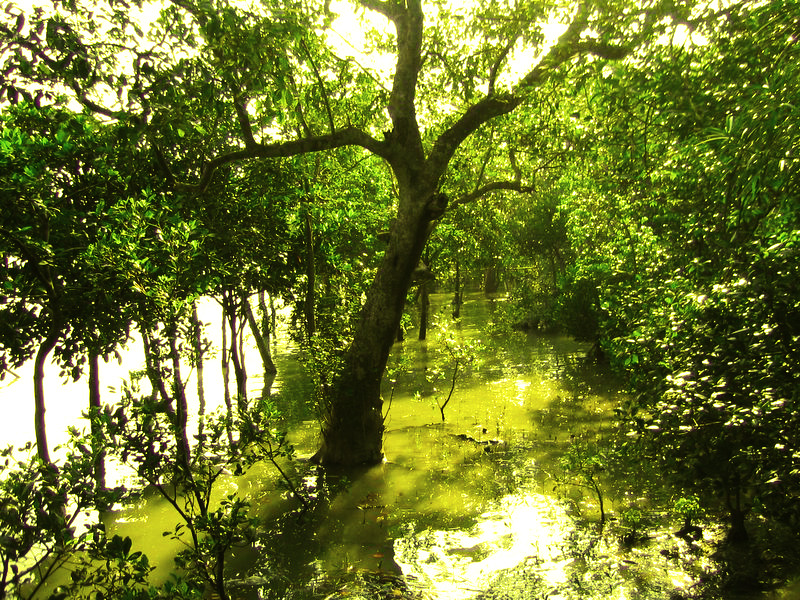
In the mangrove forests of the Sundarbans, where the Ganges and the Brahmaputra dissolve into the Bay of Bengal in a labyrinth of tidal channels, the people who go into the forest to collect honey, crabs, and wood pray before they enter. They pray to Bonbibi, the lady of the forest, a figure honoured by both Hindus and Muslims in the region. The story told about her, in a Bengali text of the nineteenth century and countless oral versions, goes like this. The forest had been ruled by a demon king called Dakshin Rai, who took the form of a tiger and demanded human flesh. Bonbibi, sent to the forest by God, fought and defeated him, and then made a settlement: the forest would be divided. Half would belong to the tiger, and half to human beings, and each would respect the other's portion. Those who enter the forest with a pure heart, taking only what they need, are protected. Those who are greedy are not.

The myth encodes an ecological truth that the Sundarbans make unusually stark. The tigers here are among the few in the world that regularly hunt people, and for centuries, hundreds of honey collectors, fishermen, and woodcutters have died in their jaws. The forest is shared, and the sharing is dangerous. Bonbibi's treaty is a charter for coexistence with the largest cat on earth.


The animal
The tiger is the largest of the cats. A big male Bengal tiger may weigh around two hundred to two hundred and sixty kilograms and measure three metres from nose to tail tip; the Amur, or Siberian, tigers of the Russian Far East can be larger still. Its stripes are unique to each individual, like fingerprints, and researchers use camera traps to identify tigers by them. Shave a tiger and the stripes remain, because they are marked in the pigment of the skin itself. They are camouflage: in the vertical shadows of tall grass and the dappled light of the forest floor, a tiger's outline dissolves. The deer and wild pigs it hunts are largely unable to distinguish red and orange from green, so the tiger's flaming coat, which seems so conspicuous to us, reads to its prey as a pattern of shadow among the leaves.

The tiger is an ambush predator. It stalks as close as it can, belly low, placing each hind foot in the print of the forefoot to make no sound, and then charges over a short distance, seizing the prey by the throat or the back of the neck. Most attempts fail; field studies suggest that perhaps only one hunt in ten or twenty succeeds. When a tiger makes a kill of a large deer or a buffalo, it may eat thirty kilograms or more of meat in a night and then lie up beside the carcass for days, feeding repeatedly. Tigers need roughly one large kill a week. Unlike most cats, they love water, and swim well; in the Sundarbans they cross wide rivers, and in the heat of summer tigers across India lie in pools and streams to cool themselves.
The tiger has been drawn and carved in India for a very long time. At Bhimbetka in Madhya Pradesh, tigers appear among the animals painted on the walls of rock shelters, made by people who had no metal and no farms, only spears, fire and close knowledge of the forest. Later, in the cities of the Indus Valley more than four thousand years ago, craftsmen carved small square seals of soft stone, used to stamp marks on goods and clay. Many of these show animals, and the tigers on them are carved with great care: the stripes, the heavy shoulders, the turned head.
Two of these seals are especially famous. On the so-called "Pashupati" seal from Mohenjo-daro, a figure sits in what looks like a yoga posture, surrounded by a tiger, an elephant, a rhinoceros and a buffalo. Some scholars once saw in it an early form of Shiva as Pashupati, "lord of the animals", though no one can be sure, because the Indus writing has never been read. Another seal shows a figure standing between two tigers, holding one back with each hand. The same picture, a hero gripping two wild beasts, is found far away in ancient Mesopotamia too. It seems to be one of humanity's oldest images of power: a person who stands between the wild forces and holds them apart. Long before any kingdom, the tiger was already the measure of what strength looked like.
It is worth pausing on how strange the tiger's design really is. Most big predators that hunt in open country, like lions and cheetahs, rely on speed or teamwork. The tiger relies on concealment and a single explosive moment. Everything about its body serves that moment: the short, powerful forelegs that can hold down a buffalo; the long canine teeth, up to seven or eight centimetres, set wide apart so they slide between the neck bones of prey; the soft pads that silence each step; the whiskers that work like fingertips in the dark. Its night vision is about six times better than ours, because a mirror-like layer behind the retina, the tapetum lucidum, bounces light back through the eye a second time. That is why a tiger's eyes shine green-gold in a torch beam.

The stripes deserve a closer look too. In 1952, the British mathematician Alan Turing, better known for breaking codes and imagining computers, published a paper on how patterns form in living things. He suggested that two chemicals spreading through growing tissue at different speeds, one switching a colour on and one switching it off, could produce spots and stripes on their own. Biologists now call these "Turing patterns", and studies of cats and other animals suggest that something like Turing's process lays down the tiger's stripes in the embryo. The tiger's coat, in other words, is a piece of mathematics made flesh.
Every tiger alive today belongs to one species, but scientists argue about how to divide it. For a long time, people spoke of eight or nine subspecies: Bengal, Amur, Indochinese, Malayan, South China, Sumatran, and the extinct Bali, Javan and Caspian tigers. In 2017, a group of experts proposed a simpler split into just two: a mainland tiger, which includes India's Bengal tiger, and a Sunda Islands tiger, which includes the Sumatran. The debate is not only academic. It decides which populations can be mixed in captivity, and whether, for example, tigers from Russia could one day be released into the old range of the Caspian tiger in Central Asia, a plan Kazakhstan has actually begun.

The solitary life
Unlike lions, tigers are solitary. An adult tiger holds a territory, which it marks by spraying urine on trees and rocks, scraping the ground, and leaving scat along the trails. A male's territory typically overlaps those of several females, and he defends it against other males, sometimes in fights that end in death. The size of a territory depends on how much prey there is: in rich forests such as Kanha or Corbett, a female may need only twenty square kilometres, while in the thin forests of the Russian Far East a tiger may range over more than a thousand.

Solitary does not mean unsocial. Tigers keep track of each other constantly through scent. A tiger sniffing a scent mark and curling back its upper lip in a grimace called the flehmen response is drawing chemical information into a special organ in the roof of its mouth: who passed here, how long ago, whether a female is coming into season. Tigers also greet each other with a soft snorting sound called chuffing, and occasionally share a kill, especially with family members. The deepest social bond in a tiger's life is between a mother and her cubs. A tigress gives birth to two to four cubs, hides them in dense cover for the first weeks, and then raises them alone for about two years, teaching them to hunt by bringing them to her kills and later letting them practise on live prey. Young males leave and wander, sometimes hundreds of kilometres, in search of a territory of their own. It is a dangerous journey, and many do not survive it.
To its prey, the tiger's flaming coat reads as a pattern of shadow among the leaves.

Biologists learned most of this from a small number of patient people. In the 1960s, the American biologist George Schaller spent months in Kanha, then a little-known forest in Madhya Pradesh, and in 1967 published The Deer and the Tiger, the first scientific study of wild tigers. Schaller watched tigers from trees and on foot, counted their kills, and showed that the tiger was not a bloodthirsty killer but an animal living on a tight budget of energy, failing far more often than it succeeded. From the early 1990s, the Indian biologist K. Ullas Karanth, working in Nagarahole in Karnataka, pioneered the use of camera traps to count tigers by their stripes. His method replaced the old "pugmark census", in which forest guards traced paw prints on glass, a method that was easy to fake and wildly inaccurate. Many reserves had been reporting more tigers than really existed.

Some tigers became famous as individuals. In Ranthambore, a tigress known as Machli, "fish" in Hindi, for the fish-shaped mark on her face, was photographed so often that she was called the most photographed tiger in the world. She was famous for a fight in 2003 in which she killed a large mugger crocodile at a lake, and was said to have lost some of her canine teeth in the struggle. She raised several litters, and her descendants were used to restock Sariska after its tigers vanished. When she died in 2016, at about nineteen years old, far older than most wild tigers, the forest department gave her a funeral. A tiger with a name and a life story is a very different thing from "a tiger", and that change in how people see individual animals has done a great deal for conservation.
The tiger's India
Tigers live in five great landscapes in India, and each gives the animal a different life. In the north, along the Shivalik hills and the Terai grasslands at the foot of the Himalaya, tigers roam the sal forests and tall grass of Corbett, Rajaji, Dudhwa, Pilibhit and Valmiki, where the Ramganga, the Sharda and the Gandak spill out of the mountains. Corbett, India's oldest national park, lies along the Ramganga, and its tigers sometimes cross the river at dawn in full view of the forest rest house at Dhikala.

The heart of tiger country is the central Indian highlands and the Eastern Ghats, the forests of Madhya Pradesh, Maharashtra, Chhattisgarh, Odisha and Telangana. Kanha, with its great meadows along the Banjar river, Pench, which takes its name from the river that divides it between two states, Bandhavgarh, with its ancient fort on a cliff, Satpura, between the Narmada and the Tapti, Tadoba-Andhari, Melghat, Panna along the gorge of the Ken river, and Achanakmar and Similipal further east, all belong here. Madhya Pradesh has more tigers than any other state, and is often called the "Tiger State". Ranthambore, in the dry hills of Rajasthan where the Aravalli and Vindhya ranges meet, lies between the Chambal and Banas rivers; its tigers walk among the ruins of a tenth-century fort and lakeside palaces.


The Western Ghats hold what may be the largest single tiger population in the world, in the forests of the Nilgiri Biosphere Reserve: Nagarahole, Bandipur, Mudumalai, Wayanad and Sathyamangalam, joined into one great block across Karnataka, Kerala and Tamil Nadu. In summer, when the Kabini river's reservoir shrinks, its grassy banks draw elephants, gaur and tigers in remarkable numbers. Further south, Periyar's tigers live around a lake made by a dam built in 1895, and Anamalai and Kalakad-Mundanthurai shelter tigers in the steep rainforests of the southern hills.


In the Northeast, along the Brahmaputra floodplain, Kaziranga has one of the highest tiger densities in the world, sharing its grasslands with rhinos, wild buffalo and swamp deer, while Manas, on the border with Bhutan, Nameri, Pakke and the vast rainforest of Namdapha in Arunachal hold tigers in hill forests. And in the Sundarbans, in the delta of the Ganga and Brahmaputra, tigers live in mangroves washed twice a day by the tide, drinking brackish water and swimming between islands across channels like the Matla and Raimangal.


The 2022 tiger estimate counted at least 3,167 tigers by camera, and estimated around 3,700 in total, spread across more than fifty tiger reserves. But tigers do not stay inside reserves. Young tigers walk along corridors of forest, farmland and riverbanks linking one reserve to another, between Kanha and Pench, between Tadoba and the forests of Telangana, between Rajaji and Corbett. In 2019, a young male from Tipeshwar in Maharashtra walked about thirteen hundred kilometres over five months, crossing rivers, highways and fields, into Dnyanganga sanctuary. Keeping these corridors open, with underpasses beneath highways and forests along rivers, is now as important as protecting the reserves themselves.
The goddess and her tiger
In the Hindu imagination, the tiger is above all the mount of the goddess. Durga, the warrior goddess created by the combined energy of the gods to defeat the buffalo demon Mahishasura, rides a lion in the classical texts, but in eastern India and in countless popular images she rides a tiger. The fusion of the great cat and the divine feminine expresses something that the myth makes explicit: raw power, which is dangerous and untameable in itself, becomes protective when it serves the goddess. The goddess does not destroy the tiger. She rides it.

Shiva, the ascetic, sits on a tiger skin and in some stories wears one; one tradition says that sages in the forest sent a tiger to kill him, and he flayed it with the nail of his little finger and wrapped its skin around his waist. In Kerala, the god Ayyappa, whose shrine at Sabarimala draws millions of pilgrims, is told to have ridden into his foster father's palace on a tigress, having been sent to fetch tiger's milk to cure the queen. Among the Warli of Maharashtra, Waghdeo, the tiger god, is worshipped as a guardian of the village, and among many Adivasi communities of central India, tigers are considered kin, not to be killed.
Far to the northeast, among some Naga peoples, there is a story that the tiger and man were once brothers, born of the same mother, and that a dispute between them led to their separation. Because of this ancient kinship, killing a tiger was treated, in some communities, with the gravity of killing a relative. The idea that humans and tigers share a soul, or can become one another, appears across South and Southeast Asia, in the were-tiger beliefs of Malaysia and Indonesia, where certain people are said to turn into tigers at night.

Think about the picture of Durga on her tiger (in some places a lion). She is calm, often smiling, with weapons in her many hands, and under her is the most dangerous animal in the forest, walking where she wants it to go. Writers who follow Jung love this image, and it is worth seeing why. In Jung's way of thinking, the tiger stands for raw instinct: anger, hunger, desire, the force that can tear things apart. There are two easy ways to deal with such a force. One is to let it run wild, so that it rules you. The other is to try to kill it off completely, so that you become timid and lifeless. Durga does neither. The tiger is still a tiger, still fierce, but now it carries her. The force has not been destroyed. It has been put to work.

Most of us know this in small ways. Anger that controls us makes us say things we regret. But anger that is understood and steered can give us the courage to stand up against something unjust. Desire that rules us makes us greedy, but desire that is guided becomes the energy behind any real work. Durga's tiger is a picture of that change: power that serves instead of devours.
A Chinese saying adds a warning: "He who rides a tiger cannot dismount." Imagine actually riding one. As long as you stay on its back you are safe, but the moment you climb down, it will turn on you. The saying is used for anyone who has taken hold of a dangerous power, a lie, a war, an addiction, a rule by fear, and now cannot let go without being eaten by it. It is the dark side of the Durga picture. Durga rides the tiger because she has truly mastered it. The person in the proverb only looks as though he is in control.

Shiva and many yogis, for their part, are shown sitting on a tiger skin, the vyaghrambara. Commentators read this too as a lesson. The tiger stands for desire and pride, the most restless forces in us, and the yogi has made them into a seat. Out of the wildest thing in the forest comes the ground for stillness. Again the force is not denied: it is underneath, holding him up.
The tiger's sacred life is not only in temples and books. It is still lived on the streets. In Thrissur in Kerala, every year in the Onam season, men paint their whole bodies with yellow and black tiger stripes and dance through the town in Pulikali, the "tiger play", bellies wobbling and painted faces snarling to the beat of drums. It is comic and proud at the same time: ordinary men becoming tigers for a day. In the Sundarbans, before the season when people go into the forest for honey, wood and crabs, the Bonbibi legend is still sung and acted out from the Bonbibi Johuranama, so that everyone is reminded of the bargain between the people and the forest.

The anthropologist Annu Jalais lived for a long time among the islanders there and wrote a book about them, Forest of Tigers (2010). An anthropologist is someone who studies how a group of people actually live and think, usually by living with them. What she found was that forest workers do not talk about the tiger as just an animal. They speak of it almost as a neighbour, one with its own moods, its own rights, and its own anger when people take too much. She also found something harder. The way people talk about tigers is tied to who is poor, who belongs to which caste, and who has no choice but to go into the forest at all. The tiger is not dangerous to everyone equally. It is most dangerous to those with the fewest other ways to earn a living. So the old stories about Bonbibi are not only about faith. They are also about fairness, about who carries the risk of living beside the tiger.
The story of Durga is told most fully in the Devi Mahatmya, a Sanskrit text of about the sixth century, which forms part of the Markandeya Purana and is recited during Navaratri across India. In it, the gods, defeated by the buffalo demon Mahishasura, pour out their anger as streams of light, and the light gathers into the shape of a goddess. Each god gives her a weapon: Shiva his trident, Vishnu his discus, Indra his thunderbolt. The Himalaya, the mountain itself, gives her a lion as her mount. In the art of Bengal and the east, and in the calendar prints that reached almost every Indian home in the twentieth century, the lion often becomes a tiger. Scholars have suggested that this shift reflects the landscape. In the forests of Bengal and Assam, the tiger, not the lion, was the great cat people actually knew and feared.

What does it mean that a goddess rides the most dangerous animal in the forest? One answer comes from the history of religion. Many Indian goddesses began as local village deities, tied to a particular forest, river or disease, and were later absorbed into the great Puranic traditions. A goddess who could command tigers was exactly what forest villagers needed. Another answer is psychological, and here the Jungian reading discussed earlier comes in. A rider does not destroy her mount. She guides it. The image suggests a relationship with fierce energy, in nature and in ourselves, that is neither denial nor surrender. The Sundarbans' Dakshin Rai and Bonbibi tell the same story in folk form: the tiger-demon is defeated, but not removed. The forest is divided, and the tiger keeps its share.

Tribal India has its own tiger religion, older than the Puranas and still alive. The Warli of the Sahyadri hills paint Waghdeo in their wedding pictures and set up wooden tiger posts at the edge of the village. In parts of Odisha and Chhattisgarh, communities hold that a person killed by a tiger was taken for a reason, and perform rites to calm the animal's spirit as well as the dead person's. Among some Gond communities, a man who has killed a tiger must undergo purification, as if he had killed a relative. In Kodagu, in Karnataka, men who once killed a tiger held a nari mangala, a "tiger wedding", in which the hunter was dressed as a bridegroom and the dead tiger treated as a bride, a ceremony that mixed boasting with apology. These rituals show that the people who lived nearest the tiger did not see it simply as an enemy or simply as a god, but as a powerful neighbour with whom a relationship had to be kept in good order.
The tiger in the East
In China, the tiger is the king of the beasts, and the markings on its forehead are read as the character 王, wang, meaning king. It is one of the four celestial animals guarding the directions of the sky: the White Tiger of the West, associated with autumn and the metal element, alongside the Azure Dragon of the East, the Vermilion Bird of the South, and the Black Tortoise of the North. Images of tigers were painted on doors and embroidered on children's shoes and caps to frighten away evil spirits. In Korea, the tiger is the most beloved animal of folklore, appearing in hundreds of tales, sometimes as a fearsome predator, sometimes as a foolish creature outwitted by a rabbit or frightened by a dried persimmon. In Korea's founding myth, a tiger and a bear both asked to become human; they were told to stay in a cave for a hundred days eating only mugwort and garlic. The bear endured and became a woman, who gave birth to the founder of the first Korean kingdom. The tiger, impatient, ran out.

The tiger also stands in the Chinese zodiac, third of the twelve animals, and people born in the Year of the Tiger are said to be brave, restless and generous. In Chinese medicine, every part of the tiger, from bones to whiskers, was once thought to carry the animal's power, and "tiger bone wine" was sold as a tonic for strength. This belief, more than anything else, drove the modern poaching that emptied forests across Asia. In 1993, China banned the trade in tiger bone. But tiger farms, where thousands of tigers are bred in captivity, still exist in China and Southeast Asia, and conservationists argue that they keep the demand for wild tiger parts alive. The ancient symbol of strength became, in the hands of a market, one of the tiger's deadliest threats.

The hunt and the fall
Around 1900, there may have been something like a hundred thousand wild tigers across Asia, from eastern Turkey and the Caspian to Bali and the Russian Far East. In the century that followed, they were destroyed on an extraordinary scale. In India, tiger hunting was the sport of Mughal emperors, maharajas, and British officials; some princes boasted of killing hundreds of tigers each, and bounties were paid for their carcasses as "vermin." Forests were cleared for agriculture, and the prey on which tigers depended disappeared.

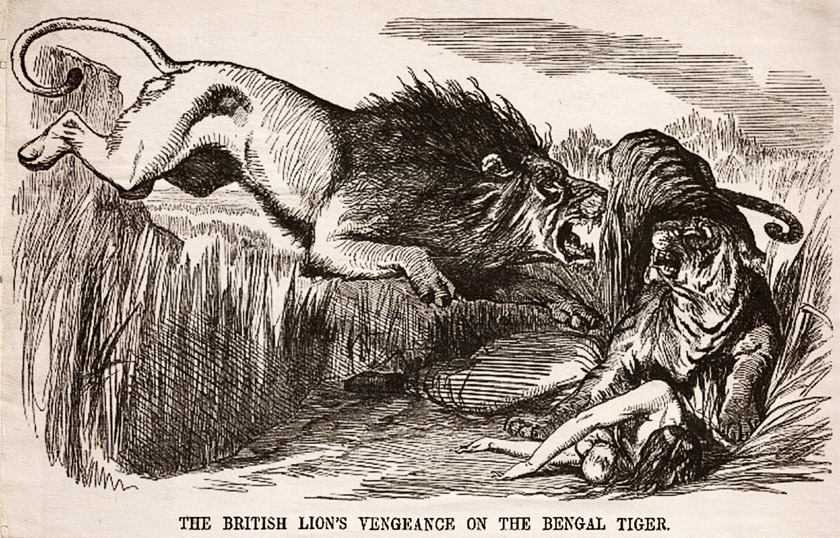
The tiger also killed. In the early twentieth century, the Champawat tigress in the hills of Kumaon was reported to have killed over four hundred people before the hunter Jim Corbett shot her in 1907. Corbett, who went on to become one of India's first great conservationists and after whom Corbett National Park is named, argued in his books that man-eaters were almost always tigers that had been injured or were too old to hunt their natural prey, often because of wounds from hunters' bullets. The man-eater, in his view, was a creature created by human beings.
By the late 1960s, India's tigers had fallen to perhaps under two thousand. In 1973, the government launched Project Tiger, one of the most ambitious conservation programmes in history, creating a network of reserves in which tigers and their habitat were protected. The recovery has been uneven. The Sariska Tiger Reserve in Rajasthan lost all its tigers to poaching by 2005, and Panna in Madhya Pradesh lost its entire population by 2009; both were later restocked by moving tigers from other reserves. But the overall trend has been remarkable. India's most recent national tiger estimate, released in 2023, put the population at around three thousand seven hundred, roughly three quarters of all the wild tigers left on earth. Three subspecies, the Bali, Javan, and Caspian tigers, are extinct.

Indian rulers did not only hunt the tiger. Some took it as their badge, the sign of who they were. The most famous was Tipu Sultan of Mysore, who fought the British East India Company in the late eighteenth century. Tiger stripes were everywhere around him: on his throne, his soldiers' uniforms, his swords and guns. He is often called the "Tiger of Mysore", and a saying is linked with him, that it is better to live one day as a tiger than a hundred years as a sheep.
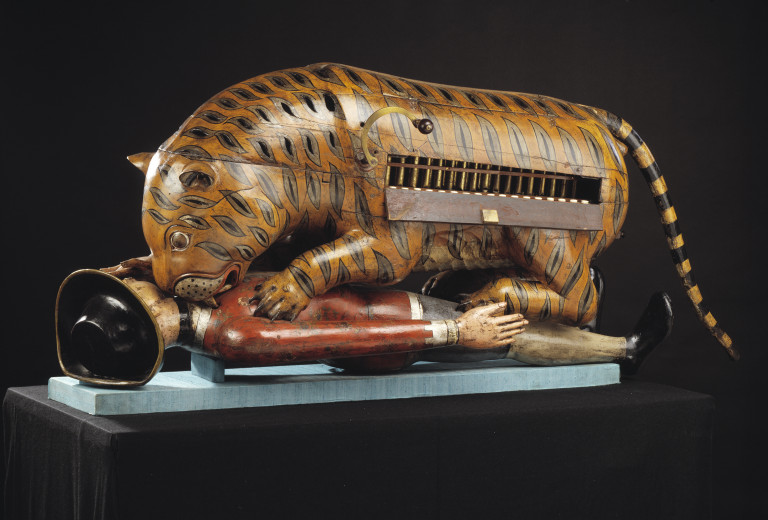
His strangest treasure was a large painted wooden toy now called "Tipu's Tiger", made in the 1790s. It shows a tiger lying on top of a European soldier and biting his neck. Inside it is a small organ. When a handle is turned, air is pushed through pipes, and the tiger makes a growling sound while the man's arm moves and he lets out a wailing cry. When the British captured Tipu's capital, Srirangapatna, in 1799 and killed him, they carried the tiger back to London, where it is still kept in the Victoria and Albert Museum. Think about what it meant. For Tipu it was a dream of what his tiger, his kingdom, would do to the invaders. For the British who took it, it became a trophy of victory. The same object told two opposite stories.
The writing of the tiger-hunting age is still read. Jim Corbett was a hunter who spent years killing man-eating tigers and leopards in the hills of Kumaon, tigers that had begun killing villagers, often because they had been wounded or were too old to hunt their normal prey. His book Man-Eaters of Kumaon (1944) remains one of the finest books about the forest written in English. What makes it more than a hunting story is how much he respected the animals and the poor hill people, and how he later turned towards protecting the tiger. Kenneth Anderson wrote in the same spirit about the man-eaters of the Deccan in south India.
Much older Indian stories had already warned about trusting a tiger. In one tale of the Hitopadesha, an old tiger sits by a lake holding a golden bangle. He calls out to travellers that he has given up killing, has become pious, and wants to give the bangle away as charity. A greedy man wants the gold so badly that he talks himself into believing the tiger. He steps into the mud to take it, gets stuck, and is eaten. The lesson is simple and still true: when someone who has always been dangerous suddenly offers you something precious, look hard at why you want to believe them.
Rudyard Kipling made the tiger Shere Khan the villain of The Jungle Book (1894), the lame, proud tiger who wants to kill the boy Mowgli. Disney's films of 1967 and 2016 carried him to children all over the world. For many people, Shere Khan is the first tiger they ever met, which shows how strongly stories shape what we feel about real animals.
The scale of the colonial hunt is hard to imagine. The Maharaja of Surguja, in what is now Chhattisgarh, is said to have shot more than eleven hundred tigers in his lifetime. Visiting British royals were taken on hunts in which hundreds of beaters and dozens of elephants drove tigers towards the guns; King George V shot thirty-nine tigers in ten days in Nepal in 1911. The photographs of these hunts, with rows of dead tigers laid out before smiling men, are now among the most disturbing images of the age. The British also paid rewards for killing tigers, leopards and wolves, and between 1875 and 1925 official records list around eighty thousand tigers killed in British India, a figure that is certainly an undercount.

Tipu Sultan's tiger organ belongs to this violent history. Tipu, ruler of Mysore from 1782 until his death in 1799, fought four wars against the British East India Company and was its most dangerous enemy in the south. His throne was decorated with tiger heads, his soldiers wore tiger-striped jackets, and his personal emblem, the bubri, was a tiger-stripe pattern. The wooden tiger, almost life-size, was probably inspired by a real event: in 1792, the son of a British general, Hector Munro, was killed by a tiger on an island near Calcutta, and the story spread across India. When the British stormed Tipu's capital, Srirangapatna, in 1799, and Tipu was killed in the fighting, they found the machine in his palace and shipped it to London. There it became one of the most popular exhibits in the East India Company's museum. The poet John Keats saw it and mentioned it in a poem. A toy made to mock the British became, in Britain, a trophy proving that they had tamed the tiger.
Jim Corbett's own life shows the turn from hunting to protecting. Born in 1875 in Nainital to an Irish family settled in India, he grew up in the forests of Kumaon, learning the calls of birds and animals from the hill people. He shot his first man-eater, the Champawat tigress, in 1907, at the request of the government, and went on to kill more than thirty man-eating tigers and leopards over three decades, often alone and on foot. But he refused to hunt for sport in later life, began photographing and filming tigers instead, and warned that tigers would vanish from India unless their forests were protected. In 1936, the Hailey National Park, India's first national park, was created in the Kumaon hills; in 1957 it was renamed Corbett National Park. Corbett left India in 1947 and died in Kenya in 1955. His books, written in a plain, modest style, are full of affection for the villagers whose lives he was trying to save, and for the animals he had to kill.

Project Tiger was the work of a few determined people. Kailash Sankhala, a forest officer known as the "Tiger Man of India", campaigned for a ban on tiger hunting and became the project's first director. Prime Minister Indira Gandhi, a keen naturalist, backed it with her full authority, and the Wildlife (Protection) Act of 1972 gave it legal force. The project began with nine reserves; today there are more than fifty. Its idea was simple and radical for the time: protect not just the tiger but the whole forest, with a core area free of human use. That idea also had a cost. Many Adivasi and forest-dwelling families were moved out of reserves, sometimes with little choice and poor compensation. The Forest Rights Act of 2006 tried to recognise their claims. The tension between protecting tigers and respecting the rights of forest people remains one of the hardest questions in Indian conservation.

What the tiger teaches
The tiger lives alone, in the dark, at the top of the food chain, and it needs vast spaces. Where tigers survive, the forest survives, and with it the deer, the rivers, the langurs, and the people who depend on all of these. Conservationists call the tiger an umbrella species: protect it, and you protect everything beneath its reach. The Sundarbans' Bonbibi said the same thing, long before the term was invented. Divide the forest fairly. Take only what you need. Respect the other nation, and it may respect you.

Writers keep coming back to this animal, each finding something different in it. The English poet William Blake wrote "The Tyger" in 1794. The poem is a string of questions to the tiger: what hand, what eye, could have made your "fearful symmetry"? Did the same maker who made the gentle lamb make you? Blake is not really asking about zoology. He is asking how one world can hold both gentleness and terror, and whether the beauty of the tiger and its danger can be separated at all. The poem has no answer, which is why people still read it.
The Argentine writer Jorge Luis Borges was haunted by tigers all his life. As a child he stood for hours in front of the tiger's cage at the zoo, and in his poems and stories the tiger keeps appearing as something he can never fully catch in words. In one poem he describes trying to write a tiger and finding that the tiger on the page is only made of words and symbols, while the real tiger walks on in its own forest, untouched. It is a lesson this whole book keeps returning to: the animal is always more than what we say about it.
Indian writers have their own tigers. Ruskin Bond's short story "A Tiger in the Tunnel" is a school favourite: a railway watchman, a tunnel in the forest, and a tiger, with a quiet, sad ending about the people whose work brings them face to face with the wild. Amitav Ghosh's novel The Hungry Tide (2004) takes the Bonbibi legend into the modern Sundarbans, asking whether saving tigers and protecting poor islanders can ever both be done, and whose life counts more when they clash.
Yann Martel's Life of Pi (2001) puts a boy and a Bengal tiger together in a lifeboat for 227 days on the open sea. The boy survives because he learns to understand the tiger, to mark his space, to feed him, to never forget that he is a tiger. At the end, the book suggests that the tiger might also be a picture of the boy's own wild side, the part of him that let him do what he had to do to survive. Ang Lee's film of it (2012) made its tiger, Richard Parker, feel truly alive. Aravind Adiga's The White Tiger (2008), which won the Booker Prize and was filmed in 2021, uses the rare white tiger, an animal born once in a generation, as a picture of a poor driver breaking out of the cage that his birth and class have built around him. It is not a gentle story. It asks what a person must become to escape.
Indian cinema has its own tigers too. The Malayalam blockbuster Pulimurugan (2016) is about a man who hunts the tigers that raid his village, a story about fear and survival on the forest edge. Roar: Tigers of the Sundarbans (2014) was shot among the mangroves. And Amit Masurkar's Sherni (2021) follows a quiet woman forest officer in central India trying to save a tigress from politicians who want a quick kill and trophy hunters who want a trophy. The film shows how much of saving a tiger is not about the tiger at all but about villages, jobs, votes and egos. It ends close to Bonbibi's old lesson: the forest can be shared only if people take no more than they need.
Blake's poem repays a closer look. Written in 1794, in the middle of the French Revolution, "The Tyger" sits in his Songs of Experience as a twin to "The Lamb" in Songs of Innocence. The lamb is gentle and easy to love. The tiger is terrifying and magnificent. Blake does not answer his own question, "Did he who made the Lamb make thee?", and that is the point. A world that contains both tigers and lambs is hard to explain with a simple idea of a kind creator. Borges, who read Blake closely, wrote poems and stories about tigers all his life. In one, "The Other Tiger", he admits that the tiger in his poem is only a tiger of words, and that the real one, "which treads the earth", lies forever beyond his reach. That gap between the tiger we imagine and the tiger that exists is exactly the gap this book is trying to cross.
Two Indian novels show how the tiger has changed meaning. In Amitav Ghosh's The Hungry Tide, a Delhi translator and an American scientist of Bengali origin arrive in the Sundarbans and meet Fokir, a crab-catcher who cannot read but knows the river and the tiger intimately. The novel sets the story of Morichjhapi, where refugees from Bangladesh were forcibly evicted from an island in 1979 in the name of tiger protection, against the Bonbibi legend. It asks a sharp question: whose lives count when we save the tiger? Aravind Adiga's The White Tiger uses the tiger in a completely different way. Its narrator, Balram, is told as a boy that he is a "white tiger", the rarest creature in the jungle, because he is clever in a village of the poor. The novel follows him as he breaks out of what he calls the "rooster coop" of servitude, by violent means. Here the tiger is not an animal at all, but a picture of a man who refuses his cage. Taken together, the two books show the tiger as both a real neighbour in the mangroves and a symbol in the mind of a changing India.
Life of Pi turns the tiger into a test of faith. Pi Patel, the son of a zookeeper in Pondicherry, survives a shipwreck in a lifeboat with a Bengal tiger called Richard Parker. To survive, he must train the tiger, feed it and keep it at a distance. At the end, Pi offers a second, darker version of his story without the animals, and asks which story the listener prefers. Most readers choose the one with the tiger. Martel's point is that stories with animals in them, like religions, help us carry truths that would otherwise be too hard to bear. That is very close to what the Bonbibi legend does for the honey collectors of the Sundarbans.