Part Six · The Tricksters
Chapter 28
The Fox, the Jackal and the Coyote
The clever ones: jackals who advise kings, the fox who became a goddess's messenger, and the coyote who stole fire.
Assisted and Curated by Claude, Referenced and Collated by me
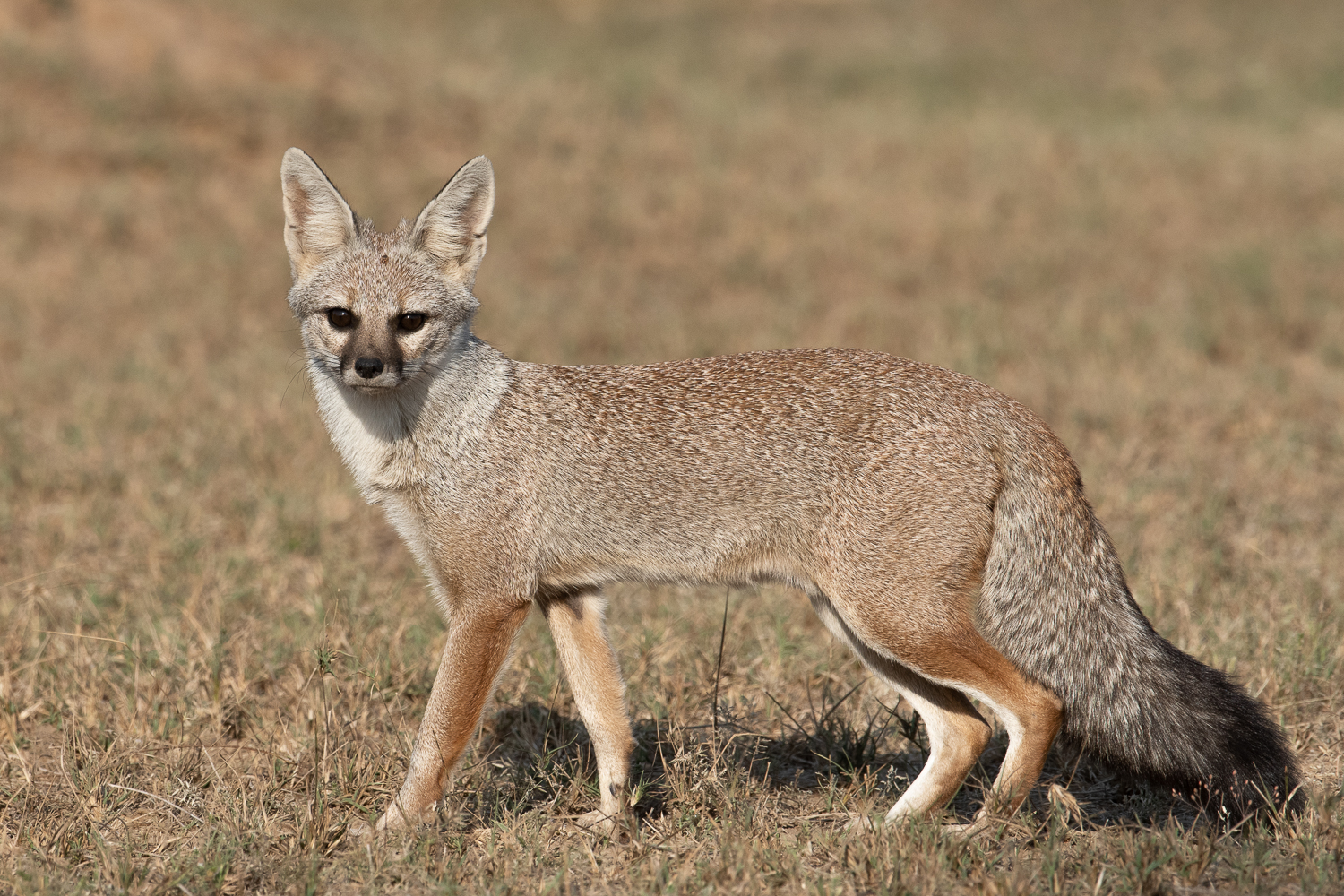
Vulpes · Canis aureus · Canis latrans
The first book of the Panchatantra, the great collection of Indian animal fables composed in Sanskrit perhaps two thousand years ago, opens in a forest ruled by a lion named Pingalaka. One day, the lion hears a tremendous bellow he does not recognize and becomes terrified. It is only a bull, Sanjivaka, abandoned by a merchant, but the lion does not know that. Two jackals, Karataka and Damanaka, sons of the lion's former minister, observe his fear. Karataka, the cautious one, says it is none of their business. Damanaka, the ambitious one, sees an opportunity. He introduces the bull to the lion, and the two become inseparable friends, so close that the lion neglects his other courtiers. Jealous, Damanaka then sets about destroying the friendship, whispering lies to each about the other, until the lion kills the bull.

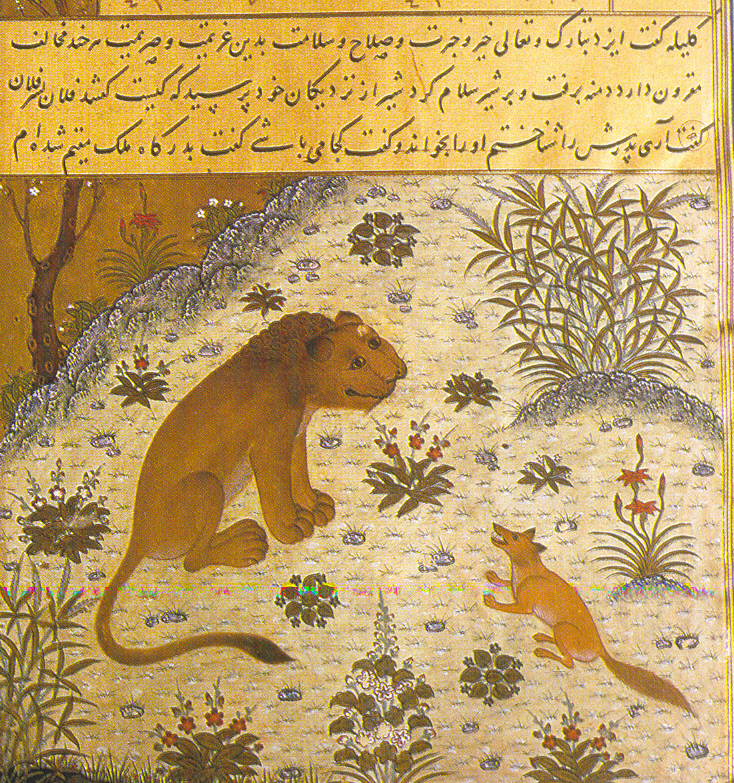
The Panchatantra was composed as a textbook of statecraft, niti, for young princes, teaching them through animal stories how politics really works: how advisers manipulate, how friendships are broken, how the clever survive. It travelled to Persia in the sixth century, where it was translated into Middle Persian, then into Arabic as Kalila wa Dimna, the Arabic names of the two jackals, and from there into Hebrew, Latin, Greek, and nearly every language of Europe and Asia. It is one of the most widely translated books in history. And its schemers are jackals.
The Panchatantra's own frame story explains why it was written. A king named Amarashakti had three sons who were, the text says, supremely stupid and hostile to learning. Desperate, he asked his ministers how they could be educated, since the study of grammar alone took twelve years. A wise Brahmin, Vishnusharma, eighty years old, promised to make the princes wise in the ways of the world within six months, using stories. He composed five books: on the loss of friends, the winning of friends, war and peace (the crows and owls), the loss of what one has gained (the monkey and crocodile), and hasty action. The stories are nested inside one another, like boxes within boxes, with animals quoting proverbs and telling tales to make their points. Scholars date the text to around the third or fourth century CE, though it may draw on much older material. The Panchatantra is, in this sense, one of the world's first textbooks of politics, and its teachers are jackals, crows, lions and mice.

The book's journey west is one of the great stories of world literature. In the sixth century, the Persian king Khosrow I sent his physician Borzuy to India to find the Panchatantra; Borzuy translated it into Middle Persian, adding chapters of his own. In the eighth century, Ibn al-Muqaffa, a Persian convert to Islam, translated it into Arabic as Kalila wa Dimna, after the two jackals; it became a model of Arabic prose. From Arabic it went into Syriac, Hebrew, Greek and Persian again, then into Latin, Spanish, Italian, German and English. The French writer Jean de La Fontaine acknowledged "Pilpay, the Indian sage" as a source for some of his famous fables. In the Islamic world, illustrated copies of Kalila wa Dimna are among the treasures of manuscript painting. So the scheming jackal Damanaka, born in an Indian forest, ended up in the libraries of Baghdad, Toledo and Paris.
The survivors
The fox, the jackal, and the coyote are all members of the dog family, medium-sized, intelligent, adaptable, and omnivorous. The golden jackal, found across South Asia, the Middle East, and southeastern Europe, lives in pairs that mate for life, and their eerie, wailing chorus at dusk is one of the characteristic sounds of the Indian countryside, rising from the edges of villages and fields. Jackals scavenge, hunt small animals, eat fruit, and follow tigers and leopards to feed on the remains of their kills. The Bengal fox, small and grey with a black-tipped tail, lives in the grasslands and scrub of the subcontinent. The red fox, the most widely distributed wild carnivore on earth, lives across the Northern Hemisphere and was introduced to Australia, and has adapted brilliantly to cities; London, for example, has thousands of urban foxes.

Red foxes hunting small rodents under snow or grass perform a characteristic high, arching pounce, diving nose-first into the snow. In 2011, a team led by Jaroslav Červený, having analysed hundreds of such pounces, reported that foxes were far more successful when they jumped in a roughly north-eastern direction, and suggested that the fox might be using the earth's magnetic field as a kind of rangefinder, to judge the distance to the prey it could hear but not see. The hypothesis is unconfirmed, but intriguing.
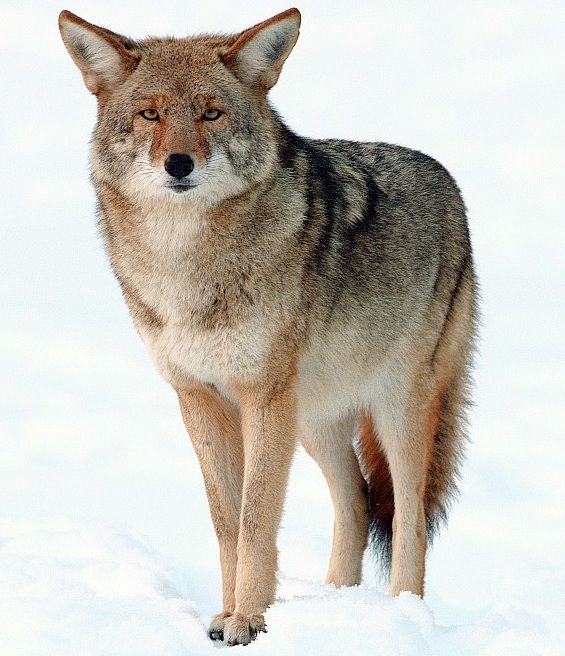
The coyote of North America is the great survivor of the modern age. As wolves were exterminated across much of the continent, coyotes expanded from the western plains to occupy nearly all of it, from Alaska to Panama, including cities such as Chicago and Los Angeles, despite more than a century of intense efforts to kill them. When coyote populations are reduced, they tend to breed faster and have larger litters, which is one reason why attempts to eliminate them have failed.
Wherever there are clever, adaptable animals living at the edges of human settlements, there are trickster stories.
The bond between people and foxes may be very old. At Uyun al-Hammam in northern Jordan, archaeologists found a cemetery about sixteen thousand years old. In one grave, a person was buried together with a fox. Later, it seems, the grave was opened and the person's bones were moved to another grave, and the fox's bones were moved with them, as if the people burying them felt the two should stay together, even in death. Perhaps the fox was a companion, a pet, a spirit guide. We cannot know. But it is one of the oldest signs of a close bond between people and a wild member of the dog family, older than the first known burials of dogs. Before people tamed the wolf, it seems, some of them already felt close to the fox.

In north India, the jackal's night chorus, "hukka-hua", rising from the fields just after dark, one voice starting and then many joining, is part of village life and village sayings. The way one jackal starts and all the rest join in has also made the sound a picture of people who simply repeat whatever the crowd is saying.
The golden jackal has been expanding across Europe in recent decades, spreading from the Balkans into Italy, Austria, Germany, Poland, Denmark, the Baltic states and even Finland and France. Scientists think the decline of wolves, which kill jackals, and milder winters have helped. In India, jackals are everywhere: in forests, farmland, city edges and even the grounds of universities. The jackal's call, the long, rising wail that bursts into yapping, is part of the night soundscape of rural India, and has entered Hindi in phrases like hukka-hua and in proverbs about jackals who all howl together. In folk belief, a jackal's call from certain directions could be a good or bad omen, and the jackal's horn, siyar singhi, a small horny growth said to appear on some jackals' skulls, was sold as a charm for luck. Most "jackal horns" sold in markets are fakes, and the trade harms jackals, which are protected in India.
The fox's pounce has fascinated naturalists for centuries. A red fox hunting in snow or tall grass stands still, head tilted, listening for the movement of a vole or mouse beneath, then leaps high into the air in an arc and dives nose-first, front paws together, to pin the prey. Jaroslav Červený and his colleagues watched 84 foxes make nearly 600 such jumps in the Czech Republic, and found that jumps aimed roughly north-east were successful about three quarters of the time, while jumps in other directions mostly failed. They proposed that foxes use the earth's magnetic field, combined with sound, to judge distance: when a sound and a certain magnetic angle line up, the fox knows the prey is at a fixed distance and jumps. The idea is still unproven, but other animals, including birds, turtles and some mammals, are known to sense magnetism.

The coyote's success has a lesson for anyone trying to control wildlife. In the United States, the federal government has killed coyotes for over a century to protect livestock, with poison, traps and shooting, killing tens of thousands a year even today. Yet coyotes have expanded their range many times over, from the western plains to every state except Hawaii, and into Canada and Central America. Studies have shown that when coyotes are heavily hunted, survivors breed younger and have larger litters, so populations bounce back quickly. In the east, coyotes have interbred with wolves and dogs, producing larger animals sometimes called "coywolves" or eastern coyotes. In cities like Chicago, researchers led by Stanley Gehrt have tracked coyotes living secretly in parks, cemeteries and even near airports, mostly unseen, eating rodents, rabbits and fruit. The coyote, like the trickster of the stories, keeps winning the game humans thought they controlled.

Where foxes and jackals live in India
The Bengal fox is an animal of open grassland and scrub. It lives in the Banni grassland and the Little Rann of Kutch, in Velavadar, in the grasslands of the Deccan around Pune and Solapur, in the Rollapadu sanctuary of Andhra Pradesh, in Tal Chhapar and the Desert National Park in Rajasthan, and in the dry plains of Tamil Nadu and Karnataka. As grasslands are ploughed or covered with solar farms and plantations, it loses its home. The desert fox, a pale subspecies of the red fox, lives in the dunes of the Thar, around Jaisalmer and Barmer, and digs its dens in the sand. Higher up, the Tibetan fox, with its strangely square face, and the Himalayan red fox live on the cold plateaus of Ladakh and Spiti, hunting pikas and marmots.

The golden jackal lives almost everywhere in India, from the Sundarbans mangroves, where it scavenges on mudbanks, to the Thar, the Deccan, the forests of Kanha and Pench, and the edges of cities. In Mumbai, jackals live in the mangroves along Thane creek and the Mahim and Vasai creeks, eating crabs and fish, and are now studied by researchers working with the Wildlife Conservation Society. In Delhi, jackals survive in the Ridge forest and along the Yamuna floodplain. Their evening calls, rising from riverbanks, fields and city wasteland, remain one of the most widespread wild sounds in India.


The fox that became a dog
In 1959, the Soviet geneticist Dmitry Belyaev began one of the longest and most famous experiments in the history of biology. At a fur farm in Novosibirsk, in Siberia, he and his colleague Lyudmila Trut began selecting silver foxes for breeding based on a single trait: tameness, meaning how calmly they reacted to humans. Within a few generations, the selected foxes were wagging their tails, seeking human attention, and licking their handlers' hands. Over decades, something extraordinary happened. The foxes began to develop floppy ears, curly tails, piebald coats, and shorter snouts, features seen in many domestic animals, although no one had selected for them. The experiment suggested that selecting for friendliness alone could produce a whole suite of physical changes, a "domestication syndrome," and offered a powerful model for how the wolf may have become the dog.

The Russian fox experiment almost did not happen. Dmitry Belyaev started it in 1959, at a time when genetics was dangerous in the Soviet Union. Under Stalin, the pseudo-scientist Trofim Lysenko had declared genetics a "bourgeois" science, and geneticists, including Belyaev's own brother, had been arrested; some died in prison camps. Belyaev disguised the experiment as research to improve fur farming. He and Lyudmila Trut, who joined in 1959 as a young researcher and led the project after Belyaev's death in 1985, selected the tamest foxes from each generation at a farm near Novosibirsk. By the sixth generation, some fox pups were eager to be with people, whimpering for attention and licking the hands of their keepers. By the 1990s, most of the tame foxes behaved like this. They also showed physical changes nobody had selected for: floppy ears, curly tails, white patches of fur, shorter legs and snouts, and changes in hormone levels and the timing of breeding. Trut and the biologist Lee Alan Dugatkin told the story in How to Tame a Fox (and Build a Dog) (2017). After the fall of the Soviet Union, the farm nearly closed for lack of money, and some foxes were sold as pets. The experiment continues, and genetic studies of the foxes are now helping to identify the genes involved in tameness.


The trickster
Wherever there are clever, adaptable animals living at the edges of human settlements, there are trickster stories. The trickster is one of the most universal figures in world mythology: a being who breaks the rules, deceives others, is greedy, lustful, and foolish, and yet often, by accident or cunning, brings great gifts to humanity. The anthropologist Paul Radin, in a classic 1956 study of the Winnebago (Ho-Chunk) trickster, described him as both creator and destroyer, giver and negator, who is always duping others and always being duped himself.
In North America, the trickster is very often Coyote. In the stories of many peoples of the West and the Plains, Coyote shaped the landscape, stole fire from its guardians and gave it to humans, set the stars in the sky in a careless scatter, and introduced death into the world, sometimes to his own later sorrow when his own child died. He is endlessly greedy, vain, and foolish, and his schemes constantly backfire, yet he is also the one who makes the world as it is. Among the Navajo, Coyote stories are told only in winter.
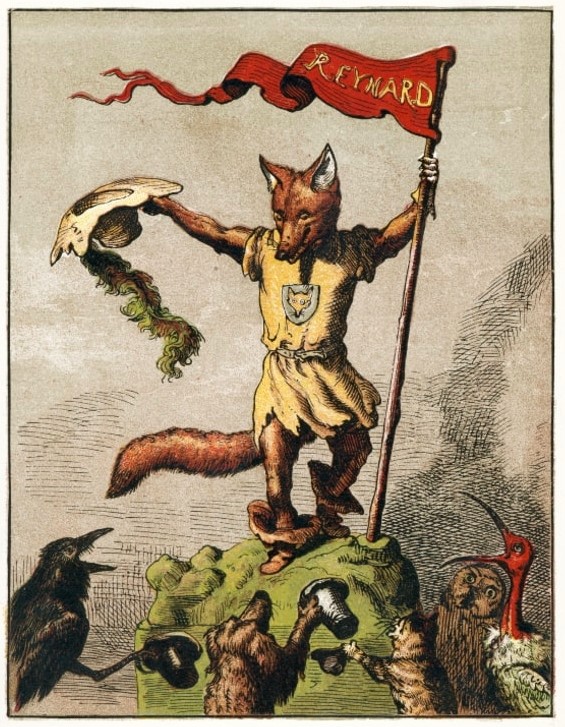
In Europe, the trickster is Reynard the Fox, the hero of a cycle of medieval satires in French, Flemish, German, and English, who outwits the king, the lion Noble, and all the other animals of the court, especially his rival, the wolf Isengrim. Reynard became so popular that in French, the word for fox itself changed: the old word, goupil, was replaced by renard, from the character's name. In Aesop's fables, the fox is the clever animal who flatters the crow into dropping its cheese and who, unable to reach the grapes, declares them sour.

Two great thinkers tried to explain the trickster, the clever, greedy, rule-breaking figure, often a fox, jackal, coyote or raven, who turns up in the stories of almost every people on earth. Carl Jung wrote an essay, "On the Psychology of the Trickster-Figure" (1954), printed in a book about Native American trickster tales by the anthropologist Paul Radin. Jung saw the trickster as an image of the earliest, most unruly level of the human mind, before we learned rules and manners: greedy, shameless, silly, always hungry, always making trouble for himself. When we laugh at the trickster's foolishness, Jung thought, we are partly laughing at the part of ourselves we have outgrown, and partly recognising it is still there.
But Jung also saw the trickster as a healer. Every society needs rules, but rules can grow too stiff, too proud, too sure of themselves. The trickster breaks them, mocks the powerful, turns things upside down, and by doing so shows where the rules have become foolish. That is why many cultures have festivals where, for a day, the world is turned upside down, and why the court jester was allowed to mock the king. The trickster's mischief lets fresh air into a closed room.

The French anthropologist Claude Lévi-Strauss asked a different question: why are tricksters so often coyotes and ravens, and not, say, bears or deer? His answer is clever. Think of the animals in three groups. Plant-eaters, like deer, eat plants and never kill. Hunters, like wolves and eagles, kill other animals to eat them. Coyotes and ravens are in between: they eat meat, but mostly meat that is already dead, scraps and carcasses, and they do not usually kill big prey. So they stand between the plant-eaters and the hunters, between life and death. Myths, Lévi-Strauss believed, are often trying to think about things that are hard to hold together: life and death, nature and culture, the wild and the human. An animal that already sits on the line between two worlds is the perfect hero for stories that cross those lines. In India, the jackal, which also lives by scavenging at the edge of villages and cremation grounds, fits the same place exactly.
India's own trickster tales are among the oldest in the world. In the Panchatantra's story of the blue jackal, a jackal running from dogs falls into a big vat of indigo dye at a dyer's house and comes out bright blue. When he returns to the forest, the animals have never seen such a creature and are afraid. Seizing his chance, he tells them he has been sent by the gods to be their king. Lions, tigers and elephants serve him, and he sends his fellow jackals away, ashamed of them. Then one night the jackals howl together in the distance, and he cannot stop himself: he throws back his head and howls too. The animals realise he is only a jackal, and he is torn to pieces. The lesson is that you can change your colour, but not your nature, and that whoever is ashamed of their own people may be betrayed by themselves.

In Bengali folk tales, children meet the sly jackal "Shial Pandit", who pretends to be a learned teacher and runs a school, until his greed gives him away, often when the crocodile mother sends her babies to his school and he eats them one by one, showing the same one baby again and again to fool her. And in Europe, Geoffrey Chaucer's "The Nun's Priest's Tale", from the fourteenth century, tells of a fox who flatters a proud rooster, Chauntecleer, into closing his eyes and singing, and then grabs him. But as the fox runs off with him, the rooster flatters the fox in turn, persuading him to open his mouth to shout at the people chasing them, and escapes. The trickster is tricked, and both learn a lesson about flattery.
Paul Radin's The Trickster (1956) was built on stories of Wakdjunkaga, the trickster of the Winnebago, or Ho-Chunk, people of Wisconsin, told to Radin by a Winnebago storyteller, Sam Blowsnake, in the early twentieth century. In the cycle, the trickster is a chief who abandons his responsibilities, goes wandering, and gets into absurd and often obscene trouble: his right and left arms fight each other, he burns his own anus as a punishment and then eats his own intestines without knowing it, he tricks ducks into dancing with their eyes shut and wrings their necks. Slowly, through these misadventures, he learns about his own body and the world, and by the end, he has helped shape the earth for humans. Radin saw the trickster as an image of humanity in its earliest, undeveloped state. Jung's essay, published in the same volume, read him as a "shadow" figure, the collective image of everything a society represses, and as a forerunner of the saviour: his foolishness and suffering make him a kind of wounded healer. The Hungarian classicist Karl Kerényi, who contributed a third essay, compared him to the Greek god Hermes, the trickster of Olympus, who stole Apollo's cattle on the day he was born.

Lévi-Strauss's explanation of the coyote and raven appears in his essay "The Structural Study of Myth" (1955), in which he argued that myths work by setting up oppositions and then finding a middle term to bridge them. Life and death, he said, are opposed; agriculture (plants that grow) and hunting (animals that are killed) mediate between them; and between plant-eaters and predators stand the carrion-eaters, coyote and raven, who eat meat but do not kill. That is why the trickster in North American myths is so often one of these two: he lives in the gap between categories, and so can carry stories across them. Critics have argued that the theory is too neat. But it shows why in-between animals, like the jackal that eats from both the hunter's kill and the villager's rubbish heap, are so often chosen as messengers, tricksters and guides to the dead.
The Panchatantra's blue jackal is a story about identity and deception. A jackal named Chandarava, chased by dogs in a town, falls into a dyer's vat of indigo and emerges blue. The forest animals, never having seen such a creature, are terrified, and the jackal, seizing his chance, declares that the god Indra has sent him to be king. The lions, tigers and elephants serve him, and he drives away his fellow jackals, ashamed of them. Then one evening, a pack of jackals howls in the distance, and he cannot help howling back. Recognising him, the other animals tear him apart. The lesson, the text says, is that one who abandons his own people for the sake of strangers will be destroyed. The story has been read in modern India as a satire on social climbers and on those who disguise their origins. It has also been retold in children's books and animated films countless times.
Chaucer's "Nun's Priest's Tale", from The Canterbury Tales (around 1390), retells a story found in the Reynard tradition. Chauntecleer, a proud rooster, dreams of a beast like a hound, red and yellow, who tries to seize him. His wife, the hen Pertelote, mocks his fears and tells him to take a laxative. The next day, the fox, Daun Russell, arrives, flatters Chauntecleer about his father's beautiful singing, and asks him to sing with his eyes closed. When he does, the fox grabs him and runs off, chased by the widow who owns the farm, her daughters, dogs, cows and pigs. Chauntecleer then tricks the fox in turn, telling him to turn and shout at his pursuers; when the fox opens his mouth to boast, the rooster flies free. The tale is a comic sermon on flattery, vanity and the power of dreams, and it shows the fox as the classic European trickster: clever, smooth-tongued, and usually, but not always, the winner.
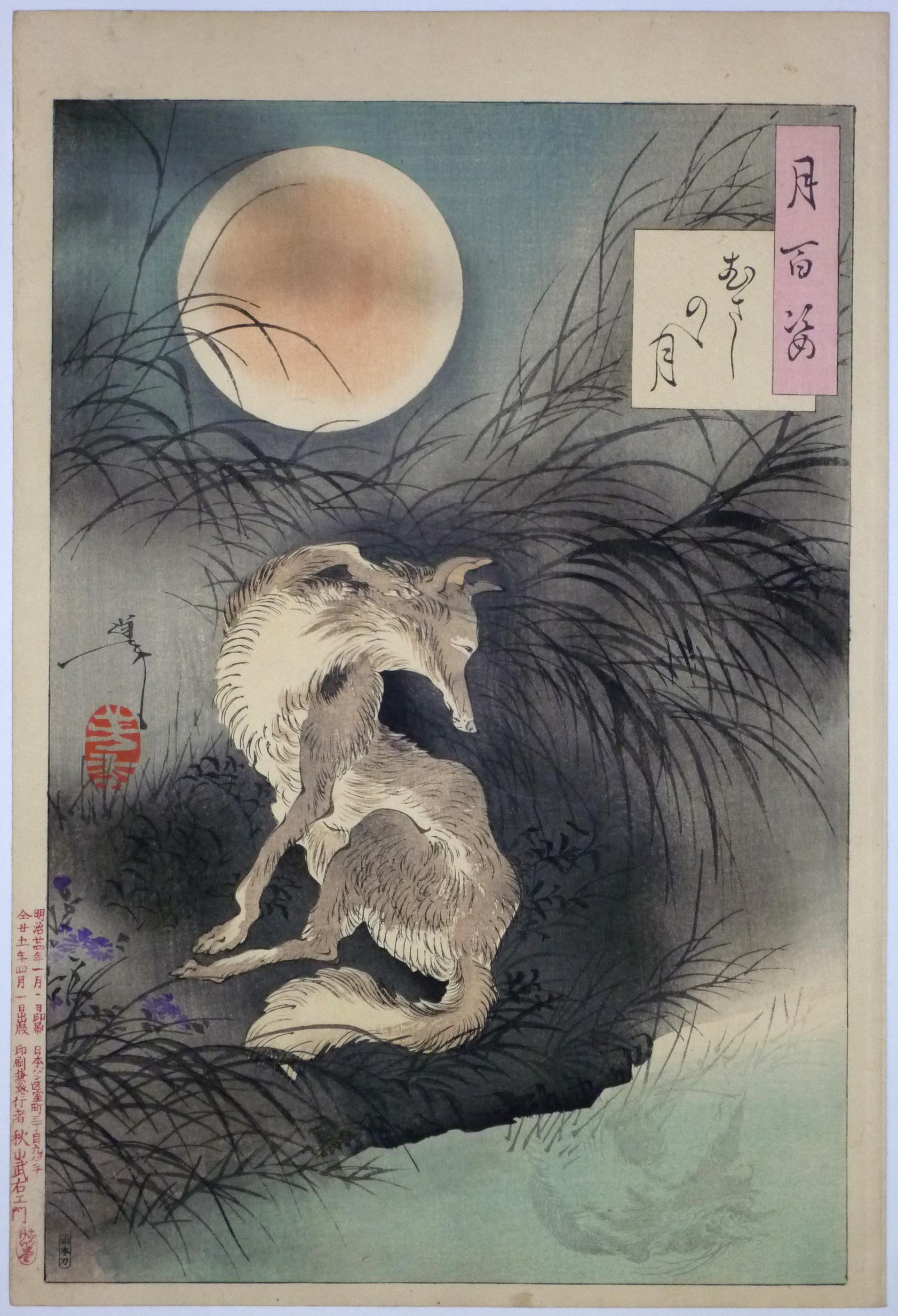
The fox goddess
In East Asia, the fox has a much stranger and grander career. In China, the huli jing, the fox spirit, could live for centuries, gaining power as it aged, and could take the form of a beautiful woman to seduce men and drain their life force. In Japan, the kitsune, or fox, is both a trickster and a divine messenger. A kitsune gains a new tail every hundred years, and a nine-tailed fox is ancient and immensely powerful. White foxes are the messengers of Inari, the Shinto deity of rice, harvests, and prosperity, and stone foxes, often holding a key or a jewel in their mouths, guard the thousands of Inari shrines across Japan, including the famous Fushimi Inari shrine in Kyoto, with its tunnels of vermilion gates. Farmers valued foxes because they kept down the rats and mice that ate rice, and this practical relationship became, over the centuries, a sacred one.

The Japanese film director Akira Kurosawa put one of these beliefs on screen. In the first part of his film Dreams (1990), a little boy is told by his mother not to go into the forest on a day when the sun is shining through the rain, because that is when the foxes hold their weddings, and they do not like to be seen. He goes anyway, and hides behind a tree to watch a slow, silent, beautiful procession of fox-people in wedding clothes. They see him. When he returns home, his mother tells him the foxes are angry and that he must go and beg their forgiveness, at a place where the rainbows end. It is a child's dream of a secret world close to our own, where breaking a rule carries real weight.


India has the same belief with a different animal. When the sun shines during rain, people in many parts of the country say the jackals are getting married, siyar ki shaadi. That the same odd weather should be explained, in Japan and in India, as a wedding of the wily dog-like animals, is one of those small echoes across cultures that make one wonder how far stories travel, or how alike human imagination is everywhere.
Inari is one of the most widely worshipped deities in Japan: there are said to be some thirty thousand Inari shrines, about a third of all Shinto shrines. Inari is the god of rice, harvests, prosperity, and later of business and success; merchants and companies make offerings for good fortune. Foxes, kitsune, are Inari's messengers, not Inari itself, though the two are often confused. At Fushimi Inari Taisha in Kyoto, the head shrine, founded in 711, thousands of vermilion torii gates, donated by individuals and businesses with their names written on them, form tunnels that wind for several kilometres up Mount Inari. Stone foxes with red bibs guard the paths, holding in their mouths a key to the rice granary, a jewel, a scroll or a sheaf of rice. Offerings of fried tofu, aburaage, said to be the foxes' favourite food, give their name to inari-zushi, rice packed in fried tofu pouches.

Kurosawa's Dreams (1990) is a film of eight short episodes, based on the director's own dreams. In the first, "Sunshine Through the Rain", a small boy is told by his mother not to go into the woods when the sun shines through rain, because that is when foxes hold their weddings, and they do not like to be watched. He goes anyway, hides behind a tree and watches a slow, eerie procession of people in fox masks and wedding robes moving through the misty forest in a ritual dance. When he returns home, his mother says a fox has come with a knife: he must go and ask forgiveness, or kill himself. She sends him off towards the place under the rainbow where the foxes live. The episode is one of the most haunting in cinema: a child's first brush with the sacred and dangerous world beyond the village. The Indian belief that a sun-shower means the jackals' wedding, siyar ki shaadi, shows the same intuition in another land: a strange moment in the weather is a door to the animal world.


The Chinese and Japanese fox-wife stories have darker sides as well. The huli jing of Chinese legend, and the kitsune of Japan, could take the form of beautiful women, marry men and bear children, and slowly drain their husbands' life, or, in kinder tales, be loyal wives forced to leave when their true nature was discovered. The most famous Japanese story is of Kuzunoha, a white fox who, saved by a man, takes human form, marries him and bears a son, the legendary astrologer Abe no Seimei; when her son sees her fox shadow, she must leave, writing a farewell poem on a paper screen. The nine-tailed fox, Tamamo-no-Mae, was said to have bewitched rulers in India, China and Japan in turn, before being killed and turned into a poisonous stone, the Sessho-seki, at Nasu in Japan. In March 2022, visitors found that the stone had cracked in two, and the news spread worldwide on social media, with jokes that the fox had escaped. Japanese folklore lives on in unexpected ways.
The jackal and the dead
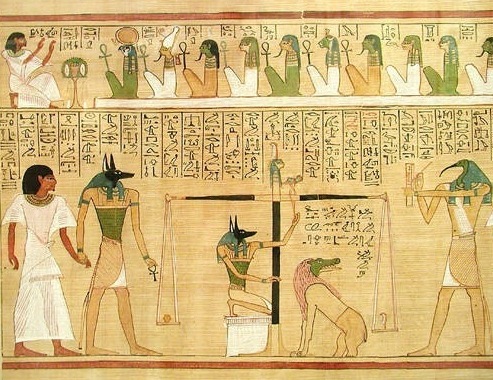
In ancient Egypt, the god Anubis, protector of the dead and god of embalming, was depicted with the head of a black canine, traditionally identified as a jackal. Jackals were often seen prowling around cemeteries in the desert, digging at graves, and the Egyptians may have made the jackal-god the guardian of the dead partly to turn the scavenger into a protector. In 2015, genetic research showed that the "golden jackals" of Africa are in fact a separate species, the African golden wolf, more closely related to grey wolves and coyotes than to the golden jackals of Asia. So Anubis, it turns out, was probably a wolf.
In India, the jackal appears in folklore as cunning and cowardly, and "jackal" is sometimes a term for a flatterer. But the jackal is also associated with the goddess Kali, who is attended in cremation grounds by jackals, and in Tantric traditions, jackals receive offerings as her messengers. Their cries at night were interpreted as omens.
The trickster is always duping others and always being duped himself. And yet he brings fire.
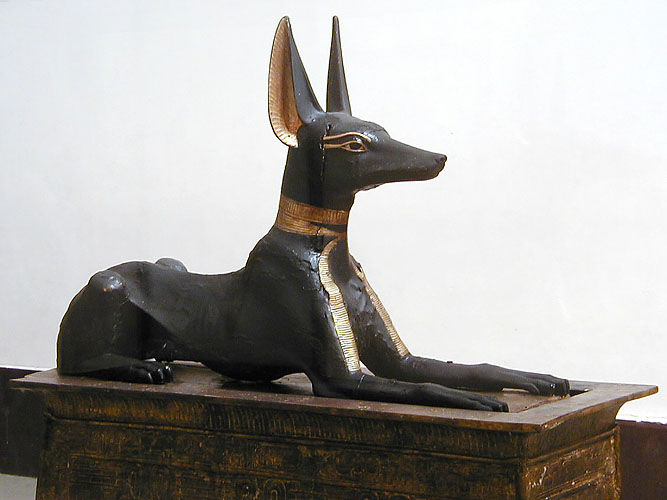
Anubis's role in Egyptian religion was central. He was the god of embalming, said to have invented mummification when he prepared the body of the murdered god Osiris; priests who embalmed the dead wore Anubis masks. He guarded cemeteries, and in the judgement of the dead, shown in the papyrus of Hunefer and many other copies of the Book of the Dead, he leads the deceased to the scales and checks the balance as the heart is weighed against the feather of Maat, the goddess of truth and order. If the heart was heavy with wrongdoing, it was eaten by the monster Ammit; if it balanced, the dead person passed into the afterlife. Tutankhamun's tomb contained a magnificent black Anubis statue, lying on a gilded shrine at the entrance to the treasury, as if guarding it. The jackal's black colour, which real jackals do not have, stood for the black fertile soil of the Nile and for rebirth, not for death.

The discovery that Africa's "golden jackals" are a separate species, the African golden wolf, Canis lupaster, came in 2015 from a genetic study led by Klaus-Peter Koepfli and Robert Wayne. Their DNA showed that the African animals were more closely related to grey wolves and coyotes than to the Eurasian golden jackals of India and Europe; the two had evolved similar looks separately. The ancient Egyptians, who knew the animal well, had called it by a word that some scholars think may simply mean "dog". So the god who guarded Egypt's dead was, biologically, a wolf, an elegant link to the wolf chapter of this book, where the wolf guards the threshold between the wild and the human, and to Anubis's Indian cousin, the jackal of the cremation grounds who attends the goddess Kali.

What the tricksters teach
The fox, the jackal, and the coyote are survivors. They have lived beside human beings for thousands of years, stealing our chickens, eating our rubbish, avoiding our traps, and thriving in the spaces we create. Human beings admired and resented them in equal measure, and turned them into the tricksters of myth: rule-breakers who expose the pretensions of kings, advisers who manipulate the powerful, thieves who steal fire for humanity. The trickster reminds us that intelligence is not the same as virtue, that cleverness can serve good or evil, and that the world is shaped as much by accident and mischief as by plan. In an age of disappearing wildlife, the tricksters are among the few wild animals that are winning. There may be a lesson in that too.

Modern writers have softened the fox. In Antoine de Saint-Exupéry's The Little Prince (1943), a fox meets the little prince in the desert and asks to be tamed. The prince does not understand, and the fox explains: to tame means to make ties. Right now, the fox says, you are just a boy like a hundred thousand others, and I am just a fox like a hundred thousand others. But if you tame me, we will need each other, and you will be unique in all the world to me. Slowly, day by day, sitting a little closer each time, the prince tames the fox. When the time comes to leave, the fox is sad, but tells him a secret: "what is essential is invisible to the eye", and that you become responsible, forever, for what you have tamed. It is one of the simplest and deepest lessons about love in modern literature, given, of all creatures, by a fox.
Roald Dahl's Fantastic Mr Fox (1970), filmed by Wes Anderson in 2009, is a children's classic in which a clever fox outwits three nasty farmers who try to dig him out of his home, and feeds all the animals underground. The fox is the hero, and the greedy farmers the villains. Ted Hughes's poem "The Thought-Fox" (1957) is about something quite different: the poet sits alone at midnight with a blank page, and slowly, a fox comes out of the dark forest of his mind, step by careful step, until it enters his head, and the page is printed. Writing a poem, Hughes suggests, is like waiting for a shy wild animal to come to you; you cannot force it. And Disney's Robin Hood (1973), with a fox as the outlaw who steals from the rich to give to the poor, and the sly, charming con-fox Nick Wilde of Zootopia (2016), play on the fox's charm: the trickster, at last, as the hero we cheer for.

Saint-Exupéry's fox is perhaps the most quoted fox in literature. In The Little Prince, the fox asks the prince to tame him, and explains what taming means: to create ties. Until then, the prince is just one little boy among a hundred thousand, and the fox one fox among a hundred thousand. Once tamed, they will need each other; the fox will love the colour of the wheat fields because they will remind him of the prince's golden hair. When the prince must leave, the fox tells him his secret: one sees clearly only with the heart, and what is essential is invisible to the eye. He adds that you become responsible, forever, for what you have tamed. It is a strange reversal of the old trickster: the fox here is not cunning but wise, and teaches love. Yet he also echoes the Russian experiment, in which taming did create real ties, and changed the fox itself.
Roald Dahl's Fantastic Mr Fox (1970) is a trickster story told from the fox's side. Mr Fox steals chickens, ducks, geese and cider from three nasty farmers, Boggis, Bunce and Bean, who try to dig him out, shoot him and starve him; he outwits them by tunnelling into their storehouses and throwing a feast for all the underground animals. Dahl wrote it in a shed at the end of his garden in Buckinghamshire, near a large beech tree where, he said, a family of foxes lived. Wes Anderson's stop-motion film (2009), with George Clooney as Mr Fox, added a middle-aged crisis: Mr Fox has promised his wife to give up stealing, but cannot resist one last raid, and has to face what he really is. "I'm a wild animal," he says. The trickster, again, cannot escape his nature. Ted Hughes's "The Thought-Fox", written in 1955 and published in 1957, describes a poet sitting at midnight before a blank page while a fox's nose, eyes and paws move through the dark snow outside, until the fox enters "the dark hole of the head" and the page is printed. The fox becomes inspiration itself: shy, sudden, coming from the wild into the mind.