Part Five · Scale and Water
Chapter 27
The Whale and the Dolphin
Songs that travel across oceans, grandmothers who lead, a blind dolphin in the Ganga, and the great fish that swallowed the prophet.
Assisted and Curated by Claude, Referenced and Collated by me
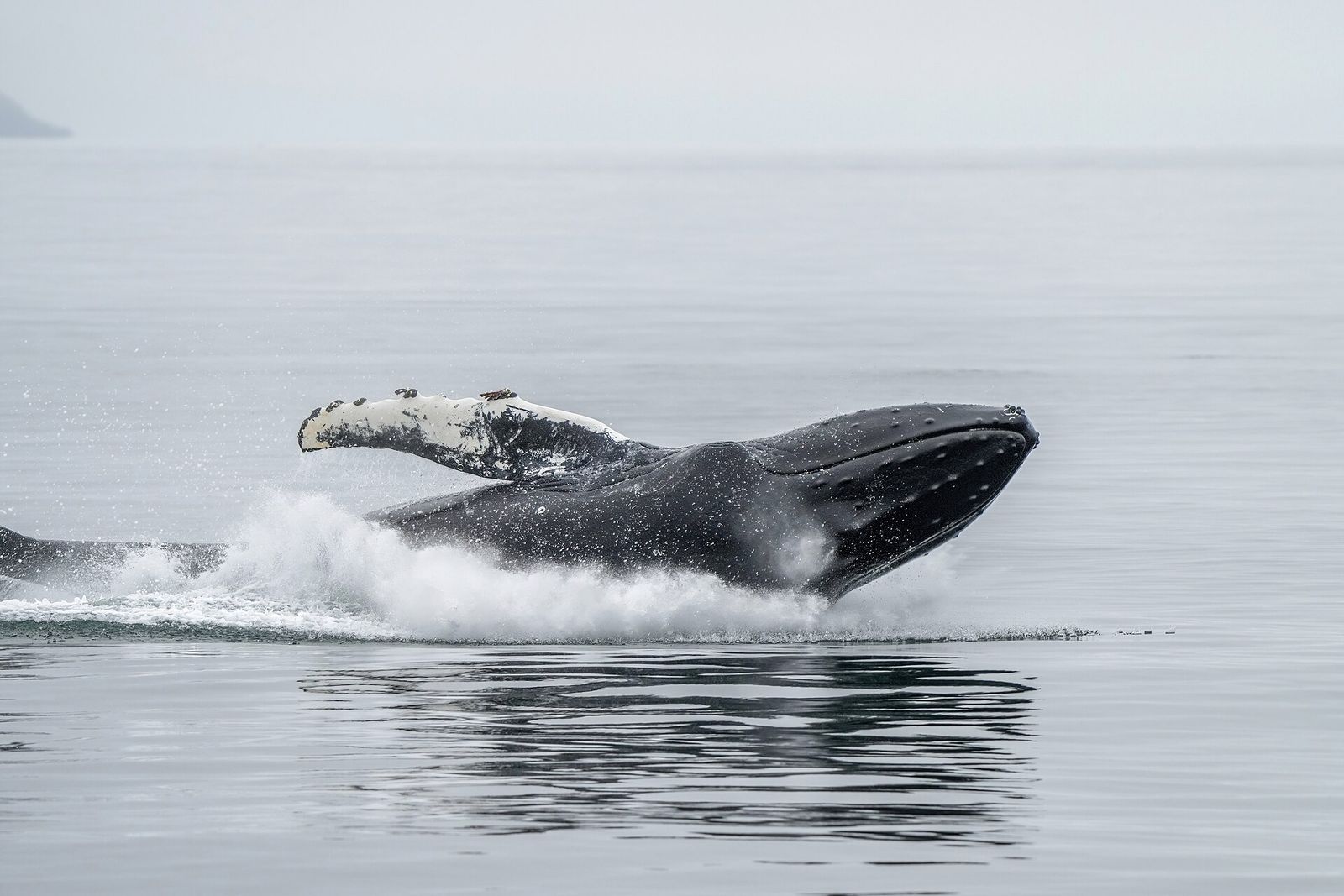
Infraorder Cetacea
In 1967, the American biologist Roger Payne and the engineer Scott McVay listened to recordings made by a US Navy engineer off the coast of Bermuda. The recordings were of humpback whales, and the sounds on them were extraordinary: long, eerie moans, rising whoops, deep rumbles, and high cries, which Payne and McVay recognized as organized into repeating phrases, themes, and sequences, sometimes lasting more than thirty minutes before starting again. They published their analysis in 1971, in a paper titled "Songs of Humpback Whales." The year before, Payne had released a record, Songs of the Humpback Whale, which became an unexpected bestseller. It was played at rallies and in parliaments, and helped launch the global Save the Whales movement. In 1982, the International Whaling Commission voted for a moratorium on commercial whaling, which took effect in 1986.

A few recordings of an animal's voice changed the fate of a whole order of creatures. It was perhaps the first time that listening to another species directly changed human law.
Roger Payne, who died in 2023, spent his life listening to whales. The recordings that changed his life were made by Frank Watlington, an engineer at a US Navy station in Bermuda, who had been listening for Soviet submarines with underwater microphones in the 1950s and kept recordings of the strange sounds he heard. He gave them to Payne and his wife Katy, the same Katy Payne who later discovered elephant infrasound. Payne and Scott McVay printed out the sounds as spectrograms, pictures of sound, and saw that they repeated in complex patterns. The record Songs of the Humpback Whale (1970) sold over a hundred thousand copies; in 1979, National Geographic included a flexi-disc of whale song in ten million copies of the magazine, the largest single pressing of a record ever made. Humpback song was included on the Golden Records carried by the Voyager spacecraft, launched in 1977 and now beyond the solar system, as one of the sounds of Earth. Payne said later that he hoped people would hear in the songs evidence of minds worth protecting.

Commercial whaling had driven many species to the edge by the twentieth century. With explosive harpoons, steam-powered catcher boats and factory ships, whalers killed nearly three million whales in the twentieth century alone, mostly in the Antarctic, for oil used in margarine, soap, lamps and lubricants. Blue whales in the Southern Hemisphere fell from perhaps a quarter of a million to a few thousand. The International Whaling Commission, set up in 1946, at first managed whaling more than it limited it. The moratorium voted in 1982 came after a decade of campaigns, protests at sea by Greenpeace, and the spread of whale songs and images. Japan, Norway and Iceland continued to hunt some whales, under scientific or national exemptions, and Japan left the IWC in 2019 to resume commercial whaling in its own waters. But humpbacks, once reduced to a few thousand, have recovered strongly in many oceans; the western South Atlantic population, down to about 450 in the 1950s, numbered around 25,000 by 2019. It is one of the most hopeful recoveries in the history of conservation.
The singers
Only male humpbacks sing, mostly on their breeding grounds, and all the males in a population sing roughly the same song, which gradually changes over the course of a season. In 2000, the Australian biologist Michael Noad and his colleagues reported something astonishing. Off the east coast of Australia, a couple of males had begun singing a song from the humpbacks of the Indian Ocean, off western Australia. Within two years, every male on the east coast had abandoned its own song and adopted the new one. Later research showed that songs spread in waves eastward across the South Pacific, from population to population, over years. It is one of the most striking examples of cultural transmission in any non-human animal: something like a hit song sweeping across an ocean.
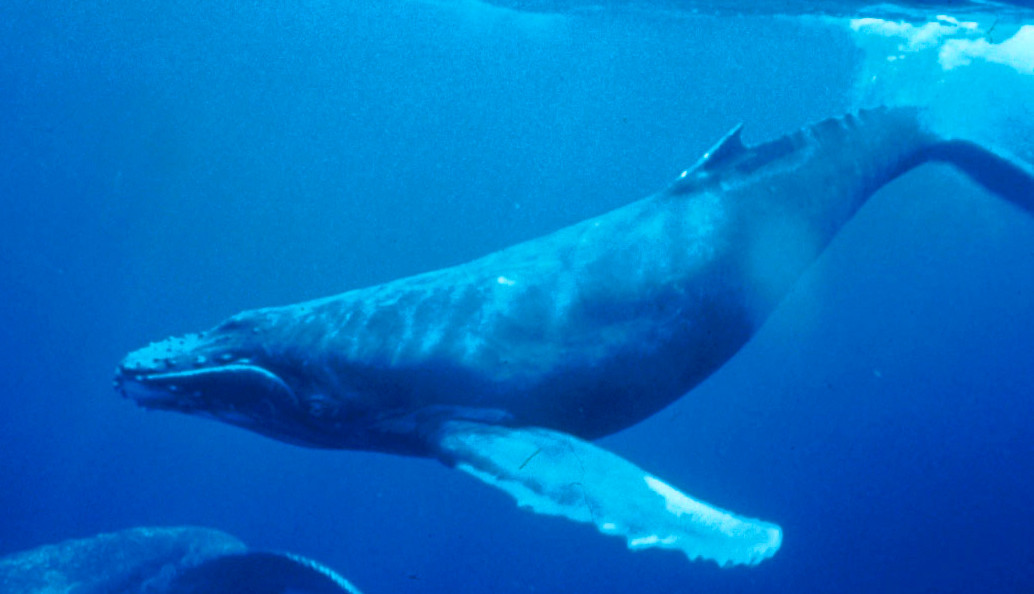
Sperm whales, the deep-diving giants of Moby-Dick, communicate with patterns of clicks called codas, and different social groups, or clans, use distinct repertoires of codas, like dialects. Research led by the biologist Shane Gero in the Caribbean, and more recently by Project CETI, which is using artificial intelligence to analyse sperm whale communication, has revealed that these codas vary in structured ways that some researchers have compared to a phonetic system. What they mean, no one yet knows.
A song sung by a few whales off western Australia spread, within two years, to every male on the east coast.

The whale's story is carved in stone too. At Bangudae, near the city of Ulsan in South Korea, a cliff face beside a river is covered with ancient carvings, perhaps seven thousand years old or more. Among deer, tigers and people, there are dozens of whales: whales diving, whales with calves on their backs, and boats full of people hunting whales with harpoons and floats tied to ropes. They may be the oldest pictures of whaling anywhere in the world. The people who made them knew the different kinds of whales well enough to draw them so you can tell them apart.
And in Wadi Al-Hitan, the "Valley of Whales", in the desert west of Cairo, the sand is full of the fossil skeletons of whales that lived about forty million years ago, when that desert was a shallow sea. Some of them, like Basilosaurus, are long and snake-like, and still have tiny back legs, complete with knees and toes, far too small to walk on. Those little legs are a message from deep time. They show that whales came from land animals, four-legged mammals that slowly returned to the sea over millions of years, losing their legs along the way. The great singer of the oceans has a walking ancestor in its family tree.
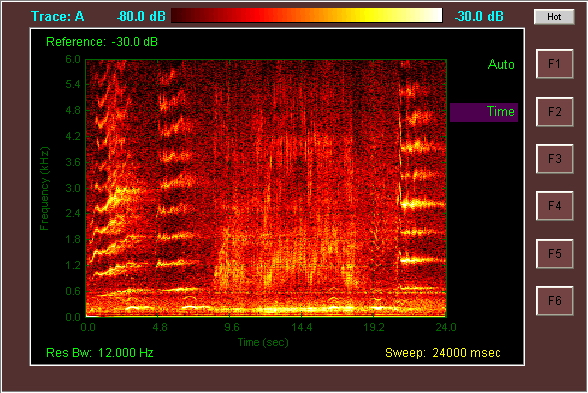
Michael Noad's discovery about song transmission was made by listening at Point Lookout, on the east coast of Australia, where humpbacks pass on their migration. In 1995, he and his colleagues recorded the usual east coast song. In 1996, two males among the eighty-two recorded were singing a completely different song, which matched the song of the west coast population, from the Indian Ocean side. By 1997, almost all the males had switched to the new song, and by 1998 the old song was gone. Researchers led by Ellen Garland later showed that songs travel eastward across the South Pacific, from Australia to New Caledonia, Tonga, the Cook Islands and French Polynesia, a new song arriving in each population after a year or two, over thousands of kilometres. Garland compared it to the spread of a hit song in human culture. Why male humpbacks change their songs is still unknown. One idea is that females are attracted to novelty, so males with new songs have an advantage, much as in human fashion.
Project CETI, the Cetacean Translation Initiative, was launched in 2020 by a group of marine biologists, linguists, roboticists and computer scientists, working with Shane Gero's Dominica Sperm Whale Project in the Caribbean. Gero had followed the same families of sperm whales off the island of Dominica since 2005, recording thousands of codas. Sperm whale families belong to vocal clans, and the clans use different sets of codas, like dialects; one clan even has a coda that seems to act as a group badge. In 2024, CETI researchers reported that sperm whale codas vary in tempo, rhythm and small extra clicks in structured ways, which they called a "sperm whale phonetic alphabet". Whether these patterns carry meaning in the way human words do is unknown. The project uses machine learning to look for patterns too complex for human listeners. Its leaders say the aim is not only to understand the whales but to change how humans treat them: if we discover they have something like language, it may be harder to ignore their suffering.

Wadi Al-Hitan, the Valley of Whales, lies in the Western Desert of Egypt, in what was once a shallow sea about forty million years ago. The fossils there were noticed from the early twentieth century, and in the 1980s and 1990s, the American palaeontologist Philip Gingerich and Egyptian colleagues studied them closely. They found complete skeletons of Basilosaurus, an early whale up to eighteen metres long, with tiny, perfectly formed hind legs, knees and toes, too small for walking, perhaps used in mating. In 2005, the valley became a UNESCO World Heritage Site. Other fossils from Pakistan and India, including Pakicetus and Indohyus, show even earlier stages: four-legged animals living near water about fifty million years ago, related to hippos. Indohyus, found in Kashmir, was a small deer-like animal with a thick ear bone like a whale's, suggesting that the ancestors of whales once walked the land of the Indian subcontinent before it collided with Asia. The great fish of Matsya and Jonah turns out to have been, long ago, a land animal from the Himalayan foothills.
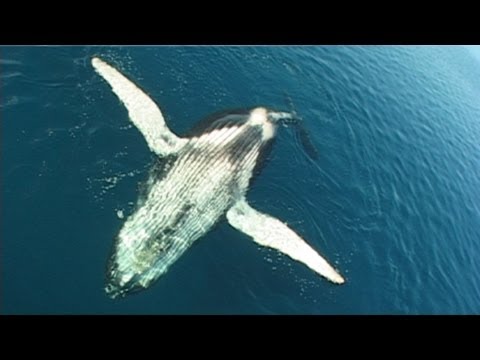
The grandmothers of the sea
Killer whales, or orcas, which are actually the largest members of the dolphin family, live in some of the most stable societies known among animals. The resident orcas of the Pacific Northwest live in matrilineal families: sons and daughters stay with their mothers for their entire lives. Female orcas go through menopause, stopping reproduction in their thirties or forties but living for decades more, one of only a handful of animal species, including humans, in which this happens. Research by Darren Croft and his colleagues has shown that these post-reproductive grandmothers lead their families to salmon, especially in years when food is scarce, and that their presence significantly improves the survival of their grandchildren. As with elephant matriarchs, the old female is the keeper of knowledge.

In 2018, an orca in the Pacific Northwest, known to researchers as Tahlequah or J35, gave birth to a calf that died within half an hour. She carried the body on her head, pushing it through the water, for seventeen days, over a distance of some fifteen hundred kilometres, while other members of her family seemed to take turns helping. The world followed her journey. In the earlier book, we noted that chimpanzee mothers sometimes carry their dead infants for weeks. Grief, if that is what it was, crosses the boundary between land and sea.
The blue whale, which can exceed thirty metres and weigh over a hundred and fifty tonnes, is the largest animal that has ever lived, larger than any dinosaur. The bowhead whale of the Arctic may be the longest-lived mammal; some individuals have been found with ancient stone harpoon tips embedded in their bodies, and chemical analysis of their eyes suggests some live for over two hundred years.

Whale hunting is still part of some peoples' lives, and their ways are very different from the factory ships that nearly wiped out the great whales. At Lamalera, a village on an island in eastern Indonesia, villagers still hunt sperm whales from wooden boats, rowing out and using hand-thrown harpoons. The harpooner leaps from the bow of the boat with his whole body behind the iron. It is extremely dangerous. When a whale is caught, the meat is shared out by ancient rules, so that every family, including widows and the poor, gets a portion. The village catches only a few whales a year, and lives on them. For the Iñupiat of northern Alaska, the spring hunt for bowhead whales from the edge of the sea ice holds the whole community together: the crews, the captains, the sharing, the feasts and the thanks given to the whale. These hunts raise hard questions, but they are a reminder that for some people the whale is not just an animal to save or to sell, but the centre of a whole way of life.

Captive orcas have their own story. The film Free Willy (1993), about a boy who helps a captive killer whale escape from a run-down marine park, moved millions of children to care about orcas in tanks. The orca who played Willy, Keiko, was later moved to better pools and finally taken back to the seas off Iceland, in a long, expensive attempt to return him to the wild. The documentary Blackfish (2013) told the story of Tilikum, a large male orca kept for decades in small tanks at marine parks, who was involved in the deaths of three people. The film argued that a life of confinement and stress had damaged him, and it changed how many people see orcas kept in marine parks. Not long after, the biggest of those parks announced it would stop breeding orcas. A film changed the fate of a species in captivity.
The orcas of the Pacific Northwest have been studied since the early 1970s, when the Canadian scientist Michael Bigg discovered that each orca could be identified by the shape of its dorsal fin and the grey "saddle patch" behind it. This allowed researchers to follow individuals and families for decades. They found that the "resident" orcas, which eat salmon, live in stable matrilines, while "transients", now called Bigg's orcas, which eat seals and other mammals, live in smaller groups and have different calls. The two types rarely mix and may be on the way to becoming separate species. The southern resident population, which lives near Seattle and Vancouver, has fewer than eighty animals and is endangered, because of declining salmon, pollution and boat noise. Tahlequah, J35, who carried her dead calf for seventeen days in 2018, belongs to this group. In 2020 she gave birth to a healthy calf, and her story became, for many people, a story about the grief of a whole endangered community. At the turn of 2025, she lost another calf, and was again seen carrying it.

Darren Croft and his colleagues, working with long-term data from the Center for Whale Research, published a series of studies from 2015 onwards on orca menopause. They found that post-reproductive grandmothers lead their groups more often in years when salmon is scarce, using their knowledge of where fish can be found. A grandmother's death sharply raises the death rate of her grandchildren in the following years. They also found that when an older and a younger female breed at the same time, the older female's calves are more likely to die, which may explain why menopause evolved: it avoids competition between generations. Humans, orcas, short-finned pilot whales, belugas and narwhals are the only species known to have a clear menopause. In all of them, the old female's knowledge and care seem to be more valuable to her family than more children of her own. In human evolution, too, the "grandmother hypothesis" suggests that grandmothers who helped feed their grandchildren gave our species an advantage.
Blackfish (2013), directed by Gabriela Cowperthwaite, told the story of Tilikum, a male orca captured off Iceland in 1983 who spent his life in marine parks and was involved in the deaths of three people, including the trainer Dawn Brancheau at SeaWorld Orlando in 2010. The film argued that keeping orcas in small tanks causes stress, aggression and suffering. It caused a public backlash, attendance at SeaWorld fell, and in 2016 the company announced it would end its orca breeding programme. Tilikum died in 2017. Free Willy (1993) had also had real consequences: its orca star, Keiko, was living in poor conditions in a Mexican amusement park; after the film, a campaign raised millions to move him to better facilities and finally to Iceland in 1998, where he was trained to live in the sea. Keiko swam to Norway in 2002 but never fully joined wild orcas, and died there in 2003. His story showed how hard it is to return an animal to the wild once it has known only captivity, the same lesson learned from Nim the chimpanzee.The blind dolphin of the Ganga
India's national aquatic animal, declared in 2009, is the Ganges river dolphin, or susu, named for the sound it makes when it surfaces to breathe. It lives in the muddy waters of the Ganga, the Brahmaputra, and their tributaries, where visibility is almost nil, and it is virtually blind: its eyes lack lenses and can probably detect only the direction and intensity of light. It finds its way and hunts fish entirely by echolocation, emitting clicks and listening to the echoes, swimming on its side and sweeping its long, thin beak through the mud. It is one of the few surviving species of true river dolphin in the world; China's Yangtze river dolphin, the baiji, was declared functionally extinct in 2006. The Ganges dolphin, numbering a few thousand, is threatened by dams, pollution, fishing nets, and boat traffic. In the brackish Chilika lagoon of Odisha lives a population of Irrawaddy dolphins, whose rounded heads give them a gentle, smiling look.

The Vikramshila Gangetic Dolphin Sanctuary in Bihar, set up in 1991, protects about sixty kilometres of the Ganga between Sultanganj and Kahalgaon for the susu, the nearly blind river dolphin. It is one of the few protected areas in India made for an animal that lives in a working river, full of boats, fishing nets and towns, so protecting it means working with the people who use the river every day.
On the Saurashtra coast of Gujarat, fishermen showed what belief can do. The whale shark, the largest fish in the world, gentle and slow, used to be killed there in large numbers for its meat and liver oil. Then, in 2004, a campaign by wildlife groups won the support of the popular spiritual leader Morari Bapu. In his public talks, he told fishermen that the whale shark comes to the Gujarat coast to give birth, just as a married daughter comes back to her parents' home to have her child, and that one does not harm a daughter who has come home. The fishermen began calling the whale shark vhali, "dear one". Many began cutting their own nets, at a cost to themselves, to set whale sharks free, and the government compensated them for the damage. Hundreds of whale sharks have been released since. Laws had made the killing illegal, but it was a story about a daughter that changed people's hearts.

The Ganges river dolphin, Platanista gangetica, is one of the oldest lineages of living whales and dolphins. It and its cousin, the Indus river dolphin of Pakistan, separated from other dolphins tens of millions of years ago. It was first described for science in 1801 by William Roxburgh, a Scottish botanist in Calcutta. Mughal writers had known it earlier: the Baburnama describes the "water hog" of the rivers. Its local names, susu, shushuk, hihu, imitate the sound of its breathing. The Ganges dolphin can grow over two and a half metres long, and the female is larger than the male. It never stops moving: studies suggest it may sleep in very short bursts of a few seconds, adding up to several hours a day, while continuing to swim and echolocate, perhaps because the fast, muddy rivers give it no safe place to rest.
The Vikramshila Gangetic Dolphin Sanctuary, between Sultanganj and Kahalgaon in Bihar, was created in 1991, largely through the efforts of the zoologist Ravindra Kumar Sinha of Patna University, who spent decades studying the dolphins and is sometimes called India's "Dolphin Man". The dolphin was declared India's National Aquatic Animal in 2009, and in 2020 the government launched "Project Dolphin", modelled on Project Tiger. A national survey published in 2025 counted about 6,300 Ganges dolphins, most in Uttar Pradesh, Bihar, West Bengal and Assam. Dams and barrages, such as the Farakka barrage, have cut the population into isolated groups, and the dolphins are often caught in fishing nets; fishermen sometimes use dolphin oil as bait for catfish, a practice that drove illegal killing. Conservationists have worked with fishing communities to find alternative baits.
The whale shark campaign in Gujarat is a remarkable example of faith serving conservation. Whale sharks, the largest fish in the world, growing over twelve metres, visit the Saurashtra coast between December and April. Until 2001, fishermen hunted them for their liver oil, used to waterproof boats, and for meat exported abroad, killing hundreds a year. In 2001 the whale shark was protected under Indian law, but protection on paper was not enough. In 2004, the Wildlife Trust of India, with the International Fund for Animal Welfare and the Gujarat Forest Department, launched a campaign with the help of the popular Ram-katha preacher Morari Bapu. He told fishermen that the whale shark was like a daughter who comes home to her parents' house to give birth, and should be welcomed, not killed. In Gujarati, the shark was named Vhali, "dear one". Fishermen began cutting their nets to release trapped sharks, and the government compensated them for the damaged nets. By the 2020s, hundreds of whale sharks had been released. A religious image did what laws alone could not.

India's coasts and seas hold many other whales and dolphins. Blue whales have been seen off Sri Lanka and the coasts of Kerala, Maharashtra and Gujarat, and in 2015 a blue whale was found stranded on the Ratnagiri coast. Bryde's whales, humpbacks of the isolated Arabian Sea population, which do not migrate and are among the most genetically distinct humpbacks in the world, sperm whales, spinner and bottlenose dolphins, and the Indo-Pacific humpback dolphin, pink and grey, which lives close to shore in the Gulf of Kachchh and along the west coast, are all part of India's marine life. The dugong, a sea cow distantly related to elephants, survives in small numbers in the Gulf of Mannar, Palk Bay and the Andamans, and may have inspired some of the mermaid stories told by sailors. Indian marine mammal science is still young, and much remains to be learned about the great nations of India's seas.

India's waters
The Ganges river dolphin lives in the Ganga and Brahmaputra and their tributaries, across Uttar Pradesh, Bihar, Jharkhand, West Bengal and Assam: in the Ganga itself from Bijnor downstream, in the Chambal, Ghaghra, Gandak, Kosi, Son, Hooghly and Sundarbans channels, and in the Brahmaputra and its tributaries such as the Kulsi, Subansiri and Dibru. Its best-known refuges are the Vikramshila sanctuary in Bihar, the Hastinapur sanctuary in Uttar Pradesh, the Kulsi river in Assam and the Chambal. A tiny, isolated population of the Indus river dolphin, the Ganges dolphin's close cousin, was discovered in 2007 in the Beas river in Punjab, near the Harike wetland, and is now protected by the Punjab government. Irrawaddy dolphins live in Chilika, a great brackish lagoon in Odisha where the Mahanadi's waters meet the sea, and in the Sundarbans; their numbers in Chilika have risen to over a hundred and fifty, and dolphin-watching from boats is now a source of income for fishing villages around Satapada.


India's seas are home to whales, dolphins and dugongs. Dugongs graze on seagrass meadows in the Gulf of Mannar Marine National Park and Palk Bay between India and Sri Lanka, in the Gulf of Kutch and around the Andaman and Nicobar Islands. In 2022, Tamil Nadu declared India's first Dugong Conservation Reserve in Palk Bay. The Gulf of Mannar's coral reefs and islands, a biosphere reserve, also shelter dolphins and sea turtles. The Arabian Sea humpbacks pass along the coasts of Gujarat, Maharashtra, Goa and Kerala; blue whales and Bryde's whales feed off the southwest coast and Sri Lanka; and whale sharks visit the Saurashtra coast, especially around Veraval, where the fishermen's protection campaign began. The Malvan Marine Sanctuary in Maharashtra and the reefs of Lakshadweep add to India's marine protected areas, though they are few and small compared with the country's long coastline.

The great fish
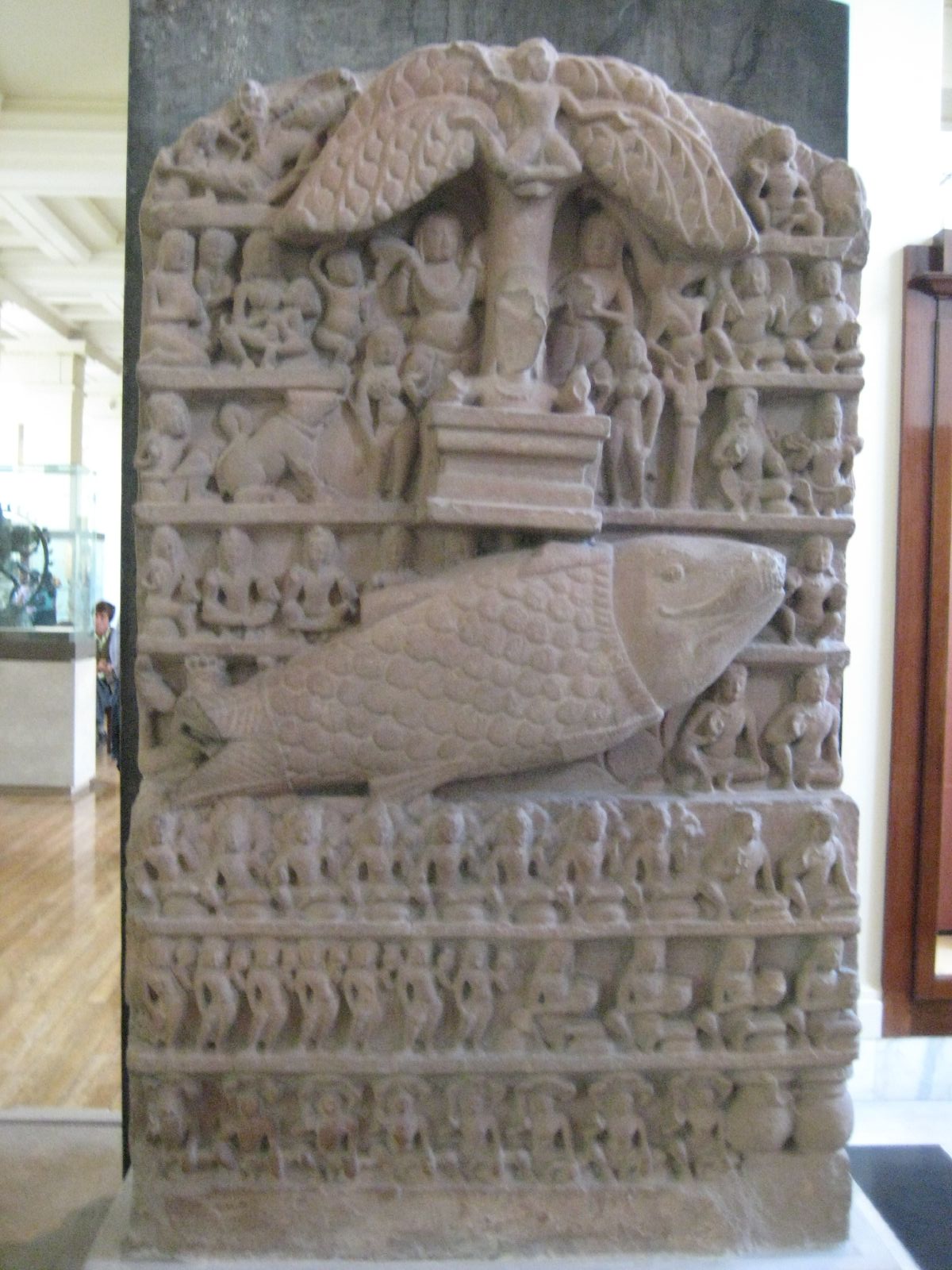
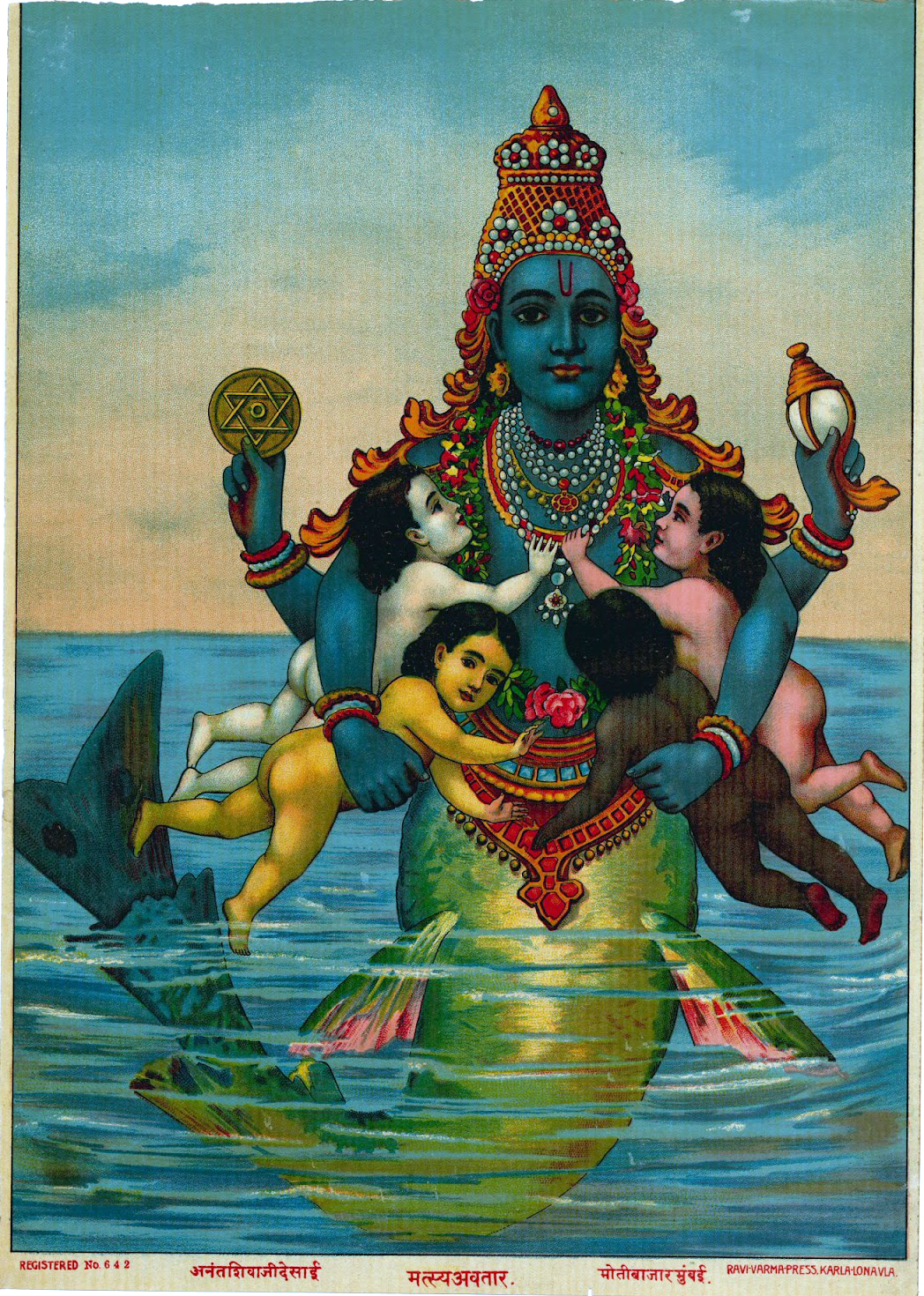
In the Hindu tradition, the first incarnation of Vishnu was Matsya, a fish. The story tells how the sage Manu, washing his hands in a river, found a tiny fish in his palm that begged him for protection. He placed it in a jar, but it grew too big; he moved it to a pond, a river, and finally the ocean, where it grew enormous. The fish then revealed itself as Vishnu and warned Manu of a great flood that would destroy the world. It told him to build a boat and gather the seven sages and the seeds of all living things. When the flood came, the fish towed the boat to safety, tied by a rope to a horn on its head. Flood myths with a rescuing creature appear across the world; Matsya's is the one in which the rescuer is the fish itself.
In the Bible, the prophet Jonah, fleeing God's command, was thrown overboard in a storm and swallowed by a great fish, often imagined as a whale, in whose belly he spent three days and three nights before being cast out on the shore. The monster Leviathan, which appears in the Book of Job and the Psalms, is a vast creature of the sea, possibly inspired by whales or crocodiles. Herman Melville's Moby-Dick of 1851 turned the white sperm whale into one of the great symbols of literature: nature, God, fate, or the unknowable, pursued to destruction by a man consumed by vengeance.
In Greece, the dolphin was sacred to Apollo, whose oracle at Delphi was said by some to take its name from delphis, dolphin; the god had taken dolphin form to guide sailors to the site. The poet Arion, thrown overboard by pirates, was carried to safety on the back of a dolphin charmed by his music. In the Amazon, the pink river dolphin, the boto, is said to take the form of a handsome young man at night, wearing a hat to hide the blowhole on his head, to seduce women at festivals. In Vietnam, whales are worshipped as Cá Ông, "Lord Fish," protectors of fishermen; when a whale washes up dead, coastal communities give it a full funeral and bury its bones in a temple. Among the Māori of New Zealand, the ancestor Paikea rode a whale to Aotearoa from the ancestral homeland.

Matsya towed the boat of the world through the flood. The whale carried Paikea across the ocean.
Carl Jung, borrowing an idea from the German ethnologist Leo Frobenius, gave a name to a story found all over the world: a hero who is swallowed by a whale or sea monster, travels in darkness inside it, often from west to east like the setting and rising sun, and finally bursts out, sometimes by cutting his way free, into the light. Jung called it the "night sea journey". He read it as a picture of something that happens inside people. There are times in life, a loss, a failure, a depression, a crisis, when we feel swallowed: everything goes dark, we cannot see a way out, and the ordinary world seems far away. Jung thought these descents into the dark of the unconscious were not only suffering. They were also a passage. If we go through them, we can come back changed, with something we could not have found any other way. The story of Jonah, swallowed by the great fish for three days and nights and then thrown out on dry land, a different man, is the most famous version.
The American psychologist Abraham Maslow, known for his ideas about human needs and growth, used the same story for a different point. He described what he called the "Jonah complex". In the Bible, God calls Jonah to go and preach to the great city of Nineveh, and Jonah, afraid, runs away in the opposite direction, onto a ship, until the storm and the fish bring him back. Maslow noticed that many people do the same. We are afraid not only of failing, but of our own best possibilities: of the talent we might have, the calling we half-feel, the bigger life we could live. Because rising to them would be frightening and demanding, we run from them and make ourselves smaller. The Jonah complex is the fear of our own greatness. Recognising it, Maslow thought, is the first step to stop running.
Sanskrit texts have their own giant fish. They speak of the timingila, a fish so enormous it can swallow whales, and even of a timingilagila, a fish that swallows the timingila. It is the Indian way of saying what English says with "there is always a bigger fish": however mighty you are, there is someone mightier. The fish is also one of the most common signs in the still-unread script of the Indus Valley, which suggests that it meant something important to those people, perhaps a god, perhaps a star, perhaps a word, though we cannot yet know. And the Matsya story, of Vishnu as the fish who saves Manu and the seeds of life from the great flood, is carved on temple walls from Odisha to Karnataka.

In Europe, Carlo Collodi's Pinocchio (1883) ends with the wooden puppet swallowed by an enormous sea monster, a giant shark in the book, a whale in Disney's film, only to find his father Geppetto already inside, living by candlelight in its belly. Pinocchio, who has lied and run away again and again, carries his father out on his back and swims to shore. It is in the belly of the great fish that he finally stops being selfish, and soon after he becomes a real boy. It is the night sea journey again, told for children.

Among the Māori of New Zealand, whales are honoured ancestors. Their stories tell of Paikea, a man who came to New Zealand riding on the back of a whale. Witi Ihimaera's novel The Whale Rider (1987), filmed in 2002, tells of Kahu, a girl in a village descended from Paikea. Her grandfather, the chief, wants a boy to lead the tribe and will not see that she is the one who has inherited the ancestor's bond with the whales. When a group of whales is stranded on the beach, it is the girl who climbs onto the largest one and leads them back to the sea. The film is about tradition and change, and about a grandfather learning to see the gift in front of him.
The Matsya story is first told in the Shatapatha Brahmana, a Vedic text of perhaps the eighth century BCE, before Matsya was linked to Vishnu, and later in the Mahabharata and the Puranas. It is one of the world's many flood myths, alongside the Mesopotamian flood in Gilgamesh, Noah's ark in Genesis, and the Greek story of Deucalion. Scholars have long debated whether these stories share a common source, perhaps memories of real floods at the end of the Ice Age, or whether floods are simply such universal disasters that every culture imagines them. What makes Matsya distinctive is that the rescuer is a small creature that grows: the fish Manu saves becomes the one who saves him. In the Matsya Purana, the god also carries the Vedas through the flood, so that knowledge survives the destruction of the world. The story links kindness to the small with the survival of everything.

The Jonah story, told in the short Book of Jonah in the Hebrew Bible, is a story about running from duty. God commands the prophet Jonah to go to Nineveh, the Assyrian capital, and warn it to repent. Jonah, who hates the Assyrians, flees by ship in the opposite direction. A storm rises, the sailors throw him overboard, and a great fish swallows him. After three days and nights, he prays from the fish's belly and is spat out on land. He goes to Nineveh, the city repents, and God spares it, to Jonah's anger. The book ends with God asking Jonah whether he should not pity a great city with so many people "and also much cattle", a rare biblical mention of concern for animals. In Islam, Jonah is the prophet Yunus, "the man of the fish", and his prayer from the belly of the fish is recited by Muslims in times of distress. The story has been painted, sculpted and retold for two thousand years, and in Christian art Jonah's three days in the fish became a symbol of Christ's three days in the tomb.
Jung's "night sea journey" comes from the German ethnologist Leo Frobenius, who collected myths from Africa and elsewhere in which a hero is swallowed by a sea monster, travels in its belly from west to east, like the sun passing through the underworld at night, and cuts his way out at dawn. Jung saw this as an image of a psychological process: in times of crisis, depression or deep change, a person is "swallowed" by the unconscious, loses their bearings, and may emerge transformed, if they do not give up. Abraham Maslow, the American psychologist known for his "hierarchy of needs", added the "Jonah complex" in his 1971 book The Farther Reaches of Human Nature: the tendency to flee from our own potential, our calling, because it frightens us. Both ideas take the great fish as a picture of an inner journey. Between them, they offer a modern reading of Matsya too: the small fish we protect may become the force that carries us through the flood.

Herman Melville drew Moby-Dick from his own years on a whaling ship in the 1840s, and from the true story of the Essex, a Nantucket whaler sunk by a sperm whale in the Pacific in 1820, whose survivors drifted for months and resorted to cannibalism. In the novel, Captain Ahab, who lost a leg to the white whale, drives his ship and crew to destruction in pursuit of revenge. The book was a failure when it was published in 1851, and Melville died forgotten in 1891. It was rediscovered in the 1920s and is now often called the greatest American novel. Its long chapters on whale anatomy, whaling and the meaning of whiteness are part of its point: the whale cannot be fully known, measured or conquered. Ahab's tragedy is to treat a living creature as a symbol of everything he hates. Witi Ihimaera's The Whale Rider offers the opposite: a girl, Kahu, who can speak to whales because she belongs to the line of Paikea, and who saves a stranded herd by riding the old bull whale back to sea. Niki Caro's film of 2002, with the young actor Keisha Castle-Hughes, who was nominated for an Oscar, made the story known around the world. Between Ahab's hunt and Kahu's ride lies the whole change in how people have come to see whales.
What the whales teach
The whales teach that intelligence, culture, grief, and memory are not the property of land animals, or of animals with hands. They live in a world of sound, where a song can travel across an ocean and a click can carry a name. For centuries, humans hunted them for oil to light their lamps. It was only when we finally listened to them that we began to stop. The lesson is simple, and it applies to every creature in this book: we protect what we have learned to hear.

