Part Two · Minds Like Ours
Chapter 8
The Elephant
The matriarch's memory, the voices below hearing, the grief over bones, and the god who removes obstacles.
Assisted and Curated by Claude, Referenced and Collated by me

Elephas maximus · Loxodonta
In 1984, the American acoustic biologist Katy Payne was standing beside the elephant enclosure at the Washington Park Zoo in Portland, Oregon, when she felt something strange: a throbbing in the air, a pressure she could feel on her skin but not quite hear. It reminded her, she later wrote, of the sensation she had felt as a child singing in a choir beside the pipe organ, when the lowest notes shook the church. She returned with recording equipment sensitive to very low frequencies, and discovered that the elephants were talking to each other in sounds below the range of human hearing, what scientists call infrasound. These rumbles, it turned out, can travel several kilometres through the air, and in the right conditions even further through the ground, where elephants may detect them with their feet and trunks.
Payne's discovery opened a hidden world. Elephants, it became clear, were carrying on long-distance conversations that humans had never suspected, coordinating the movements of family groups separated by great distances, calling to mates, and warning of danger. The largest land animals on earth had been speaking, all along, in a voice we could not hear.
The largest land animals on earth had been speaking, all along, in a voice we could not hear.
Katy Payne's discovery opened a whole new field. After Portland, she went to Amboseli in Kenya and, working with Joyce Poole and Cynthia Moss, recorded wild elephants for years. They found that elephants have dozens of distinct calls: greeting rumbles when family members meet after a separation, "let's go" rumbles when the matriarch decides to move, mating songs of females, and the deep musth rumbles of males. Later researchers, including Caitlin O'Connell, showed that elephants can pick up these rumbles through the ground, sensing vibrations with special receptors in their feet and trunk tips, and that they sometimes lean forward or lift a foot to listen better. In 2024, a study by Michael Pardo and colleagues in Kenya found evidence that African elephants call each other by individual names, unique calls addressed to particular family members. Only a few animals, including dolphins and some parrots, are known to do anything like this. Payne wrote about her years of listening in Silent Thunder (1998), a book that is as much about patience and attention as about elephants.
The matriarch
There are three living species of elephant: the African savanna elephant, the African forest elephant, recognized as a separate species only in recent decades, and the Asian elephant, which is smaller, with smaller ears, a rounded back, and tusks usually present only in males, and not in all of them. Elephant society is built around females. A family group is led by the matriarch, usually the oldest female, and consists of her daughters, their daughters, and their young. Males leave the family as they reach adolescence, around ten to fifteen years of age, and live alone or in loose groups of bulls, joining families mainly to mate.

The matriarch's age matters enormously. The biologist Karen McComb and her colleagues, working in Amboseli National Park in Kenya, played recordings of the calls of other elephants to family groups and found that families led by older matriarchs were better at distinguishing the calls of familiar elephants from strangers, and at responding appropriately to the roars of lions, especially male lions, which are more dangerous. The oldest female is the family's library: she remembers where water can be found in a drought, which routes are safe, and which animals are threats. In a severe drought in Tanzania in 1993, families led by older matriarchs, who could remember an earlier drought decades before, moved out of the park to find water and lost fewer calves. When poachers kill the oldest elephants for their large tusks, they destroy that memory.
Cynthia Moss began the Amboseli Elephant Research Project in 1972 and has followed the same families for more than fifty years, longer than almost any study of a wild mammal. Each elephant is known by name and recognised by the shape and notches of its ears. Moss's book Elephant Memories (1988) tells the life of a family led by a matriarch called Echo, who became famous through documentaries. Echo led her family through droughts, raised many calves, and once, with her family, spent days helping a calf born with weak legs until it could walk. When she died in 2009, aged about sixty-four, her daughters took over. The study has shown how much an elephant family depends on its older females: calves whose grandmothers are alive survive better, and families who lose their matriarch to poaching often fall apart for years.

The darkest proof of this came from South Africa in the 1990s. In Pilanesberg and Hluhluwe-Umfolozi parks, young male elephants began attacking and killing rhinoceroses, more than a hundred of them, which elephants almost never do. Researchers traced the problem to history: these young males had been moved to the parks as orphans after culling operations killed their families. They had grown up without adult bulls to keep them in check. When older bulls were brought into the parks, the young males' musth was suppressed and the killings stopped. Some scientists have compared the orphans' behaviour to trauma in human children who lose their families to violence. The elephant's society, it turns out, does not just keep elephants alive. It keeps them sane.
Asian elephants, the elephants of India, have been studied less than African ones, but research in recent decades has revealed their own complex societies. The ecologist Raman Sukumar began studying elephants in the Biligirirangan Hills and Mudumalai in the 1980s and showed how elephant herds move through landscapes, raid crops when forest food runs short, and how males, who are more likely to take risks, cause most crop damage. His book The Story of Asia's Elephants (2011) traces the long relationship between elephants and people in Asia. In Sri Lanka, Shermin de Silva's long-term study at Uda Walawe found that Asian elephant society is more fluid than that of African elephants: females form many small, changing groups with a wide network of friends, rather than stable families. Asian elephants also make a range of sounds, from rumbles to squeaks; in Kerala and Karnataka, mahouts have names for many of them.

Tuskless elephants have become a sign of how humans shape evolution. In Asia, only some male elephants grow tusks; in Sri Lanka, fewer than ten percent do. In parts of India, where ivory poaching targeted tuskers for decades, the proportion of tuskless males, called makhnas, has grown. In Mozambique's Gorongosa park, after heavy poaching during the civil war, a 2021 study found that half of the surviving older females were tuskless, and that the trait was passing to their daughters. Poachers, by killing elephants with tusks, had been selecting for elephants without them. A trait that served elephants for millions of years, for digging, fighting and lifting, is disappearing in a few generations because of human greed for ivory.

The ivory trade's history touches India directly. For centuries, Indian craftsmen in Travancore, Mysore, Delhi and Murshidabad carved exquisite ivory, and Indian ivory was exported across the world. India banned the domestic ivory trade in 1991, and the international ivory trade was banned in 1989 under the Convention on International Trade in Endangered Species. Yet tusker poaching continued, notably by the bandit Veerappan, who in the forests on the Tamil Nadu-Karnataka border killed perhaps two thousand elephants in the 1970s and 1980s, as well as more than a hundred people, before he was killed in a police operation in 2004. The elephant's ivory, once a symbol of royal luxury, has been its curse.
The mind of the elephant
An elephant's trunk is a fusion of the nose and upper lip, containing tens of thousands of muscle units and no bones. It can pick up a single blade of grass, uproot a tree, suck up several litres of water, smell water or danger from far away, and caress another elephant. Elephants are among the few animals that have passed the mirror test for self-recognition: in 2006, researchers Joshua Plotnik, Frans de Waal, and Diana Reiss painted a mark on the head of an Asian elephant named Happy at the Bronx Zoo, and she repeatedly touched the mark while looking in a large mirror, suggesting she understood that the reflection was herself.
The behaviour that most moves people is elephants' response to death. Elephants who encounter the bones of another elephant often stop, fall silent, and investigate the bones with their trunks and feet, turning them over, touching the skull and tusks. Families have been observed standing over a dying member, trying to lift her, and returning to the body for days. In one well-documented case in Samburu, Kenya, elephants from several different families visited the body of a dead matriarch over a week. Whether this is grief in the human sense is impossible to know. But it is clearly not indifference.
Male elephants periodically enter a state called musth, in which their testosterone levels rise dramatically, a dark, oily fluid streams from glands on the sides of the head, and they become aggressive and restless. The word comes from Persian and Urdu, meaning intoxicated. In Indian tradition, the fluid, called mada, was prized by poets as a sign of the elephant's power, and bees were said to swarm to it.
India had its own way of thinking about the elephant and the mind, and it is one of the best-known stories in the world. It is told in an old Buddhist text, the Udana, and it goes like this. A king gathers a group of men who were born blind and lets each of them touch an elephant. Then he asks them what an elephant is like. The one who touched the trunk says it is like a thick rope or a snake. The one who touched the side says it is like a wall. The one who touched a leg says it is like a pillar, the one who touched the ear says it is like a winnowing basket, the one who touched the tail says it is like a brush. Each is completely sure he is right. They begin to quarrel, and then to fight.
The story is not really about elephants. It is about how we know anything at all. Each man is partly right: he really did touch a rope-like trunk or a wall-like side. His mistake is not in what he felt but in thinking that his small part was the whole. Jain thinkers loved this story and used it to explain one of their central ideas, anekantavada, which means "not one-sidedness". It says that truth is large and has many sides, and that any one person, standing in one place, sees only some of them. So the wise response to someone who disagrees with us is not to fight but to ask: what part of the elephant are you touching? It is an idea worth carrying into every argument about religion, politics or family. Most quarrels are between people holding different parts of the same animal.
Modern psychology has borrowed the elephant too. The American psychologist Jonathan Haidt, in his book The Happiness Hypothesis (2006), pictures the human mind as a small rider sitting on top of a huge elephant. The rider is reason: the conscious, thinking part of us that makes plans and explains things. The elephant is everything else: our feelings, habits, fears and desires, most of which we are not even aware of. The rider likes to believe he is in charge. But when the elephant really wants to go somewhere, towards the sweet, away from the frightening, the rider can do little about it, and often just makes up good reasons afterwards for where the elephant went.
This explains a great deal of ordinary life: why we know exactly what we should do and still do not do it, why a diet fails, why we lose our temper after deciding not to. Haidt's point is not that the rider is useless. A good rider can guide the elephant gently, train it slowly, choose paths where it is easy to go the right way. But he cannot win by pulling hard on the reins. Change comes from understanding the elephant, not from fighting it. It is a picture that would have made sense to the old Indian teachers who spoke of taming the mind as one tames a wild elephant, patiently, over a long time.
The parable of the blind men and the elephant has several versions. In the Buddhist Udana, a king gathers men born blind and lets each touch a different part of an elephant. The one who touches the head says it is like a pot, the one who feels the ear says a winnowing basket, the tusk a ploughshare, the trunk a plough pole, the body a granary, the foot a pillar, the tail a broom. They quarrel and come to blows. The Buddha uses the story to describe teachers who cling to part of the truth and fight over it. Jain thinkers made it the classic illustration of anekantavada, "many-sidedness": every view captures some aspect of reality, none captures it all. The parable travelled to Persia, where the Sufi poet Rumi retold it with men feeling an elephant in a dark room, and in the nineteenth century the American poet John Godfrey Saxe made it a famous English poem. It has become one of the world's most quoted lessons in humility about knowledge.
Haidt's rider and elephant draws on decades of research in psychology. Studies by Daniel Kahneman and others have shown that much of our thinking is fast, automatic and emotional, while slow, careful reasoning is limited and easily tired. Haidt's image captures this: the elephant is strong and does most of the walking; the rider can plan and steer a little, but if the elephant really wants to go somewhere, the rider usually ends up explaining afterwards why he wanted to go there too. Haidt borrowed the image partly from the Buddha, who compared the mind to a wild elephant that must be patiently trained. The Buddhist Dhammapada says that just as a trainer controls a rutting elephant with a hook, so a person must tame a wandering mind. Two and a half thousand years apart, the Buddha and a modern psychologist reached for the same animal to describe the same problem.
The mirror test with Happy has a sad side story. Happy, an Asian elephant, was captured as a calf in Thailand in the 1970s and has lived at the Bronx Zoo in New York ever since, much of the time alone. In 2018, an animal-rights group went to court arguing that because Happy is self-aware, as the mirror test shows, she should be recognised as a legal person with a right to liberty and moved to a sanctuary. In 2022, New York's highest court ruled five to two against her; legal personhood, the majority said, belongs to humans. But two judges wrote strong dissents, and the case became a landmark in the debate over animal rights. The science that showed Happy knows herself in a mirror also raised the question of what we owe to a mind like hers.


The elephant in India
No civilization has lived with the elephant more intimately than India's. Elephants were captured and tamed in the subcontinent at least four thousand years ago; Indus Valley seals depict them. They became the tanks of ancient Indian warfare, and the great battles of the Mahabharata feature elephant divisions. When Alexander the Great fought the Indian king Porus at the Hydaspes river in 326 BCE, Porus's war elephants terrified the Macedonian horses. Seleucus, one of Alexander's successors, ceded territory to Chandragupta Maurya in exchange for five hundred war elephants, which he then used to win a decisive battle in the west.

India developed a whole science of elephants. The Gajashastra and the Hastyayurveda, attributed to the sage Palakapya, described how to catch, train, feed, and treat elephants, classifying them by body type, temperament, and origin. The Matangalila, a Sanskrit text on elephant lore from Kerala, described their auspicious and inauspicious signs. The elephant appears on Ashoka's lion capital, and in the story of the Buddha's birth: his mother, Queen Maya, dreamed that a white elephant with six tusks entered her side, and the Brahmin interpreters declared that she would bear a great being. In Thailand, Myanmar, and Sri Lanka, white elephants became royal treasures, and in Sri Lanka, elephants still carry the tooth relic of the Buddha in the Esala Perahera procession in Kandy.

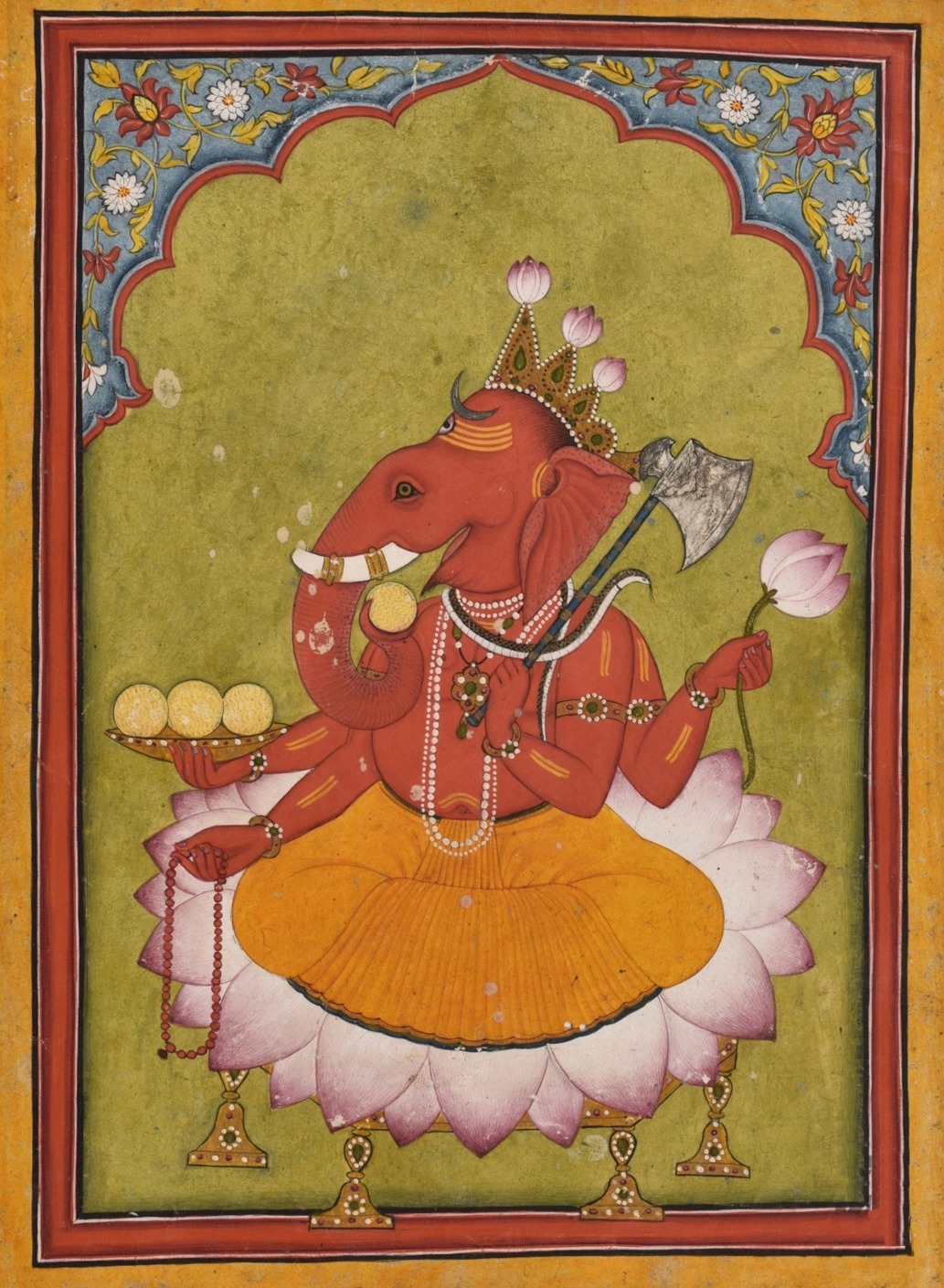
In Hindu tradition, the elephant-headed god Ganesha, the remover of obstacles and the lord of beginnings, is invoked at the start of every undertaking. In one well-known story, Parvati created him from the dirt of her body and set him to guard her door; when Shiva, returning, was refused entry, he cut off the boy's head in anger, and then, to console the grieving Parvati, replaced it with the head of the first creature found, an elephant. Indra, king of the gods, rides the white elephant Airavata, who emerged from the churning of the ocean. The goddess Lakshmi is often shown as Gaja Lakshmi, seated on a lotus while two elephants pour water over her from their trunks. Elephants were thought to hold up the world, eight of them standing at the eight directions, the diggajas, and to be related to the clouds; in one myth, elephants once had wings and flew like clouds until a sage cursed them.

The stone record of the elephant is spectacular. Far away in Ukraine, at a place called Mezhyrich, people of the Ice Age about fifteen thousand years ago built round huts out of the bones and tusks of mammoths, the woolly cousins of elephants, using huge jawbones for walls and tusks for the roof. That shows how much those people depended on these animals. But India carved elephants on a grander scale than anyone.
At Dhauli in Odisha, near the place where Ashoka is said to have fought the terrible Kalinga war and then turned to peace, the front half of an elephant is cut out of the living rock, above his inscribed edicts. It looks as if it is stepping out of the hill itself, and it may be a sign of the Buddha, who in the old stories came into his mother's womb as a white elephant. Elephants march around the gateways of the great stupa at Sanchi. At Mamallapuram on the Tamil coast, in the huge carved rock known as "Arjuna's Penance" or "The Descent of the Ganges", a family of life-size elephants walks along the bottom, the great tusker shading his little ones, and stone elephants also stand beside the Shore Temple. At Ellora, rows of carved elephants line the base of the Kailasa temple, so that the whole mountain-like temple, cut down into a single rock, seems to rest on their backs.

Poets saw elephants in the sky. In Kalidasa's Meghaduta, "The Cloud Messenger", a yaksha, a spirit exiled far from his wife, sees the first monsoon cloud resting against a hill and asks it to carry a message to her. To him the dark cloud nudging the hillside looks just like an elephant playfully butting a bank of earth with its head. It is a lovely picture, and it echoes the old myth we met above, that elephants once flew like clouds until a sage cursed them, which is why they are still linked with rain. The Sanskrit Matangalila, "the play of elephants", from Kerala, is a whole poem of elephant lore, describing their birth, their kinds, their good and bad signs, and how to care for them. It shows how much careful knowledge people had gathered about elephants, and how much they loved them.
India's long science of elephants is one of the world's oldest bodies of knowledge about a single animal. The Gajashastra and Hastyayurveda, attributed to the sage Palakapya, whom legend says was raised among elephants, cover everything from diet and housing to diseases and surgery. Kautilya's Arthashastra, a treatise on government from around the third century BCE, describes elephant forests, nagavanas, set aside along the borders of the kingdom, with officers to protect them and harsh punishments for killing an elephant. In a sense, these were India's first protected areas, and they were protected because elephants were the king's tanks. The Mughals kept tens of thousands of elephants; Akbar is said to have had over five thousand, and he was famous for riding the most dangerous musth bulls himself. Jahangir recorded in his memoirs observations on elephant pregnancy and birth in captivity.

The story of Ganesha's head has many versions, and their variety tells us something. In one, it is Shani, the planet Saturn, whose glance burns off the baby's head. In another, Shiva's trident cuts it off when Ganesha blocks his way. In some, the elephant's head comes from Airavata himself. Scholars think Ganesha may have begun as a group of troublesome forest spirits, the vinayakas, who caused obstacles and had to be appeased, before he became the god who removes them. His worship spread hugely in the first millennium CE, and today he is honoured not only across India but in Nepal, Indonesia, Thailand and Japan, where he is known as Kangiten. In 1893, the freedom fighter Bal Gangadhar Tilak turned the household Ganesh festival in Maharashtra into a public, community celebration, partly as a way of bringing people together against British rule. The giant Ganesha idols paraded and immersed in the sea in Mumbai every year are the result.
Ashoka's elephant at Dhauli was carved in the third century BCE, above the rock on which his edicts are inscribed, near Bhubaneswar, close to the battlefield where the Kalinga war was fought. Its front half emerges from the stone as if walking out of the hill, one of the oldest rock-cut sculptures in India. Some scholars think the elephant stands for the Buddha, whose mother dreamed of a white elephant, so that the emperor's words of remorse and dharma come with the Buddha's own symbol above them. At Mamallapuram, the huge relief known as "Arjuna's Penance" or "The Descent of the Ganga", carved in the seventh century under the Pallava kings, shows a family of life-size elephants walking beside a river of carved figures, the baby elephants sheltering beneath their mothers. The sculptors clearly watched real elephants. In the same relief, a cat stands on its hind legs pretending to do penance while mice play at its feet, a joke from a story about false holiness.

Kalidasa's Meghaduta, "The Cloud Messenger", written perhaps in the fifth century, is one of the great poems of Sanskrit. A yaksha, a semi-divine servant of the god of wealth, is exiled for a year to the hills of central India, far from his wife in the Himalayan city of Alaka. At the start of the monsoon, he sees a dark cloud resting on a peak, looking like an elephant playfully butting a slope, and asks it to carry a message to her. The poem then follows the cloud's journey north across India, describing rivers, cities, forests and temples, as a kind of loving map. The comparison of cloud to elephant is not a casual image. In Indian myth, elephants and clouds are cousins: Airavata's name is linked to water, and the diggajas, the elephants of the directions, were believed to bring rain.

The living temple elephants
In Kerala, elephants remain part of temple life. At the Thrissur Pooram festival, dozens of caparisoned elephants carrying umbrellas and idols stand in facing rows while drummers play. The temple of Guruvayur maintains dozens of elephants of its own. Elephants in captivity have been celebrated, loved, and given names like film stars. They have also, very often, suffered: chained for long hours, overworked in heat, and beaten into submission, and captive elephants sometimes kill their mahouts. The tension between reverence and mistreatment runs through India's relationship with the elephant.

Kerala's temple elephants are famous in their own right, and a few have become as well known as film stars. The most famous was Guruvayur Keshavan, an elephant of the Guruvayur temple who was loved for his gentle nature and his devotion during festivals. When he died in 1976, on the day of a festival, people mourned him like a person. He has a statue at the temple and even a Malayalam film about his life.
The bond between an elephant and its mahout can be very deep. A mahout may work with the same elephant for decades, sleeping beside it, bathing it, speaking to it all day. Stories are often told of elephants who refused food, or stood weeping, after the mahout they knew died. Mahouts pass down a whole culture of elephant handling, often from father to son: special words of command in their own language, songs to calm the animal, knowledge of herbs and medicines, and family traditions about how to earn an elephant's trust.

Kipling's story "Toomai of the Elephants" is about a mahout's young son, Little Toomai, who rides out one night on his father's elephant and sees something no man has seen: the wild elephants gathering in a forest clearing to dance. It is a story about a child being let into a secret world because he loves the animals more than he fears them. Sabu, a real mahout's son from Mysore, starred in the film made from it, Elephant Boy (1937), and became an international star.
Malayalam literature has its own elephant comedy. Vaikom Muhammad Basheer's novel Ntuppuppakkoranendarnnu (1951), which means "Me Grandad 'ad an Elephant", is about a proud family that keeps boasting that their grandfather once owned a great elephant, long after the money and the elephant are gone and they have become poor. The daughter of the house, Kunjupathumma, grows up with this empty pride, and the book gently mocks the habit of living on past glory instead of present truth. The elephant becomes a picture of the things we cling to, to feel important, when they no longer exist.
Guruvayur Keshavan was offered to the Guruvayur temple by a local royal family in 1922, when he was a young elephant, and served there for over fifty years. Stories of his gentleness and devotion spread across Kerala: he was said to kneel when carrying the deity, to refuse to let anyone but his chosen mahouts ride him, and to have been honoured with the title "Gajarajan", king of elephants. He died on Ekadasi day in 1976, and the temple observes the anniversary with a procession of elephants to his statue. The Guruvayur temple's elephant camp, Punnathur Kotta, still houses dozens of elephants. Investigations by journalists and animal-welfare groups, however, have repeatedly reported chained, injured and overworked elephants there and elsewhere. Kerala's love of elephants and its record of keeping them are, as the main text says, in constant tension.

Kipling's "Toomai of the Elephants", one of the stories in The Jungle Book, follows a ten-year-old mahout's son who is carried at night by the great elephant Kala Nag deep into the forest, where he sees the secret "elephant dance", a gathering of wild elephants stamping the ground flat in the moonlight. Old hunters had always said no human had seen it. The story's film version, Elephant Boy (1937), was co-directed by Robert Flaherty, a pioneer of documentary, and Zoltan Korda, and shot partly in Mysore. Its star, Sabu Dastagir, was a twelve-year-old stable boy at the Maharaja of Mysore's palace when Flaherty discovered him. Sabu went on to Hollywood, starred in The Thief of Bagdad (1940) and The Jungle Book (1942), in which he played Mowgli, and became one of the first Indian film stars known around the world.
The conflict
India has around thirty thousand wild Asian elephants, more than half the world's population. They need vast areas, and as forests have been fragmented by farms, roads, railways, mines, and settlements, elephants increasingly move through human landscapes, raiding crops and sometimes destroying houses. In recent years, around five hundred people have been killed by elephants in India annually, and around a hundred elephants die each year from electrocution, train collisions, poisoning, and poaching. In central and eastern India especially, herds have moved into new areas, where people with no tradition of living alongside elephants must suddenly learn how.

The oldest female is the family's library. When poachers kill her, they burn it.
One answer to the conflict between people and wild elephants is, strangely, to use elephants to manage elephants. Trained elephants called kumkis are used in Tamil Nadu, Kerala, Karnataka and Assam. When a wild herd or a single bull starts raiding crops near a village, mahouts ride these big, calm, experienced elephants towards it, and the kumkis push and drive the wild animals back into the forest, or help hold one that must be captured. The Tamil film Kumki (2012) is about a mahout and his trained elephant who are sent to a hill village plagued by a dangerous wild tusker, and about the love and divided loyalties that follow.
George Orwell's essay "Shooting an Elephant" (1936) shows a darker side of power. Orwell had worked as a young colonial police officer in Burma. In the essay he describes the day an elephant broke loose, killed a man, and then calmed down and stood quietly eating grass in a field. Orwell knew he did not need to shoot it. But a crowd of two thousand Burmese people had followed him, watching. He realised that he, the man with the gun, the symbol of empire, could not walk away without looking foolish. So he shot the elephant, badly, and it died slowly and terribly. The point of the essay is that power is a kind of trap. The ruler thinks he is in control, but in fact he must act as the people watching him expect, even against his own conscience. He wrote that he did it "solely to avoid looking a fool". It is one of the most honest pieces ever written about how ordinary people end up doing cruel things.

Orwell's "Shooting an Elephant" is based on his years as a police officer in Burma in the 1920s. In the essay, an elephant in musth has broken its chain, wrecked a market stall and killed a man. By the time the young officer finds it, it is calmly eating grass, and he knows the musth will pass. But two thousand Burmese people have gathered behind him, watching, and he realises that he must shoot it, because a white man in authority cannot look foolish in front of the "natives". He shoots it several times, and it dies slowly and painfully. The essay's famous insight is that when the ruler becomes a tyrant, "it is his own freedom that he destroys": he must spend his life trying to impress those he rules. Scholars still debate whether the event happened exactly as Orwell describes. But it remains one of the sharpest short pieces ever written on power, and it uses an elephant to make its point.
Modern India has found many ways to ease the conflict. In Assam and parts of the northeast, farmers use chilli smoke and fences smeared with chilli paste, which elephants dislike. In Kenya, researchers found that elephants are afraid of bees, and "beehive fences" now protect fields in Africa and parts of India. Early-warning systems send text messages to villagers when collared elephants approach. Railways in some states have used sensors and speed limits in elephant corridors. The Elephant Task Force of 2010, chaired by the historian and conservationist Mahesh Rangarajan, recommended declaring the elephant a National Heritage Animal and protecting the corridors that link elephant forests. Some 150 such corridors have been mapped across India. Protecting a narrow strip of forest a few kilometres long can keep a whole population connected.

The elephant's India
India's wild elephants live in four broad regions, and the government has declared over thirty Elephant Reserves to protect them. In the northwest, a population of about two thousand lives along the Shivalik foothills of Uttarakhand and western Uttar Pradesh, in Rajaji and Corbett, where herds cross the Ganga near Haridwar and wade the Ramganga. The Chilla-Motichur corridor, linking the two banks of the Ganga in Rajaji, is one of the most important and most threatened elephant passages in the country, cut by highways, a railway and canals.

In east-central India, elephants range through the forests of Jharkhand, Odisha, Chhattisgarh and West Bengal: Dalma sanctuary near Jamshedpur, above the Subarnarekha river; Similipal in Odisha; Satkosia, where the Mahanadi cuts a deep gorge through the Eastern Ghats; and the forests of south Bengal. Mining for coal and iron, which lies beneath many of these forests, has broken up their habitat, and since the 1980s herds have moved north and west into Chhattisgarh and even Madhya Pradesh, places where elephants had not been seen for generations. Chhattisgarh's Lemru Elephant Reserve, in the Korba coalfields along the Hasdeo river, has been at the centre of a long fight between mining and forest protection, led by Adivasi villagers of the Hasdeo Arand forest.


The Northeast holds a large population in the forests and floodplains of the Brahmaputra and its tributaries: Kaziranga, Manas, Nameri along the Jia Bhoroli river, the Garo Hills of Meghalaya, the forests of Arunachal's Kameng, and the Dooars of north Bengal, where herds cross tea gardens and railway lines, sometimes with tragic results. In the south, the largest elephant population in Asia lives in the Western and Eastern Ghats, centred on the Nilgiri Biosphere Reserve. Mudumalai, Bandipur, Nagarahole, Wayanad, the BR Hills, Sathyamangalam and the Moyar river gorge form one great elephant country. In the dry season, hundreds of elephants gather on the grassy shores of the Kabini reservoir, one of the largest elephant gatherings anywhere in Asia. Further south, Periyar, Parambikulam and Anamalai shelter herds in rainforest and grassland around the Periyar and Chalakudy rivers. The 2017 count estimated almost thirty thousand wild elephants in India; Karnataka, Assam and Kerala had the most.


Elephant corridors, narrow strips of forest connecting larger habitats, are the key to their future. The Wildlife Trust of India and the Project Elephant division have mapped about 150 of them across the country. Some are only a few hundred metres wide, squeezed between villages, roads and plantations. In the 2010s, the state of Kerala and conservation groups bought land to secure the Thirunelli-Kudrakote corridor in Wayanad, moving families who wanted to leave to new homes. Where corridors stay open, elephants pass quietly through the night. Where they close, conflict begins.

What the elephant teaches
The elephant teaches the value of memory and of the old. In a world that prizes youth, elephant society is organized around the knowledge of grandmothers. Its long life, its slow maturity, its devotion to family, and its apparent response to death make it, among all wild animals, the one most likely to make us wonder what it feels. Ganesha, with his elephant head, sits at the threshold of every beginning. Perhaps that is the right place for an animal whose memory holds the paths through drought, and whose voice, too low for us to hear, carries across the land.

Stories and films keep coming back to the elephant's gentleness. The Portuguese writer José Saramago's novel The Elephant's Journey (2008) is based on a true event. In 1551 the king of Portugal gave an Indian elephant named Solomon to the Archduke of Austria as a wedding present, and the elephant was walked, with his Indian mahout Subhro, all the way from Lisbon across Spain, over the sea to Italy and over the Alps to Vienna. Saramago tells the story with gentle humour. Kings and courtiers squabble and show off, while the elephant and his keeper simply go on walking, patient and dignified, the only real grown-ups in the story.
Disney's Dumbo (1941) made big ears a symbol of the outsider. A baby circus elephant is mocked for his huge ears, and his mother is locked up for defending him. In the end he discovers that the very thing that made him strange is what lets him fly. In India, Haathi Mere Saathi (1971), "The Elephant, My Companion", made elephants Bollywood stars. In it, a man is saved as a boy by elephants and grows up loving them as his family. Its songs are still sung, and its sad ending, when one of the elephants is killed, made audiences weep.
Most moving of all is The Elephant Whisperers (2022), a short documentary about Bomman and Bellie, a couple of the Kattunayakan people in Mudumalai in Tamil Nadu, who raise an orphaned baby elephant named Raghu. We watch them feed him, bathe him, worry over him when he is ill, and slowly become a family around him. When Raghu is finally moved to another camp, their grief is quiet and enormous. It won an Oscar in 2023, the first for an Indian documentary short. Its lesson is very old and very simple: care for another creature changes the one who gives it.
In 2010, the government of India declared the elephant a National Heritage Animal, following the recommendation of the Elephant Task Force. The title has no special legal force, but it captures something true: no other animal is woven so deeply into India's religion, history, art and daily life, from Ganesha on every doorway to the elephants of Kerala's festivals and the herds that walk, still, across the forests of the east and south.