Part Two · Minds Like Ours
Chapter 9
The Apes and Monkeys
Tool-makers, warriors, peace-makers, healers, and the monkey god who leapt across the sea.
Assisted and Curated by Claude, Referenced and Collated by me

Order Primates
In October 1960, a twenty-six-year-old Englishwoman named Jane Goodall, without a university degree, sat on a hillside in the Gombe Stream reserve in Tanzania and watched a chimpanzee she had named David Greybeard. He was crouched by a termite mound. He picked a grass stem, stripped it of leaves, poked it into a hole in the mound, and pulled it out covered with termites, which he ate. Then he did it again. At the time, the use and making of tools was widely considered the defining feature of humanity. Goodall telegraphed her mentor, the paleoanthropologist Louis Leakey. His reply has become famous: in substance, he said that now scientists must redefine "tool," redefine "man," or accept chimpanzees as humans.
That moment was the beginning of a revolution in how human beings understood their closest relatives, and themselves.
Jane Goodall's path to Gombe was unusual. Born in London in 1934, she loved animals from childhood, especially a toy chimpanzee called Jubilee and the Tarzan and Doctor Dolittle books. She could not afford university, so she worked as a secretary and a waitress to save money for a trip to Kenya, where in 1957 she met the paleoanthropologist Louis Leakey. Leakey believed that studying our closest living relatives could help explain the behaviour of early humans, and he deliberately chose people without formal training, whom he thought would observe with fresh eyes. He sent Goodall to Gombe in 1960, with her mother as companion, because the authorities would not let a young woman go alone. For months the chimpanzees fled from her. Then David Greybeard, a calm older male, began to tolerate her, and the others followed. Goodall gave the chimpanzees names instead of numbers, which shocked some scientists, and described their personalities and emotions, which shocked them more. Later, she earned a doctorate at Cambridge, one of very few people admitted without a first degree. In 1977 she founded the Jane Goodall Institute, and she spent the last decades of her life travelling the world to speak for chimpanzees and forests. She died in 2025, aged ninety-one. Few people have changed how humanity sees itself as much as she did.
The great apes
The great apes are our nearest kin. Chimpanzees and bonobos share about ninety-eight to ninety-nine percent of their DNA with us, and our lineages separated from theirs roughly six to seven million years ago. Gorillas are a little more distant, and orangutans more distant still. Apes differ from monkeys in having no tails, larger brains relative to body size, more upright postures, and, as research has repeatedly shown, extraordinary cognitive and social abilities.

Chimpanzees live in communities of twenty to a hundred or more individuals, which split into smaller, shifting groups during the day. Males stay in the community where they were born and form alliances; females usually move to other communities at adolescence. Chimpanzee politics is intricate. The Dutch primatologist Frans de Waal, in his book Chimpanzee Politics (1982), described how males at the Arnhem Zoo formed and broke coalitions, reconciled after fights, and used both intimidation and generosity to gain power. Chimpanzees hunt monkeys cooperatively and share the meat. They also wage war. Goodall and her team watched, between 1974 and 1978, as one community at Gombe systematically attacked and killed the males of a neighbouring group that had split away from it. It was one of the most disturbing discoveries in the history of primatology: that our closest relatives, too, could organize lethal violence.
Bonobos, which live only in the forests south of the Congo River, look similar but behave very differently. Bonobo societies are led by coalitions of females, and conflicts are frequently defused by sexual contact, which bonobos use as a social tool for reconciliation, bonding, and easing tension. Lethal violence has not been observed in the wild. Between the chimpanzee and the bonobo, some writers have suggested, lie the two faces of human nature.

Between the chimpanzee and the bonobo, some have said, lie the two faces of human nature.
The study of apes and monkeys changed psychology too, and one set of experiments did so in a way that is hard to forget. In the 1950s, the American psychologist Harry Harlow took baby rhesus monkeys away from their mothers soon after birth and put them in cages with two fake "mothers". One was a frame of bare wire with a bottle of milk attached. The other was the same shape, but covered in soft cloth, and it gave no milk at all.
At the time, many experts believed that a baby loves its mother mainly because she feeds it: love, they thought, was just a habit built on food. If that were true, the baby monkeys should have clung to the wire mother. They did not. They went to the wire mother only to drink, and spent the rest of their time clinging to the soft cloth one. When something frightening was put into the cage, they ran to the cloth mother and held on tight. Monkeys raised with no soft mother at all grew up anxious, strange and unable to care for their own young.

These experiments were cruel, and many people today think they should never have been done. But they helped prove something that changed how children are raised all over the world: that warmth, touch and comfort are not luxuries. A child needs them as much as it needs food. Hospitals began to let parents stay with sick children, and the ideas of "attachment" that shape modern parenting grew partly from this work. It is a painful irony that we learned how much a baby needs its mother by taking baby monkeys away from theirs.
In 1970 the psychologist Gordon Gallup tried a simpler test. He let chimpanzees get used to a mirror, then, while they were asleep under anaesthetic, put a small red mark on their brow where they could not see it without a mirror. When they woke up and looked in the mirror, they touched the mark on their own heads. They knew the face in the mirror was theirs. This "mirror test" was the first clear proof that another species can recognise itself, that it has some sense of "me". Since then, orangutans, gorillas (some of them), elephants, dolphins and magpies have been shown to pass versions of it. The line between us and other animals has turned out to be much blurrier than people once believed.

Our deep past is written in fossils. In 1974, in Ethiopia, scientists found a large part of a skeleton about 3.2 million years old, a small female of the kind called Australopithecus. They named her "Lucy", after a Beatles song that was playing in their camp. Lucy walked upright on two legs, like us, but had a small brain and long arms, more like an ape. She shows part of the long road between the ancestor we share with chimpanzees and ourselves: our ancestors stood up long before their brains grew large.
India holds part of the ape story too. In the Siwalik hills along the foot of the Himalaya, in north India and Pakistan, fossils have been found of an ape called Sivapithecus, named after Shiva, around ten to twelve million years old. Its face and teeth are among the best clues to the ancestry of the orangutan, which now lives only in Borneo and Sumatra. Some of these fossils were once given another name, Ramapithecus, after Rama, and for decades textbooks presented it as an early human ancestor. Later, better fossils showed it was really the same as Sivapithecus, part of the orangutan's family, not ours. It is a famous lesson in how science works: a confident claim, taught for years, overturned by new evidence.

The "four-year war" at Gombe began when a group of chimpanzees split from the main community in the early 1970s and moved to the south of the valley. Between 1974 and 1978, males from the northern group made repeated raids into the south, ganging up on lone individuals and beating them fatally, until the southern group was destroyed. Goodall later wrote that the discovery changed her view of chimpanzees, and of human nature, for ever. Scientists have argued over whether the conflict was caused partly by the bananas the researchers had provided at a feeding station, which may have increased competition. But later studies of chimpanzees in places where no one fed them, notably at Ngogo in Uganda, recorded similar attacks, and in 2014 a large study across many sites concluded that such killings are a natural part of chimpanzee life. The question these findings raise is uncomfortable: if our closest relatives make war, how much of our own violence is inherited? The answer from most scientists is that both war and peace are in our nature; what matters is which one a society encourages.
Bonobos were identified as a separate species only in 1929, from a skull in a Belgian museum, and were hardly studied in the wild until the 1970s, partly because they live in remote forests of the Democratic Republic of Congo, which have often been torn by war. When researchers did study them, they found societies in which females form strong alliances and dominate males, and in which sexual contact of all kinds is used to smooth tensions, make friends, and share food peacefully. Frans de Waal, who studied both species, wrote that if humans had known bonobos first, our idea of our own nature might have been very different. In some popular accounts, bonobos became the "hippie apes" of peace and love. Field researchers caution that they can be aggressive too, but no killings have been recorded among them. Living in a single country, in numbers that may be only a few tens of thousands, bonobos are endangered.
Harry Harlow's monkey experiments are among the most famous, and most disturbing, in the history of psychology. In the 1950s at the University of Wisconsin, Harlow took newborn rhesus monkeys from their mothers and gave them two artificial mothers: one made of bare wire with a bottle of milk, and one made of wood covered in soft terry cloth, with no milk. The babies fed from the wire mother but spent nearly all their time clinging to the cloth one, and ran to her when frightened. Harlow's paper "The Nature of Love" (1958) argued that comfort and contact, not food, are the basis of a baby's love. In later experiments, monkeys raised in total isolation became severely disturbed, unable to play, mate or care for their own young. The British psychiatrist John Bowlby used Harlow's work to support his theory of attachment, which transformed how hospitals, orphanages and parents treat children; for example, it helped end the practice of keeping parents away from children in hospital. The experiments were so cruel that they helped spark the modern animal-welfare movement. Our understanding of love was built, in part, on the suffering of monkeys.

The mirror test was invented by the American psychologist Gordon Gallup in 1970. He gave chimpanzees a mirror for several days, then, while they were anaesthetised, painted a red mark on their brow and ear. When they woke and looked in the mirror, they touched the marks on their own faces, showing they understood the reflection was themselves. Monkeys given the same test did not. Since then, orangutans, bonobos, some gorillas, elephants, dolphins, orcas and magpies have passed versions of the test; human children usually pass at around eighteen months to two years. Critics point out that the test favours animals that rely on sight, and that dogs, who live in a world of smell, might recognise themselves in other ways. Still, the mirror test opened the door to serious scientific study of self-awareness in animals.
Culture among the apes
One of the great findings of the last half-century is that apes have cultures: behaviours that differ between groups and are passed on by learning rather than genes. In 1999, a team led by Andrew Whiten brought together long-term data from seven chimpanzee study sites across Africa and found dozens of behaviours, such as ways of cracking nuts with stone hammers, fishing for ants, or grooming each other, that were customary in some communities and absent in others, even where the same resources were available. In West Africa, chimpanzees have been cracking nuts with stones for thousands of years; archaeologists have excavated chimpanzee stone tools in Côte d'Ivoire that are over four thousand years old. Orangutans, too, show cultural variation in tool use between populations.

In 2024, researchers in Sumatra reported that a male orangutan named Rakus, who had a wound on his face, chewed the leaves of a climbing plant known for its medicinal properties and applied the juice to the wound, and then covered it with the chewed leaves. The wound healed within weeks. It was the first recorded case of a wild animal treating a wound with a plant known to have medical properties.
Gorillas, the largest primates, live in family groups led by a mature male, the silverback. The American primatologist Dian Fossey, who studied the mountain gorillas of Rwanda from 1967 until her murder in 1985, revealed them as gentle, largely vegetarian animals, very different from the image of the chest-beating monster in films. Her work, and that of those who followed, helped the mountain gorilla population recover from a few hundred to over a thousand. Orangutans, the great red apes of Borneo and Sumatra, are the most solitary; Biruté Galdikas, the third of Leakey's famous trio of women researchers, has studied them since 1971.
In the forests of Côte d'Ivoire in West Africa, chimpanzees crack hard nuts by placing them on a stone or root and hitting them with a stone hammer. Archaeologists dug under such places and found stones that had been used in exactly this way about four thousand years ago, by chimpanzees. This means archaeology now has a chimpanzee Stone Age too. Chimpanzees have been passing this skill from mother to child, in the same places, for longer than many human civilisations have existed.
Researchers also tried to teach apes human language, and this raised some of the hardest questions in the whole story. Koko, a gorilla raised in California, learned hundreds of signs adapted from American Sign Language. The chimpanzee Nim Chimpsky, whose name was a joke on the linguist Noam Chomsky, was raised in the 1970s as a human child in a New York family, wearing clothes and learning signs. Did they really learn language, or only to make signs to get rewards? Scientists still argue. Nim seemed to use signs mostly to ask for things, and rarely put them together into new sentences in the way even young human children do. So the experiments helped define what is special about human language: not just using words, but building new meanings from them without end.

But the stories also asked a moral question. Nim was taken from his mother as a baby, raised as a human child, and then, when the project ended and he grew strong and difficult, he was sent back to a cage and then to a medical laboratory. What do we owe an animal that we raise as one of us and then no longer want? The documentary Project Nim (2011) tells his sad story. The film Gorillas in the Mist (1988) told the story of Dian Fossey, who spent nearly twenty years studying mountain gorillas in Rwanda, fought poachers fiercely, and was murdered in her hut in 1985. Her grave lies beside those of the gorillas she loved.
The attempts to teach apes language began with great hope. In the 1960s, Allen and Beatrix Gardner raised a chimpanzee named Washoe in their home in Nevada and taught her American Sign Language; she learned around 250 signs, and reportedly taught some to an adopted son. Koko, a gorilla raised by Francine Patterson from 1972, was said to use over a thousand signs and to have mourned a pet kitten, All Ball, when it died. Nim Chimpsky, a chimpanzee whose name mocked the linguist Noam Chomsky, was raised in a New York family as part of an experiment led by Herbert Terrace. In 1979, Terrace analysed hours of video and concluded that Nim was not really making sentences but imitating his teachers to get rewards. The debate over whether apes can learn language continues. Most linguists now think apes can learn many symbols and use them meaningfully, but not grammar of the human kind. Kanzi, a bonobo who learned to communicate with a keyboard of symbols, showed some of the most impressive understanding of spoken English ever recorded in an animal.
Nim's later life is the subject of Project Nim (2011), by James Marsh. After the experiment ended, Nim was sent back to a primate centre in Oklahoma, then sold to a medical research laboratory, before being rescued and spending his last years at an animal sanctuary in Texas. He died in 2000, aged twenty-six. The film shows the people who raised him, loved him, and then let him go, and asks hard questions about using an intelligent animal for human curiosity. Gorillas in the Mist (1988), starring Sigourney Weaver, told the story of Dian Fossey, who studied mountain gorillas in Rwanda's Virunga mountains from 1967 and fought fiercely, sometimes illegally, against poachers. She was murdered in her cabin in 1985; the crime was never solved. Her gravestone, beside those of the gorillas she loved, carries the name the local people gave her: Nyiramachabelli, often translated as "the woman who lives alone on the mountain".
The chimpanzee Stone Age was uncovered by the archaeologist Julio Mercader and colleagues in the forests of Côte d'Ivoire, where chimpanzees still crack hard-shelled nuts with stone and wooden hammers on root or rock anvils. In 2002 and 2007, his team excavated stones bearing starch from nuts and the typical wear of pounding, dated to about 4,300 years ago, before farming reached the region. The finds mean that chimpanzee nut-cracking is a tradition passed down for at least two hundred and fifty generations. Some researchers now study chimpanzee and monkey tool sites with the same methods used for early human sites. In Brazil, capuchin monkeys have been cracking cashew nuts with stones for at least three thousand years. Archaeology, once the study of only human pasts, now includes the histories of other primates.


The monkeys of India
India has only one ape, the hoolock gibbon of the northeastern forests, whose haunting duets echo through the canopy at dawn. But it has many monkeys, and they are among the most visible wild animals in the country. The rhesus macaque, clever, bold, and adaptable, lives in cities, temples, and railway stations across northern India, snatching food and sometimes terrorizing residents. The Hanuman langur, grey with a black face and long tail, lives across much of the subcontinent and is protected by its association with the god Hanuman. Its alarm calls, as we saw at the start of this book, are one of the forest's early-warning systems. The lion-tailed macaque, with its silver mane and black body, lives only in the rainforests of the Western Ghats and is endangered.

The langur has also been the subject of one of the most important and controversial studies in the history of behavioural science. In the 1970s, the American anthropologist Sarah Blaffer Hrdy, working at Mount Abu in Rajasthan, observed that when a new male took over a group of langur females, he sometimes killed the unweaned infants, just as male lions do. Many scientists at the time regarded such behaviour as pathological, a result of crowding or human disturbance. Hrdy argued that it was an evolved reproductive strategy. The debate was fierce, but her interpretation is now widely accepted, and her work transformed understanding of the roles of females and mothers in primate evolution.

Indian monkeys have a social history of their own. In Delhi, rhesus macaques became a real problem in government buildings, stealing files and food and frightening staff. So for years men called "langur-wallahs" were hired to bring trained langurs on leashes to scare them away, since rhesus macaques are afraid of the bigger langurs. It was a strange sight in the heart of the capital, until the practice was stopped because keeping langurs in this way breaks wildlife law.
At Ramlila performances across north India, held each year before Dussehra, actors in monkey masks and painted faces play Hanuman's army, leaping about the stage to roars from the crowd, and children often love them best. Temple monkeys are fed as Hanuman's own, especially on Tuesdays and Saturdays, his special days. This is one reason monkeys are allowed to live so close to people in Indian towns: they are pests and gods at the same time.

The langur-wallahs of Delhi were part of a strange urban arms race. By the 2000s, Delhi's rhesus macaques had become so numerous and bold that they raided government offices, stole files, and terrorised residents; in 2007, the deputy mayor died after falling from his balcony while trying to fight off monkeys. Langurs, larger and more dominant, frighten macaques away, so the city and government departments hired men who kept trained langurs on leashes to patrol buildings, including Parliament. After wildlife laws were enforced against keeping langurs, which are protected, some langur-wallahs began imitating langur calls themselves to scare the macaques. The story shows how difficult it is to share a city with an intelligent wild animal that has learned to live off people.
Sarah Blaffer Hrdy's study of langurs at Mount Abu, published as The Langurs of Abu (1977), started a long scientific argument. Hrdy saw that when a new male took over a group, infants sometimes died from his attacks, and argued that this was a reproductive strategy, as in lions. Many primatologists objected, and some said the killings were a result of crowding in langurs living near people and temples. Over the following decades, infanticide by males was documented in many primate species, from gorillas to chimpanzees, and Hrdy's view became widely accepted. She went on to write Mother Nature (1999) and Mothers and Others (2009), arguing that human children evolved to be raised not by mothers alone but by many helpers, grandmothers, aunts, older siblings and fathers, what she calls "cooperative breeding". It began with patient watching of langurs on a hill in Rajasthan.

The lion-tailed macaque, with its black coat and silver mane, lives only in the rainforests of the Western Ghats, in Kerala, Tamil Nadu and Karnataka. Its story became famous in the 1970s and 1980s during the campaign to save Silent Valley in Kerala, where a hydroelectric dam threatened one of India's last untouched rainforests. Scientists and activists, including the Kerala Sastra Sahitya Parishad, the poet Sugathakumari and the ornithologist Salim Ali, made the macaque the symbol of the forest. In 1983 Prime Minister Indira Gandhi cancelled the project, and in 1984 Silent Valley became a national park. A small, shy monkey helped save a whole forest.
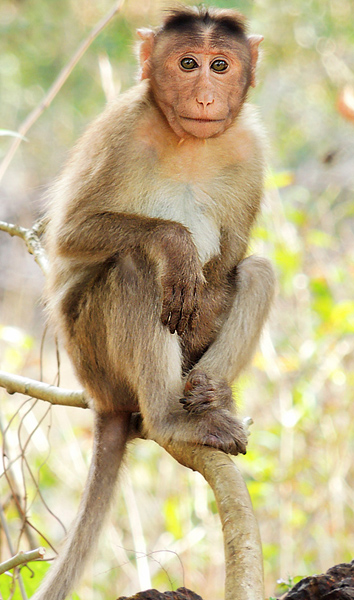
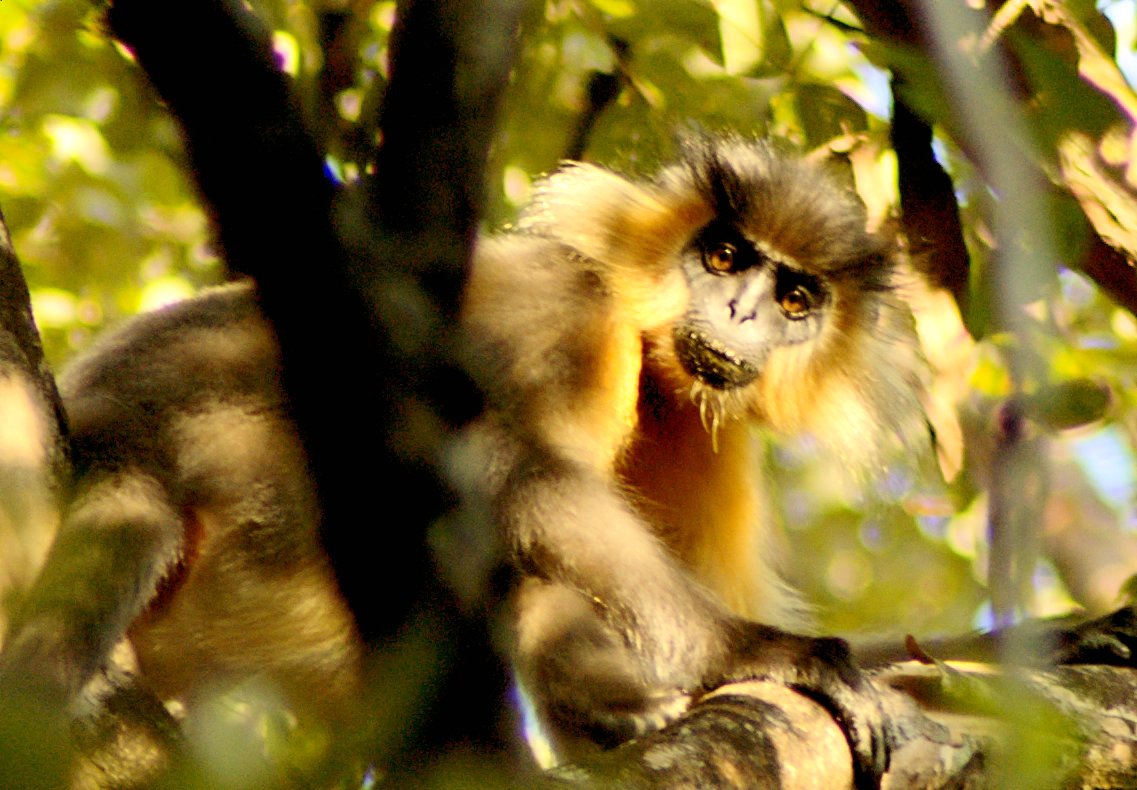
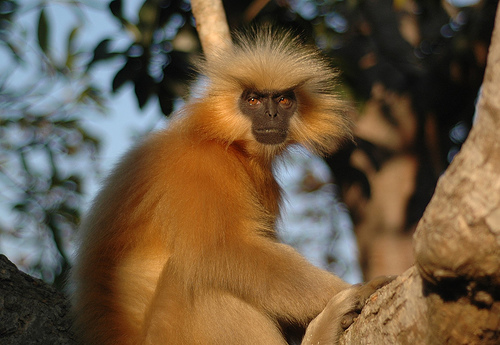
India has more kinds of monkey than many people realise: rhesus and bonnet macaques, Assamese, stump-tailed, pig-tailed and Arunachal macaques, the lion-tailed macaque, several species of grey langur, the Nilgiri langur, the golden langur of Assam and Bhutan, and the capped and Phayre's langurs of the northeast. The Arunachal macaque was described as new to science only in 2004. The golden langur, with its cream-to-golden coat, was made known to science in the 1950s by the naturalist E. P. Gee, though local people had known it for centuries. Together with the hoolock gibbon and the slow lorises, they make India one of the world's important primate countries.


Where India's primates live
India's primates follow its forests closely. The hoolock gibbon, India's only ape, lives only south of the Brahmaputra and east of the Dibang river, in the evergreen forests of Assam, Arunachal, Meghalaya, Nagaland, Manipur, Mizoram and Tripura. Assam's Hollongapar Gibbon Sanctuary, a small patch of forest surrounded by tea gardens near Jorhat, was named after the gibbons and shelters several families, along with six other primates. Namdapha in Arunachal holds gibbons in vast forest, and the Mishmi hills have their own population, recognised in 2013 as a distinct species, the Mishmi Hills hoolock.

The golden langur has one of the most precise ranges of any animal, bounded by rivers on three sides: the Manas river to the east, the Sankosh river to the west and the Brahmaputra to the south, with the Bhutan hills to the north. Within this small triangle, in Manas National Park and the Chakrashila Wildlife Sanctuary in western Assam, live India's few thousand golden langurs. The rivers, too wide and fast for langurs to cross, kept the species isolated and made it unique. The capped langur and Phayre's langur live further east, and the stump-tailed, pig-tailed, Assamese and Arunachal macaques in the hills of the Northeast, where Arunachal's Pakke and Eaglenest sanctuaries are among the best places to see them.


In the Western Ghats live the lion-tailed macaque and the Nilgiri langur, both found nowhere else on earth. The lion-tailed macaque lives in the rainforests of Silent Valley, where the Kunthipuzha river runs clear through untouched forest, in the Anamalai hills and the fragmented forests of the Valparai plateau, now surrounded by tea and coffee estates, in the Sharavathi valley of Karnataka, and in Kalakad-Mundanthurai at the southern tip of the Ghats. In Valparai, researchers have built canopy bridges across roads so that macaques need not come to the ground, where they are hit by vehicles. The Nilgiri langur, glossy black with a golden-brown head, lives in the Nilgiris, the Anamalais and the hills of Kerala. The grey langurs, bonnet macaques of the south and rhesus macaques of the north, meanwhile, live almost everywhere, from Himalayan pine forests to temple towns on the Ganga and the banks of the Kaveri.


The monkey god
Hanuman is one of the most beloved figures in Hindu tradition. In the Ramayana, he is the son of the wind god Vayu, a vanara, one of the forest people usually depicted as monkeys, and the devoted servant of Rama. He leaps across the ocean to Lanka to find the abducted Sita, sets fire to the city with his burning tail, and carries a whole mountain back from the Himalaya to find the herb that will revive Rama's wounded brother. He embodies strength, loyalty, devotion, celibacy, and courage, and he is worshipped across India, especially on Tuesdays and Saturdays. His temples are among the most common in the country, and the monkeys that live around them are fed and protected.

The monkey appears as a divine or heroic figure elsewhere in Asia, most famously in the Chinese novel Journey to the West of the sixteenth century, whose hero Sun Wukong, the Monkey King, is born from a stone, acquires magical powers, rebels against heaven, and is finally tamed to accompany a monk on his pilgrimage to India to fetch Buddhist scriptures. Scholars have debated for a century whether Hanuman influenced the creation of Sun Wukong. In ancient Egypt, the baboon was sacred to Thoth, god of wisdom and writing, and baboons were said to greet the rising sun with their morning cries. In medieval Christian Europe, by contrast, the ape was often a figure of the devil, of vanity, and of human sinfulness, a mocking imitation of man.

The Sundara Kanda, "the beautiful book", is the fifth part of Valmiki's Ramayana. It tells of Hanuman's leap across the ocean to Lanka, his search for Sita, his meeting with her in the Ashoka grove and the burning of Lanka. In many homes it is recited on its own as a book of courage and hope, especially in times of trouble, because it is the part of the story where, after long despair, everything begins to turn. A single faithful servant does what an army could not.
Tulsidas's Hanuman Chalisa, forty short verses in Awadhi written in the sixteenth century, is perhaps the most sung prayer in north India. Millions of people know it by heart and recite it when they are afraid, before an exam, on a dark road at night. It calls Hanuman the remover of fear and trouble, the strong one who is also humble. Kamban's Tamil Ramayana, written centuries earlier in the far south, gives the monkey warriors their own grandeur and poetry. Across the whole country, then, people have looked to a monkey as their picture of strength used in loving service.

Hanuman has found new life on screen too. The animated film Hanuman (2005) was a hit with children, and the Telugu film Hanu-Man (2024) turned his power into an Indian superhero story, about an ordinary young man in a village who gains Hanuman's strength. It shows how naturally the old god fits into the shape of the modern hero: very strong, very good, and on the side of the weak.
Hanuman's birth story explains much of his character. His mother, Anjana, was an apsara cursed to be born as a monkey, and his father in spirit was Vayu, the wind. As a baby, Hanuman saw the rising sun and, thinking it a ripe fruit, leapt into the sky to eat it. Indra struck him with a thunderbolt on the jaw, hanu, which gave him his name. In grief, Vayu withdrew all the air from the world, and the gods, to calm him, gave Hanuman gifts: immortality, strength, and the power to change his size. But because the child played too many pranks on sages, he was cursed to forget his powers until someone reminded him. That is why, in the Kishkindha Kanda, the old bear Jambavan must remind Hanuman of his strength before he leaps across the ocean. The story is often read as a lesson about human potential: we too forget what we are capable of until someone believes in us.

Tulsidas wrote the Ramcharitmanas, a retelling of the Ramayana in Awadhi, in the 1570s in Varanasi, and the Hanuman Chalisa, forty verses in praise of Hanuman, is traditionally attributed to him. It is recited daily by millions, in temples, homes, before exams and journeys, and even on cricket grounds. Its language is simple and musical, and many people who do not know Sanskrit or even much Hindi know it by heart. Kamban, who wrote the Tamil Ramavataram around the twelfth century, gives Hanuman some of the poem's most beautiful passages, especially when he finds Sita in the ashoka grove in Lanka. Across Southeast Asia, Hanuman is a hero of the Ramakien in Thailand, the Reamker in Cambodia and the wayang shadow plays of Java, where he is often shown as white.
The story of the Monkey King in China is told in Journey to the West, written in the sixteenth century and attributed to Wu Cheng'en. It is based on a real journey: the Buddhist monk Xuanzang travelled from China to India between 629 and 645 CE, studied at Nalanda, and returned with hundreds of Buddhist texts. In the novel, Xuanzang is protected on his pilgrimage by Sun Wukong, a monkey born from a stone who has made himself immortal, can travel thousands of kilometres in a single somersault, and wields a magic staff that shrinks to the size of a needle. Before the journey, he rebels against heaven so violently that the Buddha traps him under a mountain for five hundred years. The resemblances to Hanuman, a monkey hero of enormous strength who serves a holy figure on a journey, led scholars such as Hu Shih to argue for Indian influence, possibly through Buddhist storytelling. Others see Sun Wukong as purely Chinese. Either way, the two great monkey heroes of Asia both express the same idea: wild energy turned to devotion.

What the apes teach
When Carl Linnaeus classified the natural world in the eighteenth century, he placed humans among the primates, and privately admitted that he could find no clear criterion to separate humans from apes. Darwin and his defender Thomas Henry Huxley made the relationship explicit. The apes hold a mirror to us, and what we see in it is uncomfortable and illuminating: the roots of our tools, our politics, our cultures, our wars, our tenderness, and our capacity to heal. Hanuman, the monkey who leapt across the ocean out of love, and David Greybeard, the chimpanzee who stripped a grass stem to fish for termites, belong to the same family. So do we.

Writers have used apes to ask what makes us human. In Franz Kafka's strange story "A Report to an Academy" (1917), an ape called Red Peter, captured in Africa and shipped to Europe in a cage, stands before a gathering of learned men and explains how he became human. He learned to spit, to smoke, to drink schnapps, and finally to speak. But he insists that he did not do it because he wanted freedom, which he says is a big word humans deceive themselves with. He did it simply because he needed "a way out" of the cage. Kafka's point is unsettling. Perhaps much of what we call becoming civilised is really just a way of escaping a cage: copying those around us because there is no other way to survive. Red Peter has become human, and he is not sure he is better for it.
Edgar Rice Burroughs's Tarzan of the Apes (1912) imagined the opposite: an English boy raised by apes in the African jungle, who grows up stronger and nobler than the civilised men he later meets. Pierre Boulle's novel Planet of the Apes (1963) turned the tables completely. Space travellers land on a planet where apes are the rulers and scientists, and humans are dumb animals hunted and kept in cages. Seeing humans treated as we treat animals makes the reader feel the cruelty of it in a new way.
On screen, King Kong (1933) gave the world its great ape-monster: a giant gorilla taken from his island, put on show in New York, who breaks free, climbs the Empire State Building holding the woman he loves, and is shot down by planes. He is frightening, but the film makes us feel for him: he is loving and doomed, a wild creature destroyed by being brought into our world. And the opening of Stanley Kubrick's 2001: A Space Odyssey (1968), called "The Dawn of Man", shows a group of hungry ape-men. One of them picks up a bone, realises he can use it to strike, and uses it to kill. Then, in one of the most famous cuts in cinema, the bone thrown into the air becomes a spaceship in orbit. Kubrick's suggestion is chilling: the first tool was a weapon, and everything we have built since rests on that discovery.
Kafka's "A Report to an Academy" is told by Red Peter, an ape captured on the Gold Coast of Africa and shipped to Europe in a cage so small he could neither stand nor sit. He explains to the learned gentlemen of the academy that he became human, learning to drink, spit, shake hands and speak, not because he wanted to, but because it was the only "way out" of the cage. He insists he did not seek freedom, which he says humans deceive themselves about, only an exit. Readers have seen the story as a satire on the forced assimilation of outsiders, including Jews in the Europe of Kafka's day, and as a bitter comment on what we call civilisation. It is also simply a haunting picture of an animal mind trapped by people.
King Kong (1933) is about a giant ape captured on a remote island and brought to New York as a show, where he escapes, carries off the woman he loves, and dies falling from the Empire State Building, shot down by aircraft. Its last line, "It was beauty killed the beast", has become famous. Critics have read the film in many ways: as a story about the exploitation of nature for profit, as a Depression-era fantasy, and, uncomfortably, as reflecting racial fears of the time. The "Dawn of Man" sequence in Stanley Kubrick's 2001: A Space Odyssey (1968) shows a group of hungry apes in a desert, one of whom, after the appearance of a mysterious black monolith, picks up a bone, realises it can be used as a club, and kills. As he throws the bone into the air, it turns into a spacecraft. In one cut, Kubrick joins the first tool to the space age, and suggests that human technology began as a weapon. Goodall's grass stem offers a gentler story: the first tool may have been for fishing termites, not for killing.Pierre Boulle, who wrote Planet of the Apes, had also written The Bridge over the River Kwai, and had himself been a prisoner during the Second World War. In Planet of the Apes, astronauts land on a world where apes rule and humans are mute animals in cages, a reversal that forces readers to see how humans treat animals. The film versions, from 1968 onwards, became one of cinema's longest series. In the recent films, from 2011, the ape Caesar, raised in a human home, leads a revolt of laboratory apes, a story that echoes the real lives of Nim, Washoe and the chimpanzees once used in medical research. In 2015, the United States declared captive chimpanzees endangered, effectively ending invasive research on them, and most were retired to sanctuaries.
Perhaps the most important lesson of the apes is humility. Every line we have drawn between us and them, tools, culture, self-awareness, medicine, has been crossed as we watched them more carefully.