Part One · The Hunters
Chapter 7
The Bear
The animal that sleeps through winter and wakes, the grandfather of the forest, and the stars of the Great Bear.
Assisted and Curated by Claude, Referenced and Collated by me

Family Ursidae
Every autumn, a brown bear in the mountains of Alaska or Romania or Kamchatka eats as though its life depends on it, because it does. In the weeks before winter, it may gain more than a kilogram of fat a day, eating berries, roots, nuts, and, where it can, salmon. Then it digs a den in a hillside or finds a cave, lines it with grass and branches, crawls inside, and goes to sleep. For up to six or seven months, in the coldest regions, it will not eat, drink, urinate, or defecate. Its heart rate falls from around forty beats per minute to as few as eight. And yet, unlike a person confined to bed for months, it does not lose significant bone or muscle mass. It recycles the waste products of its own body, converting urea back into protein. In the depths of this winter sleep, the pregnant female gives birth, to tiny, nearly hairless cubs weighing only a few hundred grams, which nurse as she dozes.

In spring, the bear emerges, thin and hungry, and sometimes with cubs at her heels. It is hard to imagine a more powerful natural image of death and resurrection: an animal that goes into the earth in autumn, lies as if dead through the winter, and comes back to life with new life beside it.
The science of the bear's winter sleep is one of the most exciting areas of modern medicine. Doctors have long known that a person kept in bed for weeks loses bone and muscle, and that kidney failure poisons the blood with waste. Bears seem to escape all of this. During hibernation, their kidneys almost stop working, but they recycle the nitrogen from urea into new protein, so that their muscles stay strong. Their bones keep their density. Their blood becomes thicker without forming dangerous clots. And though they become very fat before winter, they do not develop diabetes or heart disease. Researchers studying brown bears in Sweden and black bears in North America hope that understanding these tricks could help astronauts on long space journeys, patients confined to bed, and people with kidney disease. The animal that seems to die each winter may hold secrets for keeping people alive.

Whether bears truly "hibernate" was argued over for a long time. Small hibernators like ground squirrels and marmots drop their body temperature almost to freezing and are very hard to wake. Bears' temperatures fall only a few degrees, and a bear can wake and defend itself if disturbed. Some scientists called this "winter lethargy" or "torpor" instead. Today most accept that bears do hibernate, but in their own way: their metabolism slows to about a quarter of normal, even though they stay fairly warm. India's sloth bear and sun bear, living in warmer forests, do not hibernate at all, though pregnant sloth bears retreat into dens to give birth. The Himalayan brown bear and the Asiatic black bear of the higher hills do sleep through the winter.
The Himalayan brown bear, a large, pale subspecies of the brown bear, lives in the high meadows and rocky slopes of Ladakh, Kashmir, Himachal Pradesh and Uttarakhand. It is one of the rarest large mammals in India, with perhaps only a few hundred left, scattered in small groups. It feeds on roots, grasses, insects and marmots, which it digs out of their burrows, and sometimes takes sheep and goats from herders' flocks. In Deosai, across the border in Pakistan, a high plateau protected largely for these bears, numbers have slowly recovered. Many scientists believe that the yeti legend of the Himalaya grew partly out of sightings of Himalayan brown bears and Asiatic black bears standing on their hind legs in the snow. In 2017, a genetic study of supposed yeti remains, including hair, bone and a tooth kept in monasteries and museums, found that nearly all came from bears, and one from a dog. The "abominable snowman" was, it seems, mostly a bear.
The bears of the world
There are eight living species of bear. The brown bear, including the North American grizzly and the Kodiak, ranges across the Northern Hemisphere. The polar bear, the largest land carnivore, evolved from brown bears and lives on the Arctic sea ice, hunting seals. The American black bear lives in the forests of North America. In Asia live the Asiatic black bear, with a white crescent on its chest, the sun bear of Southeast Asian rainforests, the smallest bear, with a long tongue for extracting honey, and the sloth bear of the Indian subcontinent. The giant panda of China, which eats almost nothing but bamboo, is a bear too. And in South America lives the spectacled bear, the only bear of the southern continent.

Bears are omnivores, and most eat far more plants than meat. They are intelligent, curious, and have an excellent sense of smell, perhaps seven times better than a bloodhound's. They walk on the soles of their feet, like humans, and can stand upright, which is one reason people across the world have seen them as kin. When skinned, a bear's body looks disturbingly human.

The polar bear's story shows how quickly evolution can work. Genetic studies suggest that polar bears split from brown bears only a few hundred thousand years ago, a short time in evolutionary terms, and that the two species have interbred at times since then. In 2006, a hunter in the Canadian Arctic shot a bear that turned out to be a hybrid, with a polar bear mother and a grizzly father; such "pizzly" or "grolar" bears have since been found several times, as warming pushes grizzlies north. Polar bears are built for the ice: their fur is not actually white but made of hollow, transparent hairs over black skin, which helps trap heat. They depend on sea ice to hunt seals, and as Arctic ice shrinks earlier each summer, many bears are forced ashore for longer, hungry and thin. That is why the polar bear has become the world's best-known symbol of climate change.

The giant panda was for a long time a puzzle to scientists. With its black-and-white coat and diet of bamboo, it looked so unlike other bears that some placed it with the raccoons. Genetic studies in the 1980s confirmed it is a true bear, an early branch of the family. Its "thumb", which it uses to hold bamboo, is not a real finger but an enlarged wrist bone, a famous example of evolution making do with what it has. The biologist Stephen Jay Gould wrote an essay about it, "The Panda's Thumb" (1978), arguing that such clumsy-but-workable solutions are among the best evidence for evolution: a designer starting fresh would have done it better. Since 1972, when China gave two pandas to the United States after President Nixon's visit, pandas have also been used in "panda diplomacy", loaned to friendly countries as signs of goodwill.

Bears have had a special place in human entertainment and cruelty for a long time. In Elizabethan England, "bear-baiting", in which a chained bear was attacked by dogs, was a popular sport, with arenas in London close to Shakespeare's Globe theatre; Shakespeare's famous stage direction in The Winter's Tale, "Exit, pursued by a bear", may have used a real bear from a nearby pit. Bear-baiting was banned in Britain only in 1835. In Russia, the bear became the national symbol, the friendly mascot Misha of the 1980 Moscow Olympics as well as the threatening "Russian bear" of Western cartoons. The teddy bear itself was born in 1902, when President Theodore Roosevelt refused to shoot a bear that had been tied to a tree for him on a hunt in Mississippi; a cartoon of the incident inspired a shopkeeper in New York to make a toy bear called "Teddy's bear". At almost the same time, the German company Steiff began making toy bears. The fearsome animal of the northern forests became the first soft toy given to millions of children, a comfort in the dark.

The sloth bear
India's most distinctive bear is the sloth bear, a shaggy black animal with a pale muzzle, long curved claws, and a white V or Y on its chest. Early European naturalists, seeing it hanging upside down from branches, mistook it for a relative of the South American sloth, which is how it got its name. It feeds largely on termites and ants, tearing open their mounds with its claws, blowing away the dust, and sucking up the insects through a gap in its front teeth with a noise that can be heard a hundred metres away. It also eats fruit, especially the flowers of mahua, and honey. The mother carries her cubs on her back for months, a sight unique among bears.

The sloth bear has a fearsome reputation. Short-sighted and easily startled, it often attacks when it encounters people suddenly at close range, and in central India, where people collect mahua flowers, tendu leaves, and firewood in the forests where sloth bears feed, it causes more injuries than tigers and leopards combined in some districts. The injuries are usually to the face and head, and they are terrible.
For centuries, the Kalandar community of north India made a living by capturing sloth bear cubs, piercing their muzzles, and training them to "dance" on a rope for audiences. By the 1990s, hundreds of dancing bears were being displayed on the roads of India. A campaign by conservation groups, notably Wildlife SOS, combined rescue centres for the bears with retraining and new livelihoods for Kalandar families, and in 2009 the last dancing bear in India was taken off the streets.
An animal that goes into the earth in autumn, lies as if dead, and returns in spring with new life beside it.

Kipling's Baloo, the sleepy, kindly bear who teaches Mowgli the Law of the Jungle and the "master words" that let him speak to every creature, is a sloth bear, the shaggy, honey-loving bear of Indian forests. Films, though, always draw him as a big brown bear, because that is the bear most Western audiences know. It is a small sign of how often India's own animals are seen through other people's eyes.
The end of the dancing-bear trade is a hopeful story, and it is studied around the world. For centuries, members of the Kalandar community travelled India with sloth bears they had taken as cubs from the wild. The bears' teeth were pulled and a rope was passed through a hole in their muzzle, so they could be made to "dance" for coins. It was cruel, but it was also the only living many families had. When groups like Wildlife SOS worked to end it, they did not simply take the bears away. They helped the former handlers find new work, gave them small loans to start businesses, and sent their children to school. By 2009 the last dancing bear had been taken off India's roads. The lesson is that you cannot save an animal by abandoning the people whose lives are tied to it. Conservation works best when it cares for both.

The sloth bear's teeth and lips are a marvel of adaptation. It lacks the two upper front teeth that other bears have, leaving a gap through which it can suck. Its lips are long and mobile, and it can close its nostrils to keep out dust and insects. When it finds a termite mound, it digs a hole with its claws, puts its snout to the hole, and alternately blows to clear dust and sucks to draw out termites, making a noise that can be heard from a long way off. It also loves the sweet, heavy-scented flowers of the mahua tree, which fall in the hot season, and it competes with the people who collect the same flowers to make liquor and sweets. This overlap, in the same forests, at the same season, at the same trees, explains many of the surprise encounters between sloth bears and people in central India.
The sloth bear's attacks have been studied by biologists and by the doctors who treat the victims. Sloth bears do not usually set out to kill. They attack because they are startled at close range, especially a mother with cubs, and they strike at the face and head, the highest part of a standing person, which is why injuries are so severe. In some districts of Madhya Pradesh, Chhattisgarh and Odisha, sloth bears cause more injuries each year than tigers and leopards. Forest departments now teach villagers to walk in groups, to make noise, to carry a stick and a torch, and to avoid collecting mahua alone before dawn. In Karnataka's Daroji Sloth Bear Sanctuary, near Hampi, forest staff feed the bears honey and dates on rocky hillsides where tourists can watch from a distance, and conflict with nearby villages has fallen.

The dancing bear trade had a long history. The Kalandars, a Muslim community of entertainers, trace their tradition back to the Mughal courts, where trained bears and monkeys performed for nobles. The method was cruel: cubs were taken from the wild, often after their mothers were killed, their muzzles were pierced with a hot iron rod to pass a rope through, and their teeth were knocked out. A bear on a rope would rise on its hind legs in pain as the handler tugged and drummed. By the 1990s, there were well over a thousand dancing bears on India's roads. Wildlife SOS, founded in 1995 by Kartick Satyanarayan and Geeta Seshamani, began rescuing them, but realised that simply confiscating bears would leave Kalandar families destitute and angry. So they paid for retraining, gave small grants for new businesses and sent Kalandar children to school. The last dancing bear, Raju, was rescued in 2009. The Agra Bear Rescue Facility, near the Taj Mahal, now houses hundreds of former dancing bears who will never return to the wild.
Sloth bear mothers carry their cubs on their backs, the only bears to do this regularly. The cubs, usually one or two, ride clinging to the mother's long, shaggy fur for up to nine months, until they are almost a third of her size. When danger threatens, the mother does not send them up a tree, as black bears do, but turns to face the threat with her cubs still on her back, rearing up and charging. This is one reason sloth bear encounters can be so dangerous: a startled mother with cubs aboard cannot run away, so she attacks. Biologists think this behaviour may have evolved because sloth bears shared their forests with tigers, which can climb poorly but could easily catch cubs on the ground. The mother's back is the safest place in the forest.

India's bear country
India is home to four bears, more than almost any other country. The sloth bear lives across the peninsula and the Terai: in the sal and teak forests of Madhya Pradesh, Chhattisgarh, Odisha and Jharkhand, in Kanha, Satpura and Similipal, in the rocky hills and scrub of Karnataka and Andhra Pradesh, in the forests of Mount Abu and Kumbhalgarh in Rajasthan, in Gujarat's Ratanmahal sanctuary, and in Assam's Manas. Daroji Sloth Bear Sanctuary, near Hampi, lies among granite boulder hills above the Tungabhadra river; its bears shelter in caves among the rocks, the same landscape in which the Ramayana places Kishkindha, the kingdom of the monkeys and bears.

The Asiatic black bear, with its white crescent, lives in the Himalayan forests from Kashmir to Arunachal, and in the hills of the Northeast. Dachigam National Park, above Srinagar, along the Dagwan river, is one of the best places to see it, especially in autumn when bears climb walnut, oak and mulberry trees to feed; the Great Himalayan National Park in Kullu, along the Tirthan and Sainj rivers, and Uttarakhand's Kedarnath sanctuary are other strongholds. Black bears sometimes raid orchards and maize fields, and in Kashmir conflict with people is common. The Himalayan brown bear lives higher still, in the alpine meadows and rocky slopes of Kashmir's Gurez and Kishtwar, Ladakh's Drass and Suru valleys, and Himachal's Chamba, where rivers like the Kishanganga and Suru run through its range.


The smallest bear in the world, the sun bear, lives in India only in the far Northeast: in the rainforests of Namdapha in Arunachal, Dampa in Mizoram, and the hills of Nagaland, Manipur and Meghalaya, where it climbs trees to tear open bees' nests with its long tongue. Very little is known about India's sun bears, and they are hunted for their gall bladders and paws. From the boulder hills of Hampi to the walnut forests of Dachigam and the rainforests of Mizoram, the bears of India map the country's forests from south to north and east.


Grandfather
In the earlier book, we met Irving Hallowell's great survey of bear ceremonialism across the Northern Hemisphere. Among the Sámi of Scandinavia, the Finns, the Khanty and Evenki of Siberia, the Ainu of Japan, and the Cree and Ojibwe of North America, the bear was treated with extraordinary reverence. Hunters avoided its name and called it "grandfather," "the old man," "the honey-eater," or "the one who owns the forest." In fact, the English word "bear" itself, like the German Bär, is thought by many linguists to be a euphemism, meaning "the brown one," adopted because the true Indo-European name for the bear, preserved in the Greek arktos and the Sanskrit ṛkṣa, had become too dangerous to say. The Slavic word medved means "honey-eater." The fear of naming the bear has shaped the very languages we speak.

The Greek word arktos gave us the Arctic, the region beneath the constellation of the Great Bear. In Greek myth, the nymph Callisto, a companion of Artemis, was seduced by Zeus and transformed into a bear, and later placed among the stars as Ursa Major. At the sanctuary of Artemis at Brauron, near Athens, young girls served the goddess in a rite called the arkteia, "playing the bear," before they reached marriageable age. In the Hindu tradition, the seven stars of the same constellation are the Saptarishi, the seven sages, and the Sanskrit ṛkṣa also appears in the Ramayana as the name of the bear people, whose king Jambavan, wise and ancient, helps Rama find Sita and reminds Hanuman of his forgotten power to leap across the ocean.
We also met Korea's bear-mother, Ungnyeo, who endured a hundred days in a cave eating mugwort and garlic to become a woman, and gave birth to Dangun, founder of the first Korean kingdom. And the Ainu iyomante, in which a bear cub was raised in the village and then ritually killed and sent back to the world of the spirits. The Norse berserkir, warriors who fought in a trance-like fury, may have taken their name from "bear-shirt," the skins they wore in battle.
In 1926, the American anthropologist A. Irving Hallowell published a long study called "Bear Ceremonialism in the Northern Hemisphere". It is one of the founding works of comparative anthropology, the study of what different human societies have in common. Hallowell gathered reports from peoples living all around the cold north of the world: the Finns and Sami of Scandinavia, many Siberian peoples, the Ainu of Japan, and Native peoples of Canada as far as Hudson Bay. These groups had never met. Their languages were unrelated. Yet they treated the bear in strikingly similar ways.
Many of them would not call the bear by its real name, but used polite names like "grandfather", "old man" or "the one who owns the forest", so as not to offend it. After killing a bear, hunters apologised to it, explained that they needed food, and sometimes blamed the killing on someone else. The bear's skull was treated with care, often placed in a tree or a special place, so that the bear's spirit could return and be born again. Hallowell's study showed how a single animal could call out the same feelings of respect, guilt and awe across a whole half of the planet. It suggests something deep about the bear: it looks so like a person when it stands up, eats so many of the same foods and sleeps away the winter like the dead, that people everywhere felt it was a relative.
Archaeologists have tried to find out how far back this goes. Around 1920, excavators at the Drachenloch, the "dragon's den", a cave high in the Swiss Alps, reported finding cave-bear skulls arranged in stone boxes, and claimed that Neanderthals had held a "bear cult" there. It was an exciting idea, and it spread widely. But most archaeologists now doubt it. The digging was not carefully recorded, and the bones may have ended up where they were through natural causes, not human hands. It is a useful warning: we want so much to find our own feelings in the deep past that we can see them where they are not. But at Chauvet Cave in France, a cave-bear skull really does sit on a flat block of rock in the middle of one chamber, and it seems to have been placed there by people, more than thirty thousand years ago. Someone, long ago, did think the bear deserved a special place.
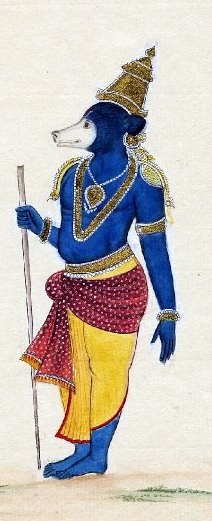
Fairy tales are full of bears who are really people under a spell. In the Grimms' "Snow-White and Rose-Red" (not the same as the more famous Snow White), two kind sisters let a bear into their cottage in winter to warm itself. They play with it and grow fond of it. In the end the bear turns out to be a prince, bewitched by a wicked dwarf, and the spell is broken. Stories like this suggest that under the rough, frightening outside of the bear there is something gentle and human, and that kindness to the strange can release it.
Jungian readers notice two other things about the bear. First, its winter sleep. The bear goes into the earth in autumn, lies as if dead, and comes out again in spring, often with new cubs born during its sleep. It is easy to see it as a picture of rebirth, of a time when we must withdraw from the world, rest and change in the dark, before coming back to life. Second, the mother bear is one of the fiercest protectors in nature, and the bear often stands in dreams and myths for the protective mother, warm and safe but terrible if her children are threatened.
The ancient Greeks seem to have felt this too. At Brauron, near Athens, young girls served the goddess Artemis in a ritual called "playing the bear". Before they came of age and married, they spent time at the sanctuary, perhaps wearing saffron robes and imitating bears. The ritual seems to have marked the move from wild, free girlhood to womanhood: a time to be a bear, before becoming a wife. The bear was a picture of the untamed child, honoured and then let go.
India's great bear is Jambavan. In the Puranas, a precious jewel called the Syamantaka goes missing, and Krishna is accused of stealing it. To clear his name, he follows the trail into a cave, where he finds the jewel with Jambavan, the old king of the bears. They fight, and the fight lasts for twenty-eight days. At last Jambavan, growing tired, realises that no ordinary being could match him like this, and that his opponent must be the same Lord he once served as Rama. He bows, gives Krishna the jewel, and gives him his daughter Jambavati in marriage. The same Jambavan, in the Ramayana, is the oldest and wisest of Rama's allies. It is he who reminds Hanuman, who had forgotten his own powers because of a childhood curse, of how strong he truly is, so that Hanuman can leap across the ocean to Lanka. In India too, then, the bear is the grandfather: old, strong and wise, the one who remembers what others have forgotten.

A. Irving Hallowell's 1926 study grew out of his work with the Ojibwe of Canada, whom he studied for decades. He gathered reports of bear rituals from Lapland to Labrador, and found the same pattern again and again. Hunters spoke to the bear before killing it, apologising and explaining their need. They avoided its true name. After the kill, they treated the body with ceremony: the skull was cleaned and placed on a pole or in a tree, the bones were not given to dogs, and the meat was shared at a feast at which special rules applied. The aim was to send the bear's spirit home content, so that it would tell the other bears it had been treated well, and they would let themselves be hunted again. Hallowell suggested that these customs might be extremely old, perhaps going back to the Ice Age, when people of the north first spread around the pole. Whether or not that is true, the bear was the clearest example of the idea that hunting is a relationship, not just a taking.
The Ainu bear ceremony, the iyomante, was the most elaborate of all. A bear cub was captured in spring and raised in the village, sometimes nursed by a woman like a human baby, and kept in a wooden cage. After a year or two, it was led around the village, shot with blunt ceremonial arrows, and killed. Its spirit, the Ainu believed, was a god, a kamuy, who had come to visit the human world wearing a bear's body as a costume. The ceremony sent the god home with gifts of food, wine and carved prayer sticks, so that he would report the Ainu's generosity and come again. To outsiders it can seem cruel. To the Ainu it was an act of hospitality and respect. Japan, which long suppressed Ainu culture, recognised the Ainu as an indigenous people only in 2008 and passed a law to protect their culture in 2019.
The constellation of the Great Bear has stories across the world. In Greek myth, Callisto, a hunting companion of Artemis, was seduced by Zeus and turned into a bear, either by Zeus himself, to hide her from his jealous wife Hera, or by Artemis in anger. Her son Arcas, grown into a hunter, nearly killed her, so Zeus placed them both in the sky as the Great Bear and the Little Bear. In India, the same seven stars are the Saptarishi, the seven sages: Marichi, Atri, Angiras, Pulastya, Pulaha, Kratu and Vasishtha, with the faint star Arundhati, Vasishtha's faithful wife, beside him. In Hindu weddings, the bride and groom are traditionally shown Arundhati and the Pole Star as symbols of faithfulness and constancy. Many Native American peoples saw the four stars of the bowl as a bear and the three stars of the handle as hunters chasing it through the year; when the bear is low in the autumn sky, its blood colours the leaves red. The same few stars carry very different stories of the bear.
The Ramayana's bear people, the rikshas, fight alongside the monkeys in Rama's army. Jambavan, their king, is said to have been born from the yawn of Brahma, and to have lived since the time of the churning of the ocean; in some tellings, he circled the earth seven times while Vishnu, as Vamana, took his three great strides across the universe. His great age is what makes him wise. At the edge of the southern ocean, when no one in the army can leap the hundred yojanas to Lanka, it is Jambavan who turns to the silent Hanuman and reminds him of his birth and his forgotten powers, so that Hanuman swells to the size of a mountain and leaps. In the Puranic story of the Syamantaka jewel, the same ancient bear, wrestling with Krishna in a cave for twenty-eight days, finally recognises in him the Rama he once served. The bear, in India as in the far north, is the elder who remembers, the grandfather of the forest whose memory reaches back to the beginning of things.
The bear and the salmon forest
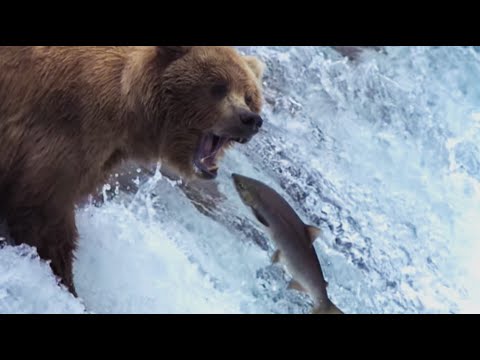
One of the most beautiful discoveries of modern ecology concerns the bears of the Pacific coast of North America. Every autumn, salmon return from the ocean to spawn in the rivers where they were born, and bears gather to catch them. A bear may carry a salmon into the forest, eat the best parts, and leave the rest. Researchers such as Tom Reimchen in British Columbia found that the nitrogen in the trees along salmon rivers carries a chemical signature of the ocean: it came from the bodies of salmon, carried into the forest by bears. The bears were fertilizing the forest with the sea. The great rainforests of the Pacific coast are, in part, made of fish, and the bears are their gardeners.

Tom Reimchen's research began with a simple observation along the rivers of British Columbia's coast: bears carried salmon into the woods, ate only the richest parts, the brain, eggs and skin, and left the rest. He and his colleagues measured the nitrogen in tree rings, mosses and insects near salmon rivers and found that a large share, in some places up to a quarter or more, came from the ocean, carried by salmon and spread by bears, wolves, eagles and flies. Trees near spawning streams grew faster than those far away. The bears were moving tonnes of fish into the forest every autumn. This research helped people see that the salmon, the bear and the old-growth forest are a single system. Cut the forest, or overfish the salmon, or kill the bears, and the others suffer. Several indigenous nations of the coast, including the Heiltsuk and Kitasoo/Xai'xais, had always described this connection in their stories; science was confirming what they already knew. The coast's Great Bear Rainforest, protected by agreements in 2006 and 2016, is named after this web of life, and it is also home to the rare white "spirit bear", a black bear with a recessive gene for a cream-coloured coat.

What the bear teaches
The bear stands upright like us, eats what we eat, mothers its young fiercely, and sleeps through the winter to rise again. Across the northern world, it was the animal most like a person, and so the one most carefully honoured and most carefully feared. Its name became unspeakable, its body a constellation, its sleep a promise of spring. In an age of melting sea ice and shrinking forests, the polar bear has become the most recognizable symbol of a changing climate. The grandfather of the forest is asking what kind of grandchildren we intend to be.

Literature has given us bears of every kind. William Faulkner's long story "The Bear" (1942) follows a boy, Isaac, who grows up joining the yearly hunt for Old Ben, a huge, almost legendary bear in the forests of Mississippi. Old Ben has outlived every attempt to kill him. When at last he is brought down, the boy understands that something more than a bear has died: the wilderness itself is ending, as the forest is sold for timber. The bear is a picture of a whole world that greed is about to destroy.
Children know gentler bears. A. A. Milne's Winnie-the-Pooh (1926), named after a real black bear at London Zoo, is a "bear of very little brain" who loves honey and his friends, and whose simple goodness is wiser than cleverness. Michael Bond's Paddington (1958), a small bear from "darkest Peru" who arrives at a London railway station with a label on his coat saying "Please look after this bear", was partly inspired by the memory of child evacuees in the Second World War. He became the gentlest bear on screen in the Paddington films (2014, 2017), stories about kindness to strangers who arrive with nothing.
Film has shown the other side as well. The Revenant (2015) is famous for its terrifying scene of a mother grizzly attacking a frontiersman who has come too close to her cubs: not a monster, just a mother doing what mothers do. And Werner Herzog's documentary Grizzly Man (2005) tells the true story of Timothy Treadwell, who spent thirteen summers living among wild grizzlies in Alaska, filming them, naming them and speaking of them as his friends. In 2003 he and his girlfriend were killed by a bear. Herzog uses Treadwell's own footage, and in his own voice he disagrees with him. Treadwell saw nature as kind and harmonious. Herzog, looking into the blank eyes of the bears, sees only indifference: the bear is not cruel and not loving, it simply does not care. The film leaves us between the two views, which is perhaps the honest place to be. The grandfather of the forest does not answer our questions. He is simply himself.
Winnie-the-Pooh has a true story behind him. In 1914, a Canadian army vet named Harry Colebourn bought a black bear cub at a railway station in Ontario and named her Winnipeg, after his home town. He took her to England with his regiment, and when he left for the fighting in France, he left her at London Zoo, where she became so gentle that children were allowed to ride on her. One of those children was Christopher Robin Milne, who named his own teddy bear after her. His father, A. A. Milne, wrote the Pooh books from the stories he told his son. The gentle, honey-loving bear of children's books grew out of a real wild bear, a soldier's kindness and a zoo in wartime.

Paddington came from a different kind of history. Michael Bond saw a lone teddy bear left on a shelf in a London shop on Christmas Eve in 1956, and remembered the children evacuated from London during the Second World War, sent off with labels around their necks. Paddington arrives at the London railway station after which he is named, from "darkest Peru", with a label saying "Please look after this bear. Thank you." The books, and the films of 2014 and 2017, are at heart a story about welcoming a stranger, and readers have often seen in them a gentle argument for kindness to refugees. The bear who might be wild becomes a guest who must be looked after.
Werner Herzog's Grizzly Man is the opposite of these gentle tales. Timothy Treadwell spent thirteen summers living among grizzlies in Katmai National Park in Alaska, filming them, naming them and speaking to them as friends. In October 2003, he and his partner Amie Huguenard were killed and eaten by a bear. Herzog built his film from Treadwell's own footage. He admires Treadwell's love and courage but disagrees with his view of nature. "I believe the common denominator of the universe is not harmony, but chaos, hostility and murder," Herzog says in the narration, looking at a close-up of a bear's blank face. The Alaska Native people interviewed in the film make another point: for thousands of years their ancestors kept a respectful distance from bears, and Treadwell crossed a line they had always known was there. The film leaves viewers torn between Treadwell's love and Herzog's hard realism. The old bear ceremonies of the north had already found a third way: deep respect combined with a clear sense of the distance between bear and human.
The bear has also stood for political power and for rebellion. California's flag carries a grizzly, the state's emblem, though California's grizzlies were all killed by the 1920s; the last known one was shot in 1922. Berlin's coat of arms shows a black bear, and Bern in Switzerland, whose name is said to come from the German for bear, has kept live bears in a "bear pit" in the city since at least the sixteenth century, now a more natural park beside the river. In India, the sloth bear rarely appeared in royal symbols, perhaps because it was seen as comic rather than noble; it was the clown of the street, not the emblem of kings. Today, as dancing bears are gone and sloth bears are better understood, it has a chance at a more dignified place in the Indian imagination.