Part Six · The Shape of Change
Chapter 25
The World That Won't Stay Still
Today jobs change often, friendships come and go, and some of the biggest dangers can't even be seen. Thinkers call this a "liquid" world.
Featuring Giddens · Beck · Bauman · Sennett
Assisted and Curated by Claude, Referenced and Collated by me
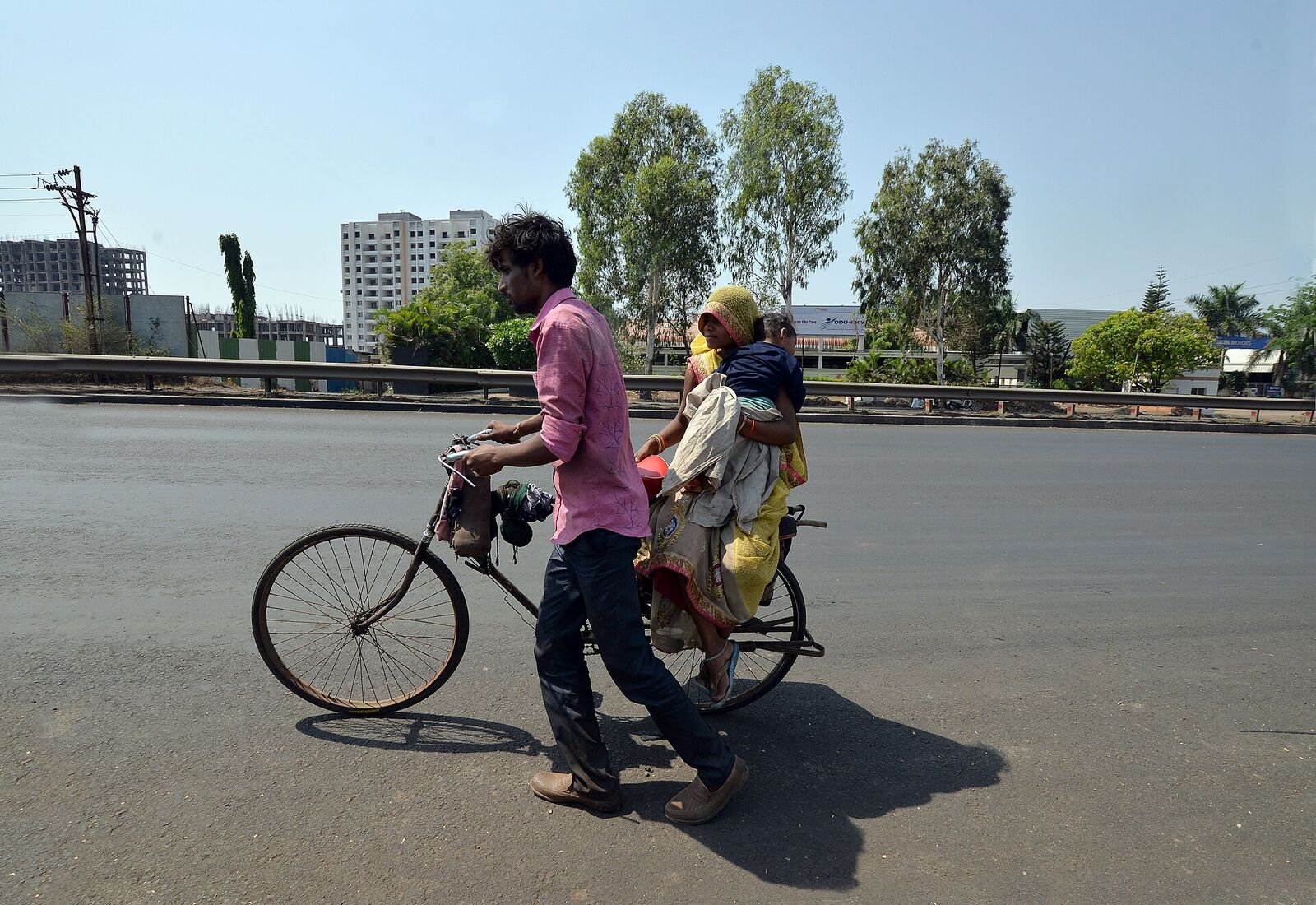
The long walk home
In March 2020, India suddenly shut down everything to stop the coronavirus. Millions of workers who had come to big cities from villages lost their jobs overnight. Factories and shops closed. Trains and buses stopped. Many had no money and nowhere to stay. So hundreds of thousands of men, women and children started to walk home, sometimes more than a thousand kilometres, carrying bags and babies along highways and railway tracks. It was very hard, and some didn't make it. Later, special trains and shelters were arranged. The pictures of that long walk are among the most famous of the pandemic in India.
This sad story shows what the thinkers in this chapter describe. A danger (the virus) was invisible and spread all over the world. Workers had jobs with no contracts and no savings, so they lost everything at once. Their lives were split between the city where they worked and the village where they belonged. And when the city failed them, they went back to the village.
Building your own story
Giddens asked an old question: do the rules of society control us, or do we make the rules? His answer: both! Think of language. Grammar rules limit how you speak, but they also let you say anything at all. And every time you speak, you keep the language alive. Society works the same way. Its rules only exist because we keep following them, so if people act differently, the rules can change.
Life today
Giddens said three things make modern life special. First, we deal with people far away all the time, by phone and the internet. Second, we trust experts we never meet: we fly in planes built by engineers we don't know and take medicines without knowing how they work. Third, societies keep studying themselves with surveys and news, and then change because of what they learn.
This affects each person too. Long ago, your life followed a script set by your family and village. Today people must keep choosing: what to study, what job to do, whom to marry, what to believe, even what to wear. Giddens said the self has become a project, like a story we keep writing and rewriting. That's exciting, but it can also be worrying. That's partly why self-help books and wellness apps are so popular!
Imagine a young woman from a small town who moves to Bengaluru to work with computers. Her mother's life followed a set path. But she has to decide everything herself: her job, her city, whether and whom to marry, what traditions to keep. That freedom is wonderful, and also tiring!
Your life becomes a story you keep writing, with no script to follow.
Giddens also said relationships have changed. Marriages used to be mostly about family duty and money. Now many people want a relationship that makes them both happy, and that is more equal, but also more fragile. In Indian cities, young people often balance family wishes with their own choices.
A world of new dangers
Beck said that in the old days, the big question was who gets the good things, like money and goods. Today, it's also who gets the bad things: pollution, poisonous chemicals, climate change and new diseases. These dangers are made by humans, by our factories and technology.
These dangers are often invisible, so we need experts to tell us if our air and water are safe. They cross borders, because pollution and viruses don't need visas! And they often come back to hit the people who made them. As Beck put it, smog doesn't pick and choose: the factory owner's children breathe the same dirty air.
But dangers still aren't shared fairly. Rich people can buy air purifiers and live far from factories. Poor people often live right next door. In 1984, in Bhopal, poisonous gas leaked at night from a pesticide factory owned by an American company. It drifted over crowded homes nearby. Thousands of people died, and many more became ill for life. Safety had been neglected to save money. Most of those hurt were poor people who lived close to the factory because land there was cheap. Survivors are still asking for help and justice today.
The coronavirus showed both sides. Anyone could catch it, even ministers and film stars. But some people could work from home and find hospital beds, while the walking workers suffered most.
Doing it yourself
Beck said modern societies now have to deal with problems they created themselves. Experts argue in public, and people trust them less. Lots of decisions are fought over outside parliament, in courts, protests and shopping choices.
He also said people have to build their own life story, without the old support of class, family and neighbourhood. When things go wrong, people blame themselves. Beck said we're expected to solve big system problems on our own. An engineering graduate who can't find a job is told to learn more skills and network harder, but nobody asks why there are so few jobs for so many graduates.
We're asked to fix big system problems all by ourselves.
Liquid times
Zygmunt Bauman retired as a professor, and then, in his seventies, he started writing a whole new set of books that made him famous all over the world. They were all about one picture: liquid.
Bauman said the older modern world was solid: big factories, jobs for life, steady marriages, planned cities. A worker might stay with one company in one town his whole life.
Today's world is liquid. Like water, it doesn't hold its shape. Nothing is meant to last. Companies can move to another country overnight. Jobs become short projects. People try on new identities and drop them.
Bauman said that today we're mostly seen as shoppers. Shops and ads keep us wanting the next new thing, so we're never quite satisfied. People who can't afford to shop get treated as failures. Bauman even said some people get treated as if they were rubbish. Think of the waste pickers in Indian cities, who sort what others throw away and are often treated as if they don't matter. Bauman wanted us to see that this is wrong.
Liquid friendships
Bauman said people today want closeness but fear promises. We like connections more than relationships, because connections can be deleted with one tap, like a contact on a phone. So we can have thousands of online friends and still feel lonely. Some critics said Bauman missed the old days too much, since the "solid" past was often unfair to women and minorities. But many people felt he described their dizzy, fast-changing world.
What changing jobs does to us
Sennett studied how work makes people feel about themselves. He found that working-class men often blamed themselves for not having much education, even while working hard so their children could do better.
He told the story of Enrico, who cleaned an office building for twenty years. The job was dull, but his life had a clear story: steady work, saving, a house and respect. His son Rico went to university and earned much more. But Rico kept changing jobs and cities, worked on short projects, and had to keep reinventing himself. He worried he couldn't teach his own children about loyalty and sticking with things, because his own work life had none of that. Sennett said character needs long-term promises, and fast-changing jobs wear them away.
This story is familiar in India too. A father might have worked thirty-five years at the same bank, known his colleagues' families and retired with a farewell party. His son might have worked at five IT companies in ten years and moved cities three times. The son earns more but may feel his life has no steady story.
Later, Sennett wrote about something hopeful: the joy of doing a job really well, just for its own sake. A carpenter, a cook, a doctor, a programmer or a musician can all be craftspeople. Think of the toy makers of Channapatna in Karnataka, who make colourful wooden toys with natural dyes, or the weavers of Varanasi, who spend weeks on one silk sari. Their skill gives them pride and is passed from parent to child.
Holding on
The workers walking home in 2020 lived through all of these ideas. Their lives were split between city and village. An invisible danger hurt them the most. Their jobs vanished overnight. And yet, in that moment, they turned back to the most solid thing they had: their village, their family and their community. The liquid world hasn't removed our need for solid ground. It's made it even more important.
Next, we look at places: cities, travel and networks, and how they change what it means to be somewhere.