Rohit Shah

Read in English Kid Mode

Kid Mode: the same story, told simply. Big ideas, small words.

Part One · The Hunters

Chapter 1

The Tiger

The biggest cat in the world, the goddess's ride, and how India saved it.

Assisted and Curated by Claude, Referenced and Collated by me

A Bengal tiger standing in a dry forest
PlateA Bengal tiger in Tadoba-Andhari Tiger Reserve, Maharashtra. Photo: Rohit Sharma / Wikimedia Commons, CC BY-SA 4.0

Scientific name: Panthera tigris

In the Sundarbans, a huge mangrove forest where great rivers meet the sea, people go into the forest to collect honey, crabs and wood. Before they enter, they pray to Bonbibi, the lady of the forest. Both Hindus and Muslims there honour her.

the tiger’s halfthe people’s half
SketchBonbibi divides the Sundarbans: one half for the tiger, one half for people. Take only what you need, and each keeps its share. Drawing made for this book

The story says a demon called Dakshin Rai once ruled the forest in the shape of a tiger. Bonbibi defeated him and made a deal: half the forest for tigers, half for people. Take only what you need, and you will be safe. It is a story about sharing, and it is still important, because Sundarbans tigers can be dangerous to people.

An old print of a village by a river
PlateA Sundarbans village in 1839, on the edge of the tiger's forest. Photo: Frederic Peter Layard (1818-1891) / Wikimedia Commons
Film 1Land of the swamp tigerRoundglass Sustain · YouTubeThe Sundarbans, its tigers, and the people who pray to Bonbibi before entering the forest.

The animal

The tiger is the biggest of all cats. A large male Bengal tiger can weigh as much as three grown men and be three metres long from nose to tail.

A tiger paw print pressed into soft earth
PlateA tiger's pugmark in Pilibhit. Its size and shape tell a tracker roughly how big the tiger is and whether it is male or female. Photo: Pixel009 / Wikimedia Commons, CC0

No two tigers have the same stripes, just like no two people have the same fingerprints. Scientists use hidden cameras to photograph tigers and tell them apart by their stripes. The stripes are even on a tiger's skin, not just its fur!

Why orange? The deer that tigers hunt cannot see orange and green as different colours. To a deer, a tiger looks like shadows in the grass.

Close view of a resting tiger's striped face and shoulder
PlateNo two tigers have the same stripes. Camera-trap surveys use them like fingerprints to count tigers one by one. Photo: Warren Garst / Wikimedia Commons, CC BY-SA 4.0

A tiger sneaks up very quietly, then rushes out at the last moment. Most hunts fail, maybe nine out of ten! Tigers also love water and are great swimmers.

Tigers were carved on Indus Valley seals more than four thousand years ago.

Film 2A tigress hunts to feed her cubsBBC · YouTubeHow a mother tiger stalks and ambushes to feed her cubs.

The solitary life

Lions live in groups, but tigers live alone. Each tiger has its own area, called a territory. It marks the borders with its smell on trees, like writing 'This is mine!'

A young tiger lifting its tail against a tree in evening light
PlateA young tiger in Ranthambore sprays a tree to mark its territory. The scent tells other tigers who passed and when. Photo: Rohitvarma / Wikimedia Commons, CC BY-SA 4.0

Tigers read these smell-messages to learn who passed by and when. When friendly tigers meet, they make a soft puffing sound called a chuff.

A tigress walking with her cubs
PlateA tigress with her cubs in Bandhavgarh. The cubs stay with her for about two years before going off alone. Photo: Yajuvendraupadhyaya / Wikimedia Commons, CC BY 4.0

A mother tiger has two to four cubs. She hides them, feeds them and teaches them to hunt for about two years. Then the young tigers go off to find their own homes.

A tigress resting
PlateMachli, the famous tigress of Ranthambore. Photo: Bhavik Thaker / Wikimedia Commons, CC BY 2.0

The goddess and her tiger

In Hindu stories, the goddess Durga rides a lion or a tiger into battle. The tiger is wild and strong, but when it carries the goddess, its strength protects people.

A painting of the goddess Durga seated on a tiger, with worshippers
PlateDurga riding a tiger, from a Janamsakhi painting. In eastern India and in popular art the goddess's lion often becomes a tiger. Photo: Kashmiri manuscript painter / Wikimedia Commons
A weathered stone tiger sculpture on a temple wall
PlateA tiger carved on the outer wall of the Shore Temple at Mamallapuram, eighth century. Photo: Sumanpreetmngt / Wikimedia Commons, CC BY-SA 4.0
A painted statue of a goddess
PlateAn image of Bonbibi, the lady of the forest, worshipped by Hindus and Muslims in the Sundarbans. Photo: V Malik from New Delhi & Pune, India / Wikimedia Commons, CC BY-SA 2.0

Shiva sits on a tiger skin. The god Ayyappa of Kerala is said to have ridden a tigress. Some tribal communities in India worship a tiger god called Waghdeo who guards the village. In parts of Nagaland, an old story says that the tiger and the human were once brothers.

Men painted with tiger stripes dancing
PlatePulikali performers, painted as tigers, dance through Thrissur during Onam. Photo: Midhun Subhash / Wikimedia Commons, CC0
A man having tiger stripes painted on his body
PlateA Pulikali artist being painted for the tiger dance. Photo: Ramesh Lalwani / Wikimedia Commons, CC BY 2.0

In Thrissur, Kerala, men paint themselves with stripes and dance as tigers in Pulikali during Onam!

Men painted as tigers dancing in a street
PlatePulikali in Thrissur, 2010: dancers painted as tigers. Photo: Adarsh Padmanabhan / Wikimedia Commons, CC BY 3.0
A satellite image of river channels and forest
PlateThe Sundarbans from space: a maze of channels, Bonbibi's forest. Photo: Cnes - Spot Image / Wikimedia Commons, CC BY-SA 3.0

The tiger in the East

In China, people said the stripes on a tiger's forehead spell the word for 'king'. Parents put tigers on children's shoes and caps to scare away bad spirits.

A Korean folk painting of a cheerful tiger under a pine tree with a magpie
Plate'Tiger and Magpie', a favourite subject of Korean folk painting. The tiger is often drawn as a comic, friendly guardian. Photo: Unknown Korean artist / Wikimedia Commons

In Korea there are hundreds of tiger stories. In one, a tiger and a bear both wanted to become human. They had to stay in a cave for a hundred days eating only garlic and herbs. The patient bear became a woman. The tiger got bored and ran away!

A Japanese ink painting of a tiger in bamboo
PlateKanō Tan'yū's tiger among bamboo, Japan, seventeenth century. Tiger and dragon stand for the forces of earth and sky. Photo: Kanō Tan’yū / Wikimedia Commons, CC0

The hunt and the fall

About a hundred years ago there were many, many tigers in Asia. Then kings and hunters shot them for sport, and forests were cut down. By around 1970, India had fewer than two thousand tigers left.

A painting of hunters on elephants attacking a tiger
PlateA tiger hunt at Jhajjar, painted by Ghulam Ali Khan around 1820. Hunting tigers from elephants was the sport of rulers for centuries. Photo: Ghulam Ali Khan / Wikimedia Commons

Jim Corbett was a famous hunter who later became a protector of animals. He noticed that tigers that attacked people were often hurt or too old to hunt. A national park is named after him.

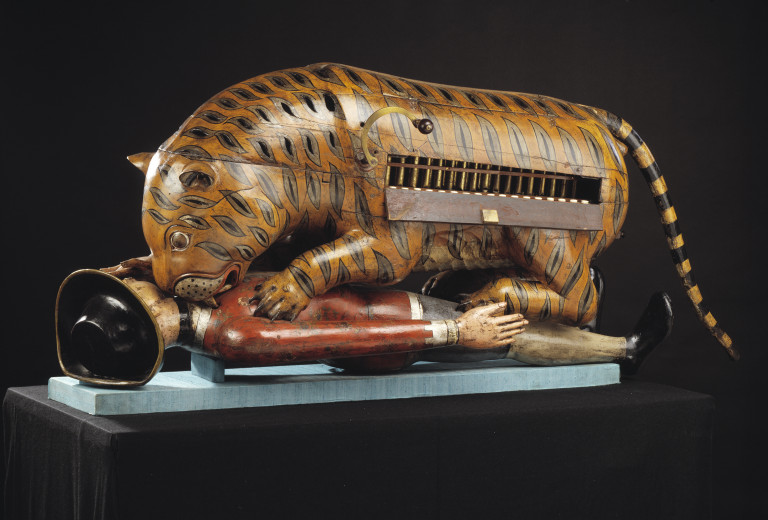
A wooden tiger attacking a European soldier
PlateTipu's Tiger in the Victoria and Albert Museum, London. Photo: Victoria and Albert Museum / Wikimedia Commons, CC BY-SA 3.0
A wooden tiger with a small keyboard in its side
PlateThe organ keyboard in the tiger's side, which made the growls and screams. Photo: Victoria and Albert Museum / Wikimedia Commons, CC BY-SA 3.0

In 1973, India started Project Tiger to protect tigers and their forests. It has worked well. Today India has about 3,700 tigers. Sadly, three kinds of tiger, from Bali, Java and the Caspian Sea, are gone forever.
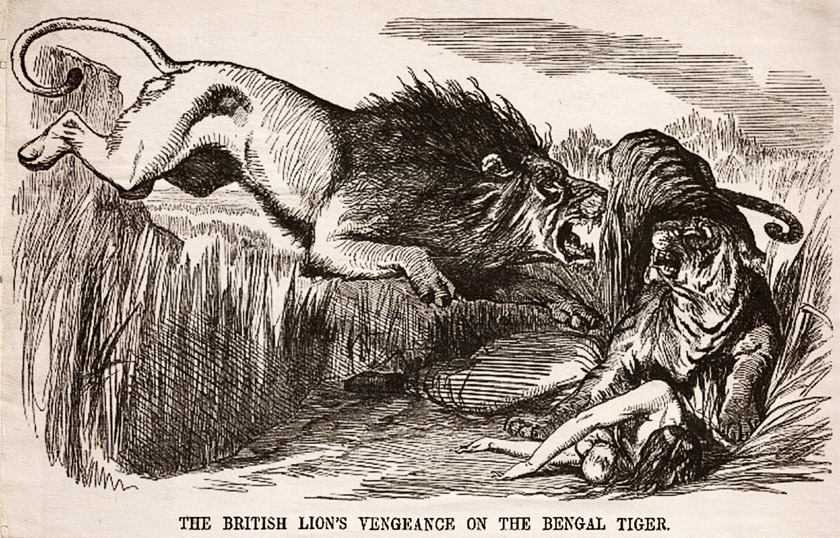
A cartoon of a lion attacking a tiger
Plate"The British Lion's Vengeance on the Bengal Tiger", a Punch cartoon of 1857: tigers had become symbols in the politics of empire. Photo: Punch Magazine / Wikimedia Commons
A portrait of a man in a hat
PlateJim Corbett in 1944, the year Man-Eaters of Kumaon was published. Photo: Jim Corbett / Wikimedia Commons
Fun fact: the face masksTigers like to attack from behind. So in the Sundarbans, people once wore masks on the backs of their heads. A tiger behind them saw a face looking back, and seemed to leave them alone!
A carved wooden tiger head
PlateThe head of Tipu's Tiger, close up. Photo: Victoria and Albert Museum / Wikimedia Commons, CC BY-SA 3.0
Film 3Fifty years of Project Tiger, explainedBusiness Standard · YouTubeHow India's tiger reserves began in 1973, and what the tiger census shows today.

What the tiger teaches

A tiger needs a big forest. If we protect the tiger, we also protect the forest, the rivers, the deer and the monkeys. Bonbibi's lesson is still true: share fairly, take only what you need, and respect the other nations.

A tiger walking through grass in Kanha
PlateA tiger in Kanha. Protect the tiger and you protect the forest, the deer, the rivers and the people who depend on them. Photo: Davidvraju / Wikimedia Commons, CC BY-SA 4.0

You can meet tigers in stories too: Shere Khan in Kipling's The Jungle Book, William Blake's poem 'The Tyger', and Ruskin Bond's 'A Tiger in the Tunnel'. On screen, watch The Jungle Book (1967 and 2016) and Life of Pi (2012), about a boy and a tiger in a lifeboat.

Assisted and Curated by Claude, Referenced and Collated by me. About this material