Part Four · Wings
Chapter 16
The Owl
Silent wings, ears that see in the dark, the bird of wisdom and of death, and Lakshmi's strange companion.
Assisted and Curated by Claude, Referenced and Collated by me

Order Strigiformes
In a completely dark room at the California Institute of Technology in the 1970s, the neuroscientists Masakazu Konishi and Eric Knudsen released barn owls and let mice run across the floor. There was no light at all; the owls could see nothing. Yet again and again, they struck the mice with perfect accuracy, guided only by the faint rustling sounds the mice made on the floor. When the researchers dragged a crumpled paper ball across the floor, the owls struck that too. When they put a small plug in one of an owl's ears, it missed, landing slightly off target in a predictable direction.

What Konishi and Knudsen discovered was one of the most precise sound-location systems in nature. The barn owl's ears are placed asymmetrically on its head, one slightly higher than the other, and its face, shaped like a dish of stiff feathers, funnels sound toward them like a satellite dish. A sound from below reaches one ear slightly louder than the other; a sound from the side reaches one ear a few millionths of a second earlier. The owl's brain combines these tiny differences into a map of auditory space, pinpointing the source in both direction and height. It is, in effect, seeing with its ears.
Masakazu Konishi's work with barn owls became one of the great success stories of neuroscience. After the dark-room experiments, Konishi and his colleagues traced the circuits in the owl's brain that compute the direction of a sound. They found that one part of the brainstem compares the tiny difference in arrival time between the two ears, as small as a few millionths of a second, using an arrangement of nerve fibres that work like delay lines, exactly as the American psychologist Lloyd Jeffress had predicted in theory in 1948. Another pathway compares loudness. The two streams are combined in the midbrain into a "map" of space, in which each brain cell responds to sounds from one particular spot. The barn owl became one of the first animals in which scientists could follow, cell by cell, how a brain turns raw sensation into knowledge of the world. Knudsen went on to show that young owls fitted with prism glasses, which shifted their view of the world, could re-tune their sound maps to match, revealing how the brain learns during a sensitive period in youth, research that has helped us understand how children's brains develop.

The silent hunter
Owls have evolved almost every adaptation a nocturnal hunter could want. Their eyes are enormous relative to their skulls, and they are not round balls but tubes, which gather light efficiently but cannot move in their sockets. To compensate, an owl can rotate its head up to about two hundred and seventy degrees, thanks to extra vertebrae in its neck and special adaptations of its blood vessels, which prevent the arteries from being pinched when the head turns.

Their flight is almost perfectly silent. The leading edges of their flight feathers are fringed like a comb, which breaks up the turbulence that makes noise; the trailing edges are soft and ragged; and the surfaces of the feathers are covered with velvety down. Engineers have studied owl feathers to design quieter aircraft wings, wind turbine blades, and fans. The prey never hears the owl coming.
There are about two hundred and fifty species of owl, from the tiny elf owl of the American Southwest, the size of a sparrow, to the Blakiston's fish owl of the Russian Far East and northern Japan, one of the largest owls in the world, which wades into icy rivers to catch salmon. India has around thirty-five species, including the spotted owlet, which is common even in cities; the barn owl, which lives in old buildings and farm sheds; the Indian eagle-owl, whose deep hoots are heard at dusk across the plains; and the forest owlet, which was thought extinct for over a century until it was rediscovered in 1997 in the forests of Maharashtra.
The owl is, in effect, seeing with its ears.

People drew owls very early. On a wall deep inside Chauvet Cave in France, more than thirty thousand years ago, someone drew an owl with their fingers in the soft surface of the rock. What is remarkable is the angle. The owl is shown from behind, its back and folded wings facing us, but its head is turned right round so that its face looks straight out at the viewer. That is exactly the trick a real owl can do: it can turn its head about three quarters of the way round, because its eyes are fixed in place and cannot move in their sockets the way ours do. The person who drew it must have watched an owl closely, perhaps sitting very still in the dusk, and seen it swivel its head to stare. It is one of the oldest pieces of careful natural observation in the world.
The owl's ability to turn its head was explained in 2013 by researchers at Johns Hopkins University, led by the medical illustrator Fabian de Kok-Mercado. Turning the head so far should, in theory, twist and tear the arteries in the neck, as can happen to people in sudden neck injuries. The team injected dye into the blood vessels of dead owls and scanned them. They found that the owl's neck bones have extra-wide holes for the arteries to pass through, giving them room to move, and that the arteries widen into small reservoirs at the base of the head, storing blood so that the brain and eyes keep getting enough while the head is turned. The owl's neck, which seems like a party trick, is a carefully engineered solution to a real problem: eyes fixed in the skull.
The comb-like front edge of the owl's wing feathers, the velvety upper surface, and the soft fringe at the back were first described in detail by the British zoologist Robert Graham in the 1930s, who was also a pilot and wondered whether owl wings could teach engineers to build quieter aircraft. Decades later, his question was taken up seriously. In the 2010s and 2020s, engineers in Germany, Japan, Britain and China tested serrated edges and soft coatings inspired by owl feathers on fans, wind turbine blades and aircraft parts, and found noise reductions of several decibels. Some computer cooling fans and Japanese bullet-train pantographs, the arms that collect power from overhead wires, now use owl-inspired designs. The Shinkansen's engineer Eiji Nakatsu, a birdwatcher, drew on owls and kingfishers to make the train quieter.
The forest owlet's rediscovery in 1997 is a detective story. The bird was first described in 1873 from specimens collected in central India, and last reliably recorded in 1884. For over a century, no one saw it, and it was thought extinct. In the 1990s, the American ornithologist Pamela Rasmussen, studying museum specimens, discovered that some supposed forest owlet specimens were frauds: a British collector, Richard Meinertzhagen, had stolen a specimen from the British Museum, re-labelled it with a false date and place, and claimed he had collected it in 1914. The fraud had misled searchers to look in the wrong places. Using the true records, Rasmussen and her colleagues searched near Shahada in northwestern Maharashtra in November 1997, and on their tenth day saw a forest owlet sitting in a tree. Since then, small populations have been found in Maharashtra, Madhya Pradesh and Gujarat. It is still endangered, threatened by the cutting of the teak forests it depends on.

India's owls are wonderfully varied, and each has its own way of life. The spotted owlet, a small, round, white-spotted bird, lives in pairs in tree holes and old buildings in towns and villages, and calls with a noisy, chattering screech at dusk; it is often the first owl Indian children see. The barn owl, pale and heart-faced, nests in temple towers, ruined forts and the roofs of old houses, and its eerie screech at night gave rise to many ghost stories. The brown fish owl, with ear tufts and bare legs, lives near streams and lakes and catches fish, frogs and crabs; its deep, booming "boom-o-boom" is heard from forests across the country. The mottled wood owl, the collared scops owl, the tiny jungle owlet and the oriental scops owl, whose call sounds like "chuk-tukroo", each fill a different corner of the night. In the Himalaya lives the tawny fish owl, and in the forests of the northeast the rare Bhutan, or Himalayan wood, owl. Together they are a reminder that the "owl" of myth and proverb is really dozens of different birds, each with its own voice.
Owls also cough up the remains of their meals. Because they swallow small prey whole, the bones, fur and feathers they cannot digest are packed into a tight pellet in the stomach and brought back up a few hours later. Scientists collect owl pellets beneath roosts and carefully take them apart, identifying the tiny skulls inside. This gives a detailed record of what small mammals live in an area, often more accurate than trapping. Researchers in India have used barn owl pellets to discover the presence of rare shrews and rodents, and schoolchildren around the world dissect pellets in science class to learn about food chains. In archaeology, layers of owl pellets in caves, preserved for thousands of years, help reconstruct ancient environments. The owl, without meaning to, has become one of nature's best record-keepers.

Where India's owls live
India's owls follow its forests and its farmland. The forest owlet, rediscovered in 1997, lives only in a narrow belt of dry teak forest in central India: in the Satpura hills between the Narmada and Tapti rivers, in Melghat Tiger Reserve in Maharashtra, in the Toranmal plateau and the forests of Nandurbar and Jalgaon, in Tansa sanctuary near Mumbai, and in parts of Madhya Pradesh's Khandwa district and Gujarat's Purna sanctuary. Its future depends on keeping these teak forests uncut. The brown fish owl lives near water everywhere from the Terai to Kerala, perched by streams in Corbett, along rivers in Kanha and Ranthambore, and over temple tanks in the south. In the Himalaya, the tawny fish owl hunts along cold mountain rivers, and the Himalayan wood owl calls from oak and rhododendron forests in Uttarakhand and Sikkim.

In the Western Ghats, the Sri Lanka bay owl, the mottled wood owl and the brown wood owl live in the rainforests of the Anamalais, Wayanad and Agumbe. In the Northeast, Namdapha and Eaglenest have a remarkable variety of owls, including the oriental bay owl and the tiny collared owlet, which calls in the daytime. Barn owls and spotted owlets, by contrast, live closest to people, in farmland, temples and old forts across the plains of the Ganga, the Deccan and the coasts; the old forts of Rajasthan and the stepwells of Gujarat are favourite roosts. Keoladeo at Bharatpur and the scrub forests of the Aravallis are good places to see dusky eagle-owls and Indian eagle-owls nesting on cliffs and in trees.


The bird of wisdom
In ancient Athens, the little owl, still known by its scientific name Athene noctua, was the bird of the goddess Athena, patroness of the city, goddess of wisdom and strategy. The owl appeared on Athenian silver coins, which were so widely used that they were simply called "owls." The Greek proverb "to bring owls to Athens" meant doing something pointless, like the English "carrying coals to Newcastle." The German philosopher Hegel wrote that the owl of Minerva, the Roman name of Athena, spreads its wings only with the falling of the dusk: meaning that philosophy understands an age only when it is ending. The association of the owl with wisdom, which we inherited from Athens, runs through Western culture to this day.

Writers who follow Jung see the owl as a figure of a particular kind of wisdom: the wisdom that sees in the dark. Most of what we call knowledge belongs to daylight. It is clear, logical, and can be explained and argued. But there is another kind of knowing that comes from the shadowy parts of the mind: a hunch, a dream, a feeling that something is wrong before we can say why, the understanding that sometimes comes only in grief or in the middle of the night. The owl, which hunts by seeing and hearing what others cannot in the darkness, is a good picture of this. It suggests that some of the most important things we learn are learned not in the light, but in our dark times, if we are willing to stay awake and look.
In the ancient Near East, a clay plaque now in the British Museum, made in Babylonia around 1800 BCE and known as the "Queen of the Night", shows a naked winged goddess with the clawed feet of a bird of prey, standing on the backs of two lions, with a large owl on either side of her. No one is sure who she is. She may be Ishtar, goddess of love and war, or a goddess of the underworld, or a night spirit. But she shows how, nearly four thousand years ago, the owl was already linked with the night, with mystery, and with a power both beautiful and frightening.

The owl on Athenian coins appeared from the sixth century BCE and became the most widely used coin in the Greek world, thanks to the silver mines of Laurion near Athens. The coins, called tetradrachms, showed Athena's head on one side and her owl on the other, with an olive sprig and the letters ΑΘΕ, short for "of the Athenians". They were so trusted that they were copied in Egypt, Arabia and Central Asia. Today, the Greek one-euro coin carries the same owl. Why Athena's bird was the owl is not certain. Some scholars think the goddess was once herself a bird goddess; others point to the owl's large, staring eyes, which suggest wisdom and watchfulness. Little owls are still common around the Acropolis.
Hegel's remark comes from the preface to his Philosophy of Right (1820). He wrote that philosophy always comes too late to tell the world how it ought to be: it paints its "grey in grey" only when a form of life has already grown old, and so cannot make it young again, only understand it. The owl of Minerva, the Roman Athena, takes flight only when dusk falls. The image has been quoted endlessly by historians and thinkers: understanding comes at the end of an era, in its evening. It sits well beside the Jungian reading of the owl as the wisdom that sees in darkness, the knowledge that is gained not in the bright noon of action, but afterwards, in reflection.

The idea of the wise owl took a strange turn in the Middle Ages. In some medieval Christian writings, the owl, which shuns daylight, was a symbol of the Jews who, it was claimed, refused the "light" of Christ, and owls mobbed by small birds were painted as images of persecution. Elsewhere in medieval art, the owl was a symbol of folly and of sin, the bird that sits in darkness. Only with the Renaissance and the rediscovery of Greek learning did the owl return firmly as a symbol of wisdom; the Dutch painter Hieronymus Bosch, around 1500, used owls in many of his paintings, sometimes as emblems of wisdom, sometimes of evil, leaving viewers still arguing over what he meant. The owl's double meaning, wise and sinister, runs through European art as it does through Indian proverbs, where the same bird is Lakshmi's vehicle and a word for a fool.
The bird of death
But the Athenians were unusual. Across much of the world, the owl, a creature of the night that hunts silently and calls with eerie voices, has been a bird of ill omen and death. The Romans considered the owl's cry a portent of disaster; the death of several emperors was said to have been foretold by owls. In Shakespeare's Macbeth, an owl shrieks on the night Duncan is murdered. Among many Native American peoples, including the Navajo and the Apache, the owl is associated with death and the spirits of the dead, and its appearance near a home is a warning. In parts of Africa, owls are associated with witchcraft. In the Hebrew Bible, owls haunt ruined cities. In ancient Egypt, the owl was the hieroglyph for the sound m, and seems to have had ominous associations too.

Among the Ainu of Hokkaido, whom we have met before, the Blakiston's fish owl was one of the most revered of all beings, Kotan kor kamuy, the god who protects the village. It was the guardian of the people, and like the bear, it could be ritually sent back to the world of the gods. In other parts of the world, owls are associated with prophecy and secret knowledge, as creatures who see what others cannot.
Poets have used the owl to set a mood in a single line. John Keats begins his poem "The Eve of St Agnes" (1820): "Ah, bitter chill it was! / The owl, for all his feathers, was a-cold". We are told nothing yet about the story or the people in it, but we already feel the night: if even the owl, wrapped in its thick feathers, is shivering, how cold must it be for everyone else? The owl here is not a sign of death but a measure of how harsh the world is.

In David Lynch's strange television series Twin Peaks (1990), set in a small, misty forest town, a mysterious giant appears to the FBI agent in a vision and tells him: "The owls are not what they seem." Owls keep appearing throughout the series, watching silently from the trees, and the line made them into watchers from another world, creatures who see what humans cannot and who may not be on our side. It is a modern version of a very old feeling about owls: that their stare means they know something we do not.
And among the Ainu of northern Japan, as we saw, the great fish owl was honoured not as a bird of death but as the village's guardian god, the one who watches over people through the night. The same bird can be a fear or a protector. It depends on the eyes of the people looking at it.
The "Queen of the Night" relief, also called the Burney Relief after a former owner, is a baked clay plaque about fifty centimetres high, made in Babylonia around 1800 BCE and bought by the British Museum in 2003. It shows a naked winged goddess with taloned bird's feet, wearing a horned crown and holding rings and rods, standing on two lions and flanked by two large owls. Scholars have argued over who she is: Ishtar, the goddess of love and war; her sister Ereshkigal, queen of the underworld; or the demon Lilitu, whose name later gave us Lilith, a night spirit in Jewish legend. The owls, birds of the night, suggest a link with darkness and the underworld. Whatever her name, the goddess stands between love, death and night, with owls as her companions.
Keats's "The Eve of St Agnes", written in 1819, opens on a night so cold that even the owl, with all its feathers, is cold, the hare limps trembling through the frozen grass, and the old beadsman's fingers are numb as he tells his prayers. The owl here sets the scene: a dark, freezing winter night against which the warm, secret love of the young Madeline and Porphyro will glow. Shakespeare used owls more darkly. In Macbeth, on the night Duncan is murdered, Lady Macbeth hears the owl shriek and calls it "the fatal bellman", the bell-ringer who announced executions. In Julius Caesar, an owl hooting in the marketplace at noon is one of the omens before Caesar's death. English poetry gave the owl both its cosiness and its dread.
Twin Peaks, created by David Lynch and Mark Frost, aired in 1990 and 1991 and returned in 2017. In the fictional town of Twin Peaks, the FBI agent Dale Cooper investigates the murder of a schoolgirl, Laura Palmer, and is drawn into a world of dreams, spirits and a mysterious place called the Black Lodge. A giant who appears in Cooper's visions warns him that "the owls are not what they seem", and the Log Lady, whose log speaks to her, hints at the same darkness in the woods. Owls appear again and again in the series, watching from trees, and fans have long debated whether they are spies, vessels of evil spirits or something else. The show drew on very old ideas: the owl as a watcher from another world, a messenger between the living and the dead, the bird of night that knows what we do in the dark.Lakshmi's owl
In India, the owl occupies a paradoxical position. In Sanskrit, it is uluka, and the goddess Lakshmi, the goddess of wealth and prosperity, is often shown riding an owl, especially in Bengal and eastern India. Various explanations are given. One is that the owl, which sees in the dark, represents the ability to see clearly where others are blind, and wealth comes to those who are alert. Another holds that the owl symbolizes the foolishness that wealth can bring: the owl sleeps by day, blind to the light of wisdom, and so the wealthy must beware of becoming owl-like. The goddess of wealth rides the owl, but the goddess of wisdom, Saraswati, rides the swan.

In Hindi and many other Indian languages, calling someone an owl, ullu, means calling them a fool. At the same time, owls are feared as omens of death and misfortune in many households, and in Tamil tradition, the call of certain owls is interpreted with care. In the Mahabharata, Ashwatthama, grieving and enraged after the death of his father, watches an owl kill a flock of sleeping crows in the night, and is inspired to launch his own terrible night attack on the sleeping Pandava camp.
This mixture of reverence and fear has had deadly consequences. In 2010, the wildlife trade monitoring network TRAFFIC published a report called Imperilled Custodians of the Night, documenting a large illegal trade in owls in India, driven by demand for use in black magic and folk rituals. The trade peaks around Diwali, the festival of Lakshmi, when owls are sometimes sacrificed in the belief that this will bring wealth or ward off misfortune. Owls are also caught for their body parts, for use in folk medicine, and for sale as pets. All of India's owls are protected by law, but the trade continues.
The goddess of wealth rides the owl. The goddess of wisdom rides the swan.

The Panchatantra has a whole book about owls, the third, called Kakolukiyam, "of crows and owls". It tells of a long war between the two birds. The owls attack by night, when crows cannot see, and the crows are losing badly. So a wise old crow minister makes a plan. He has himself beaten and thrown out by his own king, as if in disgrace, and then goes to the owls and begs to join them. Some of the owl ministers warn their king not to trust him, but the owl king takes pity on him and lets him live at the entrance of their cave. Living among them, the crow learns all their secrets. When he is ready, he slips away and leads the crows back by day, when the owls are blind and asleep, and they block the cave with sticks and set it on fire. The lesson is a hard one: be very careful about trusting an enemy who says he has suddenly changed sides, and listen to the advisers who warn you.
In parts of India, traditional beliefs about owls are now studied by ecologists and anthropologists together, because they have real effects on real birds. Around Diwali especially, some people believe that sacrificing an owl, or using its body parts in black-magic rituals, will bring wealth or harm an enemy. This drives an illegal trade in which thousands of owls are caught and sold each year, even though they are protected by law. To protect the owls, it is not enough to count them. One has to understand the beliefs, and work with communities to change them.
The Panchatantra's war of the crows and owls opens with a question: why do crows and owls hate each other? The answer is a story within a story. Long ago, the birds, unhappy with their king Garuda, who was always away serving Vishnu, decided to crown the owl as their new king. As preparations were under way, a crow arrived and mocked the choice: why choose an ugly, cruel bird blind by day as king? The birds dispersed, the owl was never crowned, and from that day owls and crows have been enemies. The main story then follows the crow king's wise old minister, Sthirajivin, who has himself beaten and thrown out, pretends to be an exile, and is taken in by the owl king despite the warnings of a wise owl minister. Living in the owls' cave, he learns its layout, and when the time is right, the crows block the entrance with burning sticks and kill the owls as they sleep. The lesson for princes is sharp: be wary of defectors, and listen to the minister who warns you. Its picture of the owl as a fool easily deceived by day also echoes the Hindi insult ullu.

The trade in owls around Diwali was documented in TRAFFIC India's 2010 report, Imperilled Custodians of the Night, by Abrar Ahmed. He found that at least fifteen of India's owl species were being trapped and sold, mostly for black magic and folk rituals promoted by self-styled tantriks, but also for street performances, folk medicine and food. Prices rose sharply in the weeks before Diwali, when owls were bought to be sacrificed or kept, in the belief that this would bring Lakshmi's favour or harm one's enemies. Ironically, this practice has no basis in mainstream Hindu tradition, which honours the owl as Lakshmi's vehicle. Forest departments in several states now carry out special patrols before Diwali, and the brown fish owl, the Indian eagle-owl and the barn owl, the most trapped species, are among those protected under the Wildlife Protection Act.
The Indian scholar Devdutt Pattanaik, who writes about mythology for a wide audience, has suggested that Lakshmi's owl carries a warning for the wealthy. Lakshmi, the goddess of fortune, is famously restless, chanchala, never staying long in one place. The owl, which sees in the dark but is blind in daylight, stands for the person who, gaining wealth, becomes blind to wisdom, Saraswati's light. That is why, he notes, Lakshmi and Saraswati are rarely shown together, and why the wise prayed for both. In Bengal, on Kojagari Lakshmi Puja, the full-moon night after Durga Puja, families stay awake all night because Lakshmi is believed to come asking "Ko jagarti?", "Who is awake?", and to bless those who are. Owls, the birds that are awake at night, are her natural companions.
The farmer's friend
The reality of the owl is more beneficent than its reputation. A single barn owl family may eat several thousand rodents in a year. In Israel, Jordan, and the Palestinian territories, farmers have installed nest boxes for barn owls across the agricultural landscape of the Jordan Valley and elsewhere, in a programme that has reduced the use of rodent poisons and, remarkably, brought together farmers from communities in conflict to cooperate over a shared bird. Similar programmes exist in Malaysia's oil palm plantations and in parts of India. The bird of death, it turns out, protects the harvest.

Bengal's farmers seem to have known the barn owl's worth for a long time. There the barn owl is called Lakshmi pyancha, Lakshmi's owl, and when one came to live near a granary it was often welcomed as a sign of plenty. The reason is simple: it ate the rats. A single family of barn owls can eat thousands of rodents in a year, saving a great deal of grain. So the belief that the owl brings Lakshmi, the goddess of wealth and harvest, to the home was, in a very practical sense, true. The owl kept the harvest safe. It is a lovely example of an old belief and modern ecology saying the same thing in different words.

The barn owl project in Israel and Jordan was started in 1983 by the Israeli ornithologist Yossi Leshem and colleagues, who began installing nest boxes for barn owls in kibbutz fields of the Beit She'an and Hula valleys, where farmers were struggling with rodents and using huge amounts of poison, which also killed owls and raptors. The owls moved into the boxes, and their families ate thousands of voles and mice a year. The project expanded across Israel, with thousands of nest boxes, and in the early 2000s Leshem, together with Jordanian and Palestinian partners, extended it across the Jordan Valley, with farmers from both sides of a conflict meeting to share knowledge about birds that ignore borders. In 2020s reports, the project still runs, and similar schemes have been set up in Cyprus, Malaysia's oil palm plantations, California's vineyards and parts of India, including Andhra Pradesh and Karnataka. Bengal's farmers who called the barn owl Lakshmi pyancha had understood the same thing: a granary with an owl is a granary with wealth.
There is also a practical side to the owl's protection in India. Rat damage to stored grain and standing crops costs Indian farmers enormous sums each year, and rodenticide poisons can harm people, pets and wildlife. Agricultural scientists at universities in Andhra Pradesh, Punjab and elsewhere have experimented with T-shaped wooden perches placed in fields, on which owls and other birds of prey can sit and hunt at night, and with nest boxes for barn owls. Farmers report fewer rats in fields with perches. The cost is tiny: a few bamboo poles. These simple experiments put into practice what Bengal's farmers expressed in calling the barn owl Lakshmi's own bird: protect the owl, and it protects your grain. In a country where owls are still trapped for superstition, the farmer's friend needs friends of its own.

What the owl teaches
The owl lives in darkness, perceives what we cannot, and moves without sound. It is no wonder that it became the bird of wisdom in one city and the bird of death in many others: both are forms of knowledge that come from the night. Its silent flight, its ears that see, and its enormous, unmoving eyes are among the most exquisite adaptations in nature. And the paradox of Lakshmi's owl, sacred and foolish, a bearer of wealth and a victim of greed, is a small parable about what human beings do with the creatures they both revere and fear.

Children meet friendlier owls. In Edward Lear's nonsense poem "The Owl and the Pussy-cat" (1871), an owl and a cat go to sea in a beautiful pea-green boat, with some honey and plenty of money, and sail for a year and a day until they reach a land where they buy a ring from a pig, get married, and dance by the light of the moon. It makes no sense and is perfectly happy, and that is the point: a world where unlikely creatures love each other.
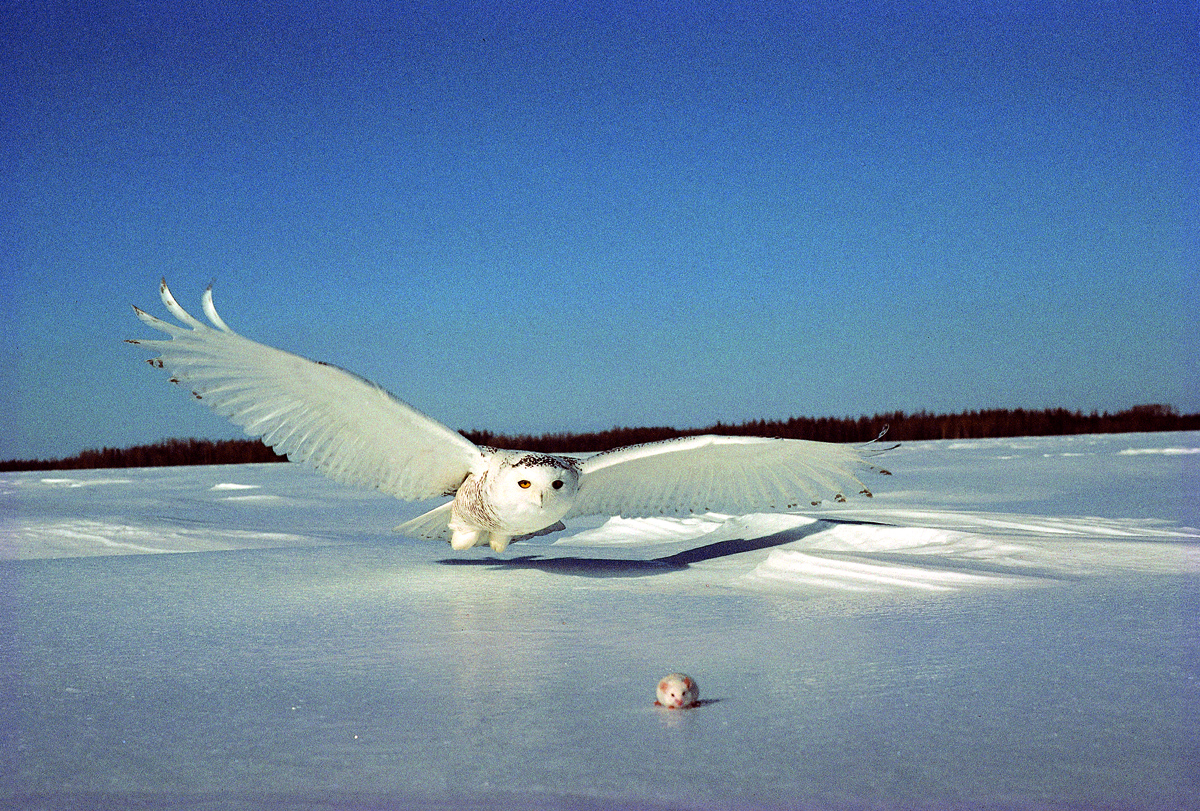
In A. A. Milne's Winnie-the-Pooh books, Owl is the one everyone thinks is wise, because he uses long words and can (nearly) spell his own name. In fact he is a bit pompous and often wrong, a gentle joke about people who seem wise because they sound clever. In the Harry Potter books, Hedwig, Harry's snowy owl, carries his letters and is his loyal companion through hard years, so that her death is a real sorrow for readers. And the animated film Legend of the Guardians (2010), based on a series of children's books, imagined whole kingdoms of owls with their own heroes, villains and history, a world where the owl's silent night is full of courage and stories.

Edward Lear wrote "The Owl and the Pussy-cat" in 1867 for a little girl, Janet Symonds, the daughter of a friend, and published it in 1871. In it, an owl and a cat sail away in a pea-green boat, with honey and money, the owl serenades the cat with a guitar, and after a year and a day they buy a ring from a pig and marry, eating mince and slices of quince with a "runcible spoon", a word Lear invented. The poem is nonsense, but gentle and musical, and it turned the owl, the bird of ill omen, into a romantic, slightly ridiculous figure. Owl in A. A. Milne's Winnie-the-Pooh books continues this tradition: he lives in a tree, considers himself wise, but cannot actually spell his own name, writing it "WOL". Hedwig, Harry Potter's snowy owl, became a symbol of loyalty, and after the films, many children in Britain and India wanted pet owls, leading wildlife groups to warn against buying them. The owl has passed, in a few centuries of children's literature, from omen to friend.
The owl has also become a symbol of learning in modern India, appearing on the logos of schools, libraries and quiz programmes, and in the mascot of countless children's magazines. It is a borrowing from the West, through English education, of Athena's bird. So the owl in India now carries three meanings at once: Lakshmi's vehicle from the Puranas, the fool of Hindi proverbs, and the wise scholar of the school badge. Few animals carry so many contradictions so lightly.