Part Four · Wings
Chapter 15
The Eagle and the Vulture
The bird that carries the gods, the bird that carries the dead, and the silent collapse of India's vultures.
Assisted and Curated by Claude, Referenced and Collated by me

Accipitridae
In the Ramayana, as Ravana flies south with the abducted Sita in his aerial chariot, an old vulture named Jatayu hears her cries. Jatayu is the king of vultures, a friend of Rama's father, and though he is old and knows he cannot win, he attacks the demon king in the sky. They fight fiercely. Jatayu breaks Ravana's chariot and kills his charioteer, but Ravana finally cuts off the old bird's wings with his sword, and Jatayu falls to the earth. When Rama and Lakshmana, searching for Sita, find him dying, he tells them which way Ravana has gone, and dies in Rama's arms. Rama performs his funeral rites as he would for his own father.

It is a remarkable portrait of a vulture: a noble, loyal, courageous creature, honoured with a son's rites by a god. Most cultures have treated vultures with disgust. India, in its oldest epic, treated one as a hero. And in the last three decades of the twentieth century, India's real vultures, once among the most abundant large birds in the world, almost vanished without most people noticing.
The Jatayu episode is told with great feeling in Valmiki's Aranya Kanda, and it grew in later tellings. In Valmiki, Jatayu introduces himself to Rama as a friend of his father Dasharatha, and promises to guard Sita while the brothers are away hunting. When Ravana seizes her, Jatayu, sixty thousand years old in the poem's reckoning, warns Ravana to let her go and then attacks him, tearing at his chariot and wounding him with his claws and beak, until Ravana cuts off his wings. When Rama finds him dying, Jatayu tells him that Ravana has gone south, and dies. Rama, grieving, says that Jatayu deserves the same honour as his own father, and performs his funeral rites himself, an extraordinary gesture from a prince to a bird. Several places in India claim to be where Jatayu fell. At Chadayamangalam in Kerala, a giant Jatayu sculpture, about two hundred feet long, opened in 2018 on a rock where tradition says he landed. At Lepakshi in Andhra Pradesh, a story says that Rama called out "Le pakshi", "Rise, bird", giving the place its name.

The eye of the eagle
Eagles and vultures are both members of the family of hawks and their relatives, the Accipitridae, and they are among the largest birds of prey. An eagle's eyesight is legendary, and justly so. Its eyes are roughly the same size as a human's, but they are packed with far more light-sensitive cells, and each eye has two foveae, the areas of sharpest vision, where humans have one. A golden eagle may be able to see a rabbit from over three kilometres away. Eagles see a wider range of colours than we do, including ultraviolet light.

Golden eagles, the most widespread of the great eagles, hunt hares, marmots, foxes, and young deer. In the Altai mountains of western Mongolia, Kazakh eagle hunters, the berkutchi, still take golden eagle chicks from their nests, train them to hunt foxes and wolves, and, after about a decade, release them back into the wild to breed. The harpy eagle of the South American rainforest, with talons as long as a grizzly bear's claws, hunts sloths and monkeys from the canopy. The Philippine eagle, one of the largest and rarest eagles in the world, is the national bird of the Philippines.
Eagle hunting is still a living culture. In the Altai mountains of western Mongolia, Kazakh families take young golden eagles from the nest, raise and train them, and ride out with them on horseback in the bitter winter to hunt foxes and hares. The eagle sits on the hunter's arm, which is protected by a thick leather glove and propped on a wooden rest on the saddle, because a golden eagle is heavy. After some years the eagle is released back into the wild to breed. The craft is passed from parent to child, and for generations it was almost always passed from father to son.

The documentary The Eagle Huntress (2016) follows Aisholpan, a thirteen-year-old girl who wants to become an eagle hunter like her father and grandfather. Some of the old men say a girl cannot do it. With her father's help she climbs down a cliff to take an eaglet from its nest, trains it, and enters the eagle festival in the town, where she wins. It is a story about an ancient tradition and a young person quietly proving that it can belong to her too.
Eagle feathers are sacred to many Native American nations. They are not decoration: they are given to honour great deeds, courage or service, and are treated with great respect, like a medal and a prayer at once. The eagle is seen as the bird that flies closest to the Creator and carries prayers upward. In the United States, the law protects eagles so strictly that only enrolled members of recognised tribes may keep their feathers, for religious use.

The English poet Alfred Tennyson caught the eagle in just six lines in "The Eagle" (1851). The poem begins "He clasps the crag with crooked hands": the eagle sits alone on a high rock, close to the sun, with the wrinkled sea crawling far below him. He watches. Then, in the last line, he falls "like a thunderbolt". In six lines Tennyson gives us everything that makes the eagle what it is: height, loneliness, patience, and then sudden, total power.
The Kazakh eagle hunters of western Mongolia, the berkutchi, practise a tradition that may be thousands of years old. In the Altai mountains of Bayan-Ölgii province, hunters take a young female golden eagle from the nest, since females are larger and stronger, and spend years training her: carrying her on a heavily gloved arm, feeding her by hand, hooding her to keep her calm, and teaching her to hunt foxes and hares from the snowy hills in winter. A good eagle can even bring down a wolf. After about ten years, the hunter takes the eagle back to the mountains and releases her to breed, leaving a sheep's carcass as a farewell gift. The Golden Eagle Festival held each autumn in Ölgii draws visitors from around the world. The Eagle Huntress, directed by Otto Bell and narrated by Daisy Ridley, followed Aisholpan Nurgaiv, a thirteen-year-old girl who trained an eagle and won the festival competition, in a tradition long kept by men. Some anthropologists criticised the film for exaggerating how rare female eagle hunters had been. But the image of the girl and her eagle against the mountains made the tradition known worldwide.
Tennyson's "The Eagle", written in 1851, is only six lines long but has been learned by generations of schoolchildren. It begins with the bird clasping the rock with "crooked hands" close to the sun, watching the wrinkled sea below, and ends with it falling "like a thunderbolt". In a few lines, the poet makes the eagle almost a person, alone and lordly, and then shows its terrible speed. Real golden eagles can reach speeds over two hundred kilometres an hour in a dive, and peregrine falcons, faster still, over three hundred. The eagle's speed and eyesight have made it the bird of kings and of watchfulness everywhere.

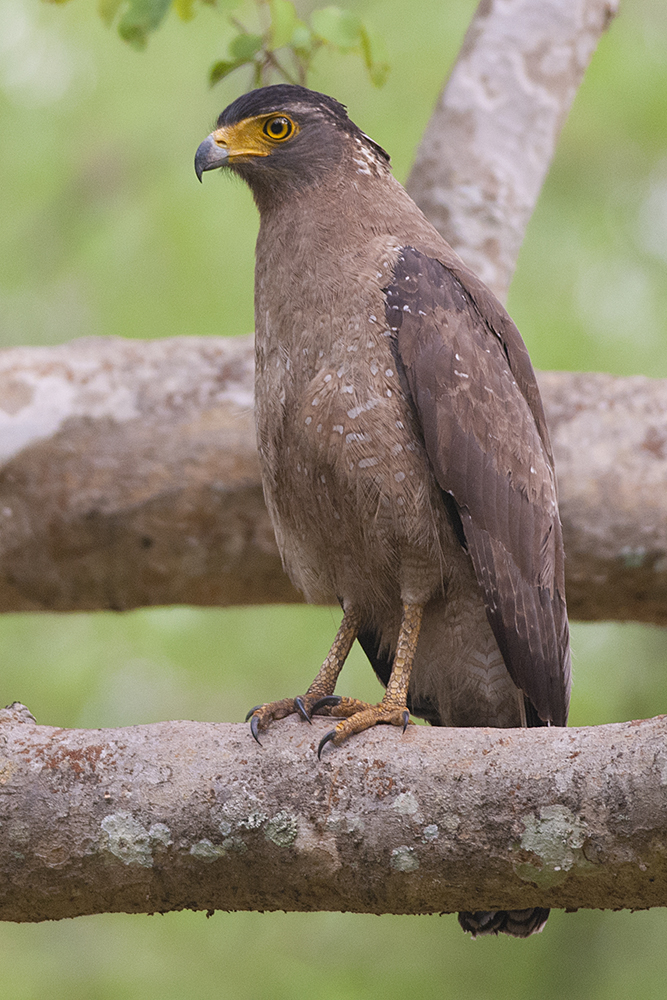
India has many eagles, and some of them are remarkable. The great Indian eagles include the steppe eagle, which migrates in winter from Central Asia; the tawny eagle of dry plains; Bonelli's eagle of rocky hills; the crested hawk-eagle and the changeable hawk-eagle of forests; the black eagle, which glides slowly just above the forest canopy, snatching eggs and chicks from nests; and the white-bellied sea eagle of the coasts. The crested serpent eagle, common in Indian forests, sits quietly on branches watching for snakes, and calls with a ringing whistle that is one of the characteristic sounds of the forest. In the Himalaya lives the golden eagle, and the bearded vulture, or lammergeier, which the main text describes. Every winter, the steppe eagles and other raptors from the north arrive in huge numbers at rubbish dumps and grasslands in Rajasthan and Gujarat; at Jorbeer, near Bikaner, a carcass dump draws hundreds of eagles and vultures, one of the best places in the world to see birds of prey up close.

The eagle of the gods
The eagle was the bird of the sky god almost everywhere it flew. In Greece, it was Zeus's bird, which carried his thunderbolts and abducted the beautiful youth Ganymede to serve as cupbearer to the gods; it also tore daily at the liver of Prometheus, chained to a rock for giving fire to humanity. The Roman legions marched behind the aquila, a golden eagle on a pole, and losing it in battle was the greatest disgrace. The eagle passed from Rome to the Holy Roman Empire, Russia, Germany, Austria, and the United States as a symbol of imperial power. In Norse myth, an eagle sits at the top of the world tree Yggdrasil. In the founding legend of the Aztec capital Tenochtitlan, the Mexica were told to settle where they found an eagle perched on a cactus, eating a serpent, and the image is on the flag of Mexico today.
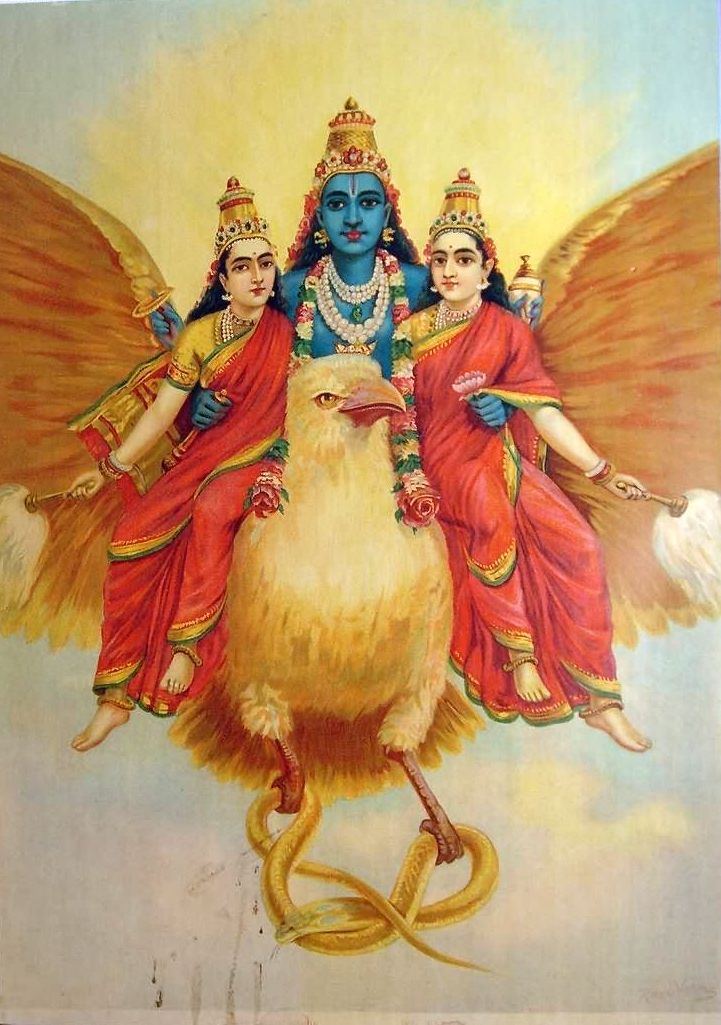
In India, the great bird is Garuda, the mount of Vishnu, part eagle and part man, the king of birds and the eternal enemy of serpents. Garuda was born the son of the sage Kashyapa and Vinata, whose sister Kadru, the mother of the serpents, had enslaved her through trickery. To free his mother, Garuda stole the nectar of immortality from the gods, defeating them all, and then made a pact with Vishnu to become his mount. Garuda is the national symbol of Indonesia, and of Thailand, and the name of Indonesia's national airline. The rivalry between the eagle and the serpent, which appears in the Aztec legend, the Norse world tree, and Garuda's myth alike, may reflect the observation, made by people everywhere, that some eagles really do hunt snakes; the short-toed snake eagle of India and the Mediterranean specializes in them.
Most cultures treated vultures with disgust. India, in its oldest epic, treated one as a hero.

India has an early stone witness to Garuda's power. At Besnagar, near the town of Vidisha in Madhya Pradesh, stands a stone pillar set up in about 110 BCE by a man named Heliodorus. He was a Greek, sent as an ambassador from a Greek king who ruled in what is now Afghanistan and Pakistan to the court of an Indian king. The inscription on the pillar says that Heliodorus, a devotee of Vasudeva, that is Krishna, raised this "Garuda pillar" in his honour. It was once crowned with a figure of Garuda. It is one of the earliest signs of a foreigner worshipping an Indian god, and a reminder that more than two thousand years ago, India was already a meeting place of peoples and beliefs.

The Garuda Purana, which is named after the eagle who carries Vishnu, is recited in many Hindu homes in the days after a death. In it, Vishnu answers Garuda's questions about what happens to the soul after it leaves the body: its journey, its judgement, and what helps it on its way. It is fitting that the questions are asked by the bird who flies between earth and heaven. In grief, families listen to the eagle asking what everyone wants to know.
In J. R. R. Tolkien's books, great eagles rescue the heroes at the last moment: they lift Bilbo and the dwarves out of a burning forest in The Hobbit, and in The Lord of the Rings they carry Frodo and Sam away from the fire of Mount Doom when all hope seems lost. It is the same role Garuda plays: the rescuer who comes from above, when no help on the ground is left.

Garuda's story is told at length in the first book of the Mahabharata. The sage Kashyapa had two wives, the sisters Kadru and Vinata. Kadru asked for a thousand serpent sons; Vinata asked for two sons more powerful than Kadru's. Impatient, Vinata broke one of her eggs early, and from it came Aruna, unformed below the waist, who became the charioteer of the sun, the red of dawn. He cursed his mother to become her sister's slave. The two sisters then made a bet about the colour of the tail of Uchchaihshravas, the divine horse; Kadru made her serpent sons cling to the white tail to make it look black, and so Vinata lost and became Kadru's servant. When Garuda hatched from the second egg, blazing like fire, he learned of his mother's slavery and asked the serpents what would free her. They demanded amrita, the nectar of immortality. Garuda flew to heaven, defeated the gods, passed through a wheel of blades and two fire-breathing serpents, and seized the nectar, without drinking a drop himself. Vishnu, impressed by his restraint, made him his mount, and Indra, who wanted the nectar back, made a deal with him. Garuda gave the nectar to the serpents, freeing his mother, but before they could drink, Indra snatched it away. The serpents licked the kusha grass where the pot had stood, and the sharp grass split their tongues, which is why snakes have forked tongues to this day. It is one of the great just-so stories of India, explaining dawn, the hatred between eagles and snakes, and the shape of a snake's tongue in one tale.

The Heliodorus pillar at Besnagar is one of the most remarkable monuments in India. Heliodorus, son of Dion, was an ambassador from the Indo-Greek king Antialcidas, who ruled in what is now northwest Pakistan and Afghanistan, to the court of King Bhagabhadra of Vidisha. Around 110 BCE, he set up a stone pillar topped with a figure of Garuda, and an inscription in Brahmi describing himself as a Bhagavata, a devotee of Vasudeva. The inscription also gives three moral precepts: self-restraint, generosity and watchfulness, which lead to heaven, words that echo the Mahabharata. It is one of the earliest inscriptions in India to record devotion to Krishna-Vasudeva, and one of the earliest records of a foreigner adopting an Indian religion. Locally, the pillar is called Khamba Baba and worshipped to this day.
Garuda's journey across Asia is a story of its own. With the spread of Hinduism and Buddhism to Southeast Asia, Garuda became a royal emblem: the Khmer kings of Angkor carved rows of Garudas holding up their temples, and in Thailand the Garuda, Phra Khrut, is the emblem of the king and the state, appearing on official documents and bank notes. Indonesia, the world's largest Muslim-majority country, chose the Garuda Pancasila as its national emblem in 1950, holding a shield with the five principles of the state, and named its national airline Garuda. In Japan, Garuda became the Karura, a bird-headed guardian of Buddhism, and in Tibet the Garuda, khyung, is linked to the Bon religion. Few mythical creatures have travelled so far and served so many states. In Tolkien's The Lord of the Rings and The Hobbit, the great eagles that rescue Bilbo, Gandalf, Frodo and Sam at decisive moments play a similar role: the rescuer from the sky who arrives when all seems lost. Tolkien called this kind of sudden rescue a "eucatastrophe", a happy turn that brings joy like a sudden glimpse of grace.

Garuda is still alive in Indian ritual and in the modern state. In central Kerala, during temple festivals at Bhagavathi shrines, performers dressed as Garuda, with huge painted wings, a red beak and a heavy crown, dance in a ritual called Garudan Thookkam, and in some forms are suspended from a tall frame by hooks or ropes, swinging high above the crowd, as Garuda once flew to carry the nectar. The ritual is linked to the goddess Kali, whom Garuda is said to have helped after she killed the demon Darika. In the modern Indian state, the Indian Air Force named its special forces unit, founded in 2004, the Garud Commando Force, and the bird appears in emblems of many Indian institutions. Garuda's journey, from the Mahabharata's story of a son freeing his mother to the shoulder badges of commandos, shows how a mythical bird can keep its meaning, swift protection from above, across two thousand years.
The vulture's work
Vultures are nature's cleaners. They feed on the carcasses of dead animals, and their bodies are extraordinarily well adapted to the task. Their stomach acid is among the most corrosive in the animal kingdom, capable of destroying the bacteria that cause anthrax, cholera, and botulism, which would kill most other animals. Their heads are often bald, which may help keep them clean when feeding inside carcasses and help regulate body temperature. They soar for hours on thermal currents, scanning for food and watching other vultures, so that when one descends to a carcass, others from kilometres around follow. A group of vultures can strip a large carcass in under an hour.

The bearded vulture, or lammergeier, of the Himalaya and the mountains of Europe and Africa, feeds mainly on bones, dropping them from a height onto rocks to break them, and swallowing the fragments. Its stomach can digest them. Remarkably, bearded vultures deliberately bathe in iron-rich red soil or water, staining their white chest feathers a deep rust-orange; the colour appears to be a signal of status. It is a rare case of an animal using cosmetics, and it echoes, oddly, the red ochre with which human beings have painted their bodies since the Stone Age.
Even Freud got tangled up with a vulture, and the story is a useful lesson in how clever people can go wrong. In 1910 he wrote a famous essay on the Italian artist Leonardo da Vinci. It was built around one strange memory that Leonardo had written down in a notebook. He wrote that when he was a baby in his cradle, a bird came down, opened his mouth with its tail, and struck him with it several times inside his lips.

Freud read a German translation in which the bird was called a vulture. This excited him, because in ancient Egypt the vulture was a symbol of the mother, and the Egyptians believed there were only female vultures, made pregnant by the wind. Leonardo had been born to an unmarried mother and spent his early years with her alone. So Freud built a whole theory: that the "vulture" memory was really a fantasy about Leonardo's mother, and that it explained his art, including the mysterious smiles of his women. Later, a follower, Oskar Pfister, even claimed to see a hidden vulture in the folds of a Leonardo painting.
But the word Leonardo actually used was nibbio, which means a kite, not a vulture. The Egyptian vulture-mother had nothing to do with it. A large part of the theory was standing on a mistranslation. The essay is still read, partly for its ideas, but it has also become a classic warning: before you build a great theory, check the small facts it rests on. A single wrong word can carry a whole tower.

Writers have not been kind to vultures either. In Edgar Allan Poe's story "The Tell-Tale Heart" (1843), the narrator says he loved the old man he lived with, and had nothing against him, except his eye: a pale blue eye with a film over it, like a vulture's. It so tormented him that he killed the old man to be rid of it. The vulture eye stands for something that sees us too clearly, and that we cannot bear to be seen by. And Disney's The Jungle Book (1967) has a group of comic vultures, with mop-top haircuts and Liverpool accents, modelled on the Beatles. They are lazy and bored, but in the end they are kind to Mowgli. It is a rare friendly vulture.
Freud's Leonardo essay is one of his most influential and most flawed works. In one of his notebooks, Leonardo wrote that his earliest memory was of a bird coming to his cradle, opening his mouth with its tail and striking him inside his lips with it several times. The bird in Leonardo's Italian was a nibbio, a kite, a bird Leonardo studied closely in his work on flight. But the German translation Freud used rendered it as Geier, vulture. Freud built a long argument on the vulture: he pointed out that the Egyptian hieroglyph for "mother" was a vulture, that ancient writers believed all vultures were female and were fertilised by the wind, and that Leonardo, an illegitimate child raised at first by his mother alone, had identified with this fatherless vulture-child. A follower of his, the pastor Oskar Pfister, even claimed to see a hidden vulture in the folds of the Virgin's robe in Leonardo's painting The Virgin and Child with Saint Anne, and Freud added the idea to later editions. When the mistranslation was pointed out in the 1920s, much of the argument collapsed. Yet the essay remains important as an early attempt to understand an artist through his childhood, and as a lesson in checking one's sources.

Poe's "The Tell-Tale Heart" gives the vulture a different kind of power. Its unnamed narrator insists he is sane while confessing to the murder of an old man he lived with, whom he says he loved. His only reason is the old man's eye: pale blue, with a film over it, "the eye of a vulture". The narrator kills him, hides the body under the floorboards, and finally confesses when he imagines he can hear the dead man's heart still beating. The vulture eye stands for the gaze of death itself, watching, waiting, the thing the narrator cannot bear to be looked at by. Poe drew on the old European image of the vulture as the bird that waits for the dying, the opposite of the Ramayana's noble Jatayu.

The vultures and the dead
In the earlier book we met the vultures painted on the walls of Çatalhöyük, swooping over headless human figures, and the great vulture carved on a pillar at Göbekli Tepe. Some archaeologists believe that the people of these sites exposed their dead to be eaten by vultures before burying the bones. The practice continues in some places today. The Parsis of India, followers of Zoroastrianism, traditionally placed their dead on stone platforms called dakhmas, or towers of silence, where vultures consumed the bodies, since burial or cremation would pollute the sacred elements of earth and fire. In Tibet, the practice of jhator, often called sky burial, involves cutting up the body of the dead and offering it to vultures on a mountainside, an act of generosity to other living beings and a reminder of impermanence. In ancient Egypt, the vulture goddess Nekhbet was the protector of Upper Egypt and of the pharaoh, and the vulture was a symbol of motherhood; the hieroglyph for "mother" was a vulture.

These are among the oldest images of birds in human art. At Göbekli Tepe in south-eastern Turkey, people about eleven thousand years ago, before farming had properly begun, raised great stone pillars in rings and carved animals on them: foxes, boars, snakes, scorpions and birds. On one of them, known as "Pillar 43" or the "Vulture Stone", a large vulture spreads its wings and holds what may be a ball or a human head above one wing. Some archaeologists think it shows a belief that vultures carried away the dead, or their souls. It is a reminder that the link between vultures and death, which we have seen in Parsi towers and Tibetan sky burials, is as old as monuments themselves.

Göbekli Tepe's "Vulture Stone", Pillar 43, is one of the most debated carvings in archaeology. Göbekli Tepe, in southeastern Turkey, was built by hunter-gatherers about eleven thousand five hundred years ago, before farming, and its great T-shaped stone pillars, carved with foxes, boars, snakes, scorpions and birds, have changed how archaeologists think about the origins of religion and civilisation. On Pillar 43, a vulture with outstretched wing appears to hold a round object, perhaps a human head; below it, a headless human figure with a raised penis stands near a scorpion. Most archaeologists think the scene relates to death rites, possibly the exposure of corpses to vultures, and to the vulture as a carrier of souls. Some writers have claimed it records a comet impact or an ancient star map, ideas most scholars reject. What is clear is that vultures were among the first creatures humans connected with death and the afterlife.


The Parsi towers of silence in Mumbai, set among gardens on Malabar Hill, still exist, though they are closed to outsiders. Zoroastrians consider a dead body impure, and fire, earth and water sacred, so burning or burying a body would pollute them. Instead, bodies were laid on the stone platform of the dakhma, open to the sky, where vultures stripped them within hours, and the bones were later swept into a central pit. When India's vultures disappeared in the 1990s, the system broke down. Bodies lay for weeks. In 2006, a Parsi woman secretly photographed decaying bodies in a tower and caused a public outcry within the community. Some Parsis began choosing cremation instead, while the trustees installed large solar concentrators to speed up decomposition, and there have been plans to build an aviary to breed vultures nearby. A religious practice thousands of years old found itself hostage to a veterinary drug.
The silent collapse
In the 1980s, India had tens of millions of vultures, among the highest densities of large birds of prey anywhere. They gathered in their hundreds at every carcass dump, cleaning up the bodies of dead cattle, which in much of India are not eaten. Then, in the 1990s, they began to die. By the mid-2000s, the populations of three species of Gyps vultures had fallen by more than ninety-five percent, and that of the white-rumped vulture, once perhaps the most abundant large raptor on earth, by more than ninety-nine percent. It was one of the fastest collapses of any bird population ever recorded.

For years, no one knew why. In 2004, a team led by Lindsay Oaks, working in Pakistan, identified the cause: diclofenac, a common painkiller given to cattle. Vultures that ate the carcasses of animals treated with the drug suffered kidney failure and died. India banned the veterinary use of diclofenac in 2006, and populations have partly stabilized in some areas, but recovery has been slow, and other harmful drugs remain in use.
The consequences for human beings were serious. With vultures gone, carcasses rotted, feral dog populations grew, and dog bites and rabies increased. A 2024 study by the economists Eyal Frank and Anant Sudarshan estimated that the loss of vultures may have led to around half a million additional human deaths in India between 2000 and 2005, through the spread of disease and contaminated water. The Parsis of Mumbai found their towers of silence no longer worked, and had to experiment with solar concentrators to speed up decomposition.

The vultures were cleaning the country. When they vanished, people began to die.
India is now trying to bring the vultures back. At centres like the Jatayu Conservation Breeding Centre in Pinjore, Haryana, named after the brave vulture of the Ramayana, vultures are bred in captivity. It is slow, patient work: vultures lay only one egg a year and take about five years to start breeding. When they are old enough, they are released into "vulture safe zones", areas where the painkiller diclofenac, which killed the vultures by poisoning the carcasses they ate, is no longer used on cattle. Each released bird is a small step in undoing one of the fastest collapses of any animal in history.

Their cousins the kites have had their own champions. Shaunak Sen's documentary All That Breathes (2022) is about two brothers in Delhi, Mohammad Saud and Nadeem Shehzad, who rescue injured black kites that fall from the polluted sky, often tangled in kite strings or sick from the air. They treat them in a cramped basement in their home. The film is quiet and beautiful, showing a city of smoke and noise in which a few people keep caring for the birds above it. It won the top documentary prize at the Cannes Film Festival and was nominated for an Oscar.
The scientist who first noticed the vulture crash in India was the ornithologist Vibhu Prakash of the Bombay Natural History Society. In the 1980s, he had counted vultures at Keoladeo National Park in Bharatpur, Rajasthan, where hundreds nested. When he returned in the late 1990s, almost all were gone, and dead and dying birds were found with their heads drooping, a symptom that became known as "neck drooping". At first, scientists suspected a virus or pesticides. It was Lindsay Oaks of Washington State University, working with the Peregrine Fund in Pakistan, who in 2004 proved that diclofenac in cattle carcasses caused kidney failure in vultures. Diclofenac had become a cheap, popular painkiller for cattle in the 1990s, and even a small number of treated carcasses could poison many birds, since vultures feed together. India banned veterinary diclofenac in 2006, followed by Nepal and Pakistan, and promoted a safer alternative, meloxicam. But human diclofenac in large vials was still sometimes used on animals, and other drugs such as aceclofenac and ketoprofen were later found to be harmful too; India banned some of these in 2023.
The breeding centre at Pinjore, set up in 2001, was the first of several Jatayu Conservation Breeding Centres, run by the Bombay Natural History Society with state forest departments and the RSPB of Britain. Vultures breed slowly: a pair lays one egg a year and may not breed until it is five years old. It took years before the first chicks hatched. In 2016, the first captive-bred white-backed vultures were released in Haryana, and since then birds have been released in several states, some fitted with satellite tags. The aim is to create "vulture safe zones", areas of a hundred kilometres around breeding colonies where no harmful drugs are used. The economists Eyal Frank and Anant Sudarshan's 2024 study, mentioned earlier, put a stark number on what had been lost: in districts where vultures disappeared, human death rates rose, probably because of rotting carcasses, more feral dogs and rabies, and contaminated water. The vulture, an animal many people found disgusting, had been quietly protecting human health.

The vulture crisis also shows how scientists from different countries worked together. After Oaks's discovery, a group called SAVE, Saving Asia's Vultures from Extinction, was formed in 2011 by organisations from India, Nepal, Pakistan, Bangladesh, Britain and elsewhere, to coordinate breeding, research and pressure on governments to ban harmful drugs. Nepal created the world's first "vulture safe zone", and community-run "vulture restaurants", where old cattle are cared for until they die naturally and their carcasses, free of drugs, are given to vultures. Tourists pay to watch the vultures feed, and the money goes to the villages. India's own Vulture Action Plan of 2020–2025 aims to set up more breeding centres and safe zones in every state. Surveys suggest that the decline of some species has slowed or stopped, though numbers remain a tiny fraction of what they were. The vulture's story is far from over.

Where India's eagles and vultures live
India's vultures nest where there are cliffs, tall trees or old buildings, and feed where there are cattle. Some of the most important surviving colonies are on the sandstone cliffs of the Ken river gorge in Panna, in Madhya Pradesh, on the cliffs of Bandhavgarh, Gandhi Sagar on the Chambal and the Ratapani sanctuary, and on the ruined cenotaphs and palaces of Orchha above the Betwa river, where Indian vultures nest on the domes built by Bundela kings. Karnataka's Ramadevarabetta, a rocky hill near Ramanagara, is India's only sanctuary created specially for vultures, protecting a small colony of long-billed vultures. In the Himalaya, Himalayan griffons and bearded vultures nest on cliffs in Himachal, Uttarakhand, Ladakh and Sikkim, and in Assam, white-rumped vultures still nest in tall trees in villages near Kaziranga and in the Brahmaputra plains. Madhya Pradesh, with its wide forests and cliffs, now has more vultures than any other state.


Eagles are found across the country. The Desert National Park near Jaisalmer, with its sand dunes and grassland, is famous for wintering raptors, including steppe eagles, imperial eagles and tawny eagles, which come to hunt among the chinkara and desert foxes. The carcass dump at Jorbeer, near Bikaner, draws hundreds of eagles and vultures each winter, and Keoladeo National Park at Bharatpur, a wetland fed by the Gambhir and Banganga rivers, hosts greater spotted eagles and other wetland raptors. In the Western Ghats and the Northeast, forest eagles like the crested hawk-eagle, the black eagle and the mountain hawk-eagle hunt in the canopy, and the white-bellied sea eagle nests along the coasts of Kerala, Goa and the Andamans. Pallas's fish eagle, one of the great river eagles, nests along the Brahmaputra and the rivers of the Terai, and the golden eagle soars over Ladakh's valleys, where it hunts marmots on the slopes above the Indus.

What the eagle and the vulture teach
The eagle and the vulture occupy opposite ends of the human imagination: the eagle soaring toward the sun, carrying gods and emperors; the vulture descending to the dead, carrying away what is left. Yet they are cousins, and both are essential. Jatayu, the old vulture who gave his life trying to rescue Sita, is perhaps the truest symbol of what vultures have done for India: an unglamorous, unthanked service, whose value became clear only when it was lost.

The Ramayana gives the brave vulture Jatayu an elder brother, Sampati. Long ago, the two brothers raced each other into the sky, flying higher and higher towards the sun. When Jatayu began to burn, Sampati spread his wings over his younger brother to shield him, and Sampati's own wings were burnt away. He fell to earth, and lived for many years old and grounded on a mountain by the sea.
When the monkey army comes searching for Sita, tired and close to giving up, they meet Sampati and tell him that Jatayu died fighting Ravana. Sampati grieves for his brother. Then, though he cannot fly, he uses the one gift he still has, a vulture's sight. He looks far across the sea and tells them that Sita is in Lanka. With that, the search can go on, and Hanuman makes his leap. Between them, the two old vultures save the epic: one by fighting to the death, the other by seeing far. It is a fitting story for birds that people have so often despised. In the Ramayana, it is the vultures who are loyal, brave and wise.