Part Three · Hoof and Horn
Chapter 11
The Deer and the Antelope
Antlers that fall off and grow back, the golden deer of the Ramayana, and the people who gave everything to protect trees and blackbuck.
Assisted and Curated by Claude, Referenced and Collated by me

Scientific name: Families Cervidae and Bovidae
Nearly three hundred years ago, in 1730, soldiers came to the village of Khejarli near Jodhpur to cut down its khejri trees. The villagers were Bishnois, who follow rules from their teacher Guru Jambheshwar: do not cut green trees, and do not kill animals.
A brave woman named Amrita Devi hugged a tree and would not let go. She and many villagers gave their lives to protect the trees. When the Maharaja heard, he stopped the cutting and made a law to protect trees and animals in Bishnoi villages.
Today Bishnoi villages are still safe places for wildlife. Blackbuck, a beautiful antelope with spiral horns, graze near the houses without fear. Bishnoi women have even fed orphaned baby deer.
Antlers and horns
Deer and antelope look alike but are different. Deer have antlers, made of bone. They fall off every year and grow back again! Antelope have horns, like cows and goats. Horns stay for life.

A growing antler is covered in soft, furry skin called velvet. Antlers grow super fast, in big deer more than two centimetres a day. Once fully grown, the velvet is rubbed off and the hard antlers are used to show off and to fight in the mating season.


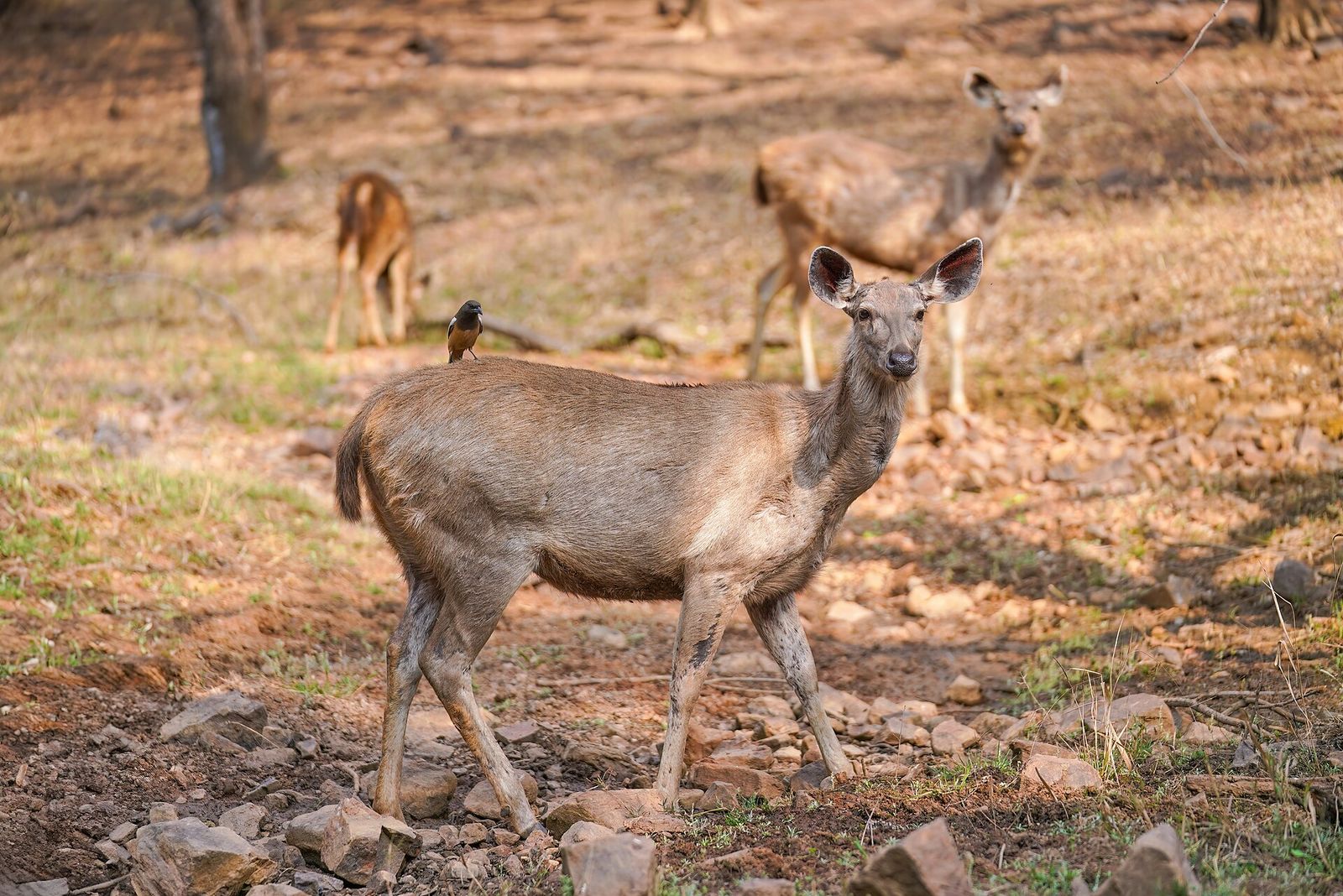
India's biggest deer, the sambar, has a loud call like a bell. The chital, or spotted deer, is the deer you are most likely to see in Indian forests.


Eleven thousand years ago, people in England wore deer antlers as headdresses.
The partnership of the forest
Remember the langur and the chital from the start of this book? They are a team. Langurs drop leaves and fruit for the deer, and spot danger from high up. Chital have a great sense of smell and notice what the monkeys miss. Each listens to the other's alarms.

The blackbuck can run at eighty kilometres an hour, as fast as a car on a highway! In Africa, more than a million wildebeest walk in a giant circle every year following the rain. It is the biggest journey of land animals on Earth.
The golden deer and the cursed king
In the Ramayana, the demon Maricha turns himself into a golden deer. Sita loves it and asks Rama to catch it. While Rama chases it, Ravana carries Sita away. The golden deer is a beautiful trick that leads to trouble. In Sanskrit, a mirage is called 'deer-thirst'.

The Buddha gave his first talk in a Deer Park at Sarnath. In one Jataka story, the Buddha, in an earlier life, was a golden deer who offered his own life to save a mother deer, and the king was so moved that he protected all deer. In Nara, Japan, deer bow to visitors and are treated as messengers of the gods.
Read the story of Shakuntala, whose pet fawn did not want her to leave. The poet Kabir said we are like the musk deer, searching everywhere for a lovely smell that is really coming from itself.

The stag in the West
In Europe, deer often appear in stories as guides to magical places. A Celtic god with antlers was carved on a famous silver cauldron. In one Christian legend, a hunter saw a cross shining between a stag's antlers. In Hungary, two brothers followed a white stag to find their new homeland.

Why deer? Maybe because they appear and vanish at the edge of the forest so suddenly, and because their antlers grow again like tree branches.


Watch Bambi (1942) and Princess Mononoke (1997), where the forest god looks like a deer.


India's rescued deer
The barasingha, or swamp deer, is named for its 'twelve-pointed' antlers. By the 1970s, only a few dozen were left in Kanha. Careful care of their grasslands brought them back to the hundreds. It is now the state animal of Madhya Pradesh.


The sangai deer of Manipur lives only on floating islands of plants in Loktak Lake, in the world's only floating national park!


What the deer teaches
Deer are always alert and ready to run. They teach us to notice things, and that beautiful things can grow back. And the Bishnois teach us how much people can do to protect other living things.

