Chapter VII
The Temple Before the City
On a hill in Turkey, hunter-gatherers built giant stone circles more than eleven thousand years ago, before anyone had learned to farm.
Assisted and Curated by Claude, Referenced and Collated by me
There's a hill in southeast Turkey called Göbekli Tepe, which means something like "potbelly hill". In 1963, researchers noticed broken limestone slabs on top and guessed it was an old graveyard. For thirty years, nobody looked again.
In 1994, a German archaeologist named Klaus Schmidt visited the hill. He noticed that the flint tools lying everywhere were from the Stone Age, and that the broken slabs weren't gravestones but the tops of giant pillars! It's said he realised within minutes that he could either walk away or spend the rest of his life there. He spent the rest of his life there. His digs uncovered one of the most important archaeological sites ever, and changed how we think civilisation began.
What they found
Under the hill were big round stone circles, each ringed by a wall and huge limestone pillars shaped like the letter T. In the middle of each circle stand two especially tall pillars, facing each other. The tallest are more than five metres high and may weigh ten tonnes or more! They were cut from the rock with stone tools, moved and raised into holes in the floor. The oldest circles are about 11,600 years old, about six thousand years older than Stonehenge and seven thousand years older than the Great Pyramid!
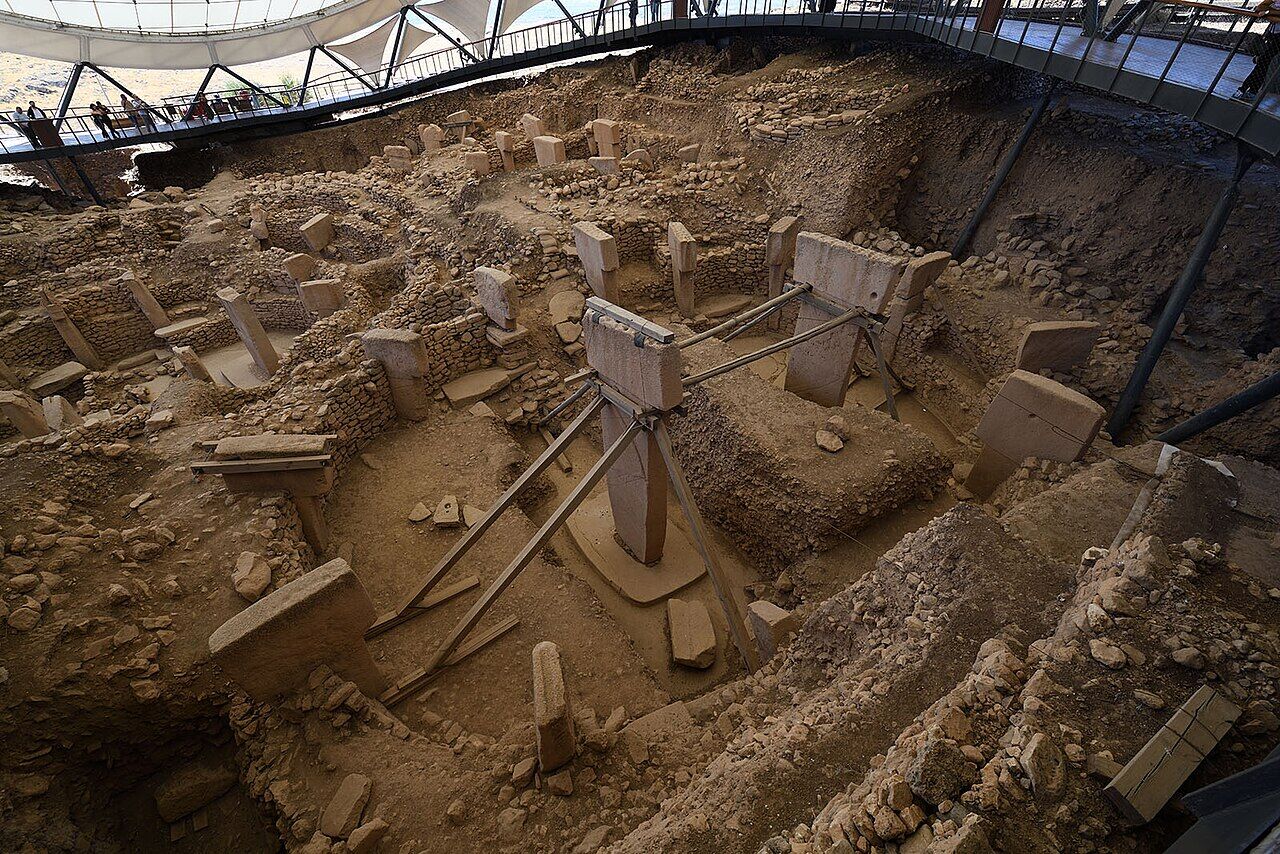
The pillars aren't plain. The two central pillars in one circle have carved arms running down their sides, with long-fingered hands meeting over the tummy, and belts with fox-skin cloths hanging from them. The T-shaped tops are heads, seen from the side. So these aren't just pillars. They're giant, simplified beings, standing in a circle of other beings.
And they're surrounded by animals: foxes, wild boars, snakes, wild cattle, wild donkeys, cranes, vultures, scorpions, spiders and big cats. Most are dangerous, many shown snarling or attacking, some carved so they seem to climb down the stone! On one pillar, the "Vulture Stone", a vulture spreads its wings above a scorpion. Snakes pour down the sides of pillars. It isn't a gentle world: it's full of hunters, poison and danger.
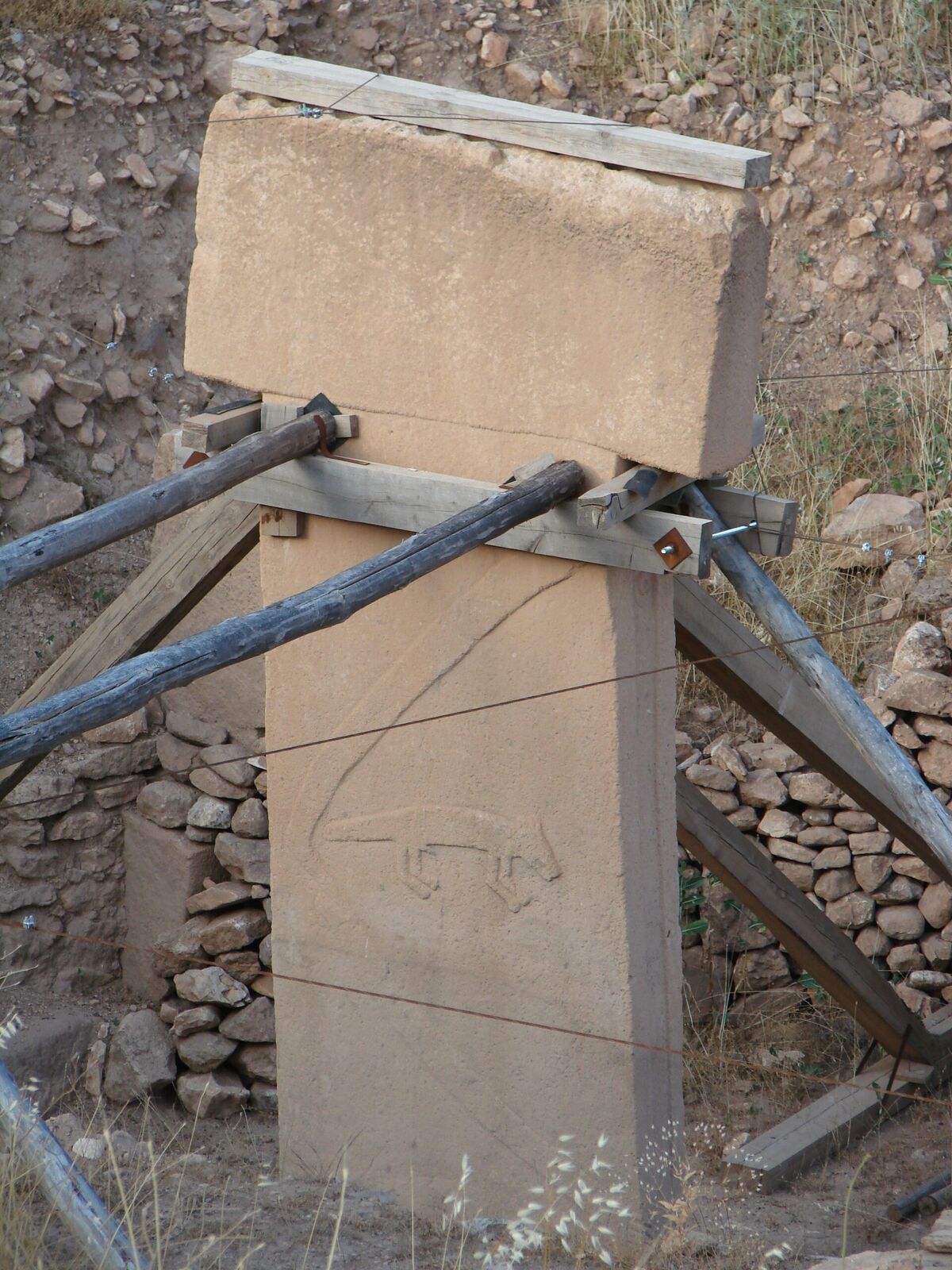
These aren't just pillars. They're giant beings standing in a circle.
Built by hunters, not farmers
What made Göbekli Tepe so astonishing was who built it. When the first circles were raised, nobody anywhere in the world had started farming yet! There were no farm animals except dogs, no pottery, no metal, no writing and no wheel. The animal bones found there were from wild animals like gazelles, boars, wild cattle and wild donkeys. The builders were hunter-gatherers.
For most of the twentieth century, textbooks said this should have been impossible. The usual story went: first farming, then extra food, then people settling down, then priests and craftspeople, and only then temples and monuments. Religion was supposed to come after farming.
Göbekli Tepe turned this upside down! Here were huge buildings and complex religious art made by people who hadn't started farming. Schmidt summed it up: first came the temple, then the city.
A cathedral for hunters?
Schmidt saw Göbekli Tepe as a special gathering place where scattered hunter-gatherer groups came together for ceremonies, on a hilltop visible for miles. He thought the T-shaped pillars showed supernatural beings, maybe ancestors or the first gods, and the animals were their companions, guardians or the symbols of different groups.
He also saw a link to farming. Building Göbekli Tepe needed hundreds of people working together for a long time, and they all needed feeding! That may have pushed people to gather, and later to grow, wild grains. Amazingly, the wild ancestor of an early kind of wheat comes from mountains less than a hundred kilometres away! So maybe the temple didn't just come before farming. Maybe it helped cause it.
A French archaeologist, Jacques Cauvin, had a similar idea. He said a change in people's minds and beliefs came before farming. In early art, he noticed two symbols becoming important: a woman and a bull. He thought people began to see themselves as separate from nature and to look up to divine powers, and that this new way of thinking made farming possible. First the mind changed, then the way of life.
First came the temple, then the city. And maybe the temple helped create the farm.
A more complicated picture
Since Schmidt died, new digs have changed parts of his picture. Researchers now think people did live at Göbekli Tepe, at least part of the year. They've found what look like houses, tanks for collecting rainwater and huge numbers of grinding stones for wild grains. So it looks less like a lonely temple and more like a settlement with amazing ceremonial buildings in the middle of everyday life.
That makes it even more important! If people were living in communities big enough to build Göbekli Tepe, without farming, then settling down happened before farming. And maybe the difference between "temple" and "village" is a modern idea. For these people, sacred buildings were part of living together.
Some evidence shows that the dead were part of the ceremonies. Scientists found pieces of human skulls with deep, carefully carved grooves and a drilled hole, perhaps so the skull could be hung up. Some carvings show figures holding human heads. Parts of the dead seem to have been present in the circles.
The Stone Hills
Göbekli Tepe isn't alone! Since 2019, a project called Taş Tepeler, "the Stone Hills", has explored about a dozen similar sites nearby from the same time. One, Nevalı Çori, had T-shaped pillars and carvings of people and birds, but is now under the water of a dam.
At Karahan Tepe, about forty kilometres away, archaeologists found a room carved into solid rock with eleven pillars rising from the floor, also carved from the rock. From one wall, a carved human head with a long neck looks out at the pillars. A narrow channel connects it to another room. Standing there feels eerie: a stone face watching a gathering of stone figures, in a space that may have been used for special ceremonies.
Under the modern city of Şanlıurfa, workers in 1993 found a limestone statue of a man about 1.9 metres tall, with eyes made of shiny black volcanic glass. Called the Urfa Man, it may be the oldest life-sized statue of a person ever found, from the same time as Göbekli Tepe.
Together, these sites show not one mysterious temple but a whole regional culture, with shared symbols and buildings, involving thousands of people over more than a thousand years. Most of the images are male, along with dangerous animals. Female images are rare, which is very different from the little carved women of the Ice Age. Why? Nobody knows yet.
Before Göbekli Tepe
Göbekli Tepe didn't appear from nowhere. Earlier, in the area that's now Israel, Jordan and Syria, lived the Natufians, hunter-gatherers who were starting to settle in villages and harvest wild grains with flint sickles. They buried their dead in their villages, sometimes under their house floors. At one site, an elderly person was buried about twelve thousand years ago with a hand resting on a puppy, one of the earliest signs of the friendship between people and dogs!
We met the Natufian woman buried with fifty tortoises earlier. In the same cave, archaeologists found signs of feasting: at least seventy-one tortoises and three wild cattle, eaten at funeral gatherings. At another cave there are signs of brewing. The Natufians were already doing, on a smaller scale, what would happen at Göbekli Tepe: settling, gathering, feasting and honouring the dead.
The feast
An archaeologist named Brian Hayden says feasts were one of the biggest causes of change in ancient times. Feasts are powerful! They create friendships and promises, show off the hosts' generosity, attract followers and create that shared fizzing feeling that binds people together. The need for bigger and bigger feasts may have pushed people to grow more food, store extra and eventually start farming.
At Göbekli Tepe, lots of gazelles were hunted, probably when herds migrated, and huge amounts of wild grain were ground. Some big stone tubs may even have been used for brewing. Whatever the details, it was clearly a place where many people ate together. Feasting, work and ceremony were all mixed together.
Feasting, work and ceremony were all mixed together. Sacred things were built by many hands, and those hands had to be fed.
Two kinds of religion
An anthropologist named Harvey Whitehouse describes two kinds of religion. One kind has rare, intense, sometimes scary ceremonies, like difficult initiations, which people remember forever and which bond small groups tightly. The other kind has frequent, calm, routine rituals, like weekly services and daily prayers, with shared teachings spread by experts, which help a religion spread to lots of people.
Göbekli Tepe, with its snarling animals, dark circles, skulls and enormous group building projects, looks like the first kind, on a huge scale. Whitehouse thinks it may show a moment when intense hunter-gatherer ceremonies were growing to bind bigger groups than ever before. The routine kind, with priests, came later with the first kingdoms.
From partners to powers
There's one more change at Göbekli Tepe, perhaps the most important for the birth of gods. Remember the animal world of the last chapter, where animals were persons, partners and relatives? The animals of Göbekli Tepe are different. They're hunters and poisoners, shown threatening, crawling over giant human-like figures. And they surround beings who stand in the centre: big, human-shaped and in charge.
Some thinkers see in this a new picture of the universe, where human-like beings stand above the animal world and command it. An archaeologist named Ian Hodder says this period was about "taming" in the widest sense: taming plants and animals, but also the wild, death and even people themselves, who became tied to places, houses, belongings and each other. The central pillars, standing in their circles like chiefs in a council of animals, may be among the first pictures of this new order. They're not yet gods with names. But they stand at the point where the spirits of the animal world began to come together into something bigger, more human-shaped and more powerful.
Göbekli Tepe tells us that the human urge to gather, build sacred places and imagine powers greater than ourselves didn't wait for farming. It may even have caused it! It shows that hunter-gatherers could achieve amazing things, and that the line between "primitive" and "civilised" is much blurrier than old textbooks said. And it hints that gods, when they came, would come not only from the sky or the heart, but from the gathered crowd, the shared feast and the huge shared effort of raising stones.