Chapter VI
The Little Carved Mothers
All across the Ice Age world, people carved small figures of women. Were they goddesses, good-luck charms, or something else?
Assisted and Curated by Claude, Referenced and Collated by me
In 2008, archaeologists digging in a cave called Hohle Fels in Germany, near where the Lion-Man was found, discovered six pieces of carved mammoth ivory. Fitted together, they made a figure about six centimetres tall: a woman with a big, rounded body and tiny carved fingers resting on her tummy. Instead of a head, there was a small polished loop, as if it had been worn on a string like a pendant. It's at least thirty-five thousand years old, the oldest certain carving of a human being in the world!
It's a tiny object with a huge job. Ever since figures like this were first found, people have asked them big questions. Was the first god a goddess? Did early societies honour women? What did Ice Age people think about birth, plenty and the body? This chapter is about the figures, and about what people have wanted them to say.
A name that started as a joke
In 1864, a French nobleman found a small ivory figure of a woman and jokingly named it a "Venus", after the Roman goddess of beauty. The joke stuck! Soon nearly every ancient carved woman was called a "Venus", which quietly suggested they were all about beauty and having babies, and all meant the same thing.
Many archaeologists now avoid the word or put it in quotation marks. It reminds us that we often look at the past through the glasses of our own time.
People in the 1800s looked at ancient carved women and saw what they were used to seeing.
A family of figures across the Ice Age
Most of these figures come from a time called the Gravettian, about thirty-three thousand to twenty-one thousand years ago, and from an amazingly wide area: from Spain and France, across Italy, Austria and Ukraine, all the way to Russia and Siberia!
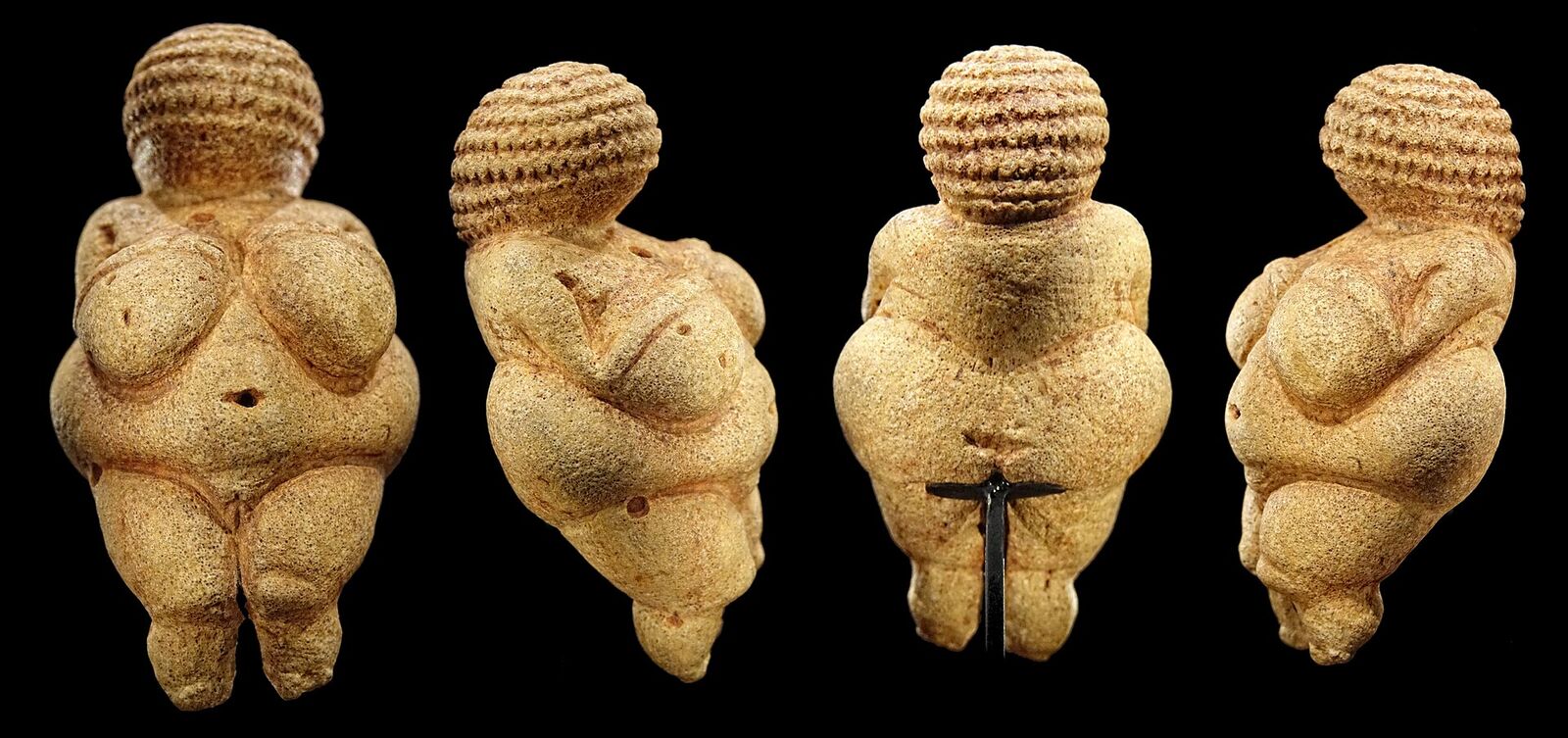
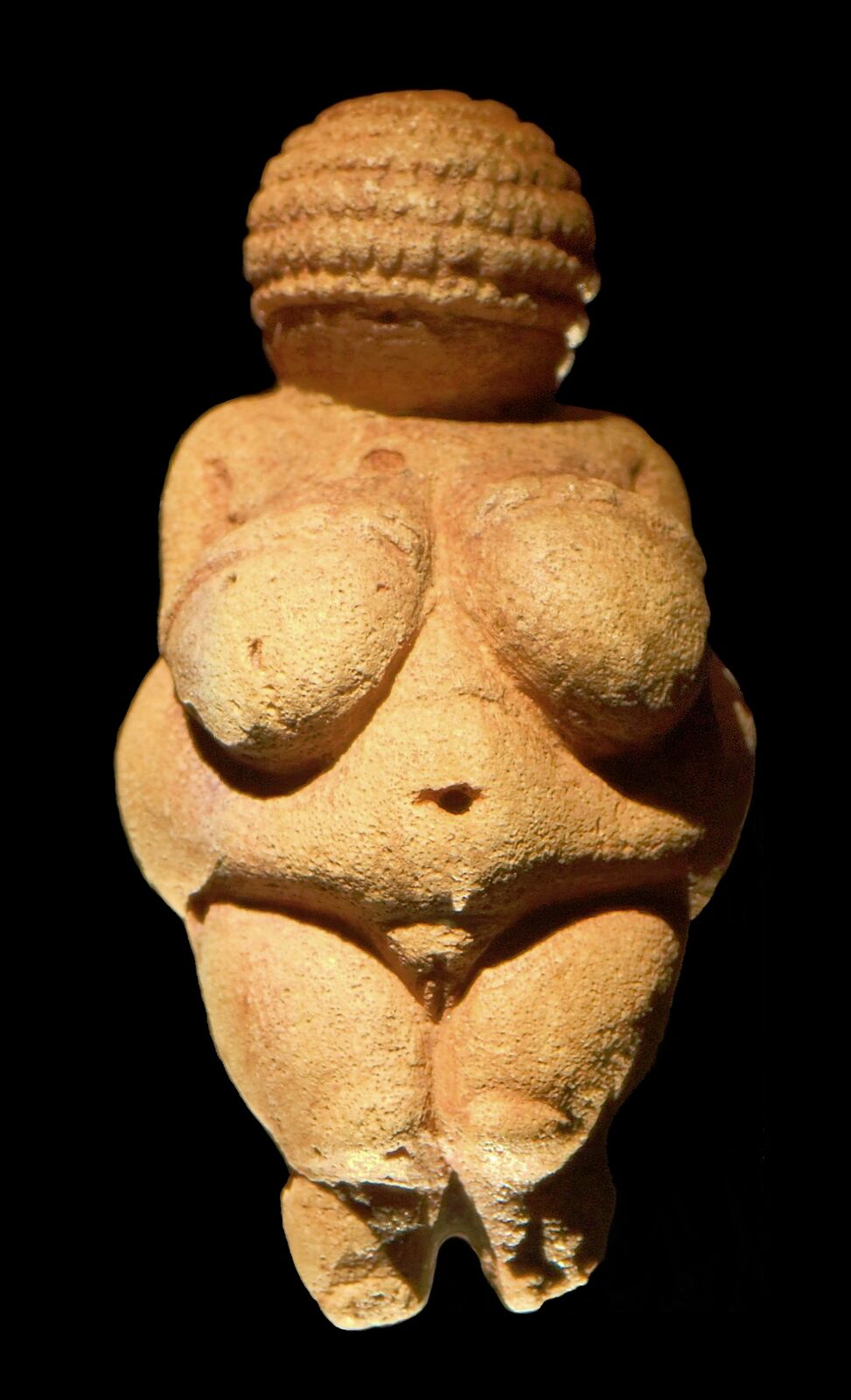
The most famous is the Venus of Willendorf, found in 1908 near the Danube river in Austria. About eleven centimetres tall, carved from limestone and once coloured with red ochre, she's about thirty thousand years old. Her body is round and full, and her head is covered with what look like rows of braids or a woven cap, with no face. A recent study suggested the stone may have come from hundreds of kilometres away, perhaps across the Alps!
The Venus of Dolní Věstonice in the Czech Republic is made of baked clay, about thirty thousand years old, one of the oldest clay objects in the world, made nearly twenty thousand years before clay pots! Thousands of broken clay figures were found there. Some scientists think people put wet clay figures in the fire on purpose so they would crack and burst, perhaps as a way of telling the future, where the breaking mattered more than the figure.
From France comes a tiny ivory head of a woman with a hood or fancy hair, about twenty-five thousand years old, one of the earliest carved human faces. Another French carving shows a woman holding up a horn with thirteen notches, which some think might count the months of the moon. In Russia and Siberia, dozens of figures were found, and some seem to wear fur clothes!
What's remarkable is how similar many of them are, across thousands of kilometres and thousands of years. Many are narrow at the top and bottom with a rounded middle, often with no face and no feet, as if meant to be held in the hand or pushed into the ground. This suggests people shared ideas across one of the biggest cultural areas of the Ice Age.
The Great Goddess?
The most famous explanation is that they represent a Great Goddess or Mother Goddess: a divine mother of birth and new life, worshipped across ancient Europe and maybe the world.
This idea is old. In 1861, a Swiss writer argued that the earliest societies were led by women and worshipped goddesses. Later, an archaeologist named Marija Gimbutas, studying thousands of figurines from early farming villages in southeastern Europe, said "Old Europe" had been a peaceful, goddess-loving world, later overrun by warlike horse-riders from the east who brought sky gods.
Part of her idea turned out true: DNA studies show that people from the eastern grasslands did move into Europe about five thousand years ago. But the idea of one single goddess religion hasn't held up well. The figurines are very varied; many aren't clearly male or female; they're often found in rubbish pits and homes, not shrines; and there's no clear evidence they were worshipped. An archaeologist named Peter Ucko showed that small human figures in known societies are used for many things: toys, dolls, teaching, portraits, lucky charms, gifts to gods and ceremonies for growing up.
Another archaeologist, Lynn Meskell, said the Great Goddess came partly from modern people's wishes for a past where women were honoured and nature was sacred. Those wishes aren't wrong, but the little figures can't carry the whole story by themselves.
The Great Goddess came partly from modern wishes, not only from the evidence.
Other ideas
People have suggested other explanations, and each captures something.
One researcher suggested that women might have carved figures of themselves. If a woman expecting a baby looks down at her own body without a mirror, her tummy looks big, her feet look small or hidden, and she can't see her face at all! Many figurines have exactly those proportions. It's hard to prove, but it opens an important possibility: that women made these figures, showing their own knowledge of their bodies.
Another archaeologist, Sarah Nelson, pointed out that books usually showed only the roundest figures. In fact, they show women of many ages and body shapes, some slender, some expecting babies and some older. They may show the stages of a woman's life and be linked to ceremonies for growing up, expecting a baby and giving birth, important and risky moments in every society.
A 2020 study noticed that rounder figures tended to come from places closer to the freezing glaciers during the coldest times. When food was scarce and winters deadly, a well-fed body could help a mother survive pregnancy and feeding a baby through the winter. So a well-nourished body might have been a symbol of survival and plenty, like a good-luck charm.
What's missing
Sometimes what's missing tells us a lot. Carvings of men are rare! Animals fill the cave walls, while women fill the small carvings. Faces are rare in both. It's as if these images weren't about particular people, but about big ideas or powers: new life, plenty, animals, the dead.
The stone in the Son valley
Now let's travel to India, where the Mother Goddess story has an amazing link to the present.
In 1980, in the Son valley near the village of Baghor in Madhya Pradesh, archaeologists found a site about nine to eleven thousand years old. There was a round platform of sandstone pieces, and in the middle had been a natural triangular stone about fifteen centimetres tall, with layers of yellowish-red and reddish-brown, like stripes.
Here's the amazing part. The local Kol and Baiga communities still collect stones like this, with natural triangle stripes, and place them on platforms as the goddess, called Mai, or as forms of Devi! The triangle is one of India's oldest symbols of the feminine and the goddess, still seen in sacred diagrams today. The archaeologists suggested the Baghor stone might be an early shrine to a mother power, set up by hunter-gatherers about ten thousand years ago, in a form local people still recognise!
It's not proven. Ten thousand years is a very long time, and traditions can break and be reinvented. But the Baghor stone is one of the most exciting possible links anywhere between an ancient ritual object and a living religion.
Later, India became a great centre of figurine making. At Mehrgarh, one of South Asia's earliest farming villages, from about 7000 BCE, clay figures of women became fancier over time, with heavy jewellery, elaborate hair and later babies in their arms. In the cities of the Indus Valley, clay female figures with fan-shaped headdresses were common. The archaeologist John Marshall thought they showed a Mother Goddess, like the later worship of Shakti. People still debate this. But in India, the Mother isn't just an idea from the past: in thousands of village shrines, a stone smeared with vermilion is a goddess.
In India, the Mother isn't just an idea. She's a vermilion-smeared stone in a thousand village shrines.
Birth and death
Step back, and a bigger pattern appears, linking the figurines to the graves and caves we've met.
For ancient people, birth and death were the two great mysteries, and they were connected. Both involved blood. Both were dangerous, in-between moments, when beings passed between this world and another. In many traditions, the dead return to the "womb" of the earth. Many ancient bodies were buried curled up, like a baby before it's born. Ancestors were believed to be reborn in children. Red ochre, the colour of blood, appears on the dead and on figurines alike. Even caves, dark and entered through narrow passages, have been compared to a womb, and coming out to being born.
So maybe the figurines weren't only about having more babies. They may have been about renewal: life renewing itself, the dead returning, animals coming back each season, the world continuing. A woman's body, which creates new life, would have been the most powerful picture of that. Whether the figures were worshipped, carried as charms, held during pregnancy, given to girls growing up or broken in the fire, they may all have been ways of thinking about the mystery of how life comes from life.
That mystery became even more important when people began planting seeds in the dark earth and waiting for them to grow. But before seeds, there were stones. On a hill in Turkey, about eleven and a half thousand years ago, people raised huge stones that made archaeologists rethink all of human history.