Chapter VIII
Seeds and Ancestors
When people started farming, the dead didn't go away. They stayed at home, under the floor, and became ancestors who looked after the family's land.
Assisted and Curated by Claude, Referenced and Collated by me
In 1953, a British archaeologist named Kathleen Kenyon was digging at Jericho, in the Jordan Valley, when her team found a human skull whose face had been rebuilt with plaster! The nose, lips and cheeks had been shaped with care, and the eyes were made of seashells. There were even traces of paint. It looked both alive and peaceful. More plastered skulls were found at Jericho and other sites, about nine to ten thousand years old, from when the first farming villages were spreading.
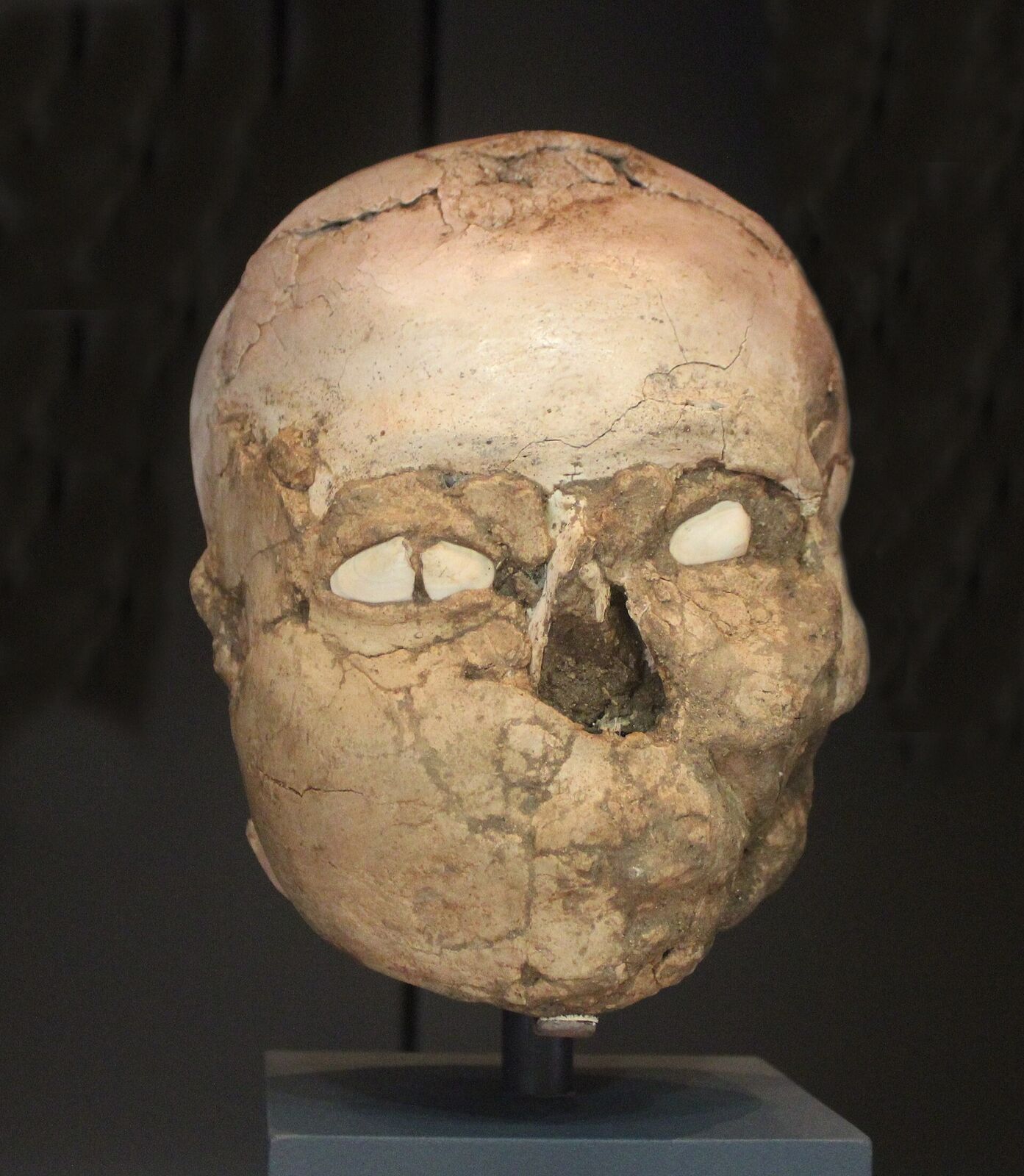
These skulls show us something surprising. When people started farming and settling down, they didn't just bury their dead and forget them. They dug them up, kept their heads, rebuilt their faces and kept them among the living. In the first villages, the dead didn't go away. They stayed at home.
In the first villages, the dead didn't go away. They stayed at home.
What farming changed
Farming began separately in about a dozen places around the world, including the Middle East, China, New Guinea, Central and South America, Africa and India, between about eleven thousand and four thousand years ago. It wasn't a sudden event but a slow change over thousands of years. It changed not only what people ate, but how they lived and saw the world.
Think about the difference. A hunter-gatherer moves around, following animals and seasons, returning to places but not owning them. Food is shared right away. A farmer works hard on one piece of land, plants it, waits months for a harvest and stores food for later. The farmer's wealth is tied to one place and to the future. The land must be protected and passed on. So a big new question arises: who owns this land, and why?
In many farming societies, the answer was: the ancestors. The land belonged to those who first cleared it and were buried in it, and it passed to their descendants. Being able to name your ancestors and point to their graves proved your right to the land. The dead became like land papers! This was a huge change in religion: from the unnamed and sometimes scary dead of hunter-gatherers, to particular, named, powerful ancestors who protected their family and its land.
Keeping the skulls
The Jericho skulls were part of a widespread practice. Across the early farming villages of the Middle East and Turkey, the dead were buried under house floors. Later, graves were reopened and the skulls removed. Some were plastered and painted; others were kept together in groups. At one site in Turkey, a "Skull Building" held the remains of more than four hundred people.
Why the skull? The head holds the face, and the face is who we are. Keeping the head kept the person, or at least the part people recognise. Rebuilding the face over the bone suggests people wanted to give the dead back their faces, so they could be seen, talked to and remembered. Maybe they were portraits of respected elders or family founders. Either way, they turned the dead into presences.
Remember Robert Hertz's idea of double funerals? This was a double funeral on a big scale. First the body was buried and left to change. Then the skull was taken out for a second ceremony that turned a dead body into an ancestor, who was kept, displayed, and later buried again. One person's death was completed by becoming part of the lasting family.
The statues of 'Ain Ghazal
In 1983, road builders near Amman, in Jordan, cut through an ancient village called 'Ain Ghazal. Archaeologists found two pits with amazing statues: more than two dozen human figures made of plaster over bundles of reeds, about nine thousand years old! Some are nearly a metre tall. Their wide, staring eyes are outlined in black, giving them an intense gaze. Some busts even have two heads!
Nobody knows who they show: ancestors, legendary founders or gods. The two-headed ones suggest beings beyond ordinary humans. They were buried carefully together, perhaps "retired" after being used. They're a step towards the statues of gods kept in temples, which became so important in Mesopotamia, Egypt and India.
Their eyes still stare. They're a step closer to the god who lives in a temple.
Çatalhöyük: a town of the living and the dead
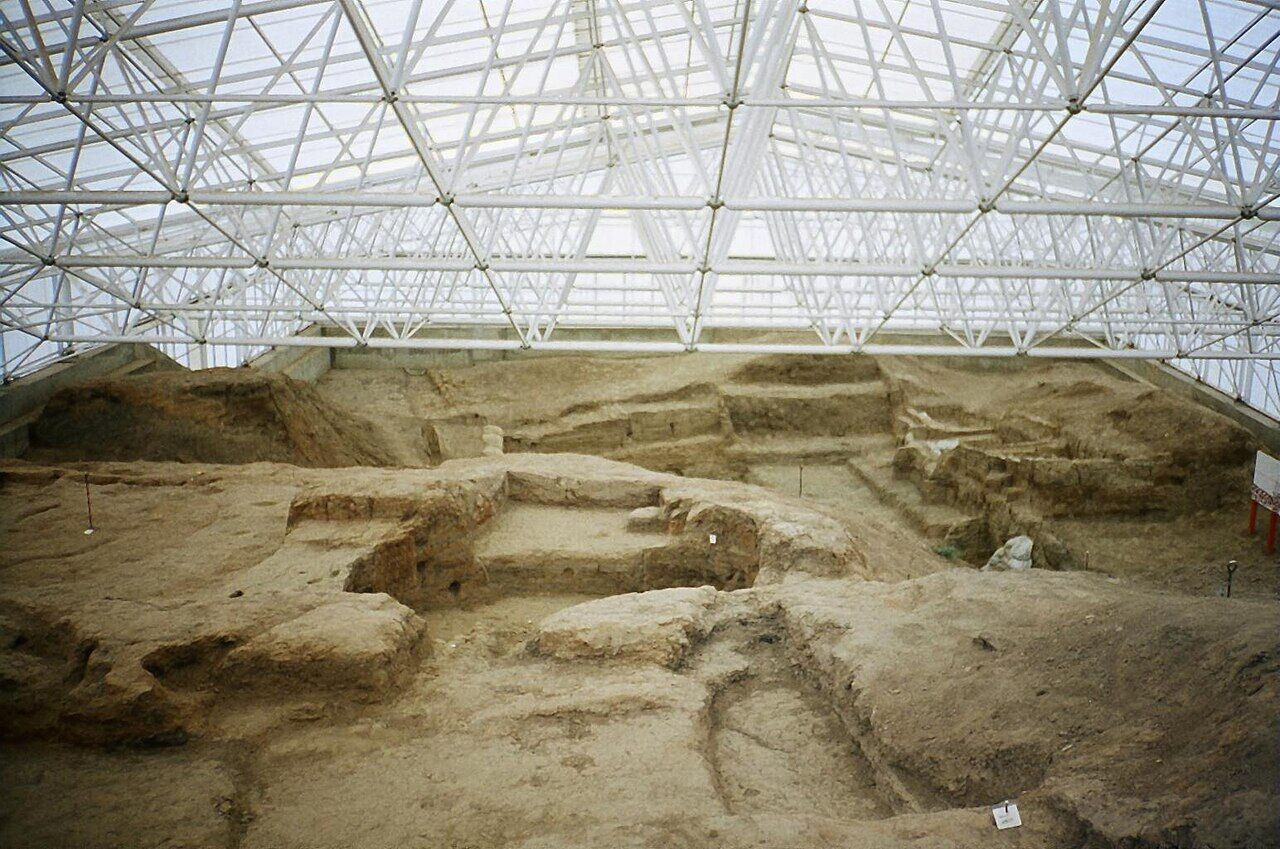
The best window into early farmers' religion is Çatalhöyük (say "chat-al-HOO-yook") in Turkey, lived in from about 7100 to 5950 BCE. It may have had up to eight thousand people, one of the biggest towns in the world at the time!
It was a strange town. There were no streets! Houses were built right against each other like a honeycomb, and people walked across the rooftops and climbed into their homes down a ladder through a hole in the roof. Inside, people sat, worked and slept on raised platforms, and under those platforms they buried their dead. Over the centuries one house might hold dozens of burials. When a house got old, it was carefully filled in and a new one built on top, often with the same layout, sometimes many times over hundreds of years. Archaeologist Ian Hodder called them "history houses", where a family's story continued by rebuilding its home over its ancestors.
The walls were plastered and painted, sometimes with patterns, sometimes with scenes of crowds teasing huge wild bulls and deer, or vultures with giant wings. The horns and skulls of wild cattle were set into the walls, covered in plaster so they stuck out into the room. There were plaster leopards facing each other, and other mysterious figures.
The first excavator, James Mellaart, thought Çatalhöyük worshipped a Great Goddess. His most famous find was a clay figure of a large woman seated on a throne, with her hands resting on two big cats, found in a grain bin. But later digs by Hodder found that most figurines were small, casual objects, often found in rubbish, and many showed animals. Hodder decided that Çatalhöyük's religion was focused more on the house, the ancestors and powerful wild animals, especially the bull, than on one goddess.
In 2004, Hodder's team found a burial that seems to capture the heart of it. A woman had been buried holding a plastered skull in her arms, its face painted red. It had been taken from someone else's grave, re-plastered and buried with her, maybe a parent. She is hugging the dead.
The seed that dies and rises
Farming brought a new rhythm: planting, growing, harvesting and dying, every year. Seeds are put into the dark earth, like the dead, and after seeming to die, they rise again as new life! This link between seeds and the dead, and between the harvest and the return of ancestors, appears in farming religions all over the world.
On the island of Seram, in Indonesia, the Wemale people tell a famous story. Long ago, a girl named Hainuwele was born magically from a coconut palm. At a great dance she gave out precious gifts. But the people, jealous or afraid, killed her and buried her. Her father dug up her body, cut it into pieces and buried them in different places. From the pieces grew the yams people have eaten ever since! In this myth, death is the origin of food.
Similar stories appear around the world: of a divine being whose sacrifice creates the world or food. In the Rigveda, the sacrifice of the cosmic being Purusha creates the universe. A Scottish writer named James Frazer collected many stories of gods who die and come back to life, like Osiris in Egypt, linked to the farming year. Later scholars said he squeezed different stories into one pattern. But the link between death and new life in farming religions is real and deep.
In the story of Hainuwele, death is the origin of food.
Mehrgarh and Jiahu
The same change happened across Asia. At Mehrgarh, at the edge of the Indus plains, farmers from about 7000 BCE grew barley and wheat and kept humped zebu cattle, goats and sheep. They buried their dead in the village with beads of shell, turquoise and lapis lazuli brought from far away, and sometimes young goats. Amazingly, scientists found that some people at Mehrgarh had tiny holes drilled in their teeth with flint-tipped drills, the earliest known dentistry in the world! The same care given to the living was given to the dead.
At Jiahu in China, from about 7000 to 5700 BCE, archaeologists found more than three hundred burials with remarkable objects, including flutes made from crane wing bones, some still playable, with finger holes that make real musical scales! There were tortoise shells filled with pebbles, maybe used as rattles, some with carved signs. Scientists also found traces of the earliest known fermented drink, made from rice, honey and fruit. Music, fortune-telling, special drinks and the dead were gathered together in the grave.
The tortoise shells are interesting because, over five thousand years later, Chinese kings of the Shang dynasty talked to their ancestors by heating tortoise shells and ox bones until they cracked, then reading the cracks as answers. These "oracle bones" are the earliest large collection of Chinese writing, and they're almost all about speaking with ancestors!
The darker side
The farming age wasn't always peaceful. Owning land and belongings also brought inequality, conflict and violence. Archaeologists have found sad evidence of attacks between farming villages in Europe about seven thousand years ago. Studies of bones also show that early farmers often had worse diets, more diseases and more tooth decay than hunter-gatherers, because they lived crowded together with animals and ate fewer kinds of food.
This shaped religion too. In a world where harvests could fail, diseases could spread and neighbours could turn hostile, people needed powerful protectors. Ancestors guarded the land and watched over their families, but they could also punish those who forgot them. In many societies, ancestor religion is about fear as well as love: the dead must be fed, honoured and kept happy.
From ancestor to god
In 1960, an American sociologist named Guy Swanson studied fifty societies. He found that belief in active ancestor spirits went with societies where families and clans controlled land. Belief in one high god, ruling the whole world, went with societies that had several levels of decision-makers, like families inside villages inside bigger chiefdoms. The shape of heaven, he said, mirrors the shape of society!
This shows one important way gods appeared. As societies grew bigger and more ranked, some families became more powerful than others, and their ancestors became more important too. The founding ancestor of a ruling family could become the ancestor of the whole community, then its protector, then its god. In Polynesia, chiefs claimed to come from the gods, and the highest chiefs were so sacred that even their shadow was thought to be powerful. Ancestors, chiefs and gods formed one long ladder.
So farming didn't just add ancestors to religion. It made some dead people more powerful than others, and the most powerful could rise, generation by generation, toward becoming gods. The village with the dead under its floors would one day become a city with a god in its temple. But first came one more big change: people began raising stones not only for their dead, but for the sky.