Chapter III
Paintings in the Dark
Deep inside caves, far from daylight, ancient people painted amazing animals. Why did they paint where almost nobody could see?
Assisted and Curated by Claude, Referenced and Collated by me
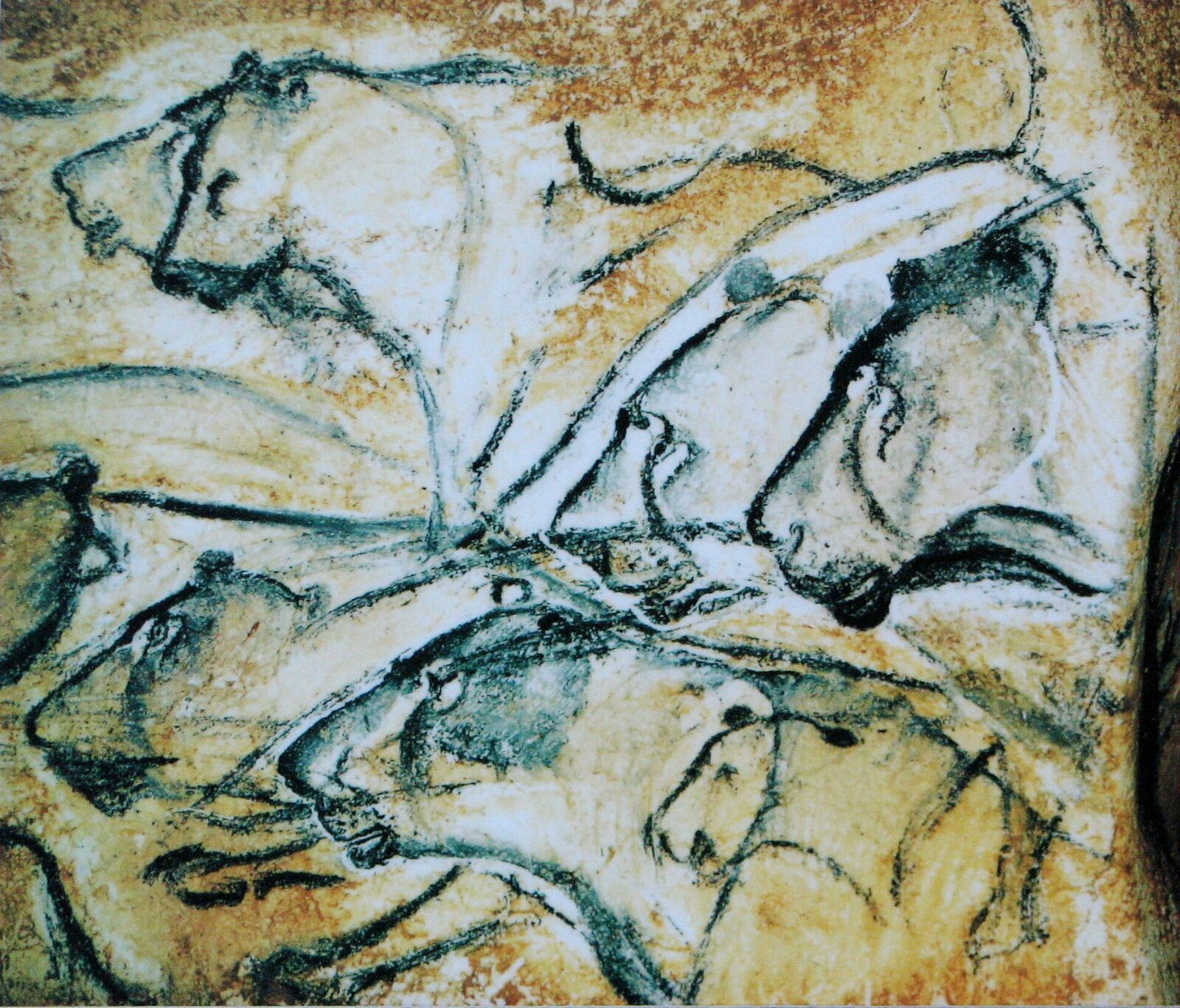
In December 1994, three cave explorers in southern France felt a breeze coming from a pile of rocks in a cliff. They cleared a way through, climbed down into huge underground halls, and shone their lamps on the walls. What they saw amazed them: horses with open mouths as if neighing, a pride of lions drawn with overlapping outlines so they seemed to move, woolly rhinos clashing horns, mammoths, bears, bison, a panther and an owl! The oldest paintings in this Chauvet Cave are about thirty-six thousand years old.
People used to think cave art started simple and slowly got better. Chauvet proved them wrong: some of the most skilful paintings were among the oldest! Art didn't slowly grow up. In Europe, at least, it arrived already brilliant.
Art didn't slowly get better. In Europe, it arrived already brilliant.
Chauvet had other clues too. Deep inside, a cave bear's skull had been carefully placed on top of a fallen rock, with dozens of other bear skulls around it. A strange drawing mixes a woman's body with a bison's head. And the cave floor kept footprints, including a child's, walking through the darkness, with the prints of a large dog or wolf nearby. Chauvet wasn't just an art gallery. It was a place where people went to do something.
Nobody believed it at first
In 1879, in a cave called Altamira in Spain, a man named Marcelino Sanz de Sautuola was digging in the floor when his young daughter María wandered further in, looked up and saw painted bison on the ceiling! When he announced the discovery, experts accused him of faking it. They said the paintings were too good to have been made by "savages" of the Stone Age. Only in 1902, after similar paintings were found in sealed French caves, did his fiercest critic say sorry. Sadly, Sautuola had already died.
This story shows how unfair assumptions can blind people. Experts didn't want to believe ancient people could be artists until the evidence forced them. The same thing happened later with Neanderthals, Africa and Asia. Again and again, people have underestimated what "ancient" minds could do.
A world map of cave art
For a hundred years, people thought Europe was the home of ancient art. Recent discoveries have changed that.
On the island of Sulawesi in Indonesia, scientists dated a painting of a warty pig to at least 45,500 years ago. Another scene, at least 43,900 years old, shows small figures hunting pigs and buffalo, and some seem to be part human and part animal, with beaks or tails! In 2024, scientists found a scene of three human-like figures with a pig that's at least 51,200 years old, the oldest known picture of real things in the world.
This matters because it shows people were painting in Asia at least as early as in Europe, so the ability probably travelled out of Africa with early humans. And the Sulawesi paintings tell stories: hunters facing animals, and strange part-human, part-animal beings. The oldest known picture made by our species is a story, and a mysterious one!
In northern Australia, the Kimberley region has some of the most rock art in the world, including graceful human figures called Gwion Gwion. A painting of a kangaroo there is at least seventeen thousand years old. In Arnhem Land, people have painted and repainted rock art for tens of thousands of years, right up to today, and they know the stories that go with the pictures. That makes Australia special: it's one place where we can sometimes ask the descendants what the art means.
In India, the rock shelters of Bhimbetka, in the Vindhya hills of Madhya Pradesh, were discovered by archaeologist V. S. Wakankar in 1957 and are now a World Heritage Site. Hundreds of shelters have paintings of hunts, dances, animals and people with fancy headdresses. Some small cup-shaped hollows hammered into rocks there may be among the oldest rock markings on Earth. India has one of the longest records of painting on stone, and Adivasi communities today still paint walls with dancing figures, animals and spirits.
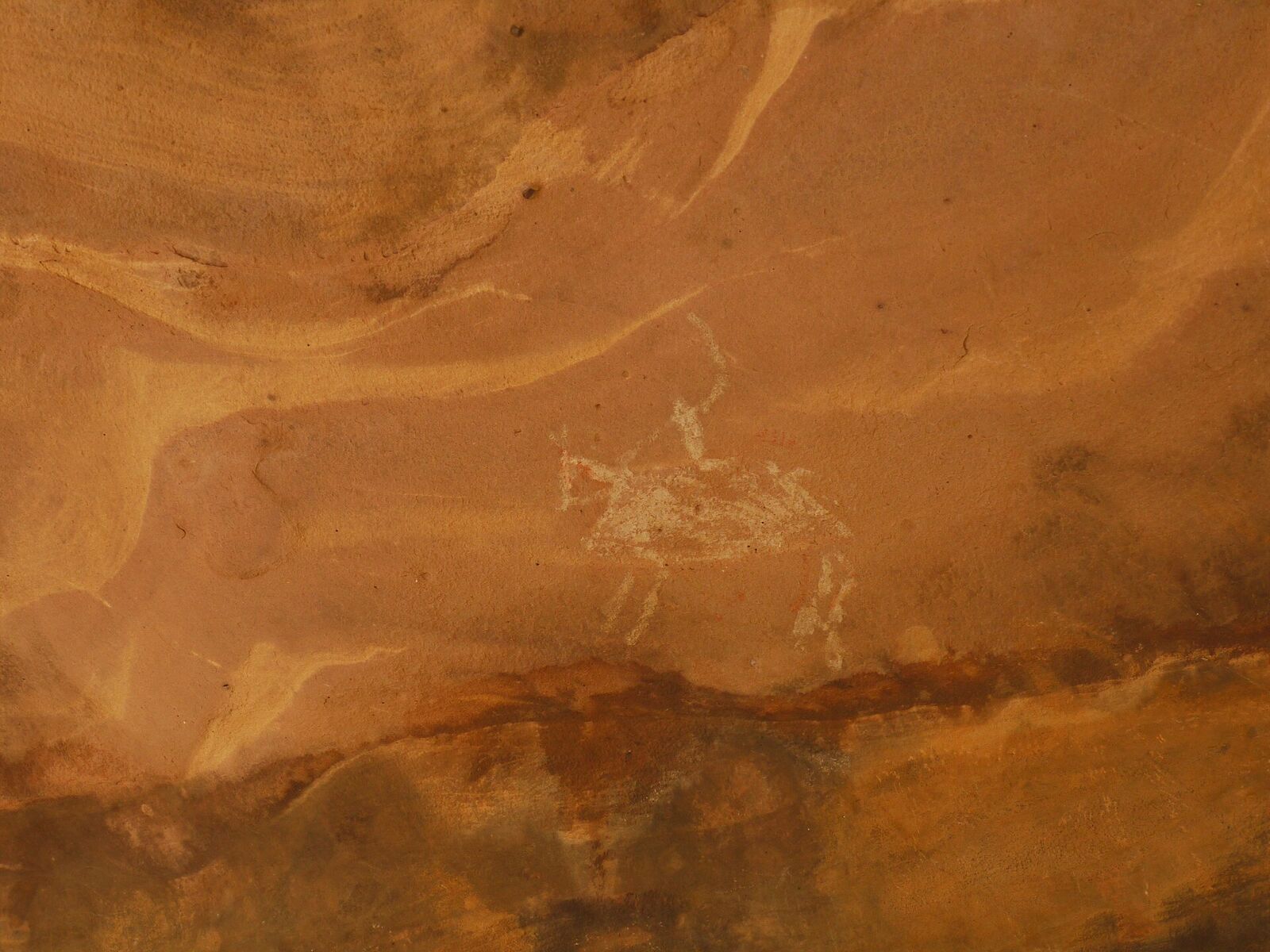
In Spain, some scientists said in 2018 that a few markings, including a hand stencil, were more than sixty-four thousand years old, before modern humans reached Europe, which would mean Neanderthals made them! Other scientists strongly disagree. If it's true, our species wasn't the only one that painted in the dark.
What's on the walls, and what isn't
Ice Age art in Europe follows a pattern. Animals are everywhere: horses, bison, wild cattle, mammoths, ibex, deer, and sometimes lions, bears and rhinos, all drawn accurately and full of movement. Humans are rare, and usually drawn simply, oddly or mixed with animals. There are almost no landscapes: no ground, trees, rivers or sun. And there are many mysterious signs: dots, lines, grids and shapes like combs or keys.
And the animals painted aren't simply the ones people ate. At Lascaux, horses are painted most, but reindeer are what people ate most, and reindeer are hardly painted at all! At Chauvet, dangerous animals like lions, rhinos and bears appear a lot. The artists weren't making a menu. They were choosing, by rules we can't read.
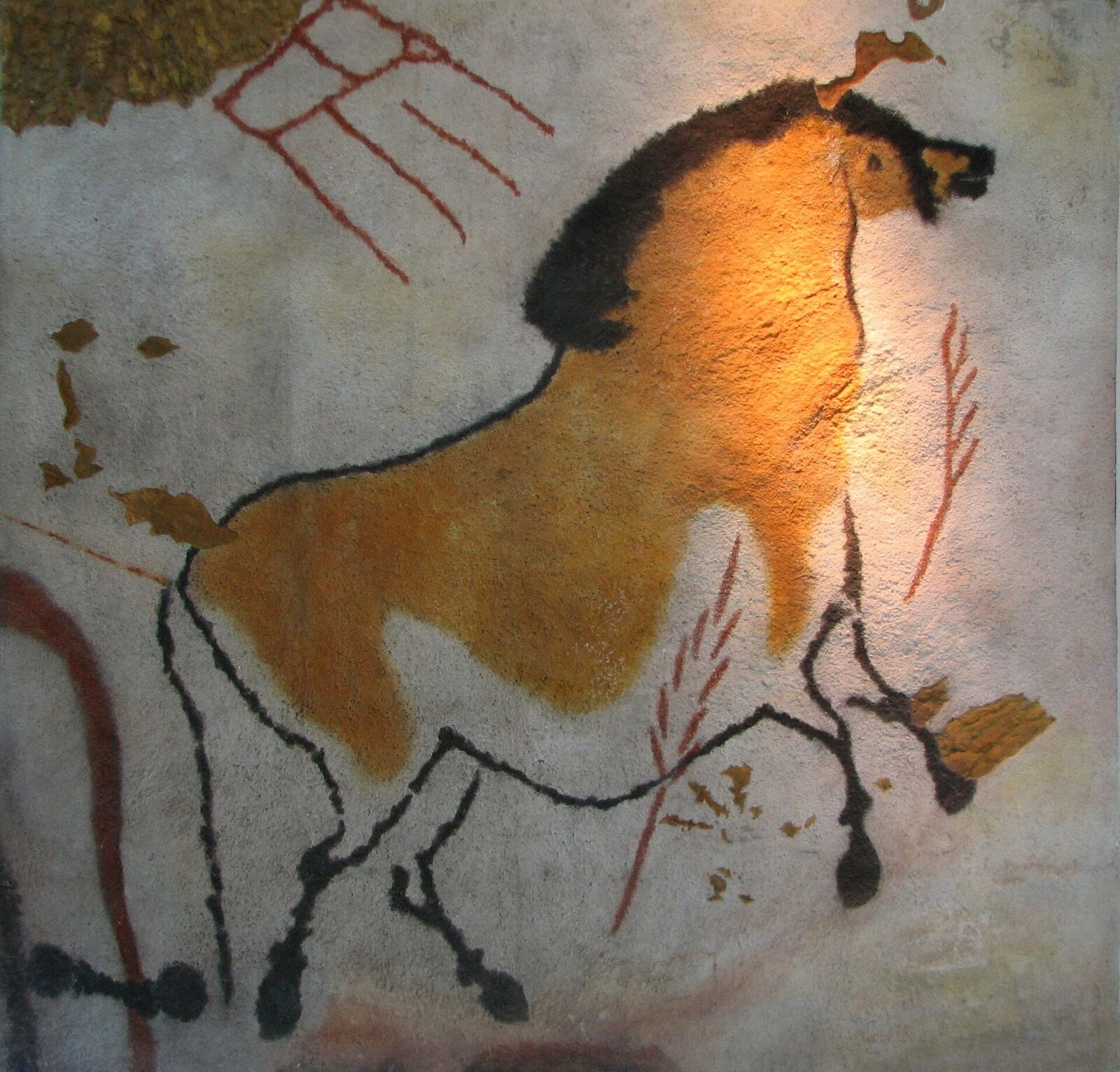
The pictures were placed carefully. Painters used bumps in the rock to make a bison's shoulder, or a crack to make an animal's back, as if the animal was already hiding in the stone. Some pictures are in big halls where many could gather. Others are in tiny cracks, high ceilings or down shafts, where only one person could see them, and where the painter had to twist into awkward positions. Some are so deep that reaching them takes hours of crawling. So the big question is: why paint where nobody can see?
The artists weren't making a menu.
Idea 1: art just for fun
The first idea was that people painted just for decoration when they had spare time. But nobody crawls a kilometre underground to decorate a crack that nobody else will see! The painters probably enjoyed their work, but fun alone doesn't explain where they painted.
Idea 2: hunting magic
Around 1900, a French priest named Henri Breuil, who spent decades copying cave art, suggested it was hunting magic. Painting an animal might give power over it, helping hunters catch it and making more animals be born.
It sounds sensible, but there are problems. The animals painted don't match the animals eaten, and very few are shown wounded. And the idea depended on old-fashioned views of how "primitive" people thought.
Idea 3: the cave has a plan
In the 1960s, André Leroi-Gourhan mapped thousands of pictures in dozens of caves, looking for patterns. He found that certain animals, like horses and bison, often appeared together in central panels, while others were near entrances or in deep corners. He thought these pairs stood for male and female.
That last part didn't hold up. But he showed something important: caves weren't random collections of pictures. They were carefully arranged spaces, and a picture's meaning depended on where it was and what it was next to, a bit like a building designed for an experience.
Idea 4: visions in the cave
The most famous modern idea came from southern Africa. Archaeologist David Lewis-Williams studied the rock art of the San people, using their own explanations recorded long ago. He found that much of it was linked to the trance dance, where healers danced, clapped and breathed hard for hours until they entered a dream-like state, to heal the sick, bring rain and travel to the spirit world. The art showed what they experienced: feeling like they were turning into animals, flying or going under water.
In 1988, he and Thomas Dowson suggested European caves might be similar. They said the human brain sees similar things in trance-like states. First, people see glowing patterns like grids, dots and zigzags. Next, the mind turns these into familiar things. Finally, after feeling like they pass through a tunnel, people enter a vivid dream world with animals and spirits, and may feel themselves become animals.
Lewis-Williams noticed that cave signs look like those glowing patterns, that part-human, part-animal figures look like the third stage, and that caves themselves, with narrow passages opening into big halls, are like that tunnel! He suggested caves were seen as the doorway to the spirit world, and the paintings were visions fixed onto the rock: spirit-animals coming out from behind the wall. The hand stencils might show people touching that "curtain" between worlds.
The painter wasn't copying the world, but fixing to the rock the visions that came from behind it.
This idea is beautiful and very influential, but also argued about. Critics say patterns appear in all kinds of art, that you can't stretch the San example across tens of thousands of years and thousands of kilometres, and that most cave animals look calm and realistic, not dream-like. Supporters say no other idea explains so well the deep caves, the mixed figures and the use of rock bumps.
Probably the truth is a mix. Trance experiences were likely important in many ancient religions, but caves may have had many purposes: welcoming young people into adulthood, telling stories, marking territory, teaching about animals and connecting with spirits.
The shaft at Lascaux
One picture is at the centre of every debate. In 1940, teenagers exploring hills in France discovered the Lascaux cave. At the bottom of a narrow five-metre shaft is an unusual scene: a wounded bison with its head lowered toward a man, who is drawn very simply, falling backwards, with a bird-like head. Next to him is a stick with a bird on top, and nearby a rhino walks away.
Some think it shows a hunting accident. Others think it's a star map or a myth. Some think the bird-headed man is a shaman in a trance, since some Siberian shamans used bird-topped staffs to help their spirit "fly". Every explanation is a guess. But it's in the hardest-to-reach spot, and it's unlike anything else, so it must have been very important. It's the first story whose meaning we've forgotten.
The sorcerer and the lion-man
Part-human, part-animal beings appear again and again in the earliest art. In a French cave, a figure high on a wall has been nicknamed "the Sorcerer". In a famous drawing of it, it has a deer's antlers, an owl's eyes, a wolf's ears, a horse's tail and human legs, and seems to be dancing. Later researchers noticed that the drawing added some details, but it's clearly a mixed creature.
Even older is the Lion-Man, found in pieces in a German cave in 1939 and put back together over many years. Carved from mammoth ivory, about thirty centimetres tall and about forty thousand years old, it has a lion's head and body but stands on human legs! It would have taken hundreds of hours to carve with stone tools. It's the oldest known picture of a creature that doesn't exist in nature, and it was found in a special chamber at the back of the cave.
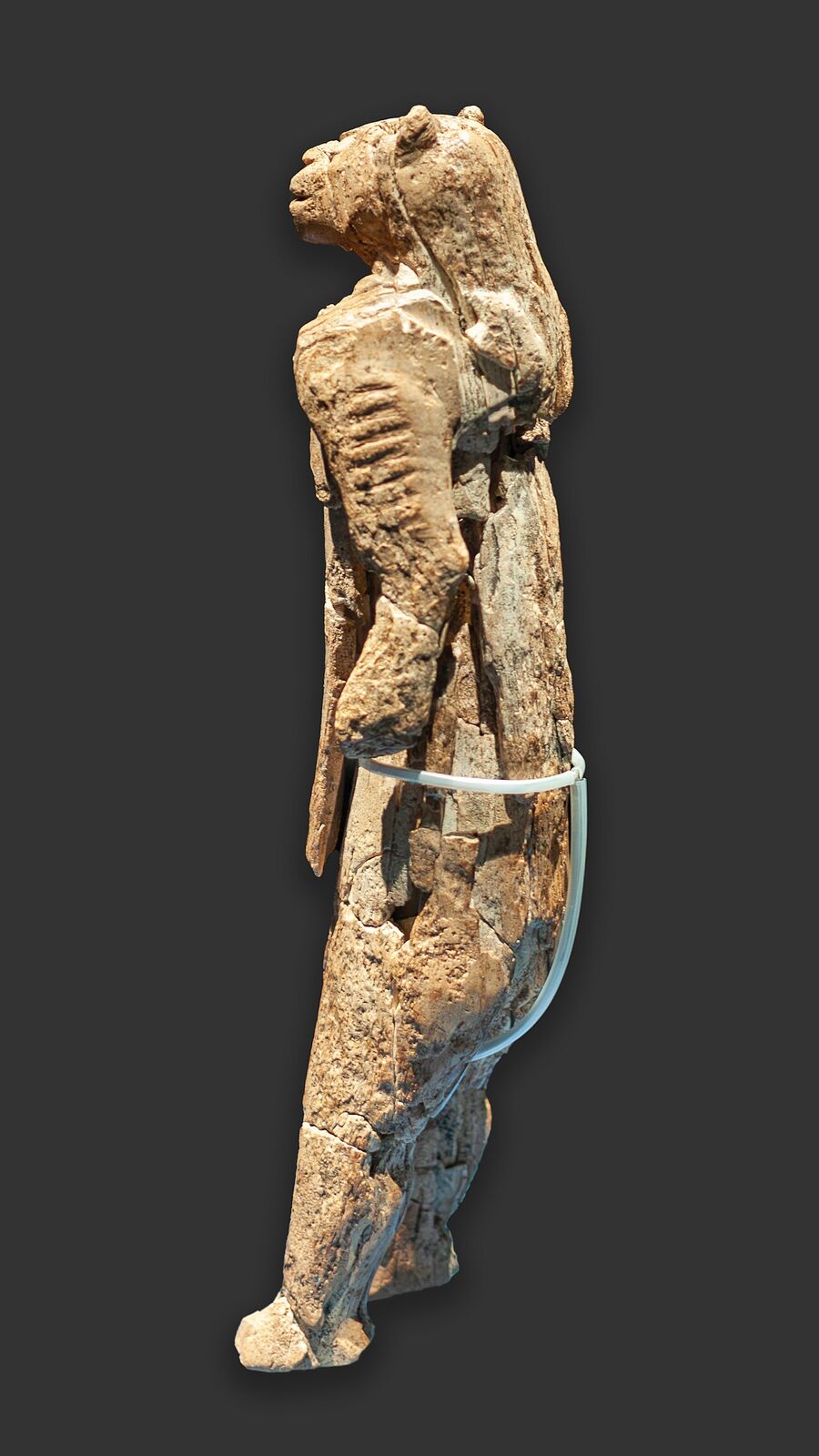
The Lion-Man is as important as any god. It proves that by forty thousand years ago, people were imagining beings beyond what they could see. It wasn't a lion, and it wasn't a person. It was something in between, and that in-between space, between human and animal, is where much of the earliest religion lived.
Nearby caves had other treasures from the same time: flutes made from vulture and swan wing bones and mammoth ivory (one, found in 2008, has five finger holes!), and a small ivory figure of a woman. Music, carving and imaginary beings all appear together in the same caves at the same time.
The sound of the cave
A French researcher named Iegor Reznikoff tested caves by singing and humming in them. He found that paintings and red dots often appeared where the cave echoed most strongly! Some stalactites seem to have been struck like musical instruments. Not everyone agrees, but it reminds us of something photos can't show. Caves weren't silent galleries. They were dark, echoing, cold and wet, lit by flickering lamps that made pictures appear and disappear, and probably filled with voices, drums and flutes.
Imagine it. Hours crawling through a narrow tunnel, hearing only your breath and your body scraping the rock. Then a big chamber. Someone raises a lamp, and a horse appears on the wall, its eye shining, its shape shifting as the flame moves. Someone chants, and the voice echoes back from the rock, as if the cave itself were answering! With no daylight, everyday feelings start to melt away. It would be surprising if it didn't feel magical and sacred.
Who went into the dark?
People often imagine cave painters as grown men. But the evidence is more surprising! One scientist studied hand stencils and suggested many were made by women, though others question his method. In a French cave called Rouffignac, finger lines drawn in soft clay were made by children, some only two to five years old, who must have been lifted up by adults to reach high spots! Footprints in caves include those of children and teenagers too.
So caves weren't only for special experts. Children were brought into the dark, perhaps for a ceremony of growing up. In one cave, two clay bison lean against a rock, and nearby heel prints in the clay may be traces of a dance by young people. In many hunter-gatherer cultures, young people become adults through ceremonies in dark, scary, life-changing places. The cave might have been where children became adults and learned their people's secrets.
The curtain between worlds
Let's return to the hand on the wall.
All these ideas share one feeling: the pictures mattered because of where they were. The cave was a doorway: between light and dark, everyday life and the underworld, the living and the dead, and ordinary and extraordinary feelings. In several cultures, the cave wall was seen as a curtain with the spirit world behind it. Painting it, touching it and blowing paint over a hand pressed against it might have been ways of reaching through.
If so, painted caves were among the world's first sacred places: special spaces where everyday rules didn't apply and people met powers greater than themselves. They weren't temples with gods and priests. They suggest a religion of relationships, especially with animals, who fill the walls, mix with humans and seem to have been the main residents of the other world.
To understand that relationship, we must leave the caves and go into the forests, tundras and grasslands where the painters lived, and ask how people who hunted and depended on animals might have seen them not as food, but as persons. That's next.