Chapter II
The First Goodbyes
Long before there were gods, people cared for their dead. The first graves may be where human beliefs about the unseen began.
Assisted and Curated by Claude, Referenced and Collated by me
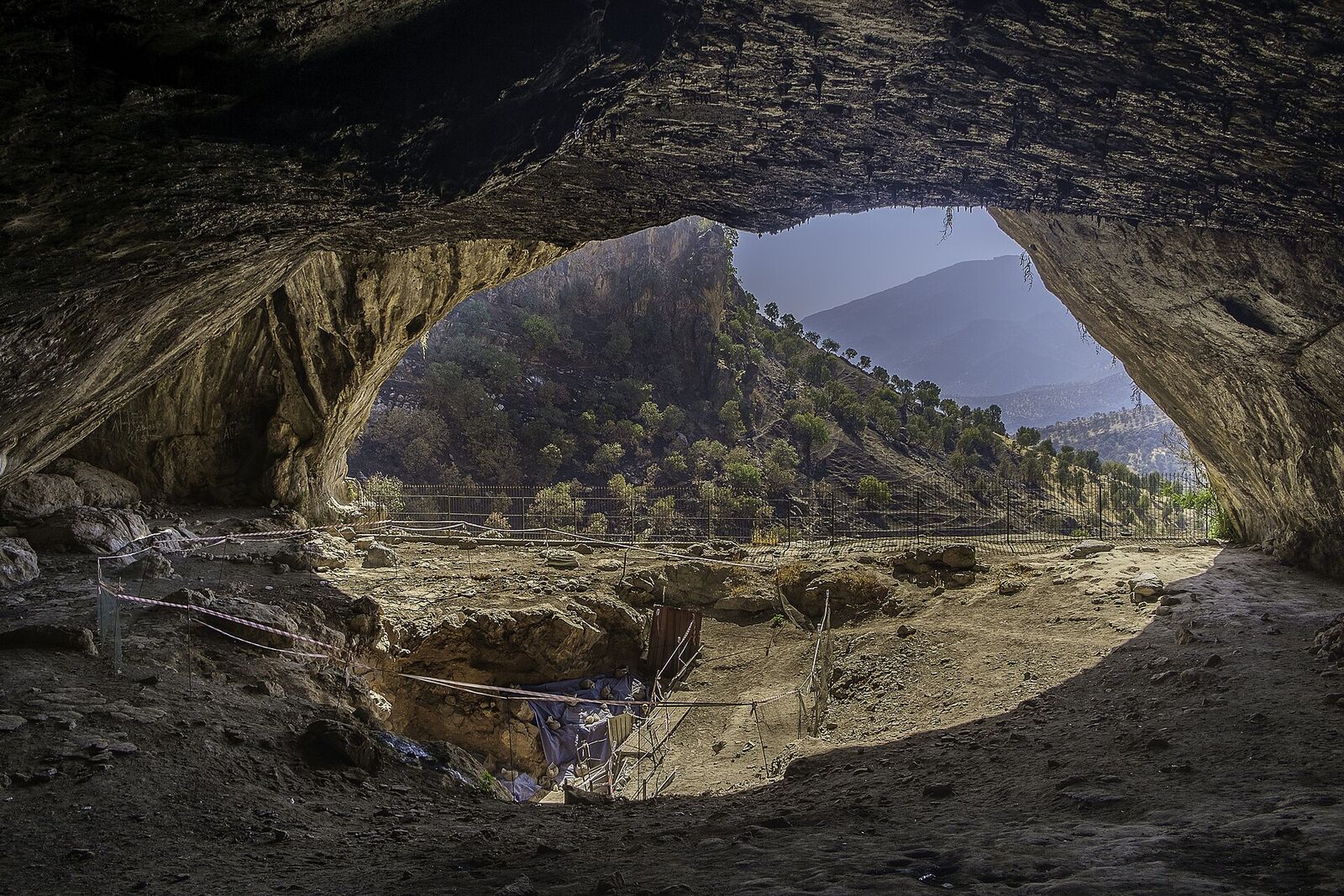
About seventy-eight thousand years ago, in a cave called Panga ya Saidi in the hills of Kenya, a little child of about three years old died. Someone dug a shallow pit, gently laid the child on its side with knees curled up, and covered it with earth. The way the head was placed suggests it may have rested on something soft, like a folded animal skin or a pillow of leaves. Scientists named the child Mtoto, which means "child" in Swahili. It's the oldest known burial of a modern human in Africa.
Nobody knows the child's name or what words were spoken. But the pillow, if that's what it was, tells us something no tool can. A pillow isn't for the dead; it's for someone sleeping. Whoever placed that little head was treating the body as if it could still be made comfortable. That feeling, of not wanting a loved one to become just an object, is where the human story of death, and maybe of religion, begins.
A pillow isn't for the dead. It's for someone sleeping.
Do animals grieve?
Many animals seem sad when one of their group dies. Chimpanzee mothers have carried their dead babies for days or even weeks, grooming them. Elephants stay near the bones of other elephants, touching them gently with their trunks. Crows gather around a dead crow. Dolphins hold up dead calves at the water's surface.
But as far as we know, animals don't move the dead to a special place, arrange them, cover them, decorate them or come back to visit. Animal grief seems to be love that doesn't switch off right away. Human funerals are different. They're shared ceremonies that change how the dead person, and the living, are seen. That's what scientists look for when they ask when burial began.
Caring for the living
Even before the first burials, there's a touching sign: people who were badly hurt or disabled surviving for a long time. In Georgia, a 1.77-million-year-old skull belonged to an old ancestor who had lost almost all their teeth years before dying. They could only have survived by eating soft food, perhaps with others' help.
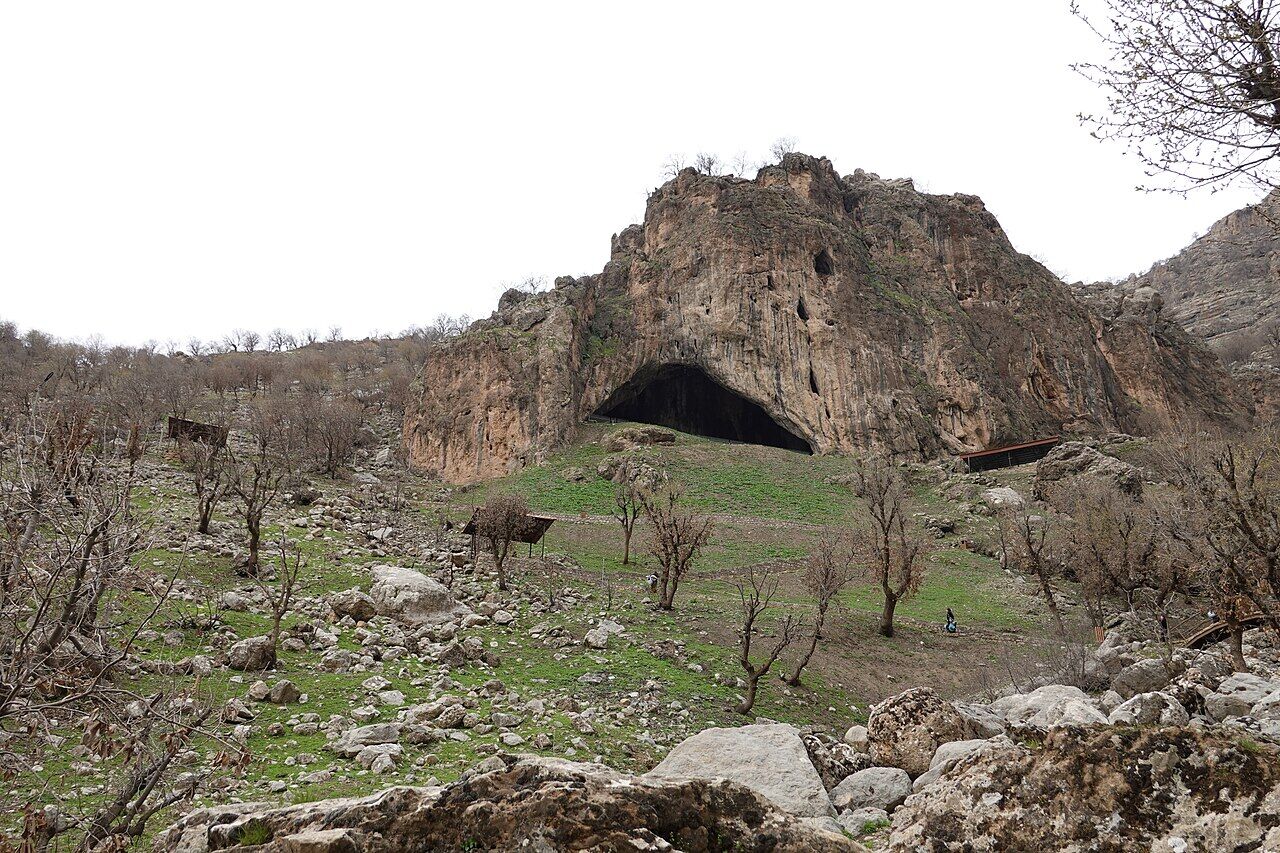
In Shanidar Cave in Iraq, scientists found a Neanderthal man with a badly injured face, probably blind in one eye, with a withered arm, hurt legs and probably poor hearing. Yet he lived to be quite old for a Neanderthal, perhaps in his forties. He couldn't have survived alone!
Much later, about eleven thousand years ago in Italy, a young man with very short arms and legs survived into his late teens in the mountains, where he couldn't have hunted much. Scientists now study bones like these as evidence of care: someone chose, again and again, to feed, carry and protect a person who couldn't repay them in the same way.
This matters for religion. A group that looks after its weakest members values people for who they are, not just for what they can do. Valuing a person as a person is what makes us treat a dead person as someone, not something.
The pit of bones
Deep in the mountains of northern Spain is the Sima de los Huesos, the "Pit of Bones". At the bottom of a thirteen-metre-deep shaft, reached only by a long crawl through caves, scientists found the remains of at least twenty-eight early relatives of the Neanderthals, about 430,000 years old.
How did so many end up there? Some scientists think their group deliberately placed them in the pit, making it the oldest known example of caring for the dead. Among the bones was one beautiful reddish stone axe that had never been used. The scientists nicknamed it "Excalibur", like King Arthur's sword, and think it might have been a gift for the dead.
Other scientists aren't sure and think water or animals might have brought the bodies there. But it's an amazing possibility: nearly half a million years ago, a group may have taken its dead to one special dark place.
A mystery in South Africa
In South Africa's Rising Star cave, scientists led by Lee Berger found more than two thousand bones of Homo naledi, a small-brained human relative that lived about 300,000 years ago. The bones are in chambers reached only through very narrow cracks. In 2023, the team said they had found burials and carvings on the walls.
Other scientists said the evidence wasn't strong enough yet. The question is still open. But it makes us wonder: do you need a big brain like ours to honour the dead? Or is it an older, deeper feeling?
Antlers and a jaw
The oldest burials most scientists agree on are from two caves in Israel, Skhul and Qafzeh, about 120,000 to 90,000 years old. At Qafzeh, a young woman and a child were buried together. A teenager was laid in a grave holding the antlers of a red deer against his chest. At Skhul, a man was buried holding a wild boar's jaw.
Antlers and a jaw aren't tools or food. They're pieces of powerful animals placed right against a person's body. We don't know if they were gifts, signs of who the person was, protectors, or a sign of kinship with animals. But from the very first graves, animals are there. They'll stay in graves for tens of thousands of years, and they'll lead us later into the world of animal spirits.
Did Neanderthals bury their dead?
Scientists have argued about this for over a hundred years! In 1908, an old Neanderthal was found in a pit in France. Some later said it was just a natural hole. But in 2014, scientists dug again and decided the pit really had been dug and the body covered.
In Kebara Cave in Israel, a Neanderthal man about sixty thousand years old lies in a grave without his skull, but with his jaw still in place. It seems the skull was carefully removed later, a practice that would appear again tens of thousands of years later in ancient Jericho.
At Shanidar, a scientist found lots of flower pollen around one Neanderthal and suggested the body had been laid on a bed of flowers. The "flower burial" became famous and made people see Neanderthals as caring mourners, not brutes. Later scientists think burrowing animals or bees may have brought the pollen. The flowers may be gone, but new digs keep suggesting that Shanidar was a place where the dead were brought again and again.
From the very first graves, animals are there.
The grave becomes a whole world
After about forty thousand years ago, burials became rarer but much fancier, as if only special people were buried this way.
The most astonishing are at Sungir, near Moscow, about thirty-four thousand years old. One man was covered with nearly three thousand beads made of mammoth ivory, once sewn onto his clothes. Two children, a boy and a girl, lay head to head wearing more than ten thousand ivory beads, with spears made from straightened mammoth tusks (an amazing skill!), ivory carvings and a belt decorated with hundreds of arctic fox teeth. Each bead might have taken an hour to make, so the children's grave alone took thousands of hours of work, in a freezing world where every hour mattered.
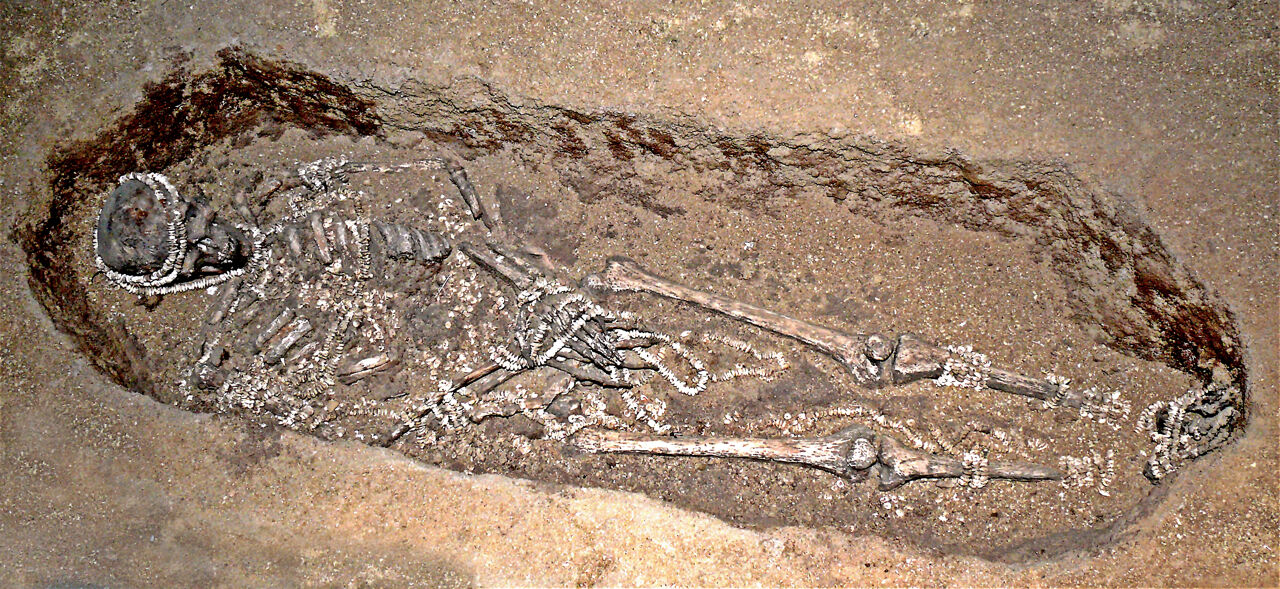
Why give such riches to children? Maybe their families were important, or maybe they were special for another reason, or people believed the dead needed these things in another world. Surprisingly, DNA tests showed the people of Sungir weren't closely related, so even small Ice Age groups kept wide networks of friendship and marriage. Religion and family were already tangled together.
At Dolní Věstonice in the Czech Republic, about thirty-one thousand years ago, three young people were buried side by side. The one in the middle probably had a disability. All three had red ochre on their heads. Nobody knows the full story, and it has puzzled scientists for years.
On the coast of Italy, about twenty-eight thousand years ago, a teenage boy now called "the Prince" was buried wearing a cap covered with hundreds of shells, with red ochre on his body and a long stone blade in his hand. He had been badly hurt, perhaps by an animal. His death was sudden, but his burial showed enormous care.
Mungo: ancestors who came home
On the other side of the world, near the dry Willandra Lakes in Australia, a scientist found the remains of a young woman in 1968, now called Mungo Lady. She had been cremated, one of the oldest cremations known anywhere. In 1974 he found Mungo Man, laid on his back with hands clasped and sprinkled with red ochre carried from far away. Both are about forty thousand years old.
For the Aboriginal peoples of that land, these weren't museum specimens but ancestors. After years of asking, Mungo Lady was returned home in 1992 and Mungo Man in 2017, with ceremonies by their descendants. Their homecoming was itself a funeral, held by descendants for ancestors who had died forty thousand years earlier! It's a powerful reminder that the deep past isn't dead for everyone.
What the dead taught the living
What did all this mean? Thinkers who studied religion have offered some ideas.
In 1871, an English thinker named Edward Tylor suggested that the first religious idea was the soul. Early people would have been puzzled by dreams, where you travel and meet faraway or dead people while your body lies still, and by death, where the body stays but something important is gone. So they imagined a spirit that can leave the body, and then imagined animals, plants and objects having spirits too. He called this animism.
Some say Tylor made early people sound like lonely philosophers. But his main point is strong. Death is a puzzle: the body is here, but the person isn't. Dreams are the opposite puzzle: the person is here, but the body isn't. A mind that could imagine absent people would naturally imagine the dead still existing somewhere.
In 1907, a French thinker named Robert Hertz studied double funerals in Borneo, where a body is first left to decay, and later the clean bones are gathered for a final ceremony. Hertz said death isn't an instant but a journey. The soul's journey to the land of the dead matches the body's slow change, and the mourners' sad, careful time matches both. When the bones are clean, the soul has arrived, the mourners can return to normal life, and the community has healed. Funerals, he said, are as much for the living as for the dead.
Another thinker, Arnold van Gennep, described rites of passage in three steps: leaving, an in-between time, and joining something new. The dead person leaves the living, passes through an in-between time, and joins the ancestors. A burial isn't just an ending; it's a change of membership.
Death is a puzzle: the body is here, but the person isn't.
Fear and comfort
In 1973, a thinker named Ernest Becker said humans, knowing they'll die one day, feel a deep worry about it, and cope by believing in cultures and religions that promise their lives will mean something lasting. Psychologists have done experiments showing that reminding people about death makes them hold more tightly to their beliefs and groups.
But others point out that many hunter-gatherer peoples seem calm about death, and are more worried about the dead than about dying. In many cultures, the recently dead are thought to be lonely or upset and must be gently persuaded to move on. Some Aboriginal communities avoid saying a dead person's name for a while, and some groups move their camp after someone dies.
Probably both feelings, love and fear, were there from the start, and the grave served both. It kept a loved one close, and it kept a possibly dangerous spirit safely contained. This mix of feelings, the dead as loved and as feared, will later lead to two things: ancestors who protect their families, and ghosts and spirits who must be calmed.
The first big questions
Put it all together. For hundreds of thousands of years, our ancestors responded to death like other animals, with love that slowly faded. Then, gradually, it became a shared custom: the dead were moved, placed and covered. By about a hundred thousand years ago, people were placing animal parts with the dead. By about forty thousand years ago, from Russia to Australia, burials showed identity, status and beliefs about what comes next, with ochre, beads and huge amounts of work.
The grave was probably the first place where the human mind had to imagine something it couldn't see. A dead body asks a question nothing else asks so sharply: where did the person go? Every answer, whether a land under the earth, a journey to the sky, coming back as an animal, being reborn as a child or becoming part of the land itself, is a big idea about the universe. Long before there were gods, there were the dead. And the dead may have been the first beings people spoke to in something like prayer.