Chapter I
The Long Silence
For almost all of human history there was no writing. How can we find out what ancient people thought and felt?
Assisted and Curated by Claude, Referenced and Collated by me
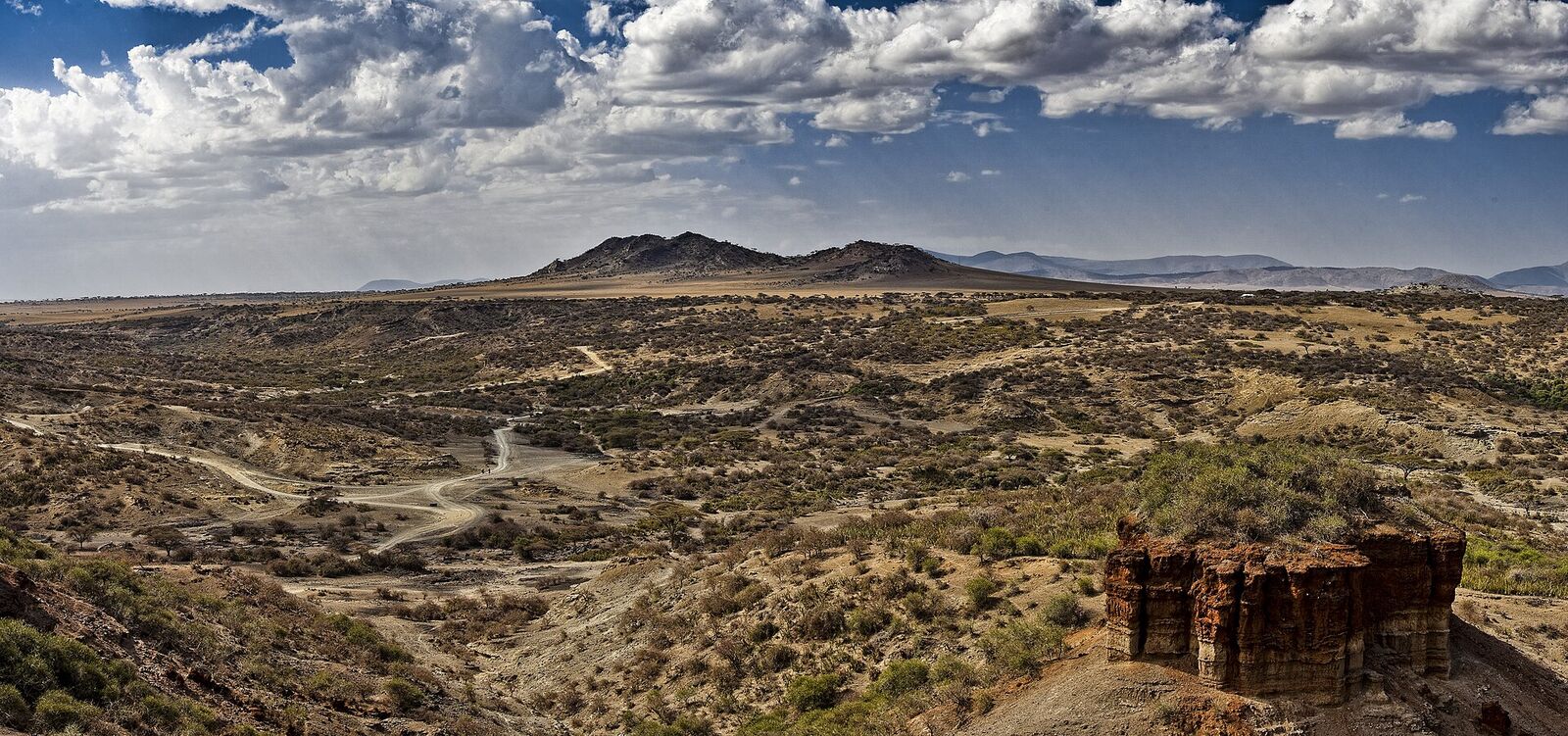
First, think about how long ago all this was. Humans' family line goes back nearly three million years. People like us appeared about three hundred thousand years ago. Farming began only twelve thousand years ago, and writing just five thousand years ago. If all of human history were squeezed into one day, writing would appear only in the last twenty-five minutes! Everything in holy books, philosophy and history happened in the final half hour. The rest of the day is "prehistory", the time before writing.
This is humbling. The feelings and beliefs people brought to the first cities weren't invented there. They came from a huge, unwritten past, when people lived in small travelling groups, knew everyone by name, depended on animals they also respected, and faced death without hospitals or any written promises about what came next. That ancient mind is like the ground floor of the building we still live in.
What survives, and what doesn't
Archaeologists study what happens to things after they're dropped or buried. Bone survives in some soils but melts away in others. Stone survives almost everywhere. Charcoal from fires survives. Paint survives on sheltered rocks and inside caves. But wood, string, leather, feathers and flesh almost always disappear. So do sounds and movements.
This can trick us badly. When we say ancient people "made stone tools", we really mean stone tools are what we found. Most things that hunter-gatherer people made were things that rot away: digging sticks, nets, baskets, bags, spears, body paint, feather headdresses and wooden carvings. Scientists in Australia point out that if Aboriginal Australia were known only from its stone tools, you might think its people had no religion at all. In fact, they had one of the richest belief systems ever recorded, almost none of it in stone!
If we judged the past only by stone tools, we'd think its people had no religion at all.
It's the same for the ancient caves. Paint deep inside caves can last tens of thousands of years. But for every painted cave, there must have been thousands of painted bodies, animal skins, trees and bark that simply rotted away. For every bone flute found, there were reed pipes, skin drums and, above all, voices. The silence of the past is only because things didn't survive. It doesn't mean the past was quiet!
Climbing the ladder of clues
In 1954, an archaeologist named Christopher Hawkes described a ladder. On the bottom step, it's easy to work out how a tool was made. One step up: what people ate. Higher: how their groups were organised. At the very top, hardest of all: what they believed. The higher you climb, the more you have to guess.
Later thinkers were more hopeful. Colin Renfrew said beliefs leave clues because they make people do things: repeat special actions in special places, work far harder than needed, destroy or bury valuable objects on purpose, build enclosures and images, and leave things with the dead. Religion isn't invisible. It's costly, and costs leave marks.
That idea, that we can spot what's sacred by how much effort it took, runs through this whole book. Burying someone takes time that could have been spent finding food. Painting a cave a kilometre underground by the light of a fat lamp takes huge effort. So does carrying a heavy stone up a hill or spending hundreds of hours drilling beads for a dead person. When people do things that make no practical sense, they're usually telling us that something matters to them more than practical sense.
The tricky mirror
Another way to learn about the ancient past is to study recent hunter-gatherer peoples, like the San of the Kalahari, the Hadza of Tanzania, the Mbuti of the Congo, the Inuit, the Andaman Islanders and Aboriginal Australians. This is very useful, but also risky.
It's useful because it gives us real examples instead of pure guesses. Many such groups share patterns: small bands of twenty-five to fifty people who sometimes gather in bigger groups; strong fairness, where anyone who tries to boss others around gets teased; big extended families; beliefs in spirits of animals and places; special people called shamans who go into trance for the group; and deep feelings about the dead. These patterns hint at what the long past might have been like.
It's risky because these peoples aren't "living fossils". The San have a history as long as anyone's! They've been in contact with farmers for centuries and their beliefs have changed. Treating them as "early humans" is bad science and disrespectful, as colonial scholars often were. It's better to see them as showing the range of ways people without cities, writing or farms have lived and thought.
First hints of a mind that went beyond needs
With those warnings in mind, let's look at the earliest signs that our ancestors were doing more than just surviving.
The hand axe, a stone tool shaped like a teardrop, first appeared in Africa about 1.76 million years ago and was made for over a million years! Many are more symmetrical than needed. Some are made from beautifully coloured stone. Some are too huge to use. One famous axe from England was carefully shaped around a fossil shell, leaving it right in the middle. We can't prove what it meant, but it feels like someone cared about beauty, not just usefulness.
In 2014, researchers looking at an old mussel shell from Java, in Indonesia, noticed a zigzag line carved on it. It's about half a million years old, and was made before our own species existed! Nobody knows what it meant, maybe just the fun of drawing a line. But it suggests the urge to make patterns is older than us.
Then there's fire. Our ancestors may have used fire a million years ago, and were clearly controlling it by four hundred thousand years ago. Fire cooked food, kept people warm and scared away predators. But it may have changed minds too. A researcher named Polly Wiessner noticed that among the San people, daytime talk was mostly about work and complaints, but around the fire at night, people told stories, often about faraway, dead or imaginary people. Firelight created a new kind of time for stories, the dead and the unseen. The first ideas about the universe may have been told around a fire!
Firelight made a new kind of time: for stories, for the dead and for the unseen.
Red earth
One substance stands at the doorway of human imagination: red ochre, an iron-rich earth that can be ground into paint, from brown to bright blood-red. It's useful as sunscreen, bug spray and glue. But it's found so often with bodies, graves and pictures that almost nobody thinks it was just practical.
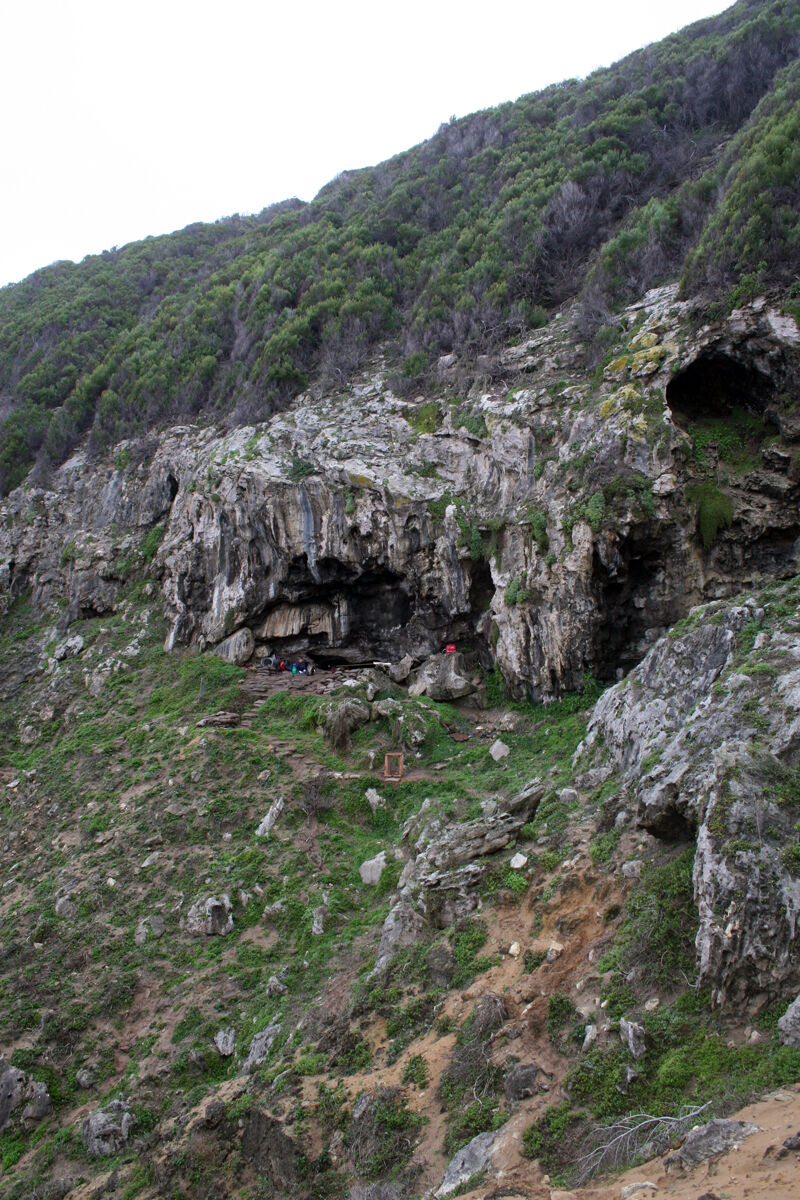
At Pinnacle Point in South Africa, ochre was used about 164,000 years ago. At nearby Blombos Cave, scientists found an ochre "workshop" about 100,000 years old, with shells used as paint pots and grinding stones! Blombos also had pieces of ochre carved with crisscross patterns, and a stone flake with a crisscross drawn in red ochre about 73,000 years ago. It's the oldest known drawing in the world!
Why red? In many languages, red is the first colour word after black and white. It's the colour of blood, so of life, injury, birth and death. A substance that looks like blood but doesn't rot couldn't have meant nothing to people beginning to think about life and death.
Beads and showing who you are
The next big clue is beads. Tiny sea snail shells with holes, some coloured with ochre and worn smooth from being strung, have been found in South Africa (about 75,000 years old), Morocco (about 82,000 years old) and Israel. Some were carried many kilometres away from the sea!
A bead is a small thing with a big meaning. Worn on the body, it tells others something: which group you belong to, your age, whether you're married, or that you're protected. It only works if others understand the code. So a bead is like a sentence in a shared language. It shows people were living in a world where you weren't just a body but someone with an identity others could read from far away. That matters for religion, which in almost every form helps people trust and belong beyond their own family.
Sudden switch or slow sunrise?
For a long time, scientists thought the modern mind "switched on" suddenly about 40,000 to 50,000 years ago, when Europe suddenly got cave art, figurines, musical instruments and fancy burials. Some thought a change in the brain caused it.
In 2000, two archaeologists, Sally McBrearty and Alison Brooks, wrote a paper called "The Revolution That Wasn't". They showed that all these things, like paint, beads, bone tools and carving, appeared slowly across Africa over more than two hundred thousand years. Europe only looked sudden because modern humans arrived there with everything already invented. Most scientists now agree: imagination grew slowly, flickered on and off in different places, and depended on how many people lived together and how connected they were. Big, connected groups built up knowledge; small, isolated ones could lose it.
So the ability to think about spirits was probably there from early on. But showing it in art and rituals depended on how people lived together. A mind that can imagine spirits isn't the same as a society that builds shrines for them.
Now we can ask the big question. When a creature that can use symbols, show who it is and tell stories by firelight looks at a dead friend, what does it see? The answer begins at the grave.