Chapter X
When the Great Gods Arrived
As villages grew into cities and kingdoms, people began to believe in powerful gods who watched over everyone and cared about right and wrong.
Assisted and Curated by Claude, Referenced and Collated by me
Over a hundred years ago, a Scottish writer named Andrew Lang noticed something surprising. Most experts then believed religion started with many spirits and only much later grew into belief in one god. But Lang read reports that some hunter-gatherer peoples, in Australia, South America and elsewhere, spoke of a great being who made the world and lived in the sky. So maybe the idea of a supreme being was very old!
An Austrian priest named Wilhelm Schmidt went further, arguing that the earliest humans believed in one kind creator god, and that spirits and magic came later. Critics pointed out that his idea conveniently matched his own religion, and that some of the sky gods he found might have come from contact with missionaries.
Few people accept Schmidt's theory now. But the puzzle is real. Some hunter-gatherer peoples do speak of great creator beings. Yet these beings are usually very different from the gods of great civilisations. Understanding that difference is the key to understanding how gods, in the full sense, appeared.
The god who went away
Mircea Eliade called it the "idle god". In many traditions, especially in Africa, a supreme being made the world long ago and then moved far away into the sky, no longer involved in human life. One story says the sky used to be close to the earth, but a woman pounding grain with a long pestle kept bumping it, so it moved away! The creator is still remembered, but people mostly pray to ancestors and nearer spirits, who are closer and listen more.
Among many hunter-gatherers too, high beings tend to be far away, unpredictable or not interested in right and wrong. Among the San, there's a powerful but moody great god, and the trickster mantis Kaggen, who is a creator but also a joker and a thief! The Hadza of Tanzania link the sun to a being called Haine, but Haine doesn't punish bad behaviour or reward good. Among the Hadza, people keep each other honest, not gods.
A big study of hunter-gatherer societies found that belief in spirits was everywhere, and belief in an afterlife and shamans was common. Some believed in high gods. But high gods who are active in daily life and care about morality were rare. The gods of small societies, if they existed, weren't moral police.
In small societies, people kept each other honest, not gods.
Why small groups don't need a watcher
In a small hunter-gatherer band, everyone knows everyone. Every kind or selfish act is seen, remembered and talked about around the fire! An anthropologist named Christopher Boehm showed that such groups stay equal by teasing, gossiping about or ignoring anyone who tries to boss others around or keep too much for themselves. When everyone is watching everyone, there's little need for an invisible watcher in the sky.
But things change when societies grow. In a village of a few hundred, you know most people. In a town of thousands, you don't. In a city or kingdom of hundreds of thousands, most people you meet are strangers. How can you trust a stranger not to cheat or steal when nobody's looking?
Big gods
A Canadian psychologist named Ara Norenzayan suggested that believing in powerful, watchful gods who care about right and wrong helped solve this problem. If people believe an all-seeing god is watching, even when no human is, they may behave more honestly with strangers. In experiments, people gently reminded of God sometimes behaved more generously. He summed it up: "Watched people are nice people." Societies with such beliefs, he argued, could grow bigger and cooperate more.
This idea has been tested and argued about a lot. A big 2019 study suggested that moral gods appeared only after societies became very large, but other scholars criticised how it was done. Which came first, the big society or the big god? It's still debated. Most scholars now think they grew together, each helping the other.
What's clear is the pattern: the bigger and more ranked a society, the more likely it is to have powerful gods who care about morality and are arranged in ranks, like rulers on earth. The shape of heaven follows the shape of society.
The Sky Father
Some amazing evidence about ancient gods comes from language. Scholars discovered that many languages, including Sanskrit, Greek, Latin, German, Celtic languages and Persian, all come from one ancient language, called Proto-Indo-European, spoken perhaps six thousand years ago, probably on the grasslands north of the Black Sea.
By comparing words for gods, scholars rebuilt the name of one ancient god. In the Rigveda, there's Dyauṣ Pitṛ, "Sky Father". In Greek, the king of the gods is Zeus Patēr, "Father Zeus". In Latin, he's Jupiter, from an older word meaning "Sky Father". They're all the same name! The same root gives us the Sanskrit deva, the Latin deus (god) and the English word "divine". When you say "divine", you're echoing a prayer to the bright sky spoken six thousand years ago!
This Sky Father was a typical high god: male, in the sky, fatherly and linked to the order of the universe. He suited herding peoples on open grasslands, where the sky is huge and everywhere, and where their cattle depended on rain from above. Turkic and Mongol peoples had a similar sky god, Tengri.
When you say "divine", you're echoing a prayer to the bright sky from six thousand years ago.
The first temple cities: Sumer
The world's first cities grew in southern Mesopotamia, in today's Iraq, over five thousand years ago. The greatest was Uruk, which may have had forty thousand people or more! At its heart were two great sacred areas: one for the goddess Inanna, goddess of love, war and the morning and evening star, and one for An, god of the sky, whose white-painted temple stood on a high platform, an early form of the stepped temple-mountain called a ziggurat.
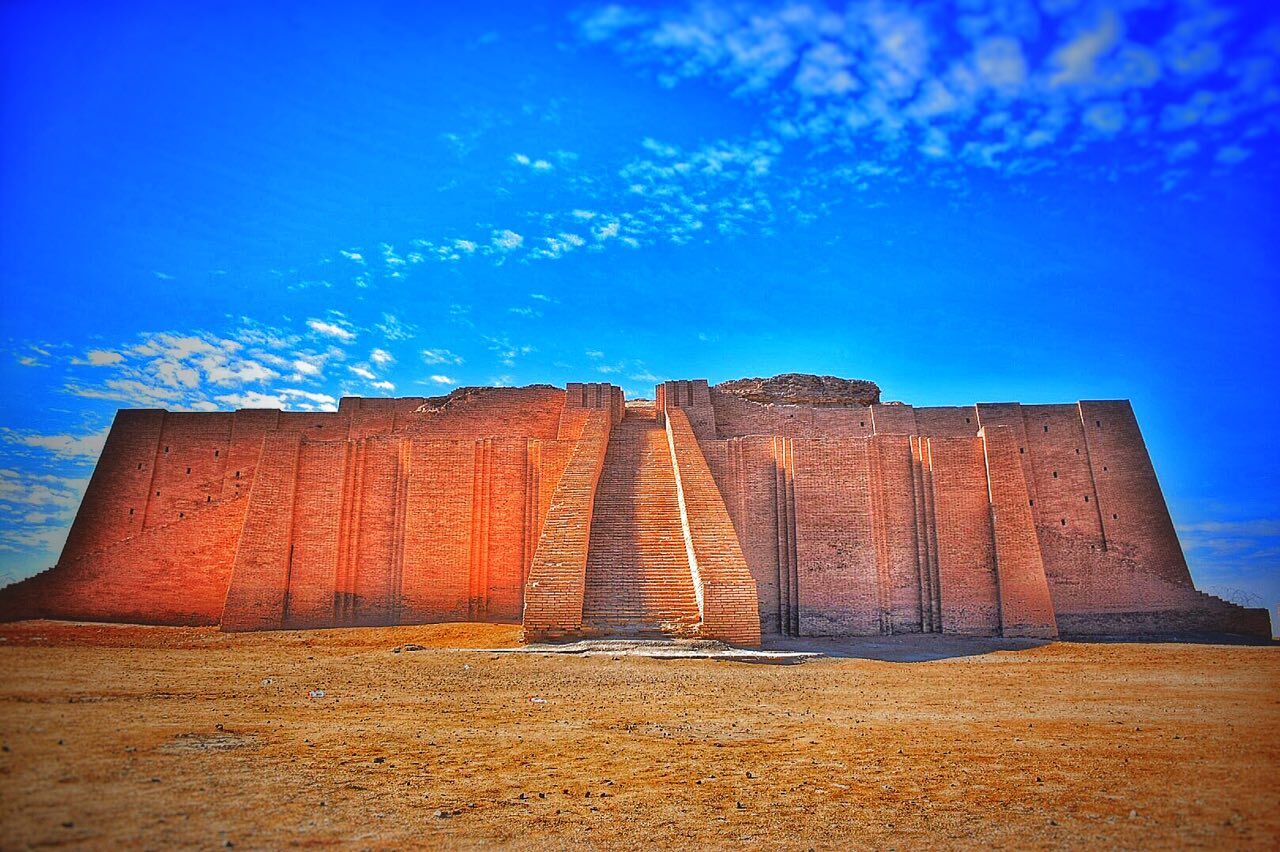
In Uruk, religion became an organisation. Temples owned land, herds and workshops, employed many workers and collected and shared out goods. The world's earliest writing, from Uruk, is mostly temple accounts: records of barley, sheep, beer, cloth and workers' food. Writing was invented partly to keep the gods' books! A famous carved vase from Uruk shows rows of people carrying food in a procession toward the goddess, as if the whole city's wealth flowed to her.
The gods of Mesopotamia had names, personalities, families and special jobs. Each city had its own god, believed to own the city and live in its temple as a statue that priests fed, dressed and bathed every day! The king ruled on the god's behalf. When cities went to war, their gods went to war too. The heavens had become like a royal court, with a council of great gods deciding everyone's fate, just like councils and kings on earth.
But older ideas survived inside the new order. Inanna's journey to the underworld and back is a story of death and return. Her husband Dumuzi dies and is mourned every year, like the dying gods we met earlier. The dead were still buried under houses, as at Çatalhöyük. The old layers weren't erased; new ones were built on top.
Egypt: the king becomes a god
In Egypt, it happened differently. Around 3100 BCE, Upper and Lower Egypt were united under one king. A famous carved stone called the Narmer Palette shows a king wearing both crowns, defeating an enemy, while the falcon god Horus holds a captive.
In Egypt, the king wasn't just a servant of the gods. He was the living Horus, a god on earth, and when he died he became Osiris, lord of the dead. Egyptian religion mixed the oldest ideas, honouring animals, caring for the dead and the cycle of death and new life, with the new power of a kingdom. Many Egyptian gods had animal heads: Horus the falcon, Anubis the jackal, Hathor the cow, Sobek the crocodile and Thoth the ibis. They're like the Masters of Animals of the hunting world, promoted to great gods of a kingdom!
The story of Osiris, killed by his brother Seth, his body broken, gathered by his wife Isis and brought back to life as king of the underworld, is like the old farming myths we met earlier. Osiris was linked to grain sprouting from the Nile's flooded fields. Some Egyptian tombs held "corn mummies", Osiris figures made of earth and seeds that would sprout in the dark! The seed in the earth, the dead in the tomb and the god who rises from death were all one idea in Egypt.
The Indus: a silent civilisation
The cities of the Indus Valley civilisation, like Harappa, Mohenjo-daro, Dholavira and Rakhigarhi, thrived between about 2600 and 1900 BCE, covering an area bigger than Mesopotamia and Egypt together! They had planned streets, drains, standard bricks and weights, but seemingly no giant temples or palaces like Mesopotamia or Egypt. Their writing, found on thousands of small seals, hasn't been decoded yet, so we must learn about their religion from objects alone.
At Mohenjo-daro is the Great Bath, a big waterproof pool surrounded by rooms, which many think was used for ritual bathing and purification, like the importance of sacred water in later Indian religion. Clay female figures may show a mother goddess. And one famous seal shows a figure with a horned headdress, sitting cross-legged in a pose like later yoga, surrounded by animals: an elephant, a tiger, a rhino, a buffalo and deer. The archaeologist John Marshall called it a "proto-Shiva", like Shiva as Pashupati, Lord of Animals.
Many scholars disagree with that and say we shouldn't read later Hinduism back into the Indus. But whoever it is, the seal shows again that ancient figure: a being sitting among wild animals, the Master of Animals we met in the Arctic and the caves, now at the heart of one of the world's first great city civilisations.
The Vedic gods and cosmic order
The Rigveda, composed in early Sanskrit perhaps between 1500 and 1200 BCE and passed down by memory with amazing accuracy for centuries before being written, preserves the religion of its time. Its gods include Dyaus, the old Sky Father, now in the background; Indra, the warrior who defeats the serpent Vritra and frees the waters; Agni, god of fire, who carries offerings to the gods; Soma, god of a sacred drink; and Varuna, guardian of ṛta, the cosmic order that keeps both nature and human behaviour right.
Varuna is especially important. He sees everything; he knows when people lie or break promises, and he binds wrongdoers. In Varuna, the sky god has become a moral guardian, the kind of "big god" Norenzayan described. And the idea of ṛta, the order holding the world together that humans keep through truth and sacrifice, would later grow into dharma, one of the central ideas of Indian thought. The Vedic sacrifice, the yajña, performed by priests with exactly memorised hymns, was believed to keep the universe running, like a grand descendant of the old midwinter ceremonies that renewed the world.
China: ancestors who spoke to God
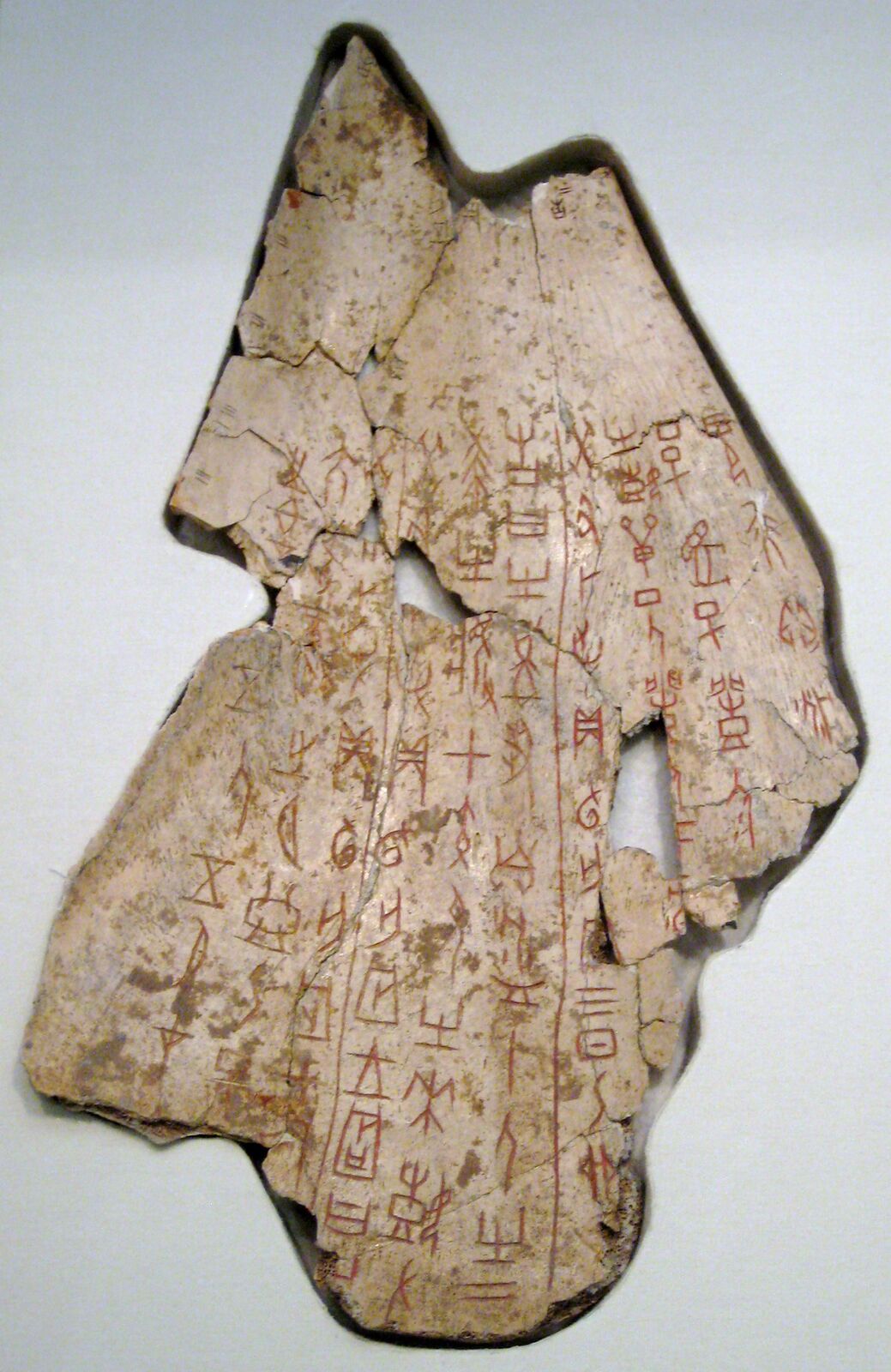
In China, the change from ancestors to gods is very clear. The kings of the Shang dynasty, from about 1250 to 1046 BCE, left behind more than a hundred thousand pieces of oracle bones: ox shoulder blades and turtle shells. Their fortune-tellers wrote questions on them, then heated them until they cracked, and read the cracks as answers. The kings asked about harvests, weather, wars, hunts, illness, babies, dreams and, above all, which ancestors needed offerings.
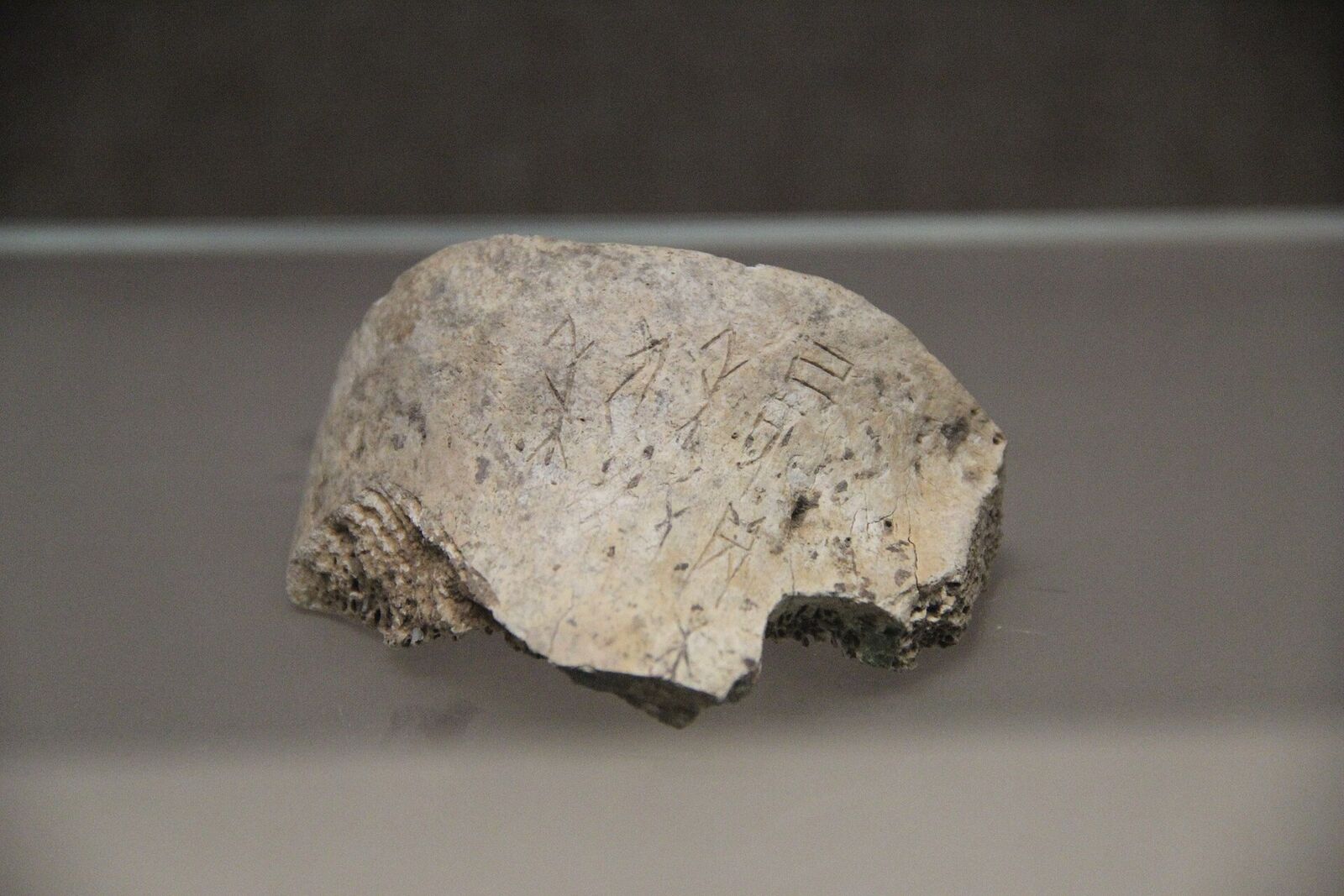
At the top was Di, or Shangdi, the "Lord Above", who controlled rain, wind and wars. But Di was far away and hard to reach. So the kings spoke to their ancestors, especially royal ones, who were close to Di and could speak on their behalf. Dead kings formed a chain of messengers between the living king and the highest power. This shows how a high god could rise above ancestor worship: the ruling family's ancestors became the ladder to the Lord Above, and the king became the only one who could climb it!
When the Zhou dynasty defeated the Shang around 1046 BCE, they introduced a new idea: Tian, "Heaven", which gave a mandate (permission) to rule to good kings and took it away from bad ones. The Shang, they said, had lost Heaven's mandate through cruelty. Heaven had become a moral power watching over rulers.
The king's ancestors became the ladder to the Lord Above, and the king was the only one who could climb it.
The great turning
In 1949, a German philosopher named Karl Jaspers noticed an amazing coincidence. Between about 800 and 200 BCE, in places that had little contact with each other, great new thinkers appeared: the Upanishads, the Buddha and Mahavira in India; Confucius and Laozi in China; the Hebrew prophets in Israel; Zoroaster in Iran; and the philosophers of Greece. Jaspers called it the Axial Age, when human history turned on its axis.
These thinkers asked big, universal questions: What is good? What is the self? What is ultimate reality? How should we live? They imagined something higher than the everyday world, like Brahman in the Upanishads, the Dao of Laozi or the one God of the prophets, and used it to judge kings, sacrifices and customs. They looked inward, at the soul, and outward, at all of humanity.
But a lot of the ancient past stayed inside these new ideas. The sages of the Upanishads went to the forest, as shamans once did, seeking direct experience of ultimate reality through meditation. The idea of rebirth echoes the old belief that the dead return in new bodies. The Buddha's kindness to all living beings, and the Jain principle of ahimsa, not harming any living creature, carry the old feeling of a world full of persons to a new, universal level.
A sociologist named Robert Bellah summed up this whole story: "Nothing is ever lost." Each new kind of religion didn't replace the old one; it was built on top of it. The great religions contain the religions of kings and temples, which contain the religions of ancestors and totems, which contain the most ancient experiences of dreams, trance, ritual and facing death. The gods didn't come from nowhere. They rose out of the whole long story: the grave, the cave, the animal, the mother, the feast, the ancestor and the sky.