Chapter IX
Stones and Sky
People raised giant stones for their dead and lined them up with the sun. The sky was becoming the home of the highest powers.
Assisted and Curated by Claude, Referenced and Collated by me
Every year, around the shortest day of winter, a small group of people gathers in the dark outside a huge grassy mound in Ireland. It's called Newgrange, built around 3200 BCE, older than Stonehenge's great stones and older than the pyramids of Egypt! It's ringed by ninety-seven huge stones, some carved with spirals and zigzags. A nineteen-metre passage leads into the heart of the mound, to a room whose stone roof has kept out the rain for more than five thousand years.
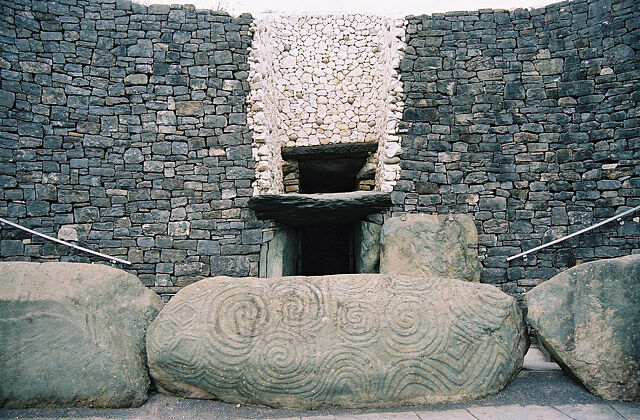
Above the entrance is a small opening called a "roof-box". Most of the year, it's just a gap. But on the mornings around the shortest day, as the sun rises, a thin beam of light enters, travels up the passage and lights up the floor of the dark inner room for about seventeen minutes. Then it shrinks and disappears! An archaeologist rediscovered this in 1967 by going inside at dawn to check. Now so many people want to see it that places are given out by lottery.
The room held the bones of several people. It was a house for the dead, built so that on the darkest day of the year, just when the sun was about to start coming back, the light would enter the tomb and touch the ancestors. It's a beautiful way of saying that death and new life are one cycle.
On the darkest day, as the sun begins its return, the light enters the tomb and touches the ancestors.
The age of giant stones
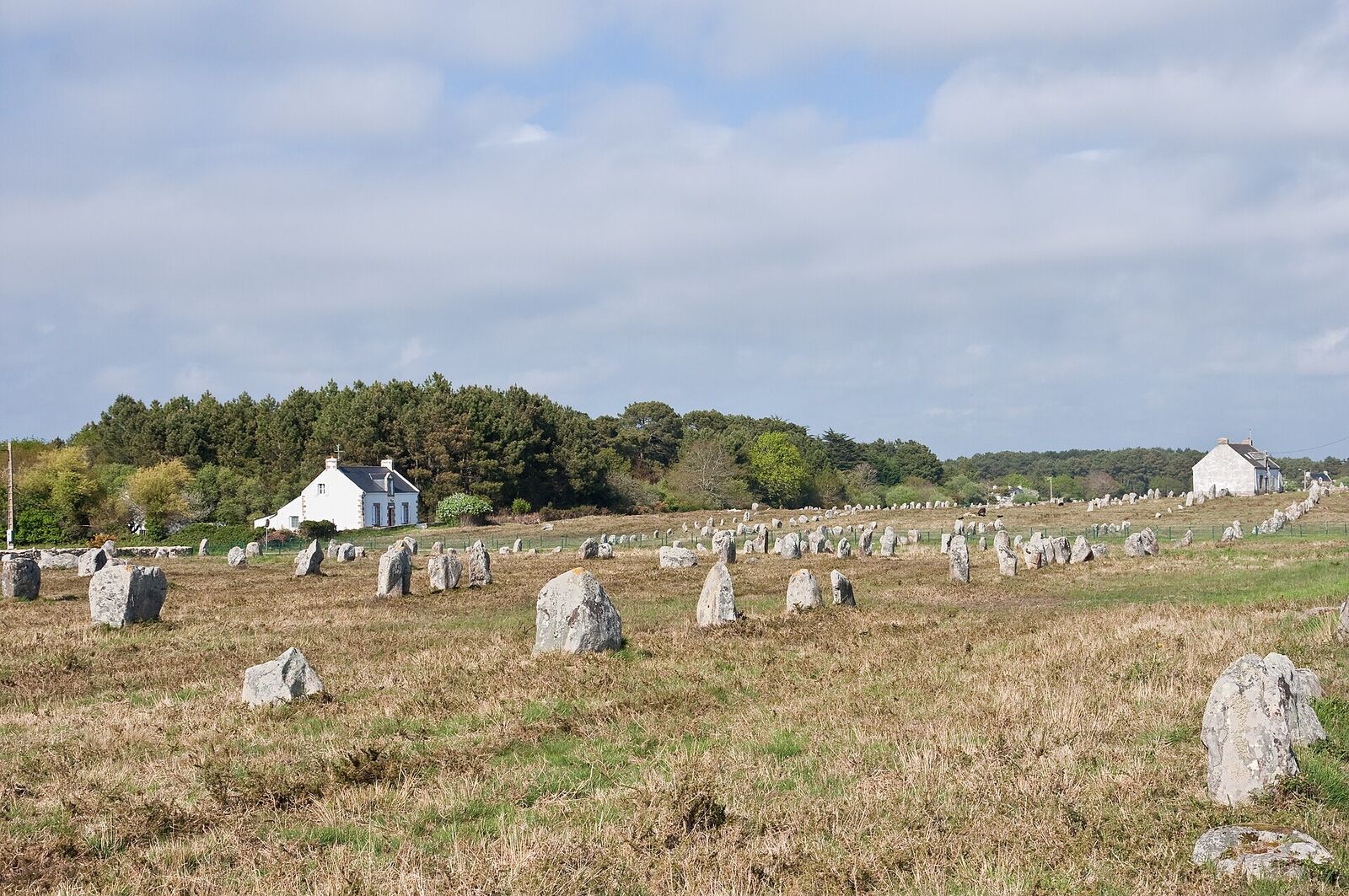
Newgrange is one of tens of thousands of megaliths (from Greek for "big stone") built across western Europe from about 4500 BCE: standing stones, stone "tables" made of upright slabs with a big flat stone on top, long rows of stones, stone circles and tombs covered by mounds. At Carnac in France, more than three thousand standing stones run in rows for several kilometres! One study suggests the tradition began in northwest France and spread along the coasts by boat.
But giant stones aren't only in Europe. People have raised them all over the world: Korea has the most stone "tables" (dolmens) on Earth; there are megaliths in the Caucasus and Ethiopia; on the island of Sumba in Indonesia, communities still drag huge stones to build tombs, with big feasts; and on Easter Island, the famous giant statues called moai were faces of honoured ancestors, set facing inland to watch over their descendants.
And in India! Across the Deccan and the south, in Karnataka, Andhra Pradesh, Tamil Nadu and Kerala, there are thousands of ancient stone burials from about 3,000 years ago: stone circles, dolmens, stone-lined graves and burial urns. At Hire Benakal in Karnataka, hundreds of dolmens cluster on a rocky hillside. In Meghalaya, the Khasi people raised great memorial stones for their clan ancestors into the twentieth century, and many still stand at Nartiang. In the forests of Bastar, Maria and Muria Gond communities raised stones and carved wooden pillars for their dead. India is one of the few places on Earth where raising stones for the dead has continued from prehistoric times to the present!
This tells us something important. Megaliths didn't come from one culture. They're something humans do again and again when they live settled lives on land passed down in families, honour ancestors and gather for big ceremonies. A stone raised for the dead says forever: this place is ours, these are our dead, we were here and we're still here.
Stonehenge: built again and again
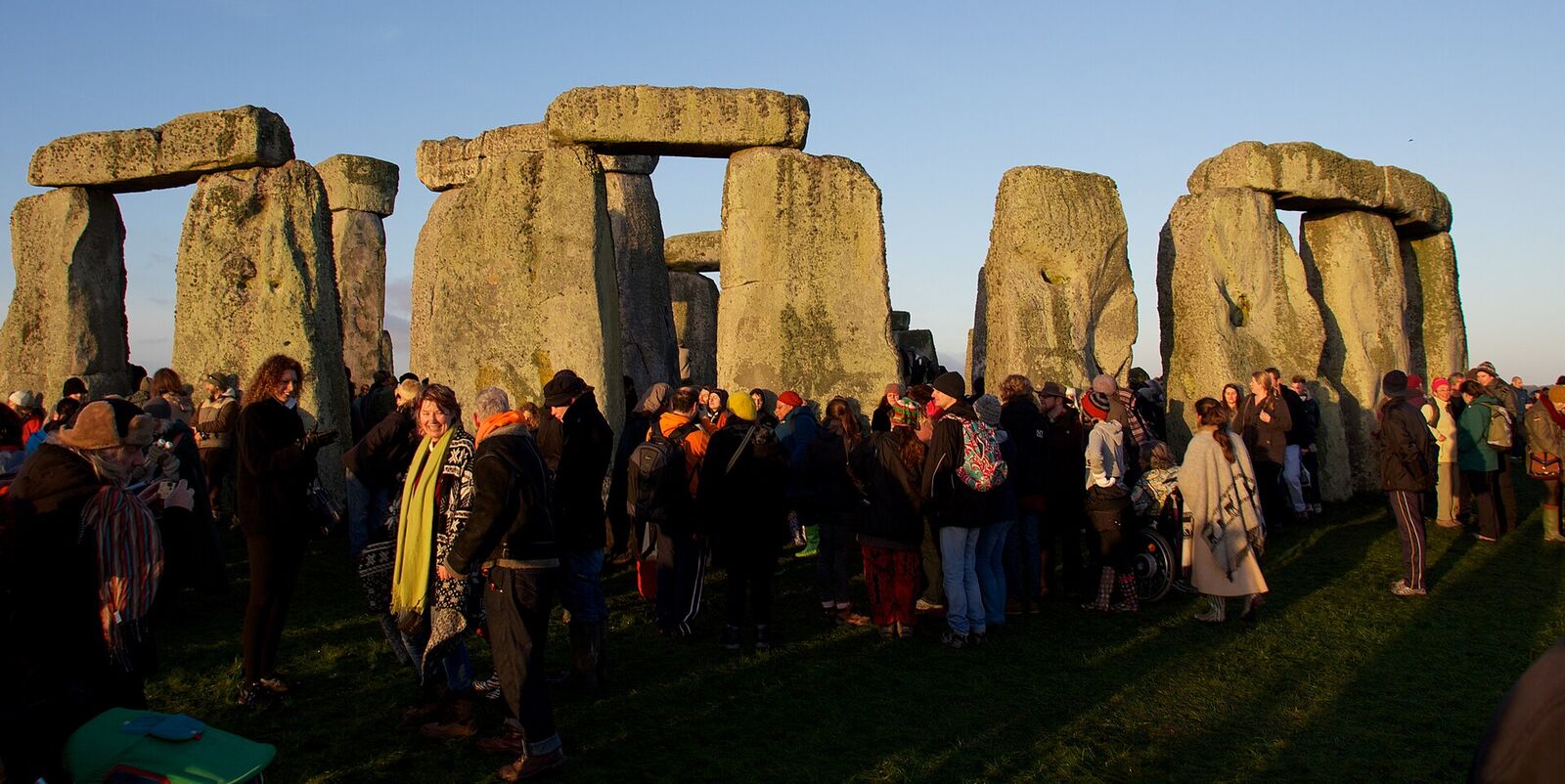
The world's most famous megalith site wasn't built all at once. Stonehenge, in southern England, was built, rebuilt and changed over about fifteen hundred years. Around 3000 BCE, its builders dug a circular ditch and a ring of fifty-six pits. Archaeologists found cremated human remains there. For its first few centuries, Stonehenge was one of Britain's biggest cemeteries!
Around 2500 BCE, the giant sarsen stones were raised, some weighing about twenty-five tonnes, brought from about twenty-five kilometres away. They were shaped and fitted together using joints like a carpenter uses for wood, making a circle of standing stones topped with a ring of lintels, around five enormous stone "doorways". Among them stood smaller bluestones from hills in Wales, about 225 kilometres away! Nobody knows exactly how they were moved, whether on sledges, rafts or both. It took enormous effort.
In 2024, scientists made a surprising discovery about the Altar Stone, a six-tonne slab at the centre. By studying tiny crystals inside it, they showed it came from northeast Scotland, more than seven hundred kilometres away! Nobody knows how it got there. But it shows Stonehenge wasn't a local project. It drew on materials, and probably people, from all over Britain.
Nearby is Durrington Walls, a huge earth enclosure with lots of houses used around 2500 BCE. Archaeologists found huge numbers of pig bones, the leftovers of feasts! Tests on the pigs' teeth showed many were killed in midwinter, around the shortest day. And chemical tests showed the pigs had been raised all over Britain, some as far as Scotland and Wales, and walked to the site. People came from across the island to feast at midwinter, and they brought their pigs with them!
People came from across the island to feast at midwinter, and they brought their pigs!
Land of the living, land of the dead
What was Stonehenge for? People have called it an observatory, a healing place, a sun temple and a place to honour ancestors. One great idea comes from archaeologist Mike Parker Pearson and his colleague Ramilisonina from Madagascar. In Madagascar, Ramilisonina explained, people build houses of wood, which rots like living flesh, and tombs of stone, which lasts like bone. Wood is for the living; stone is for the dead.
Parker Pearson suggested the Stonehenge area was arranged exactly like this. Durrington Walls, with its wooden circles and houses, was the land of the living, where people gathered and feasted. Stonehenge, made of stone and holding the dead, was the land of the ancestors. A river and a ceremonial path connected them. At midwinter, people may have walked from wood to stone, from the living to the dead, as the sun set in line with the monument.
Stonehenge lines up with the midsummer sunrise one way and the midwinter sunset the other. The feasting evidence suggests midwinter mattered most. The shortest day is when the sun stops retreating and starts coming back, the turning point from death toward new life. The ancestors, in stone, were honoured at the turning point of the year.
Watching the sky
These alignments weren't accidents. They were built by people who had watched the sky for generations and knew exactly where the sun would rise and set on key days. How far back does this knowledge go?
A bone tool from Ishango, in Congo in Africa, about twenty thousand years old, has groups of carefully cut notches. Some think it's a tally or maths, and one researcher argued it tracked the phases of the moon. That's not proven, but it suggests keeping track of time may be one of the oldest kinds of human thinking.
Clearer evidence comes from Warren Field in Scotland, where hunter-gatherers dug a row of twelve pits about ten thousand years ago. Scientists think the pits track the months of the moon, and line up with the midwinter sunrise to keep the calendar correct. If so, it's the oldest calendar monument in the world, built five thousand years before Stonehenge!
In the Sahara desert in southern Egypt, at Nabta Playa, there's a small stone circle about seven thousand years old that may line up with the midsummer sunrise, when monsoon rains once arrived there. Nearby, cattle were buried in stone-covered chambers. Some scholars think these cattle-loving herders may have influenced Egypt's later religion, with its cow goddess Hathor. Sky-watching, cattle and stone circles in the Sahara, long before the pharaohs!
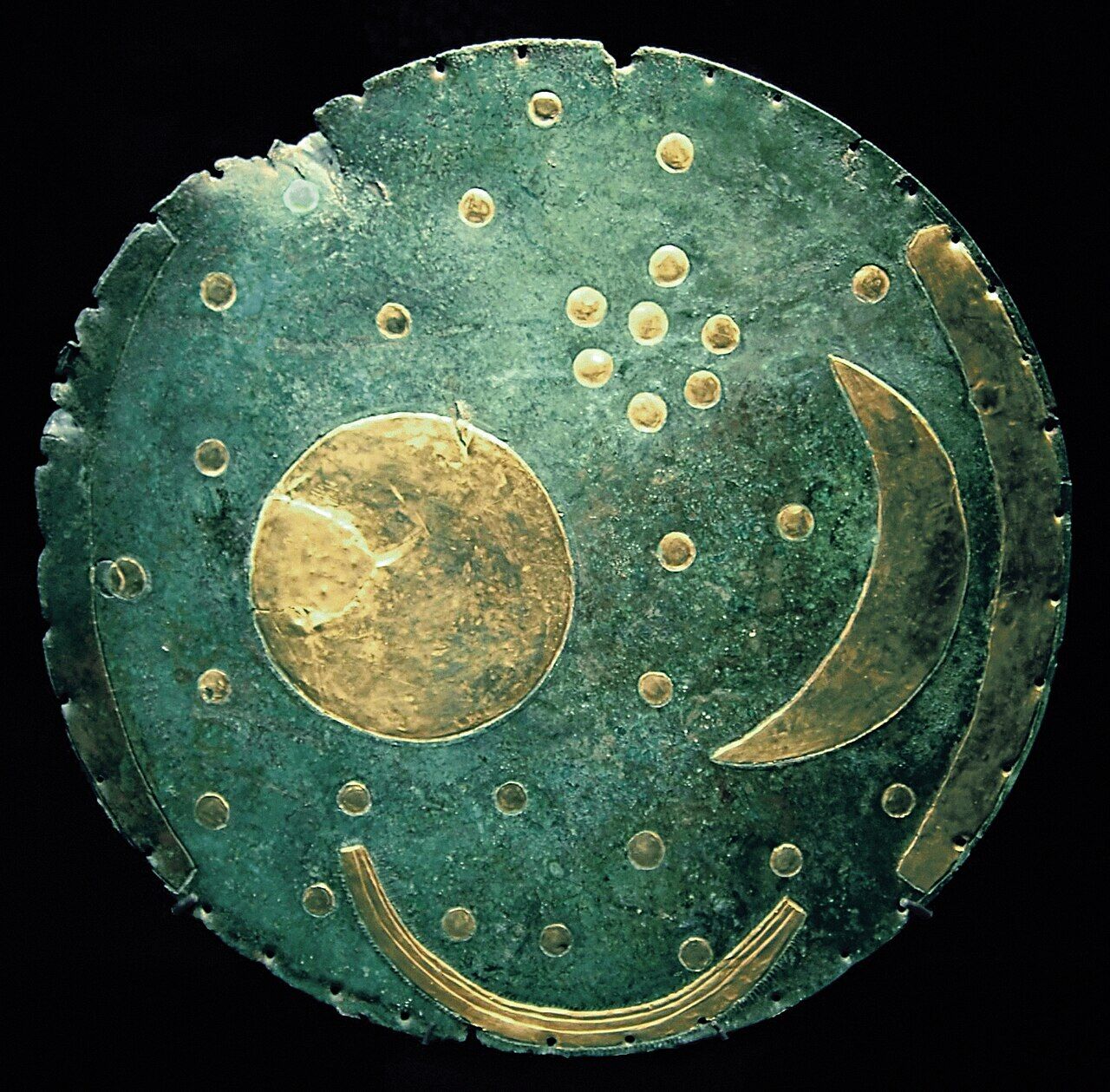
The Nebra sky disc, found in Germany in 1999, is a bronze disc about thirty centimetres across, decorated with gold shapes: a sun or full moon, a crescent moon, a cluster of seven stars (probably the Pleiades) and golden arcs that match where the sun rises and sets on the longest and shortest days. It's about 3,600 years old, the oldest known picture of the sky!
The seven sisters
The Pleiades, the little star cluster on the Nebra disc, are special in human imagination. In many cultures they're seen as a group of sisters. In Greek myth, they're seven sisters, and one has faded away, so only six are easy to see. In many Aboriginal Australian stories, they're sisters chased across the sky by a man, the star pattern we call Orion, and in some versions one sister is missing too!
That's an uncanny match. In 2021, two astronomers suggested a bold idea: maybe the story of the lost sister came from one very ancient story, carried out of Africa by early humans perhaps a hundred thousand years ago. Back then, they calculated, seven stars would have been easier to see; since then, the stars have slowly moved closer together, so only six are easily seen. Many scholars doubt this. But it asks an amazing question: how old are the stories we still tell? Some may be older than any building, and older than many languages!
How old are the stories we still tell? Some may be older than any building.
Making time sacred
What did it mean to line up a tomb with the winter sunrise, or gather thousands of people to feast at midwinter?
A thinker named Mircea Eliade said that for ancient peoples, time wasn't a straight line like it is for us, but a circle. The world was created in a sacred beginning-time, and that time could be renewed through ceremonies, especially at the turning points of the year. New Year, midwinter and harvest festivals weren't just dates on a calendar. They were ways of renewing the whole world. The sun coming back at midwinter was a victory for the universe, and people's ceremonies helped it along.
Stone monuments made this circle of time solid. They fixed the turning points of the year in stone and linked the dead to them, so the sun's return and the community's renewal through its ancestors became one event. And they created knowledge. To build Newgrange or Stonehenge, someone had to know exactly where the sun would rise on a certain day, knowledge gathered over generations, and perhaps kept secret. Those who had it could tell everyone when to plant, gather and feast. Knowing the sky was power.
This is one of the quiet roots of priests. Among hunter-gatherers, religious experts were shamans, whose power came from personal trance experiences. In the megalith societies, a new kind of authority appeared, based on special knowledge of calendars, rituals, family histories and sacred stories, passed down in certain groups. This kind of authority suited bigger, more ranked societies, and it would become the basis of the great priesthoods of Mesopotamia, Egypt, India and China.
And the sky itself was changing its meaning. For hunters, the most important powers were animals and their Masters. For farmers, the most important powers controlled the seasons, rain, sun and crops, and those powers lived above. As monuments turned toward sunrise and sunset, people's attention turned upward. The sky was becoming the home of the highest powers. It was about to become the throne of the gods.