Chapter XI
What Still Lives in Us
The ancient mind didn't disappear. It still lives inside us: in how we remember loved ones, cheer in crowds, feel wonder and leave our mark.
Assisted and Curated by Claude, Referenced and Collated by me
It would be nice to end this story with the great thinkers of long ago, as if humans had finally left the cave behind. But that's not what happened. The ancient mind didn't disappear. It went underground, into habits and feelings we hardly notice, and it pops up all the time, sometimes in the most ordinary places.
This last chapter isn't about the past. It's about today, seen in the light of everything that came before.
The dead who don't leave
For much of the twentieth century, many psychologists taught that healthy grieving meant "letting go" of the person who died. People who kept talking to the dead, kept their things or felt they were still near were thought to be stuck.
In 1996, researchers challenged this. They showed that many people who lose someone keep a relationship with them: talking to them, asking their advice, feeling they're near, visiting their graves and keeping their photos close. Many widows and widowers say they sense their partner's presence. This isn't something wrong; it often brings comfort. Grief, the new view says, isn't about breaking bonds but about changing them.
That's exactly what people were doing long ago in Jericho when they gave their dead faces of plaster. When a family in Kerala keeps a lamp burning for a grandmother who has died, when a Mexican family builds an altar with marigolds for the Day of the Dead, when a Chinese family sweeps ancestors' graves, when a Hindu son performs shraddha to remember his ancestors, or when someone talks out loud to their father at a gravestone, it's the same human act as the woman at Çatalhöyük who was buried hugging a skull.
Talking to a loved one at a grave is the same act people have done since the Stone Age.
The crowd and the sacred
Durkheim's "fizzing feeling" didn't end long ago. It fills stadiums every weekend! Fans sing together, wear their team's colours, have animal mascots, treat certain grounds as special and, when their team wins, feel joined with thousands of strangers. Scientists have even measured fans' heartbeats moving in sync! Concerts, festivals, rallies and huge religious gatherings like the Kumbh Mela and the Hajj create the same feeling: you melt into the group, and the group feels full of power bigger than anyone.
Science explains why. Moving, singing and chanting together release feel-good chemicals in the brain and make people feel close. The same thing that bonded dancers in the Kalahari and feasters at Stonehenge happens in any crowd singing the same song at the same moment. Humans are built to be carried away together!
Persons in the world
Our "someone's there!" detector is still running. We see faces in electrical sockets and the fronts of cars! We shout at computers that freeze, say sorry to furniture we bump into, name our cars and feel guilty throwing away a stuffed toy. Children talk to their toys, and people give names to robot vacuum cleaners and feel sad when they break. Today, people chat with computer programs and find themselves imagining they have feelings. The old question the Ojibwe elder answered so carefully, which things are persons?, has become an important question again.
Ancient ideas have even entered the law. In 2017, New Zealand recognised the Whanganui River as a legal person, because the Māori people see it as an ancestor. The same year, a court in Uttarakhand declared the Ganga and Yamuna rivers to be living beings with rights, though the Supreme Court later paused that. Ecuador's constitution recognises the rights of nature. These show that the ancient idea that rivers, mountains and forests can be persons we have duties toward isn't just a leftover. Some people think it could help us look after our planet.
Wonder
One feeling runs through every chapter of this book, and it's still as strong as ever: awe, the feeling of being near something huge that's beyond our understanding. A psychologist named Dacher Keltner has studied awe for over twenty years. People everywhere feel it in nature, music, art, big gatherings, at births and deaths, and in religious moments. His research shows awe makes us feel smaller in a good way, more generous and humble, and more connected to others and to something bigger.
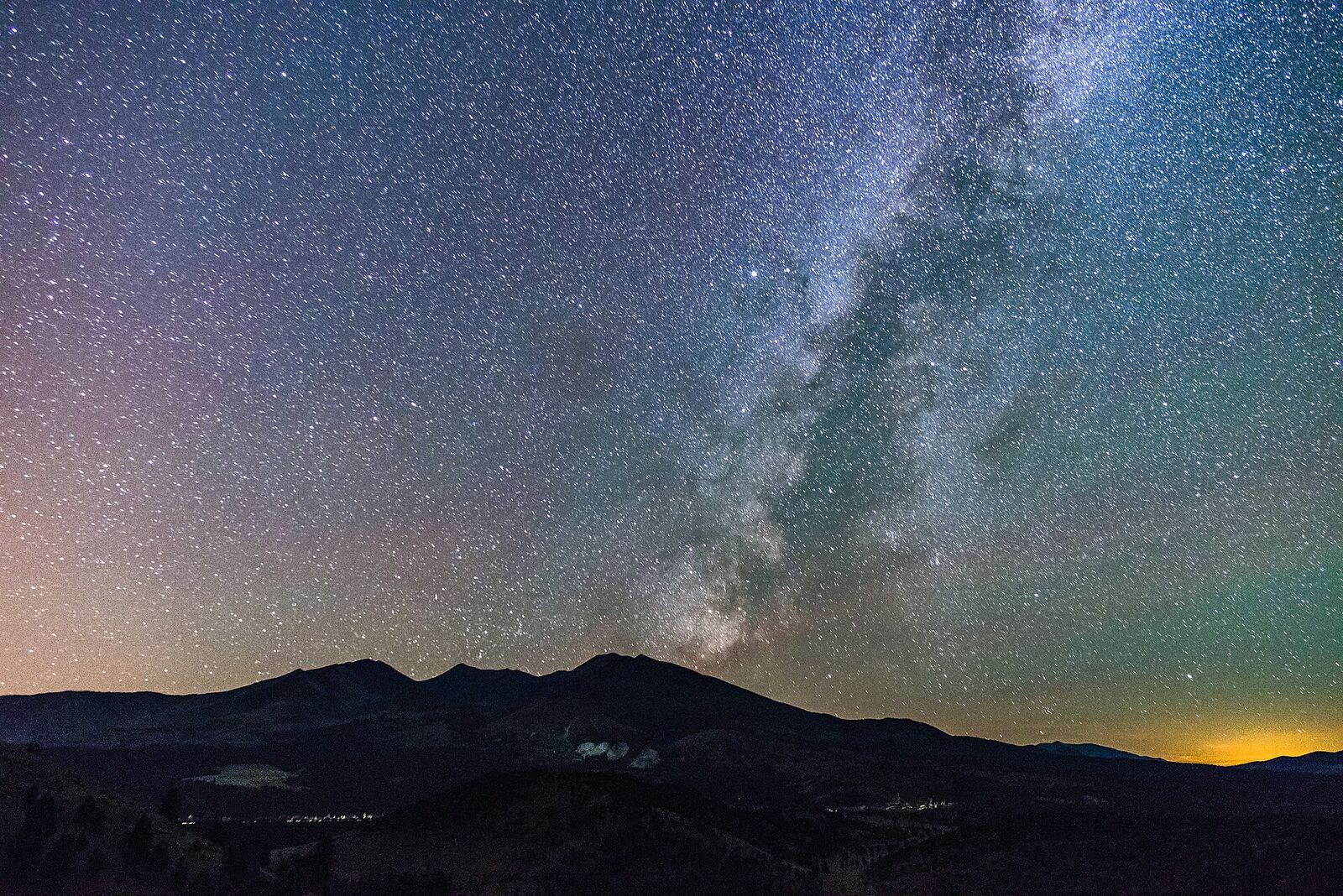
Stand under a starry sky far from city lights, and you'll feel what the sky-watchers at Newgrange felt. Walk into a huge temple, mosque or cathedral, and you'll feel what people felt entering the circle of giant pillars at Göbekli Tepe. Be there when a baby is born or when someone you love is very old and ill, and you'll feel what little Mtoto's family felt seventy-eight thousand years ago. Awe may be the oldest religious feeling, older than any belief, and it hasn't changed.
The fear that shapes us
Researchers have shown, in hundreds of experiments, that reminding people about death makes them hold more tightly to their beliefs and defend their own group more strongly. In one study, judges who had been asked to think about their own death gave much harsher decisions! Awareness of death, first seen in ancient graves, still shapes how people think and behave, usually without them realising.
That's not a reason to feel hopeless. It's a reason to know ourselves. If we know that fear can make us stubborn or unkind, we can notice it and choose differently. The same ancient mind that sometimes sees enemies in shadows also sees persons in rivers and forests and feels kindness toward them. It all depends on which side a culture chooses to grow.
The same mind that sees enemies in shadows also sees persons in rivers and forests.
What we've learned
Let's gather everything we've learned, one last time.
The ancient past wasn't silent; we just lost everything soft. What survives shows that long before cities, writing or gods, people spent huge effort on things with no practical use: burials, paintings, carvings, beads and monuments.
The first big question was the dead body: present, but empty. Where did the person go? The first answers were written in how the dead were placed, decorated and coloured. And caring for the living, seen in healed bones of hurt and disabled people, came before caring for the dead.
The ancient world was full of persons, most of them not human. Animals were partners, relatives and gift-givers, and hunting them was a moral puzzle handled with respect and ritual. Between human and animal was a space of change, where the shaman travelled and the Lion-Man stood.
The human mind leans naturally toward religion. It spots "someone" everywhere, imagines minds, sees purpose, separates mind from body, dreams of other worlds, enters trance and bonds through ritual.
Religion didn't wait for farming. At Göbekli Tepe, hunter-gatherers built huge sanctuaries, and the need to gather, feast and build may have helped start farming. Belief sometimes came before bread!
Farming turned the dead into ancestors who owned and protected the land, and some ancestors of powerful families rose toward becoming gods. The cycle of seed and harvest joined death and new life into one sacred rhythm.
Stone builders fixed sacred time in stone, lining up the dead with the sun's turning points, and created a new kind of religious authority based on knowing the sky. People's attention turned upward.
Great gods appeared as societies grew too big for everyone to watch everyone. Watchful, moral gods, arranged like chiefs and kings, helped strangers trust each other. And in the great thinking age, people began to question the gods themselves, looking for a higher truth by which to judge all earthly powers.
And nothing was lost. Every layer is still there, built over but not erased, alive in how we grieve, gather, wonder, fear and hope.
The hand on the wall, again
In schools all around the world, children dip their hands in paint and press them onto paper, and teachers write their names and the date underneath. Parents keep these handprints for years. When the children grow up and move away, the prints stay on the fridge or in a drawer, and when the parents are old, they take them out, look at them and remember a little hand that grew big.
Nobody needs to explain to a parent why a child's handprint matters. It says exactly what the cave handprints said forty thousand years ago: I was here. I was small. I was real. I touched this, and left a mark that stays after the moment has gone. It's a gesture against time and forgetting.
We don't know what the woman in the cave believed as she blew red paint around her hand. Was the wall a curtain? Did she feel spirits on the other side? Was she showing she belonged, that she was growing up, or that she loved someone who had died? We'll probably never know. But we know she did it, that it mattered enough for her to go into the dark, and that her mark still speaks to us across more than a thousand generations.
The ancient mind isn't a stranger. It's the oldest part of ourselves. And when we stand in front of the hand on the wall, what we're really looking at is a mirror.