Part Four · Power
Chapter 18
How Ordinary People Change Things
Big changes usually come not from armies but from ordinary people who get together, ask questions and speak up.
Featuring Addams · Mills · Touraine · Habermas · Tilly
Assisted and Curated by Claude, Referenced and Collated by me
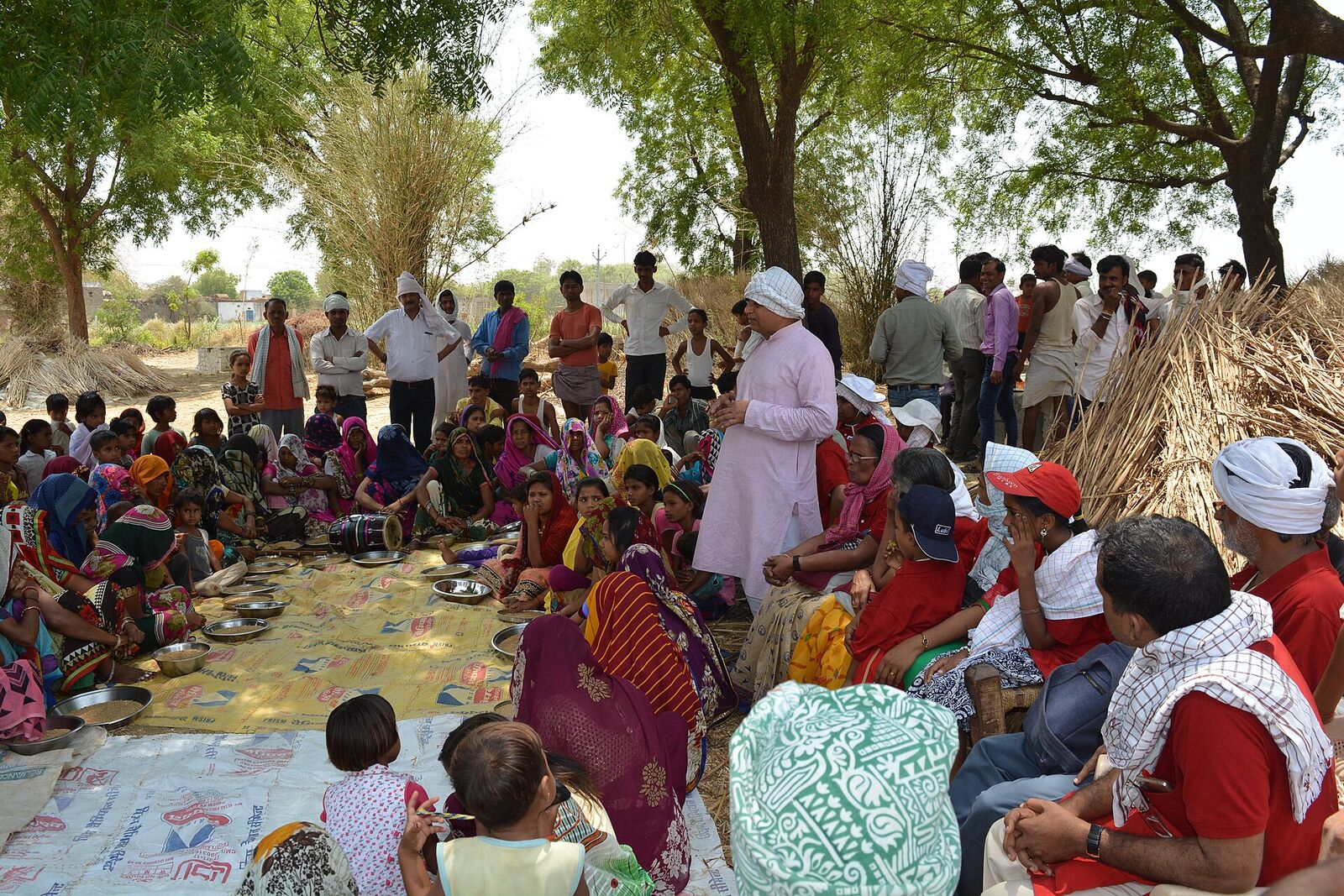
Reading the records out loud
In 1994, in a village called Kot Kirana in Rajasthan, a group of farmers and workers called the MKSS held a public hearing. For months they had tried to get copies of government records showing who had been paid to build roads, schools and wells. When they finally got them, they did something simple but amazing: they read them aloud in front of the whole village.
A woman heard her name on the list for thirty days of road work. She had worked eight days. A man heard he'd been paid money he never got. Dead people's names were on the lists! A well that had been paid for didn't exist. Villagers had always suspected their money was being stolen. Now they heard the proof with their own ears.
More hearings followed in village after village. In 1996 the group held a forty-day sit-in in the town of Beawar, with slogans like "Our money, our accounts!" Journalists, lawyers and others joined in. In 2005 India passed the Right to Information Act. Now any citizen can ask the government for its records and must get them within thirty days. Millions of people have used it.
This story shows everything in this chapter: people realising their problem is everyone's problem, a small group learning to speak up, a place to share information, clever ways to protest, and a change in the law for the whole country.
A house for neighbours
Hull House was also a place for research. Its workers made maps of every family's country and wages in the neighbourhood. They studied children working in factories and dirty housing, and helped pass laws to protect children and workers. They studied problems in order to fix them, together with the people who had those problems.
Addams said democracy isn't only about voting. It's about understanding people who are different from you. Some rich visitors judged poor people as lazy, but Addams saw that many poor people were tired from hard work and very kind to their neighbours.
India has people like Addams too. In 1972 Ela Bhatt started SEWA in Ahmedabad for women who sold things on the street, carried loads or sewed at home. They had no boss to ask for fair pay and nobody to protect them. SEWA grew to over a million members, with its own bank and health care. Its members learned to speak up for themselves.
Seeing the bigger picture
Mills said ordinary people often feel trapped, but don't see where the trap comes from. They need a special way of thinking that he called the sociological imagination: seeing how big events in the world affect your own life.
He separated personal troubles from public issues. If one person loses their job, maybe it's about them. But if millions lose their jobs at once, something is wrong with the whole system. In the same way, one village's missing wages might be one dishonest builder. Missing wages in thousands of villages is a public issue about how public money is counted.
One person out of work is a trouble. Millions out of work is an issue.
This idea is comforting. It tells people their problems aren't always their own fault. And it's the first step of every movement: when people stop blaming themselves and look at the system around them.
The people at the top
Mills said that in America, real power was held by a small group at the top of big companies, the government and the army. They went to the same schools, belonged to the same clubs and made the biggest decisions. Ordinary people just watched. He called them the power elite.
Places to talk things over
A thinker called Jürgen Habermas wrote about the public sphere: places where people come together to talk about things that matter to everyone. Long ago in Europe, people met in coffee houses, read newspapers and argued about how rulers were behaving. In these places, the best argument was supposed to win, not the richest person.
India had public spheres too. Newspapers in Bengali, Marathi, Hindi, Urdu and Tamil helped people debate. The British arrested editors like Bal Gangadhar Tilak for criticising them. In Kolkata, friends gather for long chats called adda. Village tea stalls and the chaupal where elders sit are places to share news too.
Habermas worried that TV and advertising turned citizens into watchers instead of thinkers. Think of a TV debate where everyone shouts and nobody listens! Later he worried that the internet splits people into bubbles where they only hear what they already believe.
Another thinker, Nancy Fraser, said groups that are left out, like women, workers and Dalits, make their own places to talk first, like their own magazines or study circles. There they find their voice before joining the bigger conversation.
The ways people protest
Charles Tilly studied hundreds of years of protests. He found that people don't invent new ways to protest each time. They use a familiar set of moves, like a musician using well-known tunes. He called this a repertoire.
Long ago, protests were often angry and local. Later, new ways grew: marches, meetings, petitions and strikes. Tilly said a good protest shows four things: that marchers are good people, that they are united, that there are many of them, and that they are committed.
Gandhi was brilliant at this. In 1930 he walked 240 miles to the sea at Dandi to pick up a handful of salt, breaking an unfair British tax. He was simple and peaceful (good people), his marchers were disciplined (united), crowds followed (many), and thousands were willing to go to jail (committed). The British didn't know what to do, because punishing them only made the protest stronger! Today Indians protest with sit-ins, hunger strikes, candle marches, long walks and online petitions.
Marching in your best clothes shows you're good people; filling the streets shows you're many.
Who decides the future?
Touraine said that in modern times, the big question is: who gets to decide what the future will look like? Experts and big companies often plan things, while ordinary people have to live with the plans.
He said a real movement knows three things: who we are, who we're up against, and what kind of world we want.
In 1974, in the village of Reni in the Himalayas, women led by Gaura Devi stopped loggers from cutting down their forest. They hugged the trees and refused to move! This was the Chipko movement ("chipko" means "to cling"). The women needed the forest for firewood, food for animals and water. In 1980, cutting green trees in those forests was banned. Later, the Narmada Bachao Andolan protested against big dams that would flood the homes of many people. Others said the dams would bring water to dry areas. Both sides were arguing about who decides what "progress" means.
Touraine worried that people get squeezed between cold, money-only thinking and closed groups that don't accept outsiders. He wanted people to stay free to think for themselves.
The conversation never ends
Democracy isn't a machine that runs by itself once we have elections. It's a conversation that never stops, at tea stalls, in newspapers, at hearings and in marches. People discover that their troubles are shared, get together, and work for change.
But not everyone joins this conversation equally. Some people are left out because of their colour, caste or gender. That's what the next part of this book is about.