Part Four · Wings
Chapter 19
The Sarus Crane
The tallest bird that flies, the couple that dances for life, the grief that became the first verse of the Ramayana, and the farmers who share their fields with it.
Assisted and Curated by Claude, Referenced and Collated by me

Grus antigone
On the banks of the river Tamasa, a sage named Valmiki went to bathe one morning. In the trees nearby, two cranes were making love, absorbed in each other and calling softly. As Valmiki watched, a hunter stepped out of the forest and shot the male with an arrow. The bird fell to the ground, covered in blood, and the female circled above him, crying out in grief. Valmiki was overwhelmed by pity. Words rose from him that he had not planned, in a rhythm he had never used before: "Hunter, may you never find peace for endless years, for you have killed one of this pair of cranes, lost in love."

Valmiki was astonished. What he had spoken was not ordinary speech. It had four lines of equal length, a regular beat, and could be sung to the lute. His grief, shoka, had become a verse, a shloka. According to the opening book of the Ramayana, the god Brahma then appeared and told Valmiki that this new kind of verse was a gift, and that he should use it to tell the story of Rama. And so, says the tradition, Valmiki became the adikavi, the first poet, and the Ramayana became the adikavya, the first poem. Indian poetry, in this telling, was born from a hunter's arrow and the cry of a widowed crane.
The bird in the story is called the krauncha. Scholars have argued for a long time about which bird it was. Some say a curlew, some a demoiselle crane, some a heron. But for millions of people in North India, the answer has always been obvious: it was the sarus crane, the tall grey bird with a red head that walks through their fields in pairs, calls in duet, and is believed to die of grief if its partner is killed. This chapter is about that bird, the tallest flying bird in the world, and about why, in a country where wildlife is often pushed out of farmland, the sarus has been allowed to stay.
The tallest bird that flies
The sarus crane, Grus antigone, stands up to about 1.8 metres tall, as tall as an adult man, which makes it the tallest flying bird on earth. Its wingspan reaches about 2.5 metres. Its body is soft grey, its legs long and pinkish-red, and its head and upper neck are bare of feathers, covered in bright red skin with a grey crown on top. Males and females look alike, though the male is usually a little larger. When a pair stands together in a paddy field, they are visible from far away, two grey figures taller than the rice, their red heads catching the light.

Sarus cranes live in three separated regions of the world: the Indian subcontinent, Southeast Asia, and northern Australia. The Indian population is by far the largest, and most of it lives in the farmland of the Gangetic plains, especially in Uttar Pradesh, along with Gujarat, Rajasthan, Madhya Pradesh and parts of Haryana, Bihar and Maharashtra. In Southeast Asia the sarus has declined steeply through hunting and wetland loss, and survives in Cambodia, Vietnam and Myanmar in small numbers. In Australia, a separate population lives across northern Queensland and was only recognised there in the 1960s, because Australians had mistaken it for the similar-looking brolga.
Unlike most cranes, the Indian sarus does not migrate. It lives in the same area all year, moving only short distances between wetlands and fields as water levels change with the seasons. This is one reason it has become so closely bound to particular villages and landscapes. A pair may hold the same territory, the same patch of marsh and fields, for many years.
Sarus cranes eat almost anything they can find in shallow water and fields: roots and tubers of water plants, seeds, grain, insects, snails, frogs, fish, small snakes and even the eggs of other birds. They walk slowly, probing the mud with their long bills, and are an ordinary part of the farming landscape, feeding alongside cattle and people. The species is listed as vulnerable by the IUCN, because its numbers have fallen across much of its range, but in India it remains widespread, with a total population usually estimated in the tens of thousands.

Built for the open sky
Everything about a crane is built for long legs, long necks and long journeys. Its legs let it wade into deeper water than most birds, and its long neck lets it reach the bottom of a pond or a muddy field. Its broad wings, with long primary feathers that spread at the tips like fingers, let it soar on rising warm air, circling higher and higher without flapping, and then glide for kilometres. Sarus cranes do not migrate, but they still use these skills to move between wetlands and fields, often flying in pairs or family groups, their long necks stretched forward and their legs trailing behind.
The crane's voice is one of its most remarkable features, and it comes from a remarkable piece of anatomy. In most birds, the windpipe, or trachea, runs straight down the neck to the lungs. In many cranes, including the sarus, the trachea is extremely long, and instead of running straight, it coils into the breastbone, looping through a hollow inside the bone's keel like a French horn folded inside a case. The longer tube allows the bird to produce lower, louder and more resonant sounds than its size would otherwise allow. This is why crane calls carry so far across open country. In young birds the coil is small, and their voices are high and squeaky; as they grow, the trachea lengthens, the coil deepens, and the voice becomes the full trumpet of an adult.

A crane's eyes are placed so that it can see both forward and to the sides, useful for a bird that feeds with its head down and must watch for danger. Its bill is a strong, pointed tool for digging up roots, catching frogs and stabbing at threats. An angry sarus, wings spread wide, neck stretched and bill aimed forward, is a formidable sight, and dogs, jackals and even people have been driven off by birds defending their chicks.
The red skin on the head is more than decoration. It becomes brighter and swells slightly in the breeding season and when a bird is excited or aggressive. During territorial disputes, sarus cranes face each other with their red heads raised, and the brighter, larger bird often wins without a fight. Cranes have been around for a very long time: fossils of birds very like modern cranes are known from rocks millions of years old, and their calls may be among the oldest bird sounds still heard on earth.
A marriage for life
Sarus cranes are famous for their faithfulness. A pair forms when the birds are a few years old and usually stays together until one of them dies. Pairs do almost everything together. They feed side by side, walk across the fields together, roost together, and defend their territory as a team. If you see one sarus in a field, the other is almost always nearby.
The bond is kept alive by sound. A sarus pair performs a duet called the unison call. The two birds stand close together, throw back their heads with their bills pointing to the sky, and call in a loud, trumpeting sequence. The female gives two short calls for every long call of the male, and the pattern is so regular that researchers can tell males and females apart by the rhythm alone. During the call, the male often lifts his wings over his back, showing his long flight feathers, while the female keeps her wings folded. The call carries for kilometres across the flat plains. It announces to other cranes that this territory is taken and this pair is strong.

Then there is the dance. Cranes across the world dance, and the sarus is one of the most graceful dancers of all. A pair faces each other, bows, leaps into the air with wings half-opened, lands, bows again, runs a few steps, tosses a stick or a tuft of grass into the air, and leaps again. Sometimes young unpaired birds dance in groups. Biologists believe the dance helps to form and strengthen the pair bond, to release tension, and perhaps to practise coordination. Whatever its purpose, people who have watched it rarely forget it.

A sarus pair walks, feeds, sleeps and calls together. If you see one, look for the other.
The belief that a sarus dies of grief if its mate is killed is found all over North India. Villagers tell of widowed birds that stopped eating and wasted away, or stood calling for days by the body. Biologists are more cautious. Studies of marked birds show that a sarus whose mate dies will often find a new partner, sometimes within a season or two. But the grief is not imaginary. Widowed cranes have been seen standing by a dead partner for long periods, calling repeatedly, and refusing to leave. The truth may be that sarus cranes, like people, grieve, and then, slowly, go on living. The belief in their faithfulness, whatever its exact accuracy, has protected them, because killing one of a pair is seen as a terrible sin, one that echoes the hunter's crime in Valmiki's story.
Sarus cranes also live long. Wild birds may live twenty years or more; captive birds have lived much longer. A pair that has been together for a decade has had time to know its territory intimately: where the water lies in each season, where the safest nesting spots are, which farmers are friendly and which fields are dangerous.
The nest in the paddy field
Sarus cranes nest in the monsoon. When the rains fill the wetlands and flood the paddy fields, each pair builds a large nest, a platform of reeds, grass and rice stems piled up in shallow water, sometimes nearly two metres across. Often the nest is in a marsh, a village pond or the edge of a lake; often it is in the middle of a flooded rice field. The female lays one or two large, pale eggs, and both parents take turns sitting on them for about a month.

The chicks, covered in soft brown down, can walk and swim within a day of hatching. They follow their parents closely, being fed small insects, snails and plant matter until they learn to find their own food. They take two to three months to learn to fly. Throughout this time the parents guard them fiercely, and farmers who walk too close to a nest or chick are sometimes chased off by an angry, wing-flapping adult taller than they are.
The fact that so many sarus nest in farmland is one of the most surprising things about them. In much of the world, farming has pushed large birds out. In Uttar Pradesh, the sarus has adapted to living among people. The Indian ecologist K. S. Gopi Sundar, who has studied sarus cranes in the farmland of Uttar Pradesh for more than two decades, found that the birds thrive in a patchwork of small farms, village ponds, marshes and canals, where wetlands are scattered among the fields. In districts such as Etawah and Mainpuri, he and his colleagues recorded some of the highest densities of sarus anywhere in the world, living almost entirely outside protected areas.
Why do farmers allow it? Part of the answer is tradition. In many villages, the sarus is considered a sacred bird, a symbol of marital faithfulness, and a bringer of good fortune. A pair nesting in your field is a good omen. Killing a sarus or stealing its eggs is seen as shameful. Farmers often leave a patch of rice uncut around a nest, or wait to harvest until the chicks have left. In some places, couples are blessed with the wish that they may live together like a pair of sarus. The sarus is the state bird of Uttar Pradesh, an honour that recognises what villagers had long felt.


Gopi Sundar's research led to a broader idea: that some of India's farmland, with its small fields, ponds and wetlands, is not a wasteland for wildlife but a habitat in its own right, one that can support large birds if it is managed with care. The threat to the sarus is not farming as such, but the kind of farming that drains every wetland, lines every canal with concrete, spreads chemicals over every field, and turns small farms into large monotonous ones. Power lines are another danger. Sarus cranes, flying low between fields at dawn and dusk, often collide with overhead electricity wires, and in some areas this is one of the main causes of death.

The first verse
The story of Valmiki and the cranes is told in the second chapter of the Bala Kanda, the first book of the Ramayana. The famous verse begins "Ma nishada", meaning "Do not, O hunter", and it is still recited and studied across India. The word nishada also means a forest-dwelling people, and some modern readers have pointed out that the curse falls on a hunter whose only crime, in his own world, was to hunt. Valmiki's pity for the bird is also a moment of judgement on a man. Indian writers have thought about this tension for centuries.

The most influential reflection on the story came from the Kashmiri thinker Anandavardhana in the ninth century. In his great work on poetry, the Dhvanyaloka, he argued that the soul of poetry is not its words or its ornaments but what it suggests beyond them, a hidden meaning he called dhvani, "resonance". And the best example of this, he said, was the first verse itself: the grief of the adikavi, born from the separation of the krauncha pair, became poetry. Later critics in the same tradition, especially Abhinavagupta in the tenth and eleventh centuries, built on this idea to develop the theory of rasa, the emotional flavour that poetry creates in the listener. The rasa born from Valmiki's verse was karuna, compassion or pathos. The playwright Bhavabhuti, in his play about Rama's later life, the Uttararamacharita, wrote that compassion is the one true rasa from which all others arise, like waves from water.
In other words, the cry of a crane sits at the very foundation of Indian thinking about what art is. Poetry, in this tradition, begins when someone is moved by the suffering of another being, even a bird, so deeply that ordinary speech will not do.

The theme of the krauncha pair returns again and again in Indian literature. Poets compare separated lovers to the widowed crane. Kalidasa, in the Raghuvamsha, describes Rama, after losing Sita, as grieving like a bird separated from its mate. In Hindi poetry, the sarus's faithfulness became a proverb. The bird's real habits, the pairs walking together in the fields, the loud duets, the grief of widowed birds, gave weight to the image. Poets did not need to invent the crane's loyalty; they could see it in the next field.
Indian poetry, the tradition says, was born from a hunter's arrow and the cry of a widowed crane.
Modern writers have kept returning to the scene, because it asks a question that never goes away: what do poets owe to suffering? Is turning another being's pain into beautiful verse a kind of healing, or a kind of theft? Valmiki's own answer seems to be that the poem does not replace the grief; it keeps it alive, so that others can feel it too. Every time the verse is recited, the widowed crane cries again.
There is also a quieter lesson in the story. The hunter in Valmiki's tale did not kill out of cruelty; he killed because hunting was how he lived. What shocked Valmiki was not the act of killing itself but the moment of it, a bird killed in the middle of love, and the grief of the one left behind. The verse is not only a curse. It is also the first great expression in Indian literature of an idea that runs through Buddhism, Jainism and later Hindu thought: that the suffering of animals matters, and that compassion for them is a mark of a cultivated mind.
An emperor watches a nest
One of the earliest careful descriptions of sarus behaviour comes not from a scientist but from an emperor. Jahangir, who ruled the Mughal empire from 1605 to 1627, was a keen observer of animals and plants, and he kept detailed notes in his memoir, the Tuzuk-i-Jahangiri, also called the Jahangirnama. He kept a pair of sarus cranes, which he named Laila and Majnun after the famous lovers of Arabic and Persian poetry, and he watched them closely.
In his memoir, Jahangir recorded that the pair mated and laid eggs, and he noted when the eggs were laid and when the chicks hatched. He wrote that the male and female took turns sitting on the eggs, and that when one rose, the other took its place. He described how the parents fed and protected the chicks, and how one parent stood guard while the other rested. Naturalists in later centuries were impressed by how accurate these observations were. At a time when European naturalists still believed many fanciful stories about birds, a Mughal emperor in his garden was quietly recording the truth.

Jahangir also employed some of the finest painters of animals the world has ever known. The greatest of them was Ustad Mansur, given the title Nadir-ul-Asr, "Wonder of the Age". Mansur painted birds, flowers and animals with extraordinary precision: a turkey brought by Portuguese traders, a zebra sent from Ethiopia, a dodo that may have been brought from Mauritius, and cranes, including a famous painting of a Siberian crane. These paintings are now treasured in museums around the world, and some are still used by ornithologists as records of how birds looked four hundred years ago.
In later centuries, British naturalists in India wrote about the sarus too. They noted how tame it was in villages, how it nested in fields, and how Indians protected it. Some kept tame sarus cranes as pets or garden birds, and a few even recorded that tame sarus would follow people around, guard the household like watchdogs, and attack strangers. The Amethi crane of our own time, as we will see, was not the first sarus to adopt a human.
Counting cranes
How many sarus cranes are there in India? The question is harder than it sounds. Sarus are spread across vast areas of farmland, wetlands and village ponds, mostly outside protected areas, and they move about with the seasons. Counting them means sending people out across districts at the same time, usually in the dry months when birds gather near the remaining water.
Uttar Pradesh holds the largest number. Its forest department has organised sarus counts across the state, often twice a year, and these have regularly recorded well over fifteen thousand birds, with the largest numbers in districts such as Etawah, Mainpuri, Auraiya, Shahjahanpur and around the wetlands of the Terai. Gujarat, especially the Kheda and Ahmedabad districts with their village tanks and rice fields, holds the second largest number. Smaller populations live in Rajasthan, Madhya Pradesh, Haryana and elsewhere.

Counts are useful, but they can hide changes. A population can look steady overall while declining in some districts and rising in others. Researchers have found that the sarus does best where there is a mix of small wetlands, ponds and paddy fields, and worst where wetlands have been drained, ponds filled in for construction, or farms converted to crops that need little water. The same studies found that the number of young birds raised each year, not just the number of adults, is a better guide to whether a population is healthy. A field full of old pairs that no longer raise chicks is a population heading for decline, even if the count looks good this year.
Researchers and conservation groups have urged electricity companies to mark power lines with bright devices that make them more visible to flying birds, in places where collisions are common, as has been done for the great Indian bustard in Rajasthan. Some groups have also worked with farmers to protect nests, sometimes paying small sums to compensate for any rice lost around a nest. These efforts are modest, but they build on the goodwill that villagers already feel for the bird.
The sarus beyond India
Outside India, the sarus has fared far worse. In Southeast Asia, where a separate subspecies, the eastern sarus, once lived across the great floodplains of Thailand, Laos, Cambodia and Vietnam, the bird has been hunted, its eggs taken, and its wetlands drained for rice and shrimp farms. In Thailand, the sarus disappeared from the wild in the twentieth century. Since 2011, conservationists have been releasing captive-bred sarus cranes in the province of Buriram, near the Cambodian border, working with rice farmers who agree to grow organic rice in wetland fields that cranes can use. The rice is sold under a "sarus crane" label at a higher price, giving farmers a reason to welcome the birds.
In Cambodia, the remaining eastern sarus cranes gather in the dry season at a few wetlands, such as Ang Trapaeng Thmor, a reservoir originally built by forced labour under the Khmer Rouge in the 1970s, which has since become one of the most important crane sites in the region. In Vietnam, sarus cranes winter at Tram Chim National Park in the Mekong Delta, where their numbers have fallen sharply in recent decades as wetlands have been converted and water levels changed by dams upstream on the Mekong. In Myanmar, small populations survive in the central dry zone and the Irrawaddy delta.

In northern Australia, a third population of sarus cranes lives in Queensland, mainly on the Atherton Tablelands, where flocks gather in winter in farmland and wetlands. They were long overlooked because they look so much like the brolga, Australia's native crane, and the two species sometimes even interbreed. Australian sarus cranes seem to be doing reasonably well, and are a reminder that the species once had a vast range across tropical Asia and beyond.
Against this background, India's sarus cranes look remarkable. Nowhere else in the world does the species live in such numbers, and nowhere else does it share its life so closely with farmers. The farming villages of Uttar Pradesh and Gujarat are, in effect, the sarus crane's last great stronghold.
The cranes of Kheda
In Gujarat, the second largest population of sarus cranes in India lives in the farmland of Kheda, Anand and Ahmedabad districts, in the region known as Charotar, between the rivers Mahi and Sabarmati. This is one of the most intensively farmed and densely populated parts of the state, home to the dairy cooperative movement that began at Anand in the 1940s. Yet here, among rice fields, village tanks, canals and small wetlands, hundreds of pairs of sarus cranes live and breed every year.
Studies of the cranes of Kheda have found many of the same patterns as in Uttar Pradesh: pairs hold small territories around village wetlands and fields, nest in the monsoon in rice fields and marshes, and depend on the goodwill of farmers who leave their nests alone. Villagers in Kheda, too, regard the sarus as a sacred bird and a symbol of marriage, and many say they would never harm one. Young couples are sometimes told to look for a sarus pair after their wedding, as a blessing for a long and faithful marriage.

The threats in Gujarat are familiar. Village tanks are filled in for building, wetlands are drained, and power lines criss-cross the fields. Changes in farming, such as the shift from rice to crops that need little standing water, reduce the places where cranes can nest. Researchers and local naturalists have counted the cranes for years, and have argued that the small, scattered wetlands of the farmland, often ignored by planners because they are not "proper" lakes, are exactly what the sarus needs.
The story of the sarus in Gujarat and Uttar Pradesh suggests a different idea of what a wildlife habitat can be. We usually think of wildlife living in forests and sanctuaries, far from people. The sarus lives in the middle of India's busiest farmland, and has survived there for centuries. Protecting it does not mean fencing people out. It means farming in a way that leaves room for wetlands, ponds and the birds that use them.
India's other cranes
The sarus is not India's only crane. Every winter, other cranes arrive from Central Asia, Mongolia, Siberia and Tibet. The common crane and the demoiselle crane fly over the Himalaya and the Hindu Kush to spend the cold months in western and central India. The demoiselle, the smallest crane in the world, is grey with a black neck and a white plume behind each eye. It crosses some of the highest mountains on earth on its migration, flying at great heights through the passes.
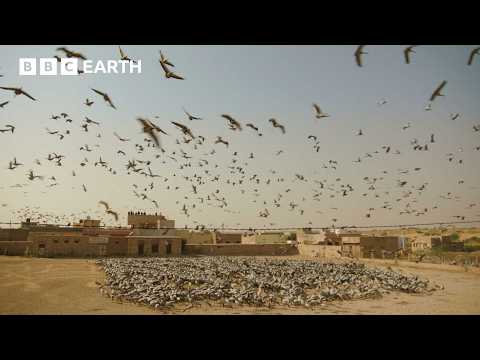
In the village of Khichan, in the Phalodi area of Rajasthan's Jodhpur district, thousands of demoiselle cranes gather every winter, and they are there because of people. Since the 1970s, villagers, many of them Jain, have scattered grain for the cranes every morning in a special feeding enclosure called the chugga ghar. A local man named Ratanlal Maloo is often credited with starting the practice. Over the years, the numbers grew from a few hundred to many thousands, so many that the grain bill now runs into lakhs of rupees every season, paid by the community and donors. At dawn the sky above Khichan fills with cranes circling down to the feeding ground, a sight that draws birdwatchers and photographers from across the world.

In Rajasthan, the demoiselle crane is called kurja, and it has a place of honour in folk songs. In the most famous of these, a woman whose husband is far away, working in another land, asks the kurja, flying north, to carry a message to him: tell him to come home. The crane, a bird that travels vast distances and returns each year, became the messenger of the lonely wife, and the song is still sung at weddings and festivals across the state.

In the cold, high valleys of Ladakh, and in a few places in Arunachal Pradesh, lives the black-necked crane, the only crane that breeds on the Tibetan plateau. In Ladakh it nests in summer around the lakes of Changthang, such as Tso Kar and Hanle. In Arunachal Pradesh, small numbers spend the winter in the Sangti valley and at Zemithang near the Bhutan border, where the Monpa people regard them as sacred. In Bhutan and Tibet, black-necked cranes are linked with Buddhism and with the Dalai Lamas. The Sixth Dalai Lama, Tsangyang Gyatso, a poet who lived at the end of the seventeenth century, wrote a famous short poem asking a white crane to lend him its wings, so that he could fly to Lithang and return. Tibetans later read it as a prophecy, because the Seventh Dalai Lama was born in Lithang. Black-necked cranes are the state bird of Ladakh.


And then there is a crane India has lost. The Siberian crane, a tall white bird with a red face and black wingtips, once flew every winter from western Siberia to the wetlands of Keoladeo, near Bharatpur in Rajasthan. Salim Ali and others watched them there through the twentieth century. But their numbers fell, as birds were shot along the long migration route through Afghanistan and Pakistan, and as wetlands dried up. By the 1990s only a handful returned to Bharatpur. The last ones, a pair, were seen there in the winter of 2001 and 2002. After that, the western population of the Siberian crane was effectively gone. A small eastern population, which winters in China, survives.
Cranes around the world
Cranes are among the oldest families of birds, with fossils going back many millions of years, and they appear in the myths and art of almost every culture that has known them. The ancient Egyptians painted cranes on tomb walls. The Greeks believed that cranes made a long migration to the south every year to fight a tribe of tiny people, the Pygmies, a story already old when Homer mentioned it in the Iliad. Another Greek legend tells of the poet Ibycus, attacked and killed by robbers. As he died, he saw a flock of cranes overhead and called on them to avenge him. Later, in a theatre, one of the murderers saw cranes flying over and cried out, giving himself away. The "cranes of Ibycus" became a phrase for the way that hidden crimes are revealed.

In China and Japan, the crane is a symbol of long life and good fortune. In Chinese art, Daoist immortals ride on cranes into the heavens, and the red-crowned crane, with its white body and red cap, appears on robes, porcelain and paintings. In Japan, the red-crowned crane, tancho, is a national symbol. Pairs dance in the snowy marshes of Hokkaido, where the species was reduced to a few dozen birds in the early twentieth century and was saved partly by local farmers who began feeding them in winter in the 1950s. Japanese tradition says that anyone who folds a thousand paper cranes, senbazuru, will be granted a wish.

That tradition became world-famous through a girl named Sadako Sasaki. She was two years old when the atomic bomb fell on Hiroshima in 1945. Ten years later, she developed leukaemia, caused by the radiation. In hospital, she began folding paper cranes, hoping to reach a thousand and wish to get well. She died in October 1955, at the age of twelve. Her classmates and friends raised money for a monument, and today the Children's Peace Monument in Hiroshima shows Sadako holding up a golden crane. Every year, children from around the world send millions of paper cranes to it. The crane, a symbol of long life, became a symbol of a short one, and of the hope for peace.

In North America, the whooping crane, the tallest bird of the continent, came closer to extinction than almost any bird that survived. By 1941, only about twenty-one wild whooping cranes remained. Over the following decades, conservationists protected their wintering grounds on the Texas coast and their breeding grounds in Canada, and later tried bold experiments: raising chicks in captivity and teaching them to migrate by leading them in flight behind ultralight aircraft, flown by pilots dressed in crane costumes. The wild population is still small but has grown to several hundred. The American naturalist Aldo Leopold, writing about the cranes of the Wisconsin marshes in A Sand County Almanac, published in 1949, described them as voices from the deep past, "wildness incarnate", a reminder of how old and how fragile the living world is.


The crane that followed a man
In 2023, a story about a sarus crane spread across India. In a village in the Amethi district of Uttar Pradesh, a young farmer named Mohammad Arif had found an injured sarus in a field about a year earlier. He took it home, cared for its leg, and fed it. When it recovered, the crane did not leave. It followed Arif around the village, walked beside his motorcycle, flew alongside him when he rode to the fields, and ate with his family. Videos of the man and the crane went viral, and journalists and politicians came to see them.
Then the forest department stepped in. The sarus is protected under Indian wildlife law, and keeping a wild bird at home, however lovingly, is not allowed. Officials took the crane away to a bird sanctuary and then to a zoo. The decision caused an outcry. Many people felt that a bird that had chosen to stay with its rescuer should be left with him. Others argued that a wild crane should live among other cranes, not as a village pet, and that allowing wild animals to be kept at home, even in kind cases, opens the door to cruelty in others.

The story touched something old. Here was a sarus, the bird of faithfulness, attaching itself to a human who had saved it, as if it had found a new partner. And here was the state, with its laws, deciding what was best for the bird. Both sides were acting out of care. The real question, which the story left unanswered, was what it means to care for a wild animal: to keep it close, or to let it be wild.
What the sarus teaches
The sarus teaches about faithfulness, and about how beliefs can protect. Science may say that a widowed sarus will often find a new mate, but the belief that the sarus is faithful unto death has kept generations of farmers from harming it. The bird has survived in the crowded plains of Uttar Pradesh not because it was fenced away in a reserve, but because people decided it belonged with them.

It teaches that wildlife does not live only in forests and sanctuaries. Some of India's richest wildlife lives in its farmland, its village ponds and its marshes, in places that are not protected by any law but by the habits and values of the people who live there. If those places are drained, poisoned or paved over, the birds will go, even if every national park remains untouched.
And it teaches, through Valmiki, that compassion is where art begins. The first poet of India did not begin by praising a king or a god. He began by grieving for a bird. Two and a half thousand years later, the sarus still walks through the fields of the Gangetic plain, its duet still carries across the paddy, and the question Valmiki's verse asked is still open: what do we owe to the creatures who share our world, and who can suffer, and who can love?