Part Four · Wings
Chapter 20
The Crow and the Raven
The bird that bends wire into hooks, remembers your face for years and holds funerals for its dead, the messenger of the ancestors, and Odin's two ravens of thought and memory.
Assisted and Curated by Claude, Referenced and Collated by me

Genus Corvus
In 2002, in a laboratory at the University of Oxford, a New Caledonian crow named Betty was given a puzzle. At the bottom of a narrow glass tube sat a tiny bucket with a piece of meat inside. Next to the tube lay two pieces of wire, one straight and one hooked. Betty's partner, a male crow named Abel, grabbed the hooked wire and flew off with it. Betty was left with the straight one. She tried to lift the bucket with it and failed. Then she did something no one had expected. She took the straight wire, wedged one end against the side of the tray, and bent the other end into a hook with her beak. Then she lowered her new tool into the tube, caught the bucket's handle, and pulled it up.

The researchers, Alex Weir, Jackie Chappell and Alex Kacelnik, repeated the test. Betty bent the wire into a hook again and again, using different methods each time. Their paper, published in the journal Science, made headlines around the world. Here was a bird solving a new problem by inventing a tool from material it had never used before. Many scientists had thought that this kind of creative tool-making was something only humans, and perhaps chimpanzees, could do.
Betty was not a freak. Over the next two decades, crows, ravens, rooks and jays would astonish scientists again and again. They solve puzzles, plan for the future, recognise individual human faces and remember them for years, understand the idea of zero, and seem to gather around their dead. They live alongside us in every city of India, picking at rubbish, quarrelling on rooftops, stealing biscuits from children, and many people think of them as ordinary, noisy, even dirty birds. But the crow is anything but ordinary. And in Indian tradition, it has always been more than a bird: it is the messenger of the ancestors, the one who receives the food we offer to the dead.
The family of crows
Crows and ravens belong to a family of birds called the corvids, the Corvidae, which also includes jays, magpies, treepies, nutcrackers, choughs and rooks. There are around 130 species of corvids, found on every continent except Antarctica. They are part of the large group of perching birds, the passerines, which includes sparrows and songbirds, and the ravens are the largest passerines of all.
India has many corvids. The most familiar is the house crow, Corvus splendens, smaller than the others, with a grey neck and shoulders and a glossy black face, wings and tail. It lives almost entirely alongside people, in cities, towns and villages, and rarely in wild places far from human settlement. The large-billed crow, often called the jungle crow, is all black, bigger, with a heavy curved bill and a deep, hoarse "kaa". It lives both in forests and around villages. In the dry northwest, in Rajasthan, Punjab and Gujarat, the common raven and the brown-necked raven live in deserts and open country. In Kashmir and the Himalaya live jackdaws, choughs with red or yellow bills that soar over mountain ridges, and the spotted nutcracker, which buries thousands of pine and hazel seeds every autumn and remembers where most of them are.


In the gardens and forests of India also live the treepies, long-tailed relatives of crows. The rufous treepie, with its chestnut body and long grey-and-black tail, is a common bird of gardens and dry forests, and its loud, metallic "bob-o-link" call is a familiar sound of Indian mornings. In the hills of the Northeast and the Himalaya live green and blue magpies, among the most beautiful birds of the region, and jays that mimic the calls of hawks.
All corvids share certain traits. They are mostly omnivores, eating almost anything: seeds, fruit, insects, eggs, nestlings, carrion and human food. They are social, often living in family groups or large flocks, and roosting together in big gatherings at night. And they are clever. In study after study, corvids have proved to be among the most intelligent animals ever tested, rivalled among birds only by parrots.
A brain like a primate's
For a long time, scientists did not expect birds to be clever. Their brains are small, and they lack the layered outer part of the brain, the neocortex, that in mammals is linked to complex thought. The insult "bird-brain" grew out of this belief. But the bird brain is organised differently, not less well. Instead of layers, it has clusters of nerve cells arranged in a different pattern, and the part of the bird brain called the pallium does many of the same jobs as the mammal neocortex.
In 2016, a team led by the Brazilian neuroscientist Suzana Herculano-Houzel and the Czech researcher Pavel Němec counted the nerve cells in the brains of many birds. They found that birds, especially parrots and corvids, pack far more neurons into their brains than mammals of the same brain size. A raven's brain is small, but it contains more neurons in its forebrain than the brains of many monkeys. Size, it turns out, is not the whole story. What matters is how many neurons there are and how they are connected.

The crow's brain is also large relative to its body, about the same proportion as in chimpanzees. And the behaviour matches the brain. In 2020 the German neuroscientist Andreas Nieder and his team recorded the activity of nerve cells in the brains of carrion crows while the birds performed a task in which they had to report whether they had seen a faint flash of light. The neurons' activity seemed to track not just what appeared on the screen but what the crow reported it had seen, which Nieder argued was a sign of a simple form of conscious perception. In 2021, the same lab showed that crows understand the concept of zero as a quantity, placing "nothing" at the start of the number line, just as monkeys and people do.
The puzzle-solvers
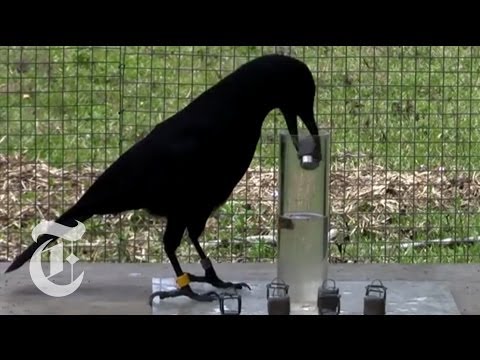
Some of the most famous experiments on crows were inspired by one of the oldest stories in the world. In Aesop's fable "The Crow and the Pitcher", a thirsty crow finds a pitcher with a little water at the bottom, too low for its beak to reach. It drops pebbles into the pitcher one by one until the water rises high enough to drink. For more than two thousand years, people told the story as a lesson about cleverness. In 2009, the British researchers Christopher Bird and Nathan Emery tested whether real birds could do it. They gave rooks, close relatives of crows, a tube with water and a floating worm too low to reach, and a pile of stones. The rooks dropped stones into the tube until the worm floated up. They even chose larger stones over smaller ones, as if they understood that bigger stones would raise the water faster.

Later experiments with New Caledonian crows and Eurasian jays found that the birds preferred to drop stones into water rather than sand, and into tubes with higher water levels, suggesting that they understood something about how water behaves. They were not perfect: they made some mistakes that children of six or seven also make. But the fable, it turned out, had been describing real abilities all along.
Wild New Caledonian crows, on the islands of New Caledonia in the Pacific, make several kinds of tools. They strip twigs into hooks, carefully nibbling and bending the end. They cut strips from the stiff leaves of pandanus plants into stepped, saw-edged tools, and use them to dig insect larvae out of holes in dead wood. Different populations of crows on the island make their pandanus tools in slightly different shapes, and young crows learn the local style from their parents. Some researchers argue that this is a simple form of culture, passed on and improved over generations.
Ravens, in experiments at Lund University in Sweden in 2017, showed something else: the ability to plan for the future. Can Kabadayi and Mathias Osvath trained ravens to use a tool to open a box containing food, and then offered them a choice of objects, including the tool, at a time and place where the box was not present. The ravens chose the tool and kept it, sometimes for many hours, until the box was brought back. They also learned to trade tokens with humans for better food later, and to give up a small reward now for a bigger one later. Planning ahead, choosing to wait, and using one thing to get another were once thought to be uniquely human. Ravens do all three.
The fable of the crow and the pitcher, it turned out, had been describing real abilities all along.
What the caw means
To most people, a crow's call is just "caw" or "kaa", a harsh, repetitive noise. But crows have a large vocabulary. Researchers who have recorded and analysed crow calls have identified many different sounds: short, sharp calls of alarm; long, drawn-out calls used for keeping in touch over distance; soft, rattling calls between mates; begging calls of young birds; and quiet, babbling "songs" that crows sometimes produce when alone, which may be a kind of vocal practice. The number of caws in a sequence, their speed and their pitch all seem to carry meaning.
Crows recognise each other's voices. Experiments in which recordings of crow calls were played back to wild crows showed that the birds responded differently to the calls of family members, neighbours and strangers. A crow can tell, from its voice alone, whether a caw comes from its own mate, from a crow in the next territory, or from a stranger passing through.

Like parrots, crows and ravens are vocal learners, able to copy new sounds. Captive crows and ravens have learned to imitate human words, and wild ravens sometimes mimic other animals, such as wolves and foxes, and even human-made sounds like engines. In India, house crows sometimes imitate the calls of other birds, and a few pet crows have been taught to say simple words.
Ravens at the roof of the world
In the high Himalaya and on the Tibetan plateau, crows and ravens live at heights where few other birds survive. The common raven nests on cliffs above four thousand metres in Ladakh and Tibet, and is a familiar companion of herders, travellers and mountaineers. Alpine and red-billed choughs, black corvids with bright yellow or red bills, have been seen at extraordinary altitudes, following climbers on Everest above eight thousand metres, scavenging food from camps.
In Tibet, ravens have a special place in the practice of sky burial. When a person dies, the body is taken to a high place, cut into pieces by a specialist called a rogyapa, and offered to vultures and other birds, which consume it. For Tibetan Buddhists, this is a final act of generosity: the body, no longer needed, is given to feed other living beings, and the spirit has already departed. Ravens and crows gather at sky burial sites along with the vultures. In Tibetan belief, ravens are also messengers and protectors, associated with Mahakala, a fierce protector deity, and their calls are read as omens.

The raven's connection with death runs through many cultures, from the battlefields of Norse legend to the sky burials of Tibet. In both, the bird that eats the dead is not simply a scavenger. It is a link between the world of the living and whatever lies beyond.
The faces they remember
In 2006, the American biologist John Marzluff and his students at the University of Washington in Seattle carried out a simple experiment. Wearing a rubber caveman mask, they trapped a few wild American crows on the university campus, put identifying bands on their legs, and released them unharmed. Then, over the following months and years, people walked around the campus wearing the same mask. The crows that had been caught scolded the masked walkers loudly, diving at them and calling. That was not surprising. What was surprising was that other crows, which had never been trapped, began to scold the mask too. Within a few years, many of the crows on campus, including young ones not yet born at the time of the trapping, mobbed anyone wearing the caveman mask, while ignoring people wearing a different, neutral mask.
The crows had learned to recognise a human face, remembered it for years, and taught other crows to fear it. Marzluff's research, described in his book Gifts of the Crow, showed that crows learn about dangerous people both from their own experience and from watching other crows react. The memory lasted for more than a decade.

Crows also seem to remember kindness. In 2015 the BBC reported on a girl in Seattle named Gabi Mann who had been feeding the crows in her garden since she was small. The crows began leaving her little objects: buttons, beads, bits of glass, a pearl-coloured heart, a small metal ornament, which she kept in a box. Scientists cannot be sure that these were "gifts" in the human sense; crows often carry and drop shiny objects. But the story matched what many people around the world had noticed: crows form relationships with individual humans, good and bad.
And crows react strongly to their dead. When a crow finds a dead crow, it often calls loudly, and other crows gather around, sometimes dozens of them, calling and circling, before slowly dispersing. The researcher Kaeli Swift, also at the University of Washington, studied this behaviour in the 2010s. She found that crows that saw a dead crow, especially with a human or a predator nearby, became more cautious about that place and that person for days afterwards. Swift argued that these gatherings, often called "crow funerals", are a way of learning about danger: a dead crow is information. Whether they also involve something like grief is harder to say. But the scene, a ring of black birds calling over a fallen companion, has struck observers for centuries.
The crows of India
In India, crows are everywhere people are. The house crow especially is a bird of human settlements. It nests in trees along streets, on telegraph poles and in temple courtyards, and it eats almost anything people throw away. Crows clean up spilt grain, dead rats and food waste, and they gather in huge numbers at rubbish dumps, slaughterhouses and fish markets. At dusk, thousands of crows fly in from all directions to roost in particular groves of trees, filling the air with noise, and at dawn they disperse again.

This close relationship with people has made the house crow one of the most successful birds on earth, and in some places one of the most troublesome. House crows have travelled on ships from Indian ports to East Africa, the Arabian Peninsula, Southeast Asia and even Europe. In the coastal towns of Kenya and Tanzania, house crows introduced in the late nineteenth and twentieth centuries multiplied into huge flocks that raid poultry, eat native birds' eggs and chicks, and compete with local wildlife. In the 2010s, Kenyan authorities launched campaigns to reduce their numbers. In the Netherlands, a small population that arrived by ship at the Hook of Holland was watched closely for years. A bird that is part of the furniture of every Indian city is, in other parts of the world, an invader.
The jungle crow, or large-billed crow, is more of a wild bird, though it too lives around villages and towns. In the forests of central India and the Western Ghats, jungle crows follow tigers and leopards, waiting to scavenge from their kills, and their calls can lead trackers to a fresh carcass. In the Himalaya, they are bold enough to steal food from campers at high altitude.
Crows also play a role in the life of cities that few people notice. Studies in Indian cities have shown that crows help to clean up garbage and dead animals, but that their numbers rise wherever waste is poorly managed. In this sense, the crow is a mirror of the city. A city with too many crows is often a city with too much rubbish.

The koel in the crow's nest
Every spring in India, a strange drama plays out in the crows' nests. The house crow builds an untidy nest of sticks high in a tree, sometimes using wire, string and even spectacle frames stolen from houses. It lays its blue-green speckled eggs and settles down to raise its young. But often, while the crows are distracted, another bird slips in and lays an egg of its own. That bird is the Asian koel, the cuckoo whose rising call, "ku-oo, ku-oo, ku-OO", is the sound of the Indian summer, and which poets have praised for two thousand years as the sweetest singer of the spring.

The koel is a brood parasite. It builds no nest of its own and raises no young. The female lays her eggs in the nests of other birds, and in India her favourite host is the house crow. Koel eggs look quite like crow eggs, though smaller. The male koel, glossy black with a red eye, often draws the crows away from the nest by flying close and calling, so that the crows chase him; meanwhile the brown, spotted female slips in and lays. The crows, returning, usually do not notice. They incubate the koel's egg with their own, and when the koel chick hatches, they feed it as their own. Unlike some cuckoo chicks, young koels do not always push the host chicks out of the nest, but they grow fast, beg loudly and often get more food than the crow chicks.


The crows are not entirely fooled. They chase koels away fiercely, and in some areas crows have become better at recognising koel eggs and throwing them out. Biologists see this as an arms race: the koel evolves better disguises and tricks, the crow evolves better defences. In different regions, the balance between them may differ.
Indian poets noticed this strange relationship long ago. In Sanskrit, the koel is called parabhrita, "one raised by another", or anyapushta, "nourished by another". Kalidasa uses the word in his plays, and the idea that the sweetest singer of the spring is raised by the harshest-voiced bird of the town gave rise to proverbs and riddles. One old Sanskrit verse asks how one can tell the koel and the crow apart, since both are black; the answer is that when spring comes, the koel sings and the crow caws, and then the difference is plain. The verse is a lesson about people: outward appearance can be the same, but true nature shows in time.
Play, mischief and partnership
Crows and ravens play. Young ravens in the mountains of Europe and North America have been seen sliding down snowy slopes on their backs, then flying back up to slide again. Crows hang upside down from wires and branches, drop sticks and catch them in mid-air, and tease dogs and cats by pulling their tails. A widely shared video filmed in Russia shows a hooded crow sliding down a snow-covered roof on a plastic lid, flying back to the top with the lid in its beak, and sliding down again. Scientists who study play think it helps young animals learn about the world and practise skills, but for many birds and mammals, it also seems simply to be fun.

Ravens also form partnerships with large predators. In Yellowstone National Park in the United States, ravens follow wolf packs, sometimes within minutes of a kill, and feed on the carcass. Some biologists have suggested that ravens may even lead wolves to dead or weak animals, though this is debated. Inuit and other northern peoples have long told stories of ravens and wolves working together, and of ravens leading human hunters to caribou. The relationship benefits both: the raven gets meat it could never kill itself, and the wolves, perhaps, get help finding prey. In India, jungle crows play a similar role with tigers and leopards, gathering around kills and alerting other scavengers.
Crows are also capable of mischief that seems almost deliberate. In Japan, carrion crows in the city of Sendai were observed in the 1990s placing walnuts on the road at traffic lights, waiting for cars to drive over them and crack the shells, and then, when the lights turned red and the cars stopped, hopping down to collect the pieces. The behaviour spread among the local crows over several years. Elsewhere, crows have been seen dropping shellfish onto rocks from a height to break them, choosing the height carefully depending on the size of the shell.
Ravens are skilled mimics. Captive ravens have learned to imitate human words, the sounds of dogs, car engines and even toilet flushes. In the wild, they produce dozens of distinct calls, and some researchers believe groups of ravens have local "dialects". The jays and magpies, cousins of the crows, are mimics too. In the forests of the Himalaya and the Northeast, some jays imitate the calls of hawks, perhaps to scare other birds away from food.
The hidden stores of the mountains
High in the Himalaya, in the forests of pine, spruce and deodar from Kashmir to Arunachal Pradesh, lives a dark brown corvid speckled with white, the spotted nutcracker. In autumn, when the pine cones and hazelnuts ripen, nutcrackers gather seeds by the thousand. They carry them in a pouch under the tongue and bury them in small caches, a few seeds at a time, in the ground, under moss, in crevices of bark, scattered across the mountainside. Then, through the winter and into spring, when snow covers the ground, they dig them up again.

The North American relative of this bird, Clark's nutcracker, has been studied closely. A single bird may bury tens of thousands of pine seeds in a season, in thousands of separate caches, and recover a large proportion of them many months later, even under snow. Experiments have shown that nutcrackers remember the positions of their caches using landmarks: rocks, trees, logs. When researchers move the landmarks slightly, the birds dig in the wrong place, shifted by the same distance. Their memory for places is among the best of any animal ever tested, and the part of their brain called the hippocampus, which is involved in spatial memory, is enlarged compared with birds that do not store food.
The seeds the nutcrackers do not recover sprout into new trees. In this way, like the hornbills of the rainforest, nutcrackers are planters of forests. Some pine species in North America depend almost entirely on nutcrackers to plant their seeds, and their forests are, in a sense, the forgotten pantries of birds. The same may be true of some Himalayan pines and hazels.
Eurasian jays, which also store food, have shown another remarkable ability in experiments at the University of Cambridge led by Nicola Clayton. Jays that had stolen other jays' food in the past were careful, when another jay was watching, to re-hide their own stores later in private. Jays that had never stolen did not bother. It was as if the thieves understood that others might do what they themselves had done. Clayton and her colleagues argued that this suggests the birds have some understanding of what others know and intend, an ability once thought to be almost uniquely human.
Food for the ancestors
In Hindu tradition, the crow has a special duty. It is the messenger between the living and the dead. During the shraddha rites performed for dead ancestors, and especially during Pitru Paksha, the fortnight dedicated to the ancestors in the month of Bhadrapada, families prepare balls of rice called pinda and offer them to crows. If a crow comes and eats the offering, it is taken as a sign that the ancestors have accepted it and are satisfied. If no crow comes, families may worry that the ancestors are displeased or that something in the ritual has gone wrong.
In many parts of India, especially in the south, a portion of food is set aside for crows every day before the household eats. In Tamil Nadu and Kerala, women often place a little cooked rice on the roof or a wall and call to the crows, and only after the crows have eaten does the family begin its meal. This practice, called kakabali or simply feeding the crows, is linked to the belief that ancestors visit in the form of crows, and that by feeding them one feeds one's forebears.

The crow also appears in Indian folk belief as a messenger of the living. In North India, a crow cawing on the roof or the windowsill is said to mean that a guest is coming. Hindi and Punjabi folk songs are full of women asking the crow whether their husband or brother will return soon, or begging it to carry a message. In some regions, a crow touching a person is considered a bad omen requiring a small ritual of purification. In others, crows are seen as harmless, clever companions of the household.
The crow is the vahana, or mount, of Shani, the god of the planet Saturn, who governs time, karma and the fruits of one's actions. In some images Shani rides a crow, in others a vulture. People who believe they are suffering under Shani's influence often feed crows on Saturdays, hoping to ease their troubles.

And the crow has a place in the epics. In the Ramayana, while Rama and Sita are living in the forest, a crow attacks Sita, pecking at her and wounding her. The crow is Jayanta, the son of Indra, in disguise. Rama, angered, picks up a blade of grass, charges it with power and hurls it at the crow as a weapon. The crow flies through all the three worlds seeking shelter, but no god will protect it. At last it returns and falls at Rama's feet, and Rama spares its life, though the weapon cannot be recalled without effect: it takes one of the crow's eyes. Folk tradition says this is why crows look at things with one eye, turning their heads from side to side.
If a crow eats the pinda, the ancestors are satisfied.
In Tulsidas's Ramcharitmanas, written in Awadhi in the sixteenth century, the entire story of Rama is told, in its final section, by an immortal crow named Kakabhushundi. A great devotee of Rama, he lives on a mountain called Nila and tells the story to Garuda, the eagle who carries Vishnu. Garuda, the king of birds, has come to him in doubt, and the crow, the humblest of birds, heals his doubt by telling him of Rama. The image is deliberate: wisdom can come from the lowest place, and a crow can be the teacher of an eagle.
The crows and the owls
The Panchatantra, the old Indian collection of animal fables, has a whole book devoted to the crow. The third book, called Kakolukiyam, "Of Crows and Owls", tells the story of a long war between the two. The owls, led by their king, attack the crows at night, when the crows cannot see, and kill many. The crows' king gathers his ministers to plan a response. One minister, an old crow named Sthirajivi, offers a bold plan. He lets himself be beaten and thrown out of the crows' tree, and the owls find him lying wounded. He tells them he was punished for speaking in their favour. Some of the owls want to kill him, but their king takes pity and lets him live among them in their cave. Over time, the old crow gathers twigs, saying he is building himself a nest. When the cave is full of dry wood, he flies to the crows, and they set fire to it by day, when the owls are blind. The owls are destroyed.

The story is about strategy, trust and the danger of letting an enemy inside one's walls, and it is still studied as an early lesson in statecraft. It also reflects something real: crows and owls are natural enemies. Crows mob owls fiercely by day, diving at them and calling, and large owls hunt sleeping crows at night. Indian storytellers built their fable on what they had watched in the trees.
Other fables reflect other aspects of the crow. In Aesop's "The Fox and the Crow", a crow sits in a tree with a piece of cheese in its beak. A fox flatters it, praising its beauty and saying it must have a wonderful voice. The crow, pleased, opens its beak to sing, and the cheese falls to the fox. A similar story appears in the Panchatantra and in the Jatakas, the Buddhist stories of the Buddha's past lives, though with different animals and a different moral. In Indian proverbs, the crow is often a figure of cleverness without wisdom: the Hindi saying "Kauva chala hans ki chaal, apni chaal bhi bhool gaya", "the crow tried to walk like the swan and forgot its own walk", mocks those who imitate others and lose themselves.
Odin's ravens
In the cold north of Europe, the raven was the bird of Odin, the chief of the Norse gods. Two ravens sat on his shoulders, named Huginn and Muninn, which mean "Thought" and "Memory". Every morning they flew out over the whole world, and every evening they came back and told Odin everything they had seen. In one poem, Odin says that he worries Huginn might not return, but he worries more for Muninn. It is one of the most haunting images in Norse mythology: the god's fear that he might lose his memory.

Viking warriors carried raven banners into battle, believed to bring victory, and ravens were linked with the battlefield, where they fed on the dead. In the Hebrew Bible, the raven is the first bird Noah sends out from the ark to find land; it flies to and fro and does not return, and Noah then sends a dove. Later, in the Book of Kings, ravens bring bread and meat to the prophet Elijah when he is hiding in the wilderness. The same bird that feeds on the dead feeds the prophet.
In the Tower of London, a group of ravens has been kept for centuries. A legend says that if the ravens ever leave the Tower, the kingdom will fall. The story is often said to go back to King Charles II in the seventeenth century, though historians think it is much more recent, possibly from the nineteenth century. Today, a keeper called the Ravenmaster looks after the birds, and their flight feathers are trimmed so they cannot fly far.

On the Pacific coast of North America, among the Haida, Tlingit and other peoples of the Northwest, Raven is the great trickster and creator. In Haida stories, Raven stole the sun, moon and stars from a box hidden by a powerful chief and released them into the sky, bringing light to the world. In another story, Raven found the first humans hiding in a clamshell on a beach and coaxed them out into the world. The Haida artist Bill Reid carved this scene in a great wooden sculpture, The Raven and the First Men, completed in 1980, now at the Museum of Anthropology in Vancouver. Raven in these stories is greedy, playful, curious and selfish, but through his tricks, the world becomes as it is.

In 1845 the American writer Edgar Allan Poe published "The Raven", a poem in which a grieving man, alone at midnight, is visited by a raven that will say only one word, "Nevermore". To every question he asks about his lost love, the bird gives the same answer. The poem made Poe famous and turned the raven into a symbol of grief and despair in modern literature. In painting, one of Vincent van Gogh's last works, Wheatfield with Crows, painted in July 1890, shows dark crows rising over a golden field under a stormy sky. Many people have read it as an image of his state of mind in the weeks before his death.


The crow in the sun
In East Asia, the crow is linked with the sun. Chinese mythology tells of a three-legged crow that lives in the sun, and ancient Chinese art, from more than two thousand years ago, sometimes shows a crow inside the sun's disc. In a famous story, there were once ten suns, each carried by a crow, which took turns crossing the sky. One day, all ten rose at once, and the earth began to burn. The archer Hou Yi shot down nine of them, and only one sun remained. The three-legged crow in the sun appears in Korean tradition too, as the samjok-o, a symbol of power used by ancient kingdoms.

In Japan, the three-legged crow is called Yatagarasu. According to Japanese legend, it was sent from heaven to guide the first emperor, Jimmu, through the mountains to the place where he founded his kingdom. Today Yatagarasu is the emblem of the Japan Football Association and appears on the shirts of the national team, a crow that once guided an emperor now guiding footballers.

Across Asia, then, the crow carries two very different meanings. It is the bird of the dead, eating the offerings of the ancestors and the bodies on the battlefield. And it is the bird of the sun and of guidance, leading the lost to safety. The two may not be as far apart as they seem. A messenger between the worlds of the living and the dead is also a guide across a boundary, and a bird that knows the way.
What the crow teaches
The crow teaches that intelligence can hide in plain sight. For thousands of years, people saw crows every day without realising how much was going on behind those dark eyes. The birds were solving problems, remembering faces, planning ahead and teaching each other, right outside our windows, while we called them pests and fed them our scraps.

It teaches that living close to people can be a great success and a great danger at the same time. The house crow thrives because of us, and in places where it has followed us across the oceans, it has become a problem for other birds. The crow is a reminder that the way we live, how we deal with waste, what we leave lying around, shapes the animals around us.
And it teaches, through the old Indian custom of feeding the crows, that the most ordinary creature can be a link to the most important things in our lives. Every day, in kitchens across South India, a handful of rice is set aside for the crow before anyone else eats. It is a small, daily act of remembering: the ancestors, the dead, and the other beings who share our world. The crow, which remembers our faces, has been helping us remember ours.